
BuddhistCatholicContemplativeEvangelicalGeneral ChristianHinduJewishLatter-day SaintMuslimNew VisionsProgressive Christian
Beliefs
- Buddhist
- Catholic
- Contemplative
- Evangelical
- General Christian
- Hindu
- Jewish
- Latter-day Saint
- More Voices
- Muslim
- New Visions
- Pagan
- Progressive Christian
Topics
- Religion News
- Food and Religion
- Sports and Religion
- Religious Art
- Religious Music and Entertainment
- Religious Events
- History and Religion
- Style and Religion
- Politics and Religion
- Women in Religion
- Recreation Outdoors and Religion
- Business Finance and Religion
- Careers Workplace and Religion
- Education and Religion
- Family Parenting and Religion
- Health Fitness and Religion
- Home and Religion
- Relationships and Religion
- Technology and Religion
- Travel and Religion
Columnists
- Buddhist Columnists
- Business Finance and Religion Columnists
- Careers Workplace and Religion Columnists
- Catholic Columnists
- Contemplative Columnists
- Education and Religion Columnists
- Evangelists Columnists
- Family Parenting and Religion Columnists
- General Christian Columnists
- Health Fitness and Religion Columnists
- Hindu Columnists
- History and Religion Columnists
- Home and Religion Columnists
- Jewish Columnists
- More Voices Columnists
- Latter Day Columnists
- Muslim Columnists
- New Visions Columnists
- Nonreligious Columnists
- Pagan Columnists
- Politics and Religion Columnists
- Progressive Columnists
- Recreation Outdoors and Religion Columnists
- Relationships and Religion Columnists
- Religion News Columnists
- Religious Art Columnists
- Religious Events Columnists
- Religious Music and Entertainment Columnists
- Sports and Religion Columnists
- Style and Religion Columnists
- Technology and Religion Columnists
- Travel and Religion Columnists
- Women in Religion Columnists
Resource Library
- 2026 Calendar
- Library of World Religions
- The 100 Most Holy Places on Earth
- Patheos Answers
- Podcasts
- Videos
- Faith Leaders Database
- Anglican Episcopalian
- Bahai
- Baptist
- Buddhism
- Christianity
- Confucianism
- Eastern Orthodoxy
- Hinduism
- Holiness and Pentecostal
- ISKCON
- Islam
- Judaism
- Lutheran
- Methodist
- The Church of Jesus Christ of Latter-day Saints
- New Age
- Paganism
- Presbytarian and Reformed
- Protestantism
- Religion Behind the Scenes
- Roman Catholic
- Scientology
- Shia Islam
- Sikhism
- Sufism
- Sunni Islam
- Taoism
- Zen
- See all religions
Research Tools
 Ad-Free & Subscriber Log-In Subscription Support
Ad-Free & Subscriber Log-In Subscription Support
Follow Patheos 

- Trending:
- Forgiveness
- |
- Marriage
- |
- Consciousness
- |
- Death Penalty
- |
- Election
- |
- Halloween
 Why I Am Catholic
-
More
- Home
- Because Vincent de Paul Was Once A Muslim’s Slave
Because Vincent de Paul Was Once A Muslim’s Slave
Last updated on: January 24, 2017 at 6:54 pm by Frank Weathers
Because Vincent de Paul Was Once A Muslim’s Slave 2017-01-24T18:54:31-05:00 Frank Weathers
Patheos Explore the world's faith through different perspectives on religion and spirituality! Patheos has the views of the prevalent religions and spiritualities of the world.
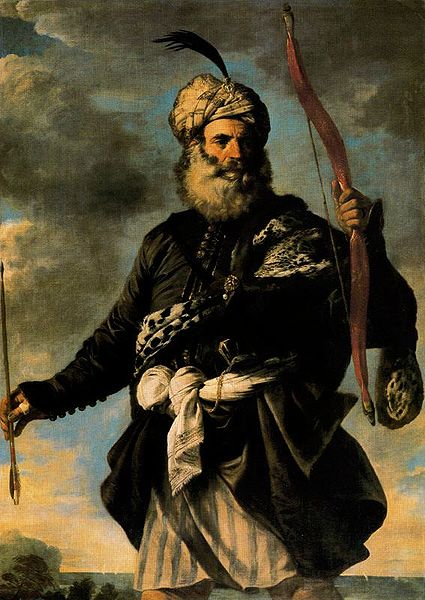
A Barbary pirate, Pier Francesco Mola 1650 (Public Domain)
Life got you down? Things perhaps haven’t turned out as you planned? Do you think everyone else has got it so easy? Your neighbors, for example, or those fortunate people who come into a considerable sum of money?
And how about those saintly types? They are simply walking on air, those guys, living lives of complete and blessed beatitude, right?
Hold up!
While in Heaven the saints enjoy the beatific vision, but while they were here on earth? They were slogging it out with the rest of us. And that even includes those who were fortunate enough to be blessed with an earthly inheritance.
Take St. Vincent de Paul for instance. Following his being ordained a priest, in the year of Our Lord 1605, he received news that someone had left him an inheritance.
Saints be praised!
Come and see where this development led him.
Once Upon a Time, over four hundred years ago…
The young priest’s life flowed on peacefully for the next five years, and then a startling adventure befell him. An old friend of his died at Marseilles, and Vincent received news that he had been left in the will a sum of fifteen hundred livres, which in those days was a considerable deal of money. Vincent’s heart was full of gratitude. What could he not do now to help his poor people. And he began to plan all the things the legacy would buy till it struck him with a laugh that ten times the amount could hardly get him all he wanted. Besides, it was not yet in his possession, and with that reflection he set about his preparations for his journey to Marseilles.
He probably went the greater part of the way on foot, and it must have taken him about as long as it would take us to go to India. But he was a man who had his eyes about him, and the country which he passed through was alive with the history he had read. Greeks, Romans, Crusaders, and the scandal, now two hundred years old, of the two popes, would be brought to his mind by the very names of the towns where he rested and the rivers which he crossed, but at length they were all left behind, and Marseilles was reached.
His business was soon done, and with the money in his pocket he was ready to begin his long walk back to Toulouse, when he received an invitation from a friend of the lawyer’s to go in his vessel by sea to Narbonne, which would cut off a large corner(of his journey). He gladly accepted and went on board at once. But the ship was hardly out of sight of Marseilles when three African vessels, such as then haunted the Mediterranean, bore down upon them and opened fire.
The French were powerless to resist, and one and all refused to surrender, which so increased the fury of the Mohammedans that they killed three of the crew and wounded the rest. Vincent himself had an arm pierced by an arrow, and though it was not poisoned, it was many years before the pain it caused ceased to trouble him. The ‘Infidels’ boarded the ship, and, chaining their prisoners together, coasted about for another week, attacking wherever they thought they had a chance of success, and it was not until they had collected as much booty as the vessel could carry that they returned to Africa.
Vincent and his fellow-captives had all this while been cherishing the hope that, once landed on the coast of Tunis, the French authorities would hear of their misfortunes and come to their aid. But the Mohammedan captain had foreseen the possibility of this and took measures to prevent it by declaring that the prisoners had been taken on a Spanish ship. Heavy were their hearts when they learned what had befallen them, and Vincent needed all his faith and patience to keep the rest from despair.
The following day they were dressed as slaves and marched through the principal streets of Tunis five or six times in case anyone should wish to purchase them. Suffering from wounds though they were, they all felt that it was worth any pain to get out of the hold of the ship and to see life moving around them once more. But after awhile it became clear that the strength of many was failing, and the captain not wishing to damage his goods, ordered them back to the ship where they were given food and wine, so that any possible buyers who might appear next day should not expect them to die on their hands.
Early next morning several small boats could be seen putting out from the shore, and one by one the intending purchasers scrambled up the side of the vessel. They passed down the row of captives drawn up to receive them; pinched their sides to find if they had any flesh on their bones, felt their muscles, looked at their teeth, and finally made them run up and down to see if they were strong enough to work. If the blood of the poor wretches stirred under this treatment they dared not show it, and Vincent had so trained his thoughts that he hardly knew the humiliation to which he was subjected.
A master was soon found for him in a fisherman, who wanted a man to help him with his boat. The fisherman, as far as we know, treated his slave quite kindly; but when he discovered that directly the wind rose the young man became hopelessly ill, he repented of his bargain, and sold him as soon as he could to an old chemist, one of the many who had wasted his life in seeking the Philosopher’s Stone.
The chemist took a great fancy to the French priest and offered to leave him all his money and teach him the secrets of his science if he would abandon Christianity and become a follower of Mohammed, terms which, needless to say, Vincent refused with horror. Most people would speedily have seen the hopelessness of this undertaking, but the old chemist was very obstinate, and died at the end of a year without being able to flatter himself that he had made a convert of his Christian slave.
The chemist’s possessions passed to his nephew, and with them, of course, Father Vincent. The priest bore his captivity cheerfully, and did not vex his soul as to his future lot. The life of a slave had been sent him to bear, and he must bear it contentedly whatever happened; and so he did, and his patience and ready obedience gained him the favour of his masters.
Very soon he had a new one to serve, for not long after the chemist’s death he was sold to a man who had been born a Christian and a native of Savoy, but had adopted the religion of Mohammed for worldly advantages. There were many of these renegades in the Turkish service during the sixteenth and seventeenth centuries, and nearly all of them were men of talent and rose high.
Vincent de Paul’s master had, after the Turkish manner, married three wives, and one of them, a Turk by birth and religion, hated the life of the town where she was shut up most of the day in the women’s apartments, and went, whenever she could, to her husband’s farm in the country, where Vincent was working. It was a barren place on a mountain side, where the sun beat even more fiercely than in Tunis; but at least she was able to wander in the early mornings and cool evenings about the garden, which had been made with much care and toil.
Here she met the slave, always busy—watering plants, trimming shrubs, sowing seeds, and generally singing to himself in an unknown tongue. He looked so different from the sad or sullen men she was used to see that she began to wonder who he was and where he came from, and one day she stopped to ask him how he happened to be there. By this time Vincent had learned enough Arabic to be able to talk, and in answer to her questions, told her of his boyhood in Gascony, and how he had come to be a priest.
“A priest! What is that?” she said.
And he explained, and little by little he taught her the doctrines and the customs of the Christian faith.
“Is that what you sing about?” she asked again. “I should like to hear some of your songs,” and Vincent chanted to her,
“By the waters of Babylon,” feeling, indeed, that he was “singing the Lord’s songs in a strange land.”
And day by day the Turkish woman went away, and thought over all she had heard, till one evening her husband rode over to see her, and she made up her mind to speak to him about something that puzzled her greatly.
“I have been talking to your white slave that works in the garden about his religion—the religion which was once yours. It seems full of good things and so is he. You need never watch him as you do the other men, and the overseer has not had to beat him once. Why, then, did you give up that religion for another? In that, my lord, you did not do well.”
The renegade was silent, but in his heart he wondered if, indeed, he had “done well” to sell his soul for that which had given him no peace. He, too, would talk to that Christian slave, and hear if he still might retrace his steps, though he knew that if he was discovered death awaited the Mohammedan who changed his faith.
But his eyes having been opened he could rest no more,and arranged that he and Vincent should disguise themselves and make for the coast, and sail in a small boat to France. As the boat was so tiny that the slightest gale of wind would capsize it, it seems strange that they did not steer to Sicily, and thence journey to Rome; but instead they directed their course towards France, and on June 28, 1607, they stepped on shore on one of those long, narrow spits of land which run out into the sea from the little walled town of Aigues-Mortes.
Vincent drew a long breath, as after two years captivity he trod on French soil again. But he knew how eager his companion was to feel himself once more a Christian, so they only waited one day to rest, and started early the next morning through the flowery fields to the old city of Avignon. Here he made confession of his faults to the Pope’s legate himself, and was admitted back into the Christian religion. The following year he went with Father Vincent to Rome, and entered a monastery of nursing brothers, who went about to the different hospitals attending the sick and poor.
It is very likely that it was Father Vincent’s influence that led him to take up this special work, to which we must now leave him, for on the priest’s return to Paris, he found a lodging in the Faubourg SaintGermain, close to the Hopital de la Charity—the constant object of his care for some months.


And did I mention that St. Vincent is an Incorruptible?
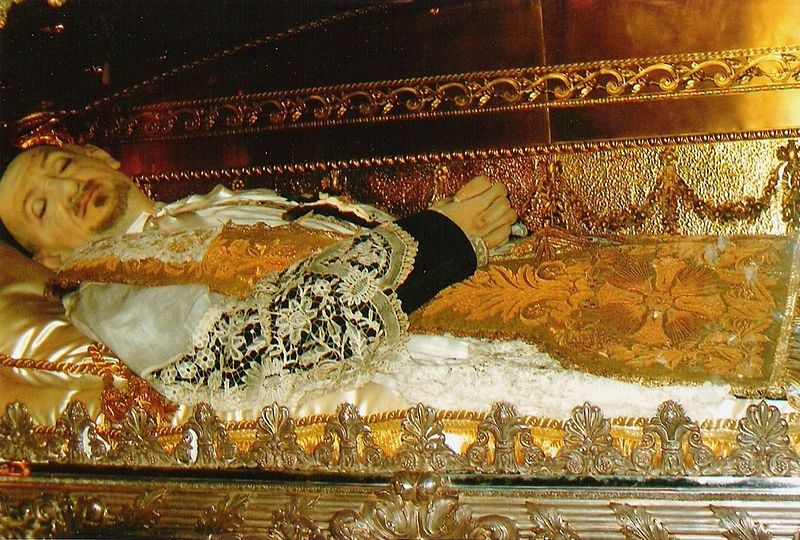

You can read the rest of St. Vincent de Paul’s story in The Book of Saints and Heroes by Leonora Lang on the YIMCatholic Bookshelf.
While you’re there, don’t forget to take a gander at the work of a dhimmi who became a Doctor of the Church..
Next Post

May 3, 2015 The Truth About The Halal Sex Shoppe In Mecca...
Browse Our Archives
Select a Category Blog News Conversion Story Culture Learning Living Nature Prayer Uncategorized Working
Select a Month June 2016 May 2016 August 2015 July 2015 June 2015 May 2015 April 2015 March 2015 February 2015 January 2015 December 2014 November 2014 October 2014 September 2014 August 2014 July 2014 June 2014 May 2014 April 2014 March 2014 February 2014 January 2014 December 2013 November 2013 October 2013 September 2013 August 2013 July 2013 June 2013 May 2013 April 2013 March 2013 February 2013 January 2013 December 2012 November 2012 October 2012 September 2012 August 2012 July 2012 June 2012 May 2012 April 2012 March 2012 February 2012 January 2012 December 2011 November 2011 October 2011 September 2011 August 2011 July 2011 June 2011 May 2011 April 2011 March 2011 February 2011 January 2011 December 2010 November 2010 October 2010 September 2010 August 2010 July 2010 June 2010 May 2010 April 2010 March 2010 February 2010 January 2010 December 2009 November 2009 October 2009 September 2009 August 2009
Follow Us!
TAKE THE
Religious Wisdom Quiz
Which prophet raised a dead boy to life for the Shunammite woman?
Select your answer to see how you score.
Samuel Elisha Elijah Isaiah
Related posts from Why I Am Catholic

Belated Happy Birthday To Blaise Pascal, Unofficial Saint...

Because My Brother Imran Yousef Is An American...

Joe Six-Pack, USMC, With A Few Post-Terrorist Attack...

This Is Why God Invented YouTube...
TRENDING AT PATHEOS Catholic

Rejecting Doom: Christian Hope And Human Action
Christianity is a religion of hope. We are to have hope and...

It’s What Comes From Within Which Matters
One of the most difficult things for us to understand is why...

Why I Choose the Eucharist Over the Sermon
Choose the Eucharist, Not the Sermon What are we supposed to get...

5 Design Elements Found in Spiritually Rooted Homes
Putting Spirituality Into Home Decor Our homes are more than our living...

Credo: A Story of God Told with the...
About 10 years ago, I began to imagine a personal "Credo" that...

The Anatomy of Divine Revelation in Catholic Thought
The claim that God has made Himself known to human beings is...
Ad-Free & Subscriber Log-In Subscription Support
- About Us
- 2026 Calendar
- Videos
- Podcasts
- Library of World Religions
- Faith In Media Tracker
- Advertise With Us
- Write for Us
- Privacy Policy
- Terms of Service
- Do Not Sell My Data
- Contact Us
- Radiant Digital
- Manage Newsletter Subscriptions
- Unsubscribe From Notifications
- Sitemap
Copyright 2008-2026, Patheos. All rights reserved.
Subscription Support Ad-Free & Subscriber Log-In
Follow Patheos