
BuddhistCatholicContemplativeEvangelicalGeneral ChristianHinduJewishLatter-day SaintMuslimNew VisionsProgressive Christian
Beliefs
- Buddhist
- Catholic
- Contemplative
- Evangelical
- General Christian
- Hindu
- Jewish
- Latter-day Saint
- More Voices
- Muslim
- New Visions
- Pagan
- Progressive Christian
Topics
- Religion News
- Food and Religion
- Sports and Religion
- Religious Art
- Religious Music and Entertainment
- Religious Events
- History and Religion
- Style and Religion
- Politics and Religion
- Women in Religion
- Recreation Outdoors and Religion
- Business Finance and Religion
- Careers Workplace and Religion
- Education and Religion
- Family Parenting and Religion
- Health Fitness and Religion
- Home and Religion
- Relationships and Religion
- Technology and Religion
- Travel and Religion
Columnists
- Buddhist Columnists
- Business Finance and Religion Columnists
- Careers Workplace and Religion Columnists
- Catholic Columnists
- Contemplative Columnists
- Education and Religion Columnists
- Evangelists Columnists
- Family Parenting and Religion Columnists
- General Christian Columnists
- Health Fitness and Religion Columnists
- Hindu Columnists
- History and Religion Columnists
- Home and Religion Columnists
- Jewish Columnists
- More Voices Columnists
- Latter Day Columnists
- Muslim Columnists
- New Visions Columnists
- Nonreligious Columnists
- Pagan Columnists
- Politics and Religion Columnists
- Progressive Columnists
- Recreation Outdoors and Religion Columnists
- Relationships and Religion Columnists
- Religion News Columnists
- Religious Art Columnists
- Religious Events Columnists
- Religious Music and Entertainment Columnists
- Sports and Religion Columnists
- Style and Religion Columnists
- Technology and Religion Columnists
- Travel and Religion Columnists
- Women in Religion Columnists
Resource Library
- 2026 Calendar
- Library of World Religions
- The 100 Most Holy Places on Earth
- Patheos Answers
- Podcasts
- Videos
- Faith Leaders Database
- Anglican Episcopalian
- Bahai
- Baptist
- Buddhism
- Christianity
- Confucianism
- Eastern Orthodoxy
- Hinduism
- Holiness and Pentecostal
- ISKCON
- Islam
- Judaism
- Lutheran
- Methodist
- The Church of Jesus Christ of Latter-day Saints
- New Age
- Paganism
- Presbytarian and Reformed
- Protestantism
- Religion Behind the Scenes
- Roman Catholic
- Scientology
- Shia Islam
- Sikhism
- Sufism
- Sunni Islam
- Taoism
- Zen
- See all religions
Research Tools
 Ad-Free & Subscriber Log-In Subscription Support
Ad-Free & Subscriber Log-In Subscription Support
Follow Patheos 

- Trending:
- Forgiveness
- |
- Marriage
- |
- Consciousness
- |
- Death Penalty
- |
- Election
- |
- Halloween
 Why I Am Catholic
-
More
- Home
- Because the Anti-Christ is Politics
Because the Anti-Christ is Politics
Last updated on: January 24, 2017 at 6:55 pm by Frank Weathers
Because the Anti-Christ is Politics 2017-01-24T18:55:48-05:00 Frank Weathers
Patheos Explore the world's faith through different perspectives on religion and spirituality! Patheos has the views of the prevalent religions and spiritualities of the world.
I’ve been reading Giovanni Papini’s Life of Christ some more. My Chinese mentor, John C.H. Wu, introduced this book, and author, to me. You’ve probably never heard of Papini (I sure hadn’t!) but he was a well known author back in the early 20th Century. Come to think of it, that was ’round about the same time G.K. Chesterton was pumping out tons of great stuff from his pen/typewriter too.
Papini had lots of ghosts in his closet. He had been an ardent atheist, having written what many considered to be the ultimate blasphemous slap at organized religion in his The Memoirs of God, published in 1911. Ten years later, after a reconversion to Catholicism, he wrote his Life of Christ. It seems he had an encounter with the truth made flesh, and it changed his life forever.
Later on, in his home country of Italy, he got entangled with Fascists, and Mussolini, and all the other kinds of interests that derail most of us from the prospect of ever officially being canonized as saints. As Qoheleth said long before the coming of the Messiah, see, “God made man simple, but he gets lost in his many thoughts.”
The following passage from his Life begins following Jesus’s time of temptation in the desert. Papini entitles it “The Return.” It reminds me of the futility of allowing our political passions to get the better of us. Because, as far as politics goes, the song remains the same as it always has been, which is to say, it generally is not the Good News. If anything, especially now that nationalism has displaced religion (in the minds of many), politics, now more than ever, when we turn it into an idol, is the ultimate anti-Christ. A heresy wherein the virtuous love of our country and neighbors has morphed into love of the thing that used to be our country, and is now a Leviathan betrothed to Mammon.
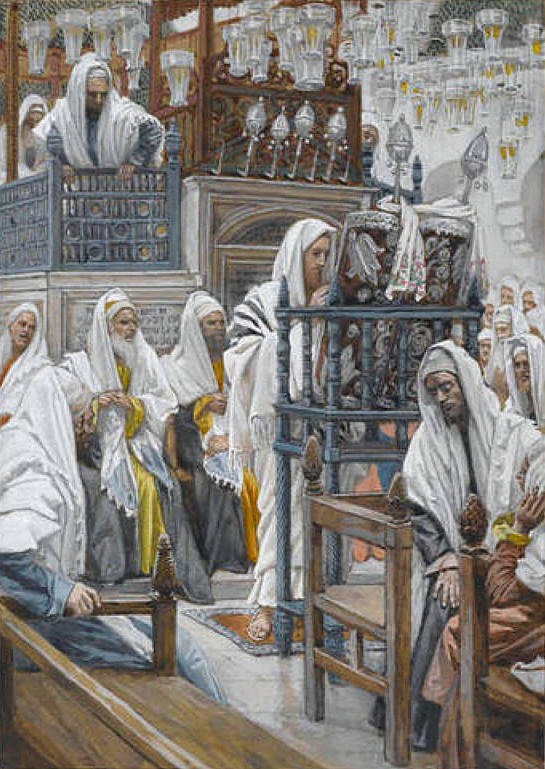
Jesus unrolls the book in the synagogue, by James Tissot (1894)
****
As soon as Jesus came again among men, he learned that the Tetrarch (second husband of Herodias) had imprisoned John (the Baptist) in the fortress of Machaerus. The voice crying in the wilderness was stilled and pilgrims to the Jordan saw no more the long shadow of the wild Baptizer fall across the water.
He had done his work and was now to give way to a more powerful voice. John waited in the blackness of the prison until his bloody head was carried on a golden platter to the banquet—almost the last dish served to that evil woman, betrayer of men.
Now Jesus understands that his day is at hand, and crossing Samaria He returns into Galilee to announce at once the coming of the Kingdom. He does not go to Jerusalem, the city of the great king, the capital. Jesus comes to destroy that Jerusalem of stone and arrogance, proud on its three hills, hard of heart like the stones. The men whom Jesus comes to combat are precisely those who glory in great cities, in the capitals, in the Jersusalems of the world.
At Jerusalem live the powerful of the world, the Romans, masters of the world and of Judea, with their soldiers in arms. Jerusalem is ruled by representatives of the Caesars; of Tiberius, the drunken assassin, the perfidious heir of Augustus, the hypocritical voluptuary, and of Julius the adulterous spendthrift. At Jerusalem live the High Priests, the old custodians of the Temple, the Pharisees, Sadducees, Scribes, the Levites and their guards, the descendants of those who pursued and killed the prophets, the petrifiers of the Law, the bigots of the letter, the haughty depositories of arid fanaticism.
At Jerusalem are the treasurers of God, the treasurers of Caeser, the guardians of the treasure, the lovers of wealth; the Publicans with their excisemen and parasites, the rich with their servants and their concubines, the merchants with their crowded shops; money bags clinking with shekels in the warmth of the bosom above the heart.
Jesus comes to combat all these. He comes to conquer the masters of the earth—the earth which belongs to all; to confound the masters of the word—the word which should be spoken freely wherever God wishes; to condemn the masters of gold, base, perishable and fatal element. He comes to overthrow the kingdom of the soldiers of Rome who oppress bodies; the kingdom of the priests of the Temple who oppress souls; the kingdom of the heapers-up of money who oppress the poor. He comes to save bodies, souls, the poor; he teaches liberty, in opposition to Rome; setting at naught the doctrines of the Temple, he teaches love; He teaches poverty against all the ideals of the rich.
He does not wish to begin his message in Jerusalem where his enemies, gathered together, are the strongest. He wishes to surround the city, take it from the outside, arrive there later with a following behind him, when already the Kingdom of Heaven has slowly begun to lay siege to it. The Conquest of Jerusalem will be the last test, the supreme trial, the great battle, the tremendous battle between “the Greater than the Prophets”, and Jerusalem “the Slayer of the Prophets.” If he should go to Jerusalem now (where he will presently enter as a king, and whence he will be buried as a criminal) he would be taken prisoner at once and would not be able to sow his word on less ungrateful, less stony, soil.
Jerusalem, like all capitals—great sewers to which flow the refuse, the outcasts, the rubbish of the nations—is inhabited by a mob of frivolous, elegant, idle, skeptical and indifferent people, by a ceremonious patrician class who have kept only the tradition of ritual and the sterile rancor of their decadence; by an aristocracy of property owners and speculators who belong to the herd of Mammon, and by a rebellious, restless, ignorant crowd, controlled only by the superstition of the Temple and the fear of the foreigner’s sword. Jerusalem was not fit soil for the sowing of Jesus.
A man from the provinces, —therefore healthy and solitary—he goes back to his province. He wishes to carry the tidings of good news to those who were to be the first to receive him, to the poor and the humble because the tidings are specially for them, because they have long been waiting for them, and because more than any others, they will rejoice. Jesus’ coming onto the world is for the poor. Therefore leaving Jerusalem, he arrives in Galilee, enters into the synagogue and begins to teach.
Try as you might to dress your candidate of choice up as a man of the people, man of God, man of hearth and home, man of the sword, and by degrees, defender of all that is true, good and beautiful, the truth is that not a single one of them even comes close to proclaiming any news that is “good.” Which is why spending a lot of your time and intellectual horsepower pretending they do is a prodigious waste of the precious resources of our spiritual lives.
So what’s left for us to do then? Well, only Frodo could go to Mordor and destroy the Ring of Power. Perhaps that is what we too must do.
Previous Post
March 3, 2015
SIGN THE PETITION: Save Religious Minorities Persecuted By ISIS
Next Post

March 15, 2015 Talking On The Radio About My Conversion, With Mark Shea
Browse Our Archives
Select a Category Blog News Conversion Story Culture Learning Living Nature Prayer Uncategorized Working
Select a Month June 2016 May 2016 August 2015 July 2015 June 2015 May 2015 April 2015 March 2015 February 2015 January 2015 December 2014 November 2014 October 2014 September 2014 August 2014 July 2014 June 2014 May 2014 April 2014 March 2014 February 2014 January 2014 December 2013 November 2013 October 2013 September 2013 August 2013 July 2013 June 2013 May 2013 April 2013 March 2013 February 2013 January 2013 December 2012 November 2012 October 2012 September 2012 August 2012 July 2012 June 2012 May 2012 April 2012 March 2012 February 2012 January 2012 December 2011 November 2011 October 2011 September 2011 August 2011 July 2011 June 2011 May 2011 April 2011 March 2011 February 2011 January 2011 December 2010 November 2010 October 2010 September 2010 August 2010 July 2010 June 2010 May 2010 April 2010 March 2010 February 2010 January 2010 December 2009 November 2009 October 2009 September 2009 August 2009
Follow Us!
TAKE THE
Religious Wisdom Quiz
Who did Paul call "my true child in the faith"?
Select your answer to see how you score.
Timothy James Silas Barnabas
Related posts from Why I Am Catholic

Belated Happy Birthday To Blaise Pascal, Unofficial Saint...

Because My Brother Imran Yousef Is An American...

Joe Six-Pack, USMC, With A Few Post-Terrorist Attack...

This Is Why God Invented YouTube...
TRENDING AT PATHEOS Catholic

Rejecting Doom: Christian Hope And Human Action
Christianity is a religion of hope. We are to have hope and...

It’s What Comes From Within Which Matters
One of the most difficult things for us to understand is why...

Why I Choose the Eucharist Over the Sermon
Choose the Eucharist, Not the Sermon What are we supposed to get...

5 Design Elements Found in Spiritually Rooted Homes
Putting Spirituality Into Home Decor Our homes are more than our living...

Credo: A Story of God Told with the...
About 10 years ago, I began to imagine a personal "Credo" that...

The Anatomy of Divine Revelation in Catholic Thought
The claim that God has made Himself known to human beings is...
Ad-Free & Subscriber Log-In Subscription Support
- About Us
- 2026 Calendar
- Videos
- Podcasts
- Library of World Religions
- Faith In Media Tracker
- Advertise With Us
- Write for Us
- Privacy Policy
- Terms of Service
- Do Not Sell My Data
- Contact Us
- Radiant Digital
- Manage Newsletter Subscriptions
- Unsubscribe From Notifications
- Sitemap
Copyright 2008-2026, Patheos. All rights reserved.
Subscription Support Ad-Free & Subscriber Log-In
Follow Patheos