
BuddhistCatholicContemplativeEvangelicalGeneral ChristianHinduJewishLatter-day SaintMuslimNew VisionsProgressive Christian
Beliefs
- Buddhist
- Catholic
- Contemplative
- Evangelical
- General Christian
- Hindu
- Jewish
- Latter-day Saint
- More Voices
- Muslim
- New Visions
- Pagan
- Progressive Christian
Topics
- Religion News
- Food and Religion
- Sports and Religion
- Religious Art
- Religious Music and Entertainment
- Religious Events
- History and Religion
- Style and Religion
- Politics and Religion
- Women in Religion
- Recreation Outdoors and Religion
- Business Finance and Religion
- Careers Workplace and Religion
- Education and Religion
- Family Parenting and Religion
- Health Fitness and Religion
- Home and Religion
- Relationships and Religion
- Technology and Religion
- Travel and Religion
Columnists
- Buddhist Columnists
- Business Finance and Religion Columnists
- Careers Workplace and Religion Columnists
- Catholic Columnists
- Contemplative Columnists
- Education and Religion Columnists
- Evangelists Columnists
- Family Parenting and Religion Columnists
- General Christian Columnists
- Health Fitness and Religion Columnists
- Hindu Columnists
- History and Religion Columnists
- Home and Religion Columnists
- Jewish Columnists
- More Voices Columnists
- Latter Day Columnists
- Muslim Columnists
- New Visions Columnists
- Nonreligious Columnists
- Pagan Columnists
- Politics and Religion Columnists
- Progressive Columnists
- Recreation Outdoors and Religion Columnists
- Relationships and Religion Columnists
- Religion News Columnists
- Religious Art Columnists
- Religious Events Columnists
- Religious Music and Entertainment Columnists
- Sports and Religion Columnists
- Style and Religion Columnists
- Technology and Religion Columnists
- Travel and Religion Columnists
- Women in Religion Columnists
Resource Library
- 2026 Calendar
- Library of World Religions
- The 100 Most Holy Places on Earth
- Patheos Answers
- Podcasts
- Videos
- Faith Leaders Database
- Anglican Episcopalian
- Bahai
- Baptist
- Buddhism
- Christianity
- Confucianism
- Eastern Orthodoxy
- Hinduism
- Holiness and Pentecostal
- ISKCON
- Islam
- Judaism
- Lutheran
- Methodist
- The Church of Jesus Christ of Latter-day Saints
- New Age
- Paganism
- Presbytarian and Reformed
- Protestantism
- Religion Behind the Scenes
- Roman Catholic
- Scientology
- Shia Islam
- Sikhism
- Sufism
- Sunni Islam
- Taoism
- Zen
- See all religions
Research Tools
 Ad-Free & Subscriber Log-In Subscription Support
Ad-Free & Subscriber Log-In Subscription Support
Follow Patheos 

- Trending:
- Forgiveness
- |
- Marriage
- |
- Consciousness
- |
- Death Penalty
- |
- Election
- |
- Halloween
 Why I Am Catholic
-
More
- Home
- Because Joseph Was Really, Really, צדיק
Because Joseph Was Really, Really, צדיק
Last updated on: January 24, 2017 at 6:55 pm by Frank Weathers
Because Joseph Was Really, Really, צדיק 2017-01-24T18:55:39-05:00 Frank Weathers
Patheos Explore the world's faith through different perspectives on religion and spirituality! Patheos has the views of the prevalent religions and spiritualities of the world.
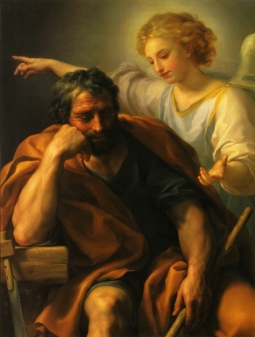
צדיק is the Hebrew word for “righteous,” and it is an adjective that the Gospel of Matthew uses to describe the foster father of Jesus (though he used the Greek word, δίκαιος). But it means righteous on the level of say a Moses or an Elijah. In other words, not just a good man, but a really, really, high level, holy man, like those paragons of holiness.
Anglicized, the word is rendered as saddiq or tzadik. Do you recall the gospel reading from last Sunday? It’s from Matthew 1, verses 18-24. It begins as follows,
This is how the birth of Jesus Christ came about.
When his mother Mary was betrothed to Joseph,
but before they lived together,
she was found with child through the Holy Spirit.
Joseph her husband, since he was a righteous man,
yet unwilling to expose her to shame,
decided to divorce her quietly.
That is my emphasis, see, as there was no italics or quotation marks on the copies of original manuscript. So why am I bringing this up? Because it’s the Feast of St. Joseph, of course.
I also wish to point you to a post written by John Janaro, who blogs at Never Give Up. He wrote an excellent post with the title, Joseph Might Not Have Thought What We Think He Thought.
Say what?
Remember that time I wrote a letter to St. Joseph, noting that since he isn’t recorded as ever saying a word in scripture, folks can practically make him into anything they want him to be? Well, that’s not quite the case. Folks in the know, and saavy with the ins and outs of ancient languages, know better.
I’m not saying that Janaro has deep language skills like that, but he knows a lot more about such things than Joe Six-Pack does. And taking a devout, dare I call it צדיק (?) approach to the passage read last Sunday, he engages in an exercise of theological speculation that brings light to an area that I personally never even realized was dark.
Take a look,
Let’s take a closer look at this text. Mary “was found with child through the Holy Spirit.” What does this mean? Exactly what it says (also in the Greek). Before Joseph took Mary into his home, she was found with child through the Holy Spirit. Once again, note well that does not say that she was “found with child and claimed that the child was conceived by the Holy Spirit.” We might assume that the point here is that Mary was “found with child” and that Matthew just adds the Holy Spirit parenthetically. Is this assumption warranted? Let’s examine further and see if we really need these invisible parentheses.
Clearly, Mary is with child and Joseph wants to end the relationship. He has no choice but to divorce Mary, since the betrothal is already a binding legal commitment. But he doesn’t want to “bring shame” upon her (stoning to death and all that), so he decides to do it “quietly.” And all of these assumptions hinge on Joseph being a “just” or “righteous” man, which means that he is a man devoted to the Law (hence divorce) who is simultaneously a man willing to set the Law aside (hence “quietly”).
Hmmmm.
The quiet divorce is something of a head-scratcher. Our lectionary translation gives us something that is appropriately bumbling: “Joseph her husband, since he was a righteous man, yet unwilling to expose her to shame, decided to divorce her quietly.” Since? Yet? He was righteous, but…? And while we’re at it, let’s look at this term that Matthew decides to toss in here: dikaios. This is Greek for the Hebrew saddiq. Such a title is not awarded lightly in the Scriptures. This is a profound and full sense of righteousness, such as is attributed to Noah and Abraham. This is the kind of “justice” out of which radical foundations can be made. Here is Joseph the Righteous.
And Matthew has introduced this term to explain to us (while also confusing us further) the reason why Joseph decided to be kind and merciful to his adulterous wife? Assuming that there’s some wiggle room in the Law for this kind of arrangement (and we all assume this, of course), it would seem that a decent man could take this road without much heroic virtue. It hardly requires the righteousness of Noah or Abraham to walk away from an unfaithful spouse, without obligations and with a spotless reputation. The betrothed woman is allowed to live. We assume (again) that the “quiet” will succeed in smoothing over the situation for everybody, whereas in fact it refers only to refraining from filing a public charge. In such circumstances, the woman is still socially disgraced and even cast out of home and family, shamed for the rest of her life. It’s not like she can go abroad for a year, have the baby, and then come back with nobody knowing anything about it. This is not the Hamptons. This is a Palestinian village. In 4 b.c. Everybody knows everything. As for Joseph? Not his problem anymore.
But, Matthew tells us, Joseph is not the average man who wants to cut his losses and get out of town. He is saddiq. He is just. He is righteous. The angel in the dream does not rebuke him nor cause some great moral conversion. Joseph is already the quintessential steadfast man. Still, given what we assume to be his understanding, he’s not doing anything “wrong.” (Or is he being shifty with the Law? Isn’t there a better way? Oh gosh what a mixup!)
What’s wrong with this picture?
I’m not going to spoil it for you, so go read it all. You’ll be glad you did.
Thank God for the righteous man betrothed to the Virgin, and for his role in raising the Savior of the World. St. Joseph, pray for us!
St. Joseph, pray for us!
Related
Because “And You Shall Name Him יהושע”.
Kevin O’Brien, “Joseph and the Angel.”
The Sacred Page, “Was Joseph Really Suspicious of Mary? A Look at the Gospel for Christmas Eve.”
The Prophetic Dimension of Joseph.
Previous Post

March 18, 2015
BREAKING: The Cathedral Of St. Maytag Is Stuck On Rinse Cycle UPDATED
Next Post
March 20, 2015 Big News Of The Day: Cardinal O'Brien Resigns His Office
Browse Our Archives
Select a Category Blog News Conversion Story Culture Learning Living Nature Prayer Uncategorized Working
Select a Month June 2016 May 2016 August 2015 July 2015 June 2015 May 2015 April 2015 March 2015 February 2015 January 2015 December 2014 November 2014 October 2014 September 2014 August 2014 July 2014 June 2014 May 2014 April 2014 March 2014 February 2014 January 2014 December 2013 November 2013 October 2013 September 2013 August 2013 July 2013 June 2013 May 2013 April 2013 March 2013 February 2013 January 2013 December 2012 November 2012 October 2012 September 2012 August 2012 July 2012 June 2012 May 2012 April 2012 March 2012 February 2012 January 2012 December 2011 November 2011 October 2011 September 2011 August 2011 July 2011 June 2011 May 2011 April 2011 March 2011 February 2011 January 2011 December 2010 November 2010 October 2010 September 2010 August 2010 July 2010 June 2010 May 2010 April 2010 March 2010 February 2010 January 2010 December 2009 November 2009 October 2009 September 2009 August 2009
Follow Us!
TAKE THE
Religious Wisdom Quiz
Who declared, "Choose for yourselves this day whom you will serve"?
Select your answer to see how you score.
Moses Joshua Gideon Aaron
Related posts from Why I Am Catholic

Belated Happy Birthday To Blaise Pascal, Unofficial Saint...

Because My Brother Imran Yousef Is An American...

Joe Six-Pack, USMC, With A Few Post-Terrorist Attack...

This Is Why God Invented YouTube...
TRENDING AT PATHEOS Catholic

Rejecting Doom: Christian Hope And Human Action
Christianity is a religion of hope. We are to have hope and...

It’s What Comes From Within Which Matters
One of the most difficult things for us to understand is why...

Why I Choose the Eucharist Over the Sermon
Choose the Eucharist, Not the Sermon What are we supposed to get...

5 Design Elements Found in Spiritually Rooted Homes
Putting Spirituality Into Home Decor Our homes are more than our living...

Credo: A Story of God Told with the...
About 10 years ago, I began to imagine a personal "Credo" that...

The Anatomy of Divine Revelation in Catholic Thought
The claim that God has made Himself known to human beings is...
Ad-Free & Subscriber Log-In Subscription Support
- About Us
- 2026 Calendar
- Videos
- Podcasts
- Library of World Religions
- Faith In Media Tracker
- Advertise With Us
- Write for Us
- Privacy Policy
- Terms of Service
- Do Not Sell My Data
- Contact Us
- Radiant Digital
- Manage Newsletter Subscriptions
- Unsubscribe From Notifications
- Sitemap
Copyright 2008-2026, Patheos. All rights reserved.
Subscription Support Ad-Free & Subscriber Log-In
Follow Patheos