
BuddhistCatholicContemplativeEvangelicalGeneral ChristianHinduJewishLatter-day SaintMuslimNew VisionsProgressive Christian
Beliefs
- Buddhist
- Catholic
- Contemplative
- Evangelical
- General Christian
- Hindu
- Jewish
- Latter-day Saint
- More Voices
- Muslim
- New Visions
- Pagan
- Progressive Christian
Topics
- Religion News
- Food and Religion
- Sports and Religion
- Religious Art
- Religious Music and Entertainment
- Religious Events
- History and Religion
- Style and Religion
- Politics and Religion
- Women in Religion
- Recreation Outdoors and Religion
- Business Finance and Religion
- Careers Workplace and Religion
- Education and Religion
- Family Parenting and Religion
- Health Fitness and Religion
- Home and Religion
- Relationships and Religion
- Technology and Religion
- Travel and Religion
Columnists
- Buddhist Columnists
- Business Finance and Religion Columnists
- Careers Workplace and Religion Columnists
- Catholic Columnists
- Contemplative Columnists
- Education and Religion Columnists
- Evangelists Columnists
- Family Parenting and Religion Columnists
- General Christian Columnists
- Health Fitness and Religion Columnists
- Hindu Columnists
- History and Religion Columnists
- Home and Religion Columnists
- Jewish Columnists
- More Voices Columnists
- Latter Day Columnists
- Muslim Columnists
- New Visions Columnists
- Nonreligious Columnists
- Pagan Columnists
- Politics and Religion Columnists
- Progressive Columnists
- Recreation Outdoors and Religion Columnists
- Relationships and Religion Columnists
- Religion News Columnists
- Religious Art Columnists
- Religious Events Columnists
- Religious Music and Entertainment Columnists
- Sports and Religion Columnists
- Style and Religion Columnists
- Technology and Religion Columnists
- Travel and Religion Columnists
- Women in Religion Columnists
Resource Library
- 2026 Calendar
- Library of World Religions
- The 100 Most Holy Places on Earth
- Patheos Answers
- Podcasts
- Videos
- Faith Leaders Database
- Anglican Episcopalian
- Bahai
- Baptist
- Buddhism
- Christianity
- Confucianism
- Eastern Orthodoxy
- Hinduism
- Holiness and Pentecostal
- ISKCON
- Islam
- Judaism
- Lutheran
- Methodist
- The Church of Jesus Christ of Latter-day Saints
- New Age
- Paganism
- Presbytarian and Reformed
- Protestantism
- Religion Behind the Scenes
- Roman Catholic
- Scientology
- Shia Islam
- Sikhism
- Sufism
- Sunni Islam
- Taoism
- Zen
- See all religions
Research Tools
 Ad-Free & Subscriber Log-In Subscription Support
Ad-Free & Subscriber Log-In Subscription Support
Follow Patheos 

- Trending:
- Forgiveness
- |
- Marriage
- |
- Consciousness
- |
- Death Penalty
- |
- Election
- |
- Halloween
 Why I Am Catholic
-
More
- Home
- Hilaire Belloc on St. Patrick
Hilaire Belloc on St. Patrick
Last updated on: January 24, 2017 at 5:12 pm by Frank Weathers
Hilaire Belloc on St. Patrick 2017-01-24T17:12:40-05:00 Frank Weathers
Patheos Explore the world's faith through different perspectives on religion and spirituality! Patheos has the views of the prevalent religions and spiritualities of the world.
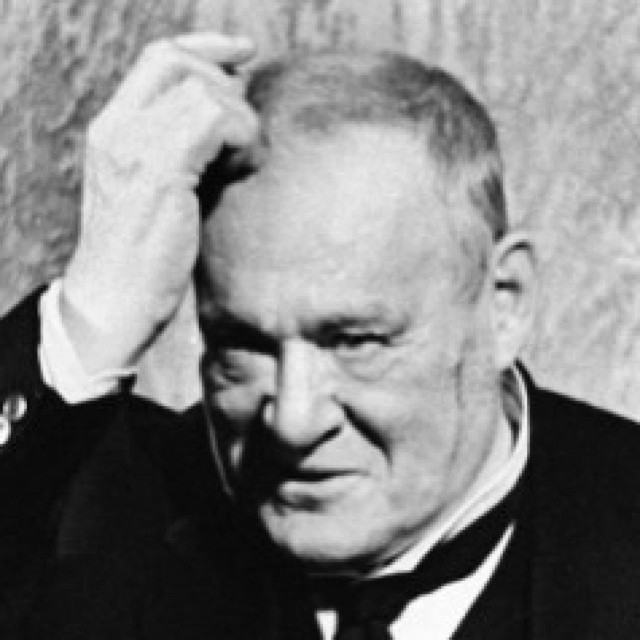
Old Thunder
What follows is from Hilaire Belloc’s collection of essays, First and Last (<<= free on Kindle*)
Saint Patrick
If there is one thing that people who are not Catholic have gone wrong upon more than another in the intellectual things of life, it is the conception of a Personality. They are muddled about it where their own little selves are concerned, they misappreciate it when they deal with the problems of society, and they have a very weak hold of it when they consider (if they do consider) the nature of Almighty God.
Now, personality is everything. It was a Personal Will that made all things, visible and invisible. Our hope of immortality resides in this, that we are persons, and half our frailties proceed from a misapprehension of the awful responsibilities which personality involves or a cowardly ignorance of its powers of self-government.
The hundred and one errors which this main error leads to include a bad error on the nature of history. Your modern non-Catholic or anti-Catholic historian is always misunderstanding, underestimating, or muddling the role played in the affairs of men by great and individual Personalities. That is why he is so lamentably weak upon the function of legend; that is why he makes a fetish of documentary evidence and has no grip upon the value of tradition. For traditions spring from some personality invariably, and the function of legend, whether it be a rigidly true legend or one tinged with make-believe, is to interpret Personality. Legends have vitality and continue, because in their origin they so exactly serve to explain or illustrate some personal character in a man which no cold statement could give.
Now St. Patrick, the whole story and effect of him, is a matter of Personality. There was once — twenty or thirty years ago — a whole school of dunderheads who wondered whether St. Patrick ever existed, because the mass of legends surrounding his name troubled them. How on earth (one wonders) do such scholars consider their fellow-beings! Have they ever seen a crowd cheering a popular hero, or noticed the expression upon men’s faces when they spoke of some friend of striking power recently dead? A great growth of legends around a man is the very best proof you could have not only of his existence but of the fact that he was an origin and a beginning, and that things sprang from his will or his vision. There were some who seemed to think it a kind of favour done to the indestructible body of Irish Catholicism when Mr. Bury wrote his learned Protestant book upon St. Patrick. It was a critical and very careful bit of work, and was deservedly praised; but the favour done us I could not see! It is all to the advantage of non-Catholic history that it should be sane, and that a great Protestant historian should make true history out of a great historical figure was a very good sign. It was a long step back towards common sense compared with the German absurdities which had left their victims doubting almost all the solid foundation of the European story; but as for us Catholics, we had no need to be told it. Not only was there a St. Patrick in history, but there is a St. Patrick on the shores of his eastern sea and throughout all Ireland to-day. It is a presence that stares you in the face, and physically almost haunts you. Let a man sail along the Leinster coast on such a day as renders the Wicklow Mountains clear up-weather behind him, and the Mourne Mountains perhaps in storm, lifted clearly above the sea down the wind. He is taking some such course as that on which St. Patrick sailed, and if he will land from time to time from his little boat at the end of each day’s sailing, and hear Mass in the morning before he sails further northward, he will know in what way St. Patrick inhabits the soil which he rendered sacred.
We know that among the marks of holiness is the working of miracles. Ireland is the greatest miracle any saint ever worked. It is a miracle and a nexus of miracles. Among other miracles it is a nation raised from the dead.
The preservation of the Faith by the Irish is an historical miracle comparable to nothing else in Europe. There never was, and please God never can be, so prolonged and insanely violent a persecution of men by their fellow-men as was undertaken for centuries against the Faith in Ireland: and it has completely failed. I know of no example in history of failure following upon such effort. It had behind it in combination the two most powerful of the evil passions of men, terror and greed. And so amazing is it that they did not attain their end, that perpetually as one reads one finds the authors of the dreadful business now at one period, now at another, assuming with certitude that their success is achieved. Then, after centuries, it is almost suddenly perceived — and in our own time — that it has not been achieved and never will be.
What a complexity of strange coincidences combined, coming out of nothing as it were, advancing like spirits summoned on to the stage, all to effect this end! Think of the American Colonies; with one little exception they were perhaps the most completely non-Catholic society of their time. Their successful rebellion against the mother country meant many things, and led to many prophecies. Who could have guessed that one of its chief results would be the furnishing of a free refuge for the Irish?
The famine, all human opinion imagined, and all human judgment was bound to conclude, was a mortal wound, coming in as the ally of the vile persecution I have named. It has turned out the very contrary. From it there springs indirectly the dispersion, and that power which comes from unity in dispersion, of Irish Catholicism.
Who, looking at the huge financial power that dominated Europe, and England in particular, during the youth of our own generation, could have dreamt that in any corner of Europe, least of all in the poorest and most ruined corner of Christendom, an effective resistance could be raised?
Behind the enemies of Ireland, furnishing them with all their modern strength, was that base and secret master of modern things, the usurer. He it was far more than the gentry of the island who demanded toll, and, through the mortgages on the Irish estates, had determined to drain Ireland as he has drained and rendered desert so much else. Is it not a miracle that he has failed?
Ireland is a nation risen from the dead; and to raise one man from the dead is surely miraculous enough to convince one of the power of a great spirit. This miracle, as I am prepared to believe, is the last and the greatest of St. Patrick’s.
When I was last in Ireland, I bought in the town of Wexford a coloured picture of St. Patrick which greatly pleased me. Most of it was green in colour, and St. Patrick wore a mitre and had a crosier in his hand. He was turning into the sea a number of nasty reptiles: snakes and toads and the rest. I bought this picture because it seemed to me as modern a piece of symbolism as ever I had seen: and that was why I bought it for my children and for my home.
There was a few pence change, but I did not want it. The person who sold me the picture said they would spend the change in candles for St. Patrick’s altar. So St. Patrick is still alive.
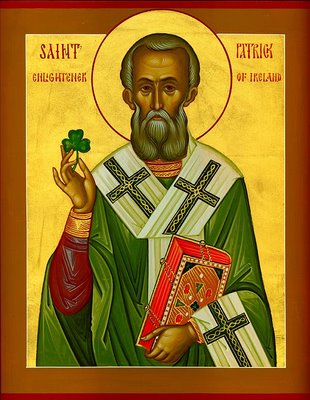
St. Patrick, pray for us.
(H/T Hilarie Belloc)

Browse Our Archives
Select a Category Blog News Conversion Story Culture Learning Living Nature Prayer Uncategorized Working
Select a Month June 2016 May 2016 August 2015 July 2015 June 2015 May 2015 April 2015 March 2015 February 2015 January 2015 December 2014 November 2014 October 2014 September 2014 August 2014 July 2014 June 2014 May 2014 April 2014 March 2014 February 2014 January 2014 December 2013 November 2013 October 2013 September 2013 August 2013 July 2013 June 2013 May 2013 April 2013 March 2013 February 2013 January 2013 December 2012 November 2012 October 2012 September 2012 August 2012 July 2012 June 2012 May 2012 April 2012 March 2012 February 2012 January 2012 December 2011 November 2011 October 2011 September 2011 August 2011 July 2011 June 2011 May 2011 April 2011 March 2011 February 2011 January 2011 December 2010 November 2010 October 2010 September 2010 August 2010 July 2010 June 2010 May 2010 April 2010 March 2010 February 2010 January 2010 December 2009 November 2009 October 2009 September 2009 August 2009
Follow Us!
TAKE THE
Religious Wisdom Quiz
What does Paul say happens when we are baptized into Christ Jesus?
Select your answer to see how you score.
We are baptized into his death We are saved We become children of God We receive the Holy Spirit
Related posts from Why I Am Catholic

Belated Happy Birthday To Blaise Pascal, Unofficial Saint...

Because My Brother Imran Yousef Is An American...

Joe Six-Pack, USMC, With A Few Post-Terrorist Attack...

This Is Why God Invented YouTube...
TRENDING AT PATHEOS Catholic

Rejecting Doom: Christian Hope And Human Action
Christianity is a religion of hope. We are to have hope and...

It’s What Comes From Within Which Matters
One of the most difficult things for us to understand is why...

Why I Choose the Eucharist Over the Sermon
Choose the Eucharist, Not the Sermon What are we supposed to get...

5 Design Elements Found in Spiritually Rooted Homes
Putting Spirituality Into Home Decor Our homes are more than our living...

Credo: A Story of God Told with the...
About 10 years ago, I began to imagine a personal "Credo" that...

The Anatomy of Divine Revelation in Catholic Thought
The claim that God has made Himself known to human beings is...
Ad-Free & Subscriber Log-In Subscription Support
- About Us
- 2026 Calendar
- Videos
- Podcasts
- Library of World Religions
- Faith In Media Tracker
- Advertise With Us
- Write for Us
- Privacy Policy
- Terms of Service
- Do Not Sell My Data
- Contact Us
- Radiant Digital
- Manage Newsletter Subscriptions
- Unsubscribe From Notifications
- Sitemap
Copyright 2008-2026, Patheos. All rights reserved.
Subscription Support Ad-Free & Subscriber Log-In
Follow Patheos