
BuddhistCatholicContemplativeEvangelicalGeneral ChristianHinduJewishLatter-day SaintMuslimNew VisionsProgressive Christian
Beliefs
- Buddhist
- Catholic
- Contemplative
- Evangelical
- General Christian
- Hindu
- Jewish
- Latter-day Saint
- More Voices
- Muslim
- New Visions
- Pagan
- Progressive Christian
Topics
- Religion News
- Food and Religion
- Sports and Religion
- Religious Art
- Religious Music and Entertainment
- Religious Events
- History and Religion
- Style and Religion
- Politics and Religion
- Women in Religion
- Recreation Outdoors and Religion
- Business Finance and Religion
- Careers Workplace and Religion
- Education and Religion
- Family Parenting and Religion
- Health Fitness and Religion
- Home and Religion
- Relationships and Religion
- Technology and Religion
- Travel and Religion
Columnists
- Buddhist Columnists
- Business Finance and Religion Columnists
- Careers Workplace and Religion Columnists
- Catholic Columnists
- Contemplative Columnists
- Education and Religion Columnists
- Evangelists Columnists
- Family Parenting and Religion Columnists
- General Christian Columnists
- Health Fitness and Religion Columnists
- Hindu Columnists
- History and Religion Columnists
- Home and Religion Columnists
- Jewish Columnists
- More Voices Columnists
- Latter Day Columnists
- Muslim Columnists
- New Visions Columnists
- Nonreligious Columnists
- Pagan Columnists
- Politics and Religion Columnists
- Progressive Columnists
- Recreation Outdoors and Religion Columnists
- Relationships and Religion Columnists
- Religion News Columnists
- Religious Art Columnists
- Religious Events Columnists
- Religious Music and Entertainment Columnists
- Sports and Religion Columnists
- Style and Religion Columnists
- Technology and Religion Columnists
- Travel and Religion Columnists
- Women in Religion Columnists
Resource Library
- 2026 Calendar
- Library of World Religions
- The 100 Most Holy Places on Earth
- Patheos Answers
- Podcasts
- Videos
- Faith Leaders Database
- Anglican Episcopalian
- Bahai
- Baptist
- Buddhism
- Christianity
- Confucianism
- Eastern Orthodoxy
- Hinduism
- Holiness and Pentecostal
- ISKCON
- Islam
- Judaism
- Lutheran
- Methodist
- The Church of Jesus Christ of Latter-day Saints
- New Age
- Paganism
- Presbytarian and Reformed
- Protestantism
- Religion Behind the Scenes
- Roman Catholic
- Scientology
- Shia Islam
- Sikhism
- Sufism
- Sunni Islam
- Taoism
- Zen
- See all religions
Research Tools
 Ad-Free & Subscriber Log-In Subscription Support
Ad-Free & Subscriber Log-In Subscription Support
Follow Patheos 

- Trending:
- Forgiveness
- |
- Marriage
- |
- Consciousness
- |
- Death Penalty
- |
- Election
- |
- Halloween
 Why I Am Catholic
-
More
- Home
- Because the Mandated HHS Rules Strike at the Heart of Freedom
Because the Mandated HHS Rules Strike at the Heart of Freedom
Last updated on: January 18, 2015 at 3:02 pm by Frank Weathers
Because the Mandated HHS Rules Strike at the Heart of Freedom 2015-01-18T15:02:13-05:00 Frank Weathers
Patheos Explore the world's faith through different perspectives on religion and spirituality! Patheos has the views of the prevalent religions and spiritualities of the world.
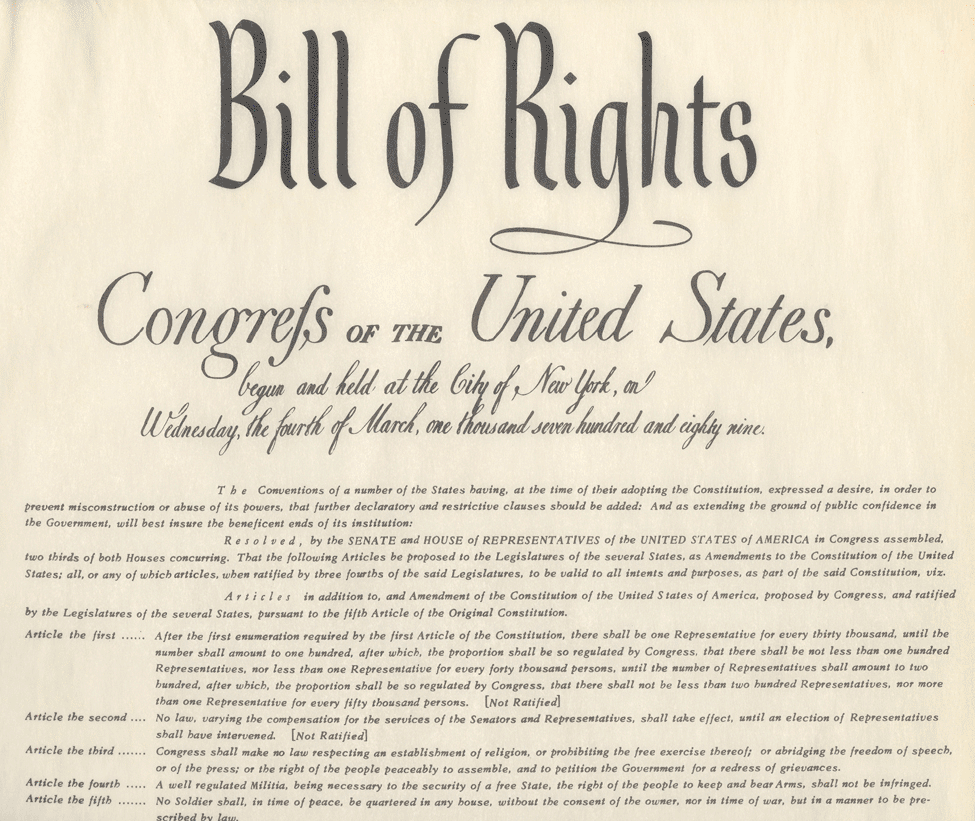
Originally, this post was published in mid-January, 2012. A few days later, the thoughts I read by John Courtney Murray, SJ, inspired me to draft the little petition that, with the help of 29,000+ folks, got the White House’s attention when they determined that the HSS Mandate was, for the Church, a “fait accompli.”
Given Justice Sotomayor’s decision to block the Administration’s HHS Mandate toward’s The Little Sisters of the Poor, I’ve decided to dust this off and republish it. Because the Administration is now doing nothing more than playing the bully, thus giving a whole ‘nother meaning to the phrase, bully pulpit. Enough justices and judges have come to the same conclusion, which is why they’ve been handing down injunctions (and stays) in a proportion that oddsmakers would clearly favor the plaintiffs, and not the defendants.
On to the post from nearly two years ago…
****
Certainly by now you’ve heard that the present Administration, through the Health and Human Services Department, is mandating that all employer healthcare insurance plans provide coverage for procedures which violate the beliefs of the Catholic Church, and Catholic institutions. Basically, the new rules require the Church, and the institutions operating faithfully under the aegis of the Church, to provide “preventative services for women” to their employees. We’re talking about contraception, and even sterilization. We’re talking the “morning after” pill, and other services “free” for the patient. No co-payments required.
I’m not going to reinvent the wheel on explaining the provisions of the mandate. Omar Gutierrez (who blogs at Regnum Novum) has already penned a primer for us, and you would do well to educate yourself by reading it. Instead, I’m going to share with you the thoughts on religious freedom of John Courtney Murray SJ, whose book, We Hold These Truths: Catholic Reflections on the American Proposition
In the passage below, Fr. Murray explains why this “new” ruling by the Administration is not only disturbing to Catholics, but should be disturbing to all Americans of all religions. It should even be disturbing to those who have no religion, or even those who practice quasi-religions like secular humanism. The reason why we all should be concerned is because with this ruling, see, the Government has made an unprecedented, as far as American history is concerned, move into the realm of deciding that the State has, for the first time, “undertaken to represent transcendental truth” on matters of conscience for all religions within the United States. That in itself is unprecedented, which is also why it is unconstitutional.
If you think I’m being a rash “sea lawyer” in saying so, have a look at the following from Fr. Murray’s book. It goes a long way in explaining why everyone in the Church hierarchy seems all hepped up about this ruling, and frankly, why you should be too.
The third and most striking aspect of the American experience consists in the fact that religion itself, and not least the Catholic Church, has benefited by our free institutions, by the maintenance, even in exaggerated form, of the distinction between church and state. Within the same span of history the experience of the Church elsewhere, especially in the Latin lands, has been alternately an experience of privilege or persecution. The reason lay in a particular concept of government. It was alternatively the determination of government to ally itself either with the purposes of the Church or with the purposes of some sect or other (sectarian Liberalism, for instance) which made a similar, however erroneous, claim to possess the full and final truth. The dominant conviction, whose origins are really in pagan antiquity, was that government should represent transcendent truth and by its legal power make this truth prevail. However, in the absence of social agreement as to what the truth really was, the result was to involve the Catholic truth in the vicissitudes of power. It would be difficult to say which experience, privilege or persecution, proved in the end to be the more damaging or gainful to the Church.
In contrast, American government has not undertaken to represent transcendental truth in any of the versions of it current in American society. It does indeed represent the commonly shared moral values of the community. It also represents the supreme religious truth expressed in the motto on American coins: “In God we trust.” The motto expresses the two truths without which, as the Letter to the Hebrews says, “nobody reaches God’s presence,” namely, “to believe that God exists and that he rewards those who try to find him” (Hebrews 11: 6). For the rest, government represents the truth of society as it actually is; and the truth is that American society is religiously pluralist. The truth is lamentable; it is nonetheless true. Many of the beliefs entertained within society ought not to be believed, because they are false; nonetheless men believe them. It is not the function of government to resolve the dispute between conflicting truths, all of which claim the final validity of transcendence. As representative of a pluralist society, wherein religious faith is—as it must be—free, government undertakes to represent the principle of freedom.
In taking this course American government would seem to be on the course set by Pius XII for the religiously pluralist international community, of which America offers, as it were, a pattern in miniature. In the discourse already cited he distinguishes two questions: “The first concerns the objective truth and the obligation of conscience toward that which is objectively true and good.” This question, he goes on, “can hardly be made the object of discussion and ruling among the individual states and their communities, especially in the case of a plurality of religious confessions within the same community.” In other words, government is not a judge of religious truth; parliaments are not to play the theologian. In accord with this principle American government does not presume to discuss, much less rule upon, the objective truth or falsity of the various religious confessions within society. It puts to itself only Pius XII’s second question, which concerns “the practical attitude” of government in the face of religious pluralism. It answers this question by asserting that in the given circumstances it has neither the mandate nor the duty nor the right to legislate either in favor of or against any of the religious confessions existent in American society, which in its totality government must represent. It will therefore only represent their freedom, in the face of civil law, to exist, since they do in fact exist. This is precisely the practical attitude which Pius XII recognizes as right, as the proper moral and political course.
In consequence of this American concept of the representative function of government the experience of the Church in America, like the general American experience itself, has proved to be satisfactory when one scans it from the viewpoint of the value upon which the Church sets primary importance, namely, her freedom in the fulfillment of her spiritual mission to communicate divine truth and grace to the souls of men, and her equally spiritual mission of social justice and peace. The Church has not enjoyed a privileged status in public life; at the same time she has not had to pay the price of this privilege. A whole book could be written on the price of such legal privilege. Another book could be written on the value of freedom without privilege. In fact, both books have been written, on the metaphorical pages of history. And looking over his own continually unrolling historical manuscript the American Catholic is inclined to conclude that his is a valid book.
That freedom of the Church, and all other religions, to fulfill their missions is what is at stake here. So also is the clear demarcation of the roles of Church and of the State. As Murray explains in his concluding thoughts to this chapter,
In the final analysis any validation of the First Amendment as good law—no matter by whom undertaken, be he Protestant, Catholic, Jew, or secularist—must make appeal to the three arguments developed above—the demands of social necessity, the rightfulness within our own circumstances of the American manner of asserting the distinction between church and state, and the lessons of experience. Perhaps the last argument is the most powerful. It is also, I may add, the argument which best harmonizes with the general tone which arguments for our institutions are accustomed to adopt.
In a curiously controlling way this tone was set by the Federalist papers. These essays were not political treatises after the manner of Hobbes and Hegel, Rousseau and Comte, or even John Locke. It has been remarked that in America no treatises of this kind have been produced; and it is probably just as well. The authors of the Federalist papers were not engaged in broaching a political theory universal in scope and application, a plan for an Ideal Republic of Truth and Virtue. They were arguing for a particular Constitution, a special kind of governmental structure, a limited ensemble of concrete laws, all designed for application within a given society. They were in the tradition of the Revolutionary thinkers who led a colonial rebellion, not in the name of a set of flamboyant abstractions, but in the name of the sober laws of the British Constitution which they felt were being violated in their regard. It has been pointed out that the only real slogan the Revolution produced was: “No taxation without representation.” It has not the ring of a trumpet; its sound is more like the dry rustle of a lawyer’s sheaf of parchment.
It is in the tone of this tradition of American political writing that one should argue for the First Amendment. The arguments will tend to be convincing in proportion as their key of utterance approaches a dry rustle and not a wild ring. The arguments here presented are surely dry enough. Perhaps they will not satisfy the American doctrinaire, the theologizer. But they do, I think, show that the first of our prejudices is “not a prejudice destitute of reason, but involving in it profound and extensive wisdom.” This is all that need be shown; it is likewise all that can be shown.
The Catholic Church in America is committed to this prejudice by the totality of her experience in American history. As far as I know, the only ones who doubt the firmness, the depth, the principled nature of this commitment are not Catholics. They speak without knowledge and without authority; and the credence they command has its origins in emotion. If perhaps what troubles them is the fact that the commitment is limited, in the sense that it is not to the truth and sanctity of a dogma but only to the rationality and goodness of a law, they might recall the story of Pompey. After the capture of Jerusalem in 63 B.C. he went to the Temple and forced his way into the Holy of Holies. To his intense astonishment he found it empty. He should not have been astonished; for the emptiness was the symbol of the absence of idolatry. It symbolized the essential truth of Judaism, that One is the Lord. Professor Boorstin, who recounts the tale, adds: “Perhaps the same surprise awaits the student of American culture [or, I add, the American Constitution] if he finally manages to penetrate the arcanum of our belief. And for a similar reason. Far from being disappointed, we should be inspired that in an era of idolatry, when so many nations have filled their sanctuaries with ideological idols, we have had the courage to refuse to do so.”
The American Catholic is on good ground when he refuses to make an ideological idol out of religious freedom and separation of church and state, when he refuses to “believe” in them as articles of faith. He takes the highest ground available in this matter of the relations between religion and government when he asserts that his commitment to the religion clauses of the Constitution is a moral commitment to them as articles of peace in a pluralist society.
Limited government is the hallmark of the American system, which is why this ruling cannot stand. Ben Franklin, upon the close of the Constitutional Convention in 1787 was asked the following question. “Well, Doctor, what have we got—a Republic or a Monarchy?” He replied, “A Republic, if you can keep it.”
Sic semper tyrannis.
Previous Post

January 1, 2014
To Pray For Michael Schumacher's Recovery UPDATE
Next Post
January 5, 2014 Archbishop Lori To Congress: Let Our People Go
Browse Our Archives
Select a Category Blog News Conversion Story Culture Learning Living Nature Prayer Uncategorized Working
Select a Month June 2016 May 2016 August 2015 July 2015 June 2015 May 2015 April 2015 March 2015 February 2015 January 2015 December 2014 November 2014 October 2014 September 2014 August 2014 July 2014 June 2014 May 2014 April 2014 March 2014 February 2014 January 2014 December 2013 November 2013 October 2013 September 2013 August 2013 July 2013 June 2013 May 2013 April 2013 March 2013 February 2013 January 2013 December 2012 November 2012 October 2012 September 2012 August 2012 July 2012 June 2012 May 2012 April 2012 March 2012 February 2012 January 2012 December 2011 November 2011 October 2011 September 2011 August 2011 July 2011 June 2011 May 2011 April 2011 March 2011 February 2011 January 2011 December 2010 November 2010 October 2010 September 2010 August 2010 July 2010 June 2010 May 2010 April 2010 March 2010 February 2010 January 2010 December 2009 November 2009 October 2009 September 2009 August 2009
Follow Us!
TAKE THE
Religious Wisdom Quiz
Who restored water to Jericho by throwing salt into a spring?
Select your answer to see how you score.
Jonah Elisha Elijah Naaman
Related posts from Why I Am Catholic

Belated Happy Birthday To Blaise Pascal, Unofficial Saint...

Because My Brother Imran Yousef Is An American...

Joe Six-Pack, USMC, With A Few Post-Terrorist Attack...

This Is Why God Invented YouTube...
TRENDING AT PATHEOS Catholic

Rejecting Doom: Christian Hope And Human Action
Christianity is a religion of hope. We are to have hope and...

It’s What Comes From Within Which Matters
One of the most difficult things for us to understand is why...

Why I Choose the Eucharist Over the Sermon
Choose the Eucharist, Not the Sermon What are we supposed to get...

5 Design Elements Found in Spiritually Rooted Homes
Putting Spirituality Into Home Decor Our homes are more than our living...

Credo: A Story of God Told with the...
About 10 years ago, I began to imagine a personal "Credo" that...

The Anatomy of Divine Revelation in Catholic Thought
The claim that God has made Himself known to human beings is...
Ad-Free & Subscriber Log-In Subscription Support
- About Us
- 2026 Calendar
- Videos
- Podcasts
- Library of World Religions
- Faith In Media Tracker
- Advertise With Us
- Write for Us
- Privacy Policy
- Terms of Service
- Do Not Sell My Data
- Contact Us
- Radiant Digital
- Manage Newsletter Subscriptions
- Unsubscribe From Notifications
- Sitemap
Copyright 2008-2026, Patheos. All rights reserved.
Subscription Support Ad-Free & Subscriber Log-In
Follow Patheos