
BuddhistCatholicContemplativeEvangelicalGeneral ChristianHinduJewishLatter-day SaintMuslimNew VisionsProgressive Christian
Beliefs
- Buddhist
- Catholic
- Contemplative
- Evangelical
- General Christian
- Hindu
- Jewish
- Latter-day Saint
- More Voices
- Muslim
- New Visions
- Pagan
- Progressive Christian
Topics
- Religion News
- Food and Religion
- Sports and Religion
- Religious Art
- Religious Music and Entertainment
- Religious Events
- History and Religion
- Style and Religion
- Politics and Religion
- Women in Religion
- Recreation Outdoors and Religion
- Business Finance and Religion
- Careers Workplace and Religion
- Education and Religion
- Family Parenting and Religion
- Health Fitness and Religion
- Home and Religion
- Relationships and Religion
- Technology and Religion
- Travel and Religion
Columnists
- Buddhist Columnists
- Business Finance and Religion Columnists
- Careers Workplace and Religion Columnists
- Catholic Columnists
- Contemplative Columnists
- Education and Religion Columnists
- Evangelists Columnists
- Family Parenting and Religion Columnists
- General Christian Columnists
- Health Fitness and Religion Columnists
- Hindu Columnists
- History and Religion Columnists
- Home and Religion Columnists
- Jewish Columnists
- More Voices Columnists
- Latter Day Columnists
- Muslim Columnists
- New Visions Columnists
- Nonreligious Columnists
- Pagan Columnists
- Politics and Religion Columnists
- Progressive Columnists
- Recreation Outdoors and Religion Columnists
- Relationships and Religion Columnists
- Religion News Columnists
- Religious Art Columnists
- Religious Events Columnists
- Religious Music and Entertainment Columnists
- Sports and Religion Columnists
- Style and Religion Columnists
- Technology and Religion Columnists
- Travel and Religion Columnists
- Women in Religion Columnists
Resource Library
- 2026 Calendar
- Library of World Religions
- The 100 Most Holy Places on Earth
- Patheos Answers
- Podcasts
- Videos
- Faith Leaders Database
- Anglican Episcopalian
- Bahai
- Baptist
- Buddhism
- Christianity
- Confucianism
- Eastern Orthodoxy
- Hinduism
- Holiness and Pentecostal
- ISKCON
- Islam
- Judaism
- Lutheran
- Methodist
- The Church of Jesus Christ of Latter-day Saints
- New Age
- Paganism
- Presbytarian and Reformed
- Protestantism
- Religion Behind the Scenes
- Roman Catholic
- Scientology
- Shia Islam
- Sikhism
- Sufism
- Sunni Islam
- Taoism
- Zen
- See all religions
Research Tools
 Ad-Free & Subscriber Log-In Subscription Support
Ad-Free & Subscriber Log-In Subscription Support
Follow Patheos 

- Trending:
- Forgiveness
- |
- Marriage
- |
- Consciousness
- |
- Death Penalty
- |
- Election
- |
- Halloween
 Why I Am Catholic
-
More
- Home
- For Blessed John Duns Scotus’s Thoughts On The Immaculate Conception
For Blessed John Duns Scotus’s Thoughts On The Immaculate Conception
Last updated on: December 27, 2014 at 10:24 pm by Frank Weathers
For Blessed John Duns Scotus’s Thoughts On The Immaculate Conception 2014-12-27T22:24:58-05:00 Frank Weathers
Patheos Explore the world's faith through different perspectives on religion and spirituality! Patheos has the views of the prevalent religions and spiritualities of the world.
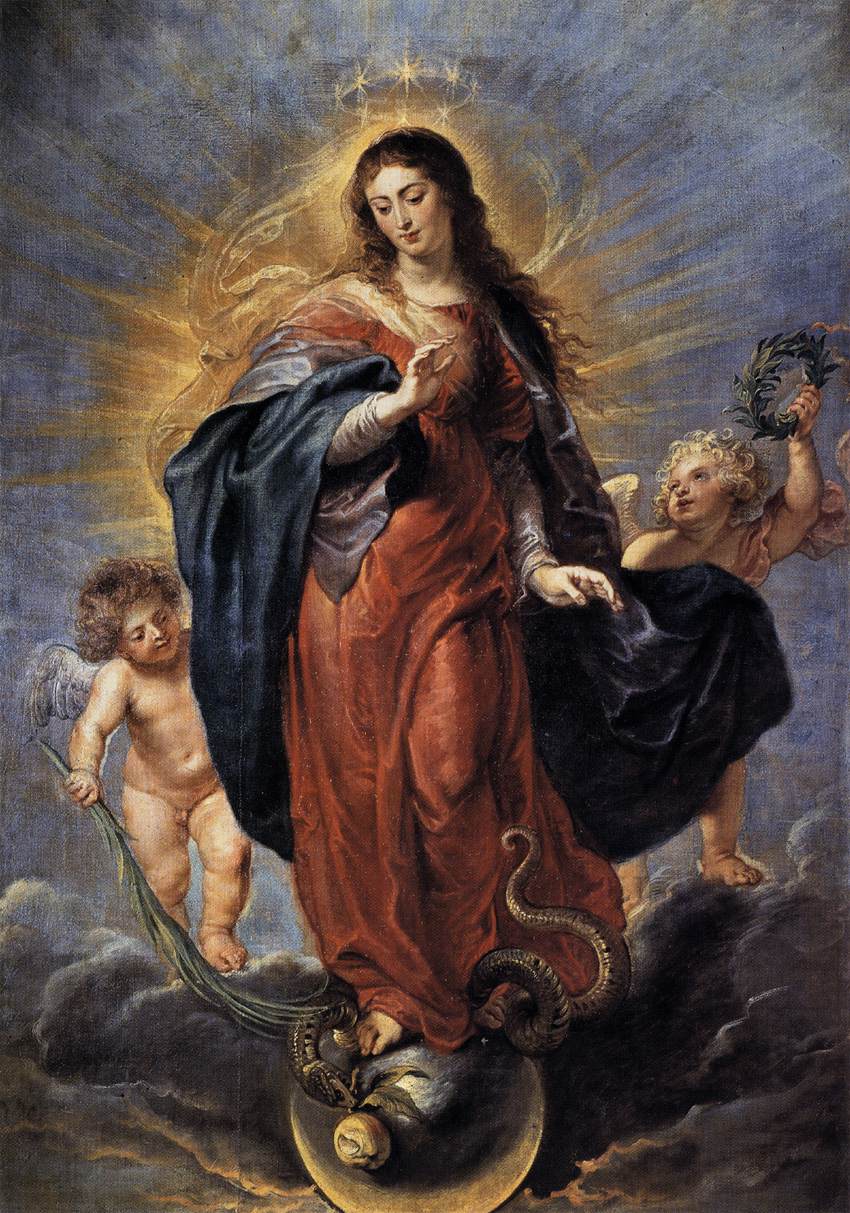
Rubens is the official YIMCatholic painter of the Immaculate Conception
Last Christmas, I shared what I called mind blowing thoughts of Blessed Duns Scotus on the Incarnation. Yesterday, though, was the Solemnity of the Immaculate Conception of the Blessed Virgin Mary, and Blessed Duns Scotus is a big reason why, roughly 550 years after his thinking on the matter, Pope Pius IX (in 1854) infallibly declared the dogma that we celebrate just as the season of Advent rounds into week #2.
Below, I’m pleased to present one of the Subtle Doctor’s articles on the matter, along with his rebuttal and answers to objections. If you are used to reading St. Thomas Aquinas, the style here is the same. I found what follows at the excellent Franciscan-Archive.org in the section where St. Thomas Aquinas’s Summa is compared to the Scoti Summae Theologicae, following the order of St. Thomas’ work. A friar named Jerome of Montefortino (1662-1738), laid the two doctors side by side, which makes for a book of considerable heft, intellectually, as well as physically.
Come and see the mind of the Subtle Doctor at work.
Article 2. Whether the Blessed Virgin was sanctified before animation?
Scotus [Oxon. 3 d.3 q.1; Report. ib.]
Objection 1. It seems that the Blessed Virgin was not sanctified until after original sin had been contracted. For [Oxon. 3 d.3 q.1 n.3] Christ was the universal redeemer of everyone and opened the door to everyone: but if the Blessed Virgin had not contracted original sin, Christ would not have been her Redeemer, because she would not have needed him; therefore we cannot and we should not attribute original innocence to his Mother because this would derogate from her Son himself.
Objection 2. [Oxon. ib.] The Blessed Virgin had the penalties common to human nature as propagated from Adam, namely hunger, thirst, and other such things; but she herself did not voluntarily assume these punishments, as they were voluntarily assumed by Christ for the satisfaction of our sins; because the Blessed Virgin was not our redeemer or repairer; therefore they were inflicted on her by God; and not inflicted unjustly; therefore they were inflicted, as in the case of other human beings, because of original sin.
Objection 3. If the Blessed Virgin had not been guilty of original sin, God would have bestowed a greater benefit on those whom he did liberate from that guilt than he did on his Mother: but that does not seem likely; therefore it is not to be said that she did not fall in Adam. Proof of the minor: [Oxon. 4 d.22 n.16] from Luke 7, where it is held that Christ inquired of Simon about the two debtors, to one of whom the creditor had forgiven more and to the other less, which of them would love the
creditor more; and he replied, “I suppose it was he to whom he gave more,” and that judgment was approved by the Savior; therefore those liberated from sin already contracted would be more bound to God, because he had forgiven them more, than the Mother of Christ, to whom he had forgiven less; therefore it is to be supposed that she had contracted original guilt.
On the contrary, [Oxon. 3 d.3 q.1 n.2] Anselm says (De Conceptione Virg., ch.18), “It was fitting that the Virgin should shine with that purity than which a greater under God cannot be conceived:” but if she had once been under original sin, we could rightly conceive a greater purity; therefore the Blessed Virgin was most pure and immune altogether from every sin.
I answer that, it must be said that although the Blessed Virgin was not sanctified before her animation, because the flesh, as it is not the subject of sin, so neither is it of sanctifying grace, she was nevertheless sanctified in her very animation, that is to say, in the same moment in which it was necessary, from the common law of the sons of Adam, that guilt be in her, such that there never was, nor did she contract, original sin. The very excellence of her Son, for the purpose of not derogating from which some hold the opposite opinion, is what shows this. For [Oxon. ib. n.4] it was fitting for the most perfect Mediator, such as Christ the Lord was, to have had the most perfect act of mediating with respect to some person of whom he was Mediator: but he is not conceived to have existed as the most perfect Mediator of God and of his Mother unless he had preserved her from falling into original guilt; therefore she was preserved from being infected with original guilt. The minor is shown: [Oxon. ib.] first by comparison to God to whom he reconciles: second by comparison to the evil from which he liberates: third by comparison to the person for whom he reconciles. And the first in this way, by supposing that it was not impossible for original guilt to be prevented from being present, since it is not guilt, except contracted from another; and if that was possible, for no one did it become the Mediator to have done it than for his Mother. Therefore the argument is as follows: [Oxon. n.5] a mediator is not conceived to mediate most perfectly, or to placate someone for an offense that had to be contracted, unless he prevents the offense from being present and prevents anyone from being offended by it; for if he placates someone already offended, and sways him to remit guilt, he does not exercise the most perfect act of mediating or placating, as he would have done by preventing the offense; therefore Christ does not most perfectly reconcile or placate the Trinity for the guilt to be contracted by the sons of Adam, if he does not prevent the Trinity from being offended, on account of the inherent guilt, in some one among them. Since therefore Christ was the most perfect Mediator, it is necessary that he have altogether prevented someone from contracting original guilt: but it was not fitting that this be any other besides his most blessed Mother. — The argument under the second head: [Oxon. ib. n.6] because Christ seems to be more immediately our Repairer from original sin than from actual sin; for the necessity of the Incarnation is commonly assigned from original sin: but he was to that extent the most perfect Mediator with respect to his Mother that he preserved her from every actual sin; therefore also from original sin; especially since this original sin is a greater punishment than the lack of the Divine vision; for sin is the greatest of punishments for an intellectual nature; therefore Christ, as the most perfect Mediator, merited to take away this most
heavy penalty from his Most Blessed Mother, otherwise he would not have reconciled most perfectly nor would he have been the most perfect Mediator. — The argument finally from the third. [Oxon. ib. n.7] A person who has been reconciled is not supremely obliged to his mediator unless he has from him the whole of the good which he can receive: but preservation from contracting guilt can be had through a mediator; therefore no person was supremely beholden to Christ as Mediator if he did not preserve anyone from original sin. (The minor was touched on also in article 1, and will be declared more clearly in the following articles.)
Reply to Objection 1. I concede that Christ is the universal Mediator and Redeemer of everyone and even of his Most Blessed Mother, and consequently [Report. 3 d.3 q.1 n.8] that she needed the Redeemer more than anyone else whatever, and she needed him the more, indeed, the greater the good that was conferred on her by him; and since perfect innocence is a greater good by far than remission of guilt after an offense, a greater good was conferred on her by the Mediator when she was preserved from original sin than if she had been purged and cleansed afterwards; therefore [Oxon. 3 d 3 q.1 n.14] she needed to the greatest possible extent the Redeemer through whose merits grace prevented her from being infected with any spot of sin, just as others need the Mediator so that sin contracted might, through him, be remitted to them.
Reply to Objection 2. About the penalties and sufferings of the Blessed Virgin I concede that she had them and that she bore them most powerfully, not because they existed as the consequences of original guilt contracted from the common way of propagation, as the argument proceeds; but rather [Oxon. ib. n.8] they were left to her so that she might win merit, whether for herself or for us; for there is nothing unacceptable if useless and inappropriate punishments, such as are sins, are taken from her by the Mediator, and useful ones, and those that would be of advantage, left to her.
Reply to Objection 3. Although [Report. 3 d.3 q.1 n.6] it is true that, of two debtors, he is more obligated to whom more is forgiven than he to whom less is; nevertheless, it is a benefit greater by far to be preserved from contracting any obligation of debt than for a
debt already contracted to be forgiven; therefore, that person is bound by an absolutely greater obligation who is preserved by the Mediator from original sin, than the person who is cleansed of what has already been contracted by the same Mediator, because the
former has received a benefit more excellent by far than those who, after sin has been contracted, are freed by the grace of the Mediator. (But the intervening article, appropriately placed below after article 2, should be looked at).
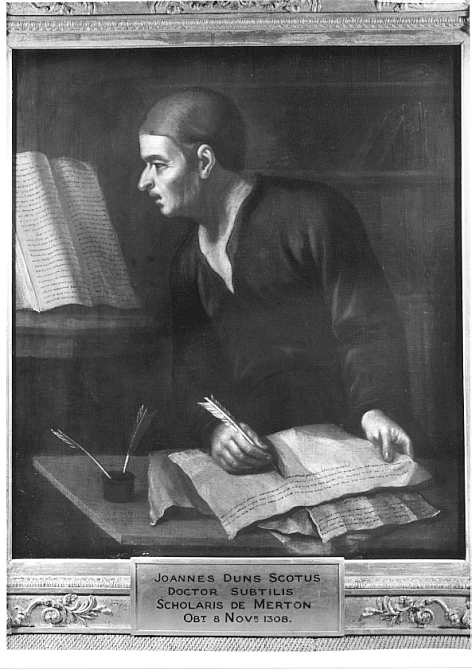

Read more of Blessed Duns Scotus’s work over at Franciscan-Archive.org.
Previous Post

December 9, 2013
Wall Street Journal Columnist Backs The "Advent Conspiracy"
Next Post
December 11, 2013 Pope Francis Is TIME Magazine's Person of the Year
Browse Our Archives
Select a Category Blog News Conversion Story Culture Learning Living Nature Prayer Uncategorized Working
Select a Month June 2016 May 2016 August 2015 July 2015 June 2015 May 2015 April 2015 March 2015 February 2015 January 2015 December 2014 November 2014 October 2014 September 2014 August 2014 July 2014 June 2014 May 2014 April 2014 March 2014 February 2014 January 2014 December 2013 November 2013 October 2013 September 2013 August 2013 July 2013 June 2013 May 2013 April 2013 March 2013 February 2013 January 2013 December 2012 November 2012 October 2012 September 2012 August 2012 July 2012 June 2012 May 2012 April 2012 March 2012 February 2012 January 2012 December 2011 November 2011 October 2011 September 2011 August 2011 July 2011 June 2011 May 2011 April 2011 March 2011 February 2011 January 2011 December 2010 November 2010 October 2010 September 2010 August 2010 July 2010 June 2010 May 2010 April 2010 March 2010 February 2010 January 2010 December 2009 November 2009 October 2009 September 2009 August 2009
Follow Us!
TAKE THE
Religious Wisdom Quiz
Who interpreted Pharaoh’s dreams in Egypt?
Select your answer to see how you score.
Moses Daniel Aaron Joseph
Related posts from Why I Am Catholic

Belated Happy Birthday To Blaise Pascal, Unofficial Saint...

Because My Brother Imran Yousef Is An American...

Joe Six-Pack, USMC, With A Few Post-Terrorist Attack...

This Is Why God Invented YouTube...
TRENDING AT PATHEOS Catholic

Rejecting Doom: Christian Hope And Human Action
Christianity is a religion of hope. We are to have hope and...

It’s What Comes From Within Which Matters
One of the most difficult things for us to understand is why...

Why I Choose the Eucharist Over the Sermon
Choose the Eucharist, Not the Sermon What are we supposed to get...

5 Design Elements Found in Spiritually Rooted Homes
Putting Spirituality Into Home Decor Our homes are more than our living...

Credo: A Story of God Told with the...
About 10 years ago, I began to imagine a personal "Credo" that...

The Anatomy of Divine Revelation in Catholic Thought
The claim that God has made Himself known to human beings is...
Ad-Free & Subscriber Log-In Subscription Support
- About Us
- 2026 Calendar
- Videos
- Podcasts
- Library of World Religions
- Faith In Media Tracker
- Advertise With Us
- Write for Us
- Privacy Policy
- Terms of Service
- Do Not Sell My Data
- Contact Us
- Radiant Digital
- Manage Newsletter Subscriptions
- Unsubscribe From Notifications
- Sitemap
Copyright 2008-2026, Patheos. All rights reserved.
Subscription Support Ad-Free & Subscriber Log-In
Follow Patheos