
BuddhistCatholicContemplativeEvangelicalGeneral ChristianHinduJewishLatter-day SaintMuslimNew VisionsProgressive Christian
Beliefs
- Buddhist
- Catholic
- Contemplative
- Evangelical
- General Christian
- Hindu
- Jewish
- Latter-day Saint
- More Voices
- Muslim
- New Visions
- Pagan
- Progressive Christian
Topics
- Religion News
- Food and Religion
- Sports and Religion
- Religious Art
- Religious Music and Entertainment
- Religious Events
- History and Religion
- Style and Religion
- Politics and Religion
- Women in Religion
- Recreation Outdoors and Religion
- Business Finance and Religion
- Careers Workplace and Religion
- Education and Religion
- Family Parenting and Religion
- Health Fitness and Religion
- Home and Religion
- Relationships and Religion
- Technology and Religion
- Travel and Religion
Columnists
- Buddhist Columnists
- Business Finance and Religion Columnists
- Careers Workplace and Religion Columnists
- Catholic Columnists
- Contemplative Columnists
- Education and Religion Columnists
- Evangelists Columnists
- Family Parenting and Religion Columnists
- General Christian Columnists
- Health Fitness and Religion Columnists
- Hindu Columnists
- History and Religion Columnists
- Home and Religion Columnists
- Jewish Columnists
- More Voices Columnists
- Latter Day Columnists
- Muslim Columnists
- New Visions Columnists
- Nonreligious Columnists
- Pagan Columnists
- Politics and Religion Columnists
- Progressive Columnists
- Recreation Outdoors and Religion Columnists
- Relationships and Religion Columnists
- Religion News Columnists
- Religious Art Columnists
- Religious Events Columnists
- Religious Music and Entertainment Columnists
- Sports and Religion Columnists
- Style and Religion Columnists
- Technology and Religion Columnists
- Travel and Religion Columnists
- Women in Religion Columnists
Resource Library
- 2026 Calendar
- Library of World Religions
- The 100 Most Holy Places on Earth
- Patheos Answers
- Podcasts
- Videos
- Faith Leaders Database
- Anglican Episcopalian
- Bahai
- Baptist
- Buddhism
- Christianity
- Confucianism
- Eastern Orthodoxy
- Hinduism
- Holiness and Pentecostal
- ISKCON
- Islam
- Judaism
- Lutheran
- Methodist
- The Church of Jesus Christ of Latter-day Saints
- New Age
- Paganism
- Presbytarian and Reformed
- Protestantism
- Religion Behind the Scenes
- Roman Catholic
- Scientology
- Shia Islam
- Sikhism
- Sufism
- Sunni Islam
- Taoism
- Zen
- See all religions
Research Tools
 Ad-Free & Subscriber Log-In Subscription Support
Ad-Free & Subscriber Log-In Subscription Support
Follow Patheos 

- Trending:
- Forgiveness
- |
- Marriage
- |
- Consciousness
- |
- Death Penalty
- |
- Election
- |
- Halloween
 Why I Am Catholic
-
More
- Home
- Unpacking Pope Francis’s Interview (Part III, the Conclusion)
Unpacking Pope Francis’s Interview (Part III, the Conclusion)
Last updated on: June 10, 2015 at 6:03 pm by Frank Weathers
Unpacking Pope Francis’s Interview (Part III, the Conclusion) 2015-06-10T18:03:33-05:00 Frank Weathers
Patheos Explore the world's faith through different perspectives on religion and spirituality! Patheos has the views of the prevalent religions and spiritualities of the world.
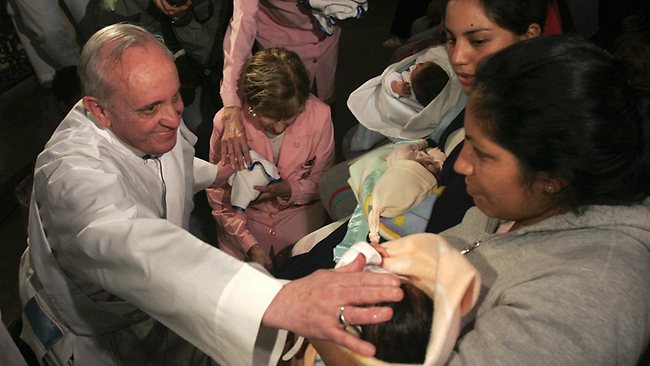
Pope Francis is leading us by example
Thus the Holy Spirit can use the humblest to enlighten the learned and those in the highest positions.
That was the last line from the Catechism that I shared yesterday. It probably got lost in the shuffle so it’s worth reading and re-reading again. In fact, it is worth committing to memory, given that the truth of the statement has been borne out time and time again in the life of the saints. After all, it sounds like something St. Paul would say, and is grounded in the teachings of Jesus himself.
As I have been attempting to show these past few days, Pope Francis’s thoughts have not arisen in a vacuum. When he says,”the wisdom of discernment redeems the necessary ambiguity of life and helps us find the most appropriate means, which do not always coincide with what looks great and strong,” I am taken right back to St. Paul’s inspired words on being strongest while being weak.
I’m also back to the section of the Catechism about Our Mother and Teacher, the Church.
2039 Ministries should be exercised in a spirit of fraternal service and dedication to the Church, in the name of the Lord.81 At the same time the conscience of each person should avoid confining itself to individualistic considerations in its moral judgments of the person’s own acts. As far as possible conscience should take account of the good of all, as expressed in the moral law, natural and revealed, and consequently in the law of the Church and in the authoritative teaching of the Magisterium on moral questions. Personal conscience and reason should not be set in opposition to the moral law or the Magisterium of the Church.
Recall Pope Francis’s comparison of himself as being like the apostle Matthew in Caravaggio’s dipiction of the call of the tax collector. “That finger of Jesus, pointing at Matthew. That’s me. I feel like him. Like Matthew.”
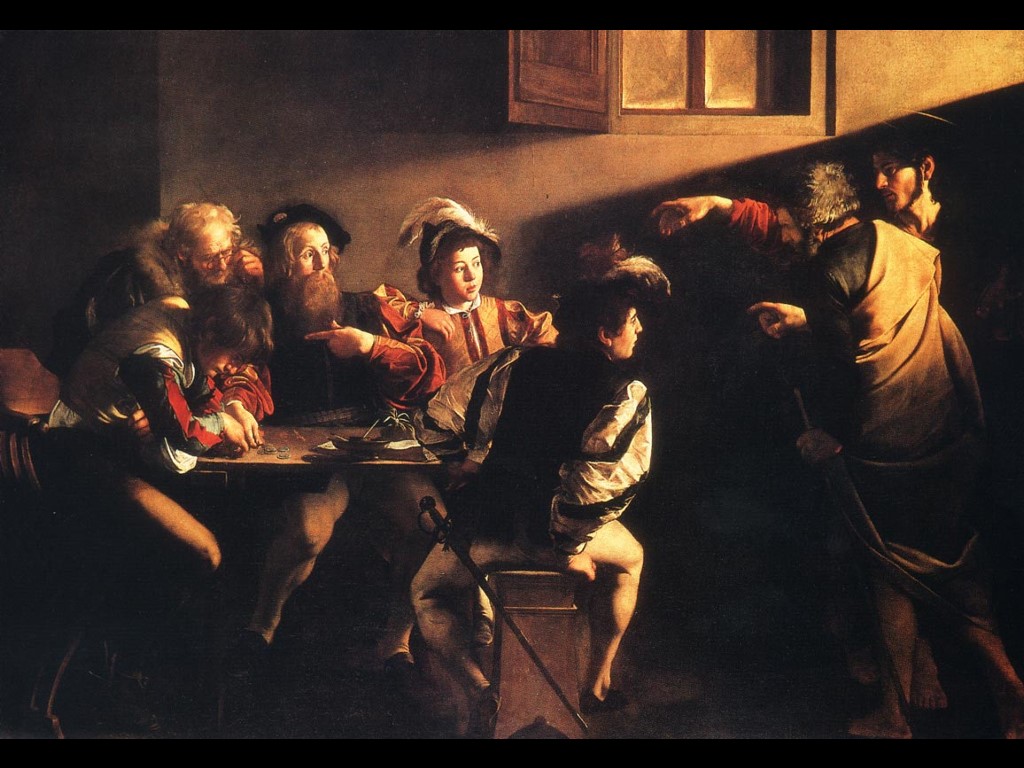
The encounter with Christ changed Matthew, as indeed it changes all who come within the merciful gaze of the Lord. The individual formerly know as Matthew, tax collector and publican, was transformed into Matthew, sinner, disciple of Jesus Christ. The conscience of the old man was slothed off like an old skin, and with his accepting of the call of Jesus, his conscience was realigned so that his soul could be freed from “individualistic considerations in its moral judgments of the person’s own acts,” and instead was opened to the truth that his narrow, individualistic, approach led to a dead-end.
2040 Thus a true filial spirit toward the Church can develop among Christians. It is the normal flowering of the baptismal grace which has begotten us in the womb of the Church and made us members of the Body of Christ. In her motherly care, the Church grants us the mercy of God which prevails over all our sins and is especially at work in the sacrament of reconciliation. With a mother’s foresight, she also lavishes on us day after day in her liturgy the nourishment of the Word and Eucharist of the Lord.
This is something that has been forgotten to a great extent. But for whatever reason, Pope Francis is being heard by many. Where his predecessors had been all but ignored, Pope Francis is causing folks to look at the faith with fresh eyes, even before the words from the interview were known. Even in unlikely places like Forbes magazine, the Francis Effect can be seen a month before the interview read ’round the world,
One of the more startling behaviors Pope Francis has displayed has been his willingness to engage in off-the-cuff, unscripted and unguarded conversations with the Vatican press corps and many others. While he has asked that his unscripted homilies not be published as official documents, the very fact that he is willing to give them reflects his desire to speak from the heart, rather than deliver highly scripted, theologically bullet-proof lectures from the head.
Experience has taught me that what comes from the heart, lands on the heart. Too often though, in our world of headline-hungry 24 hour news cycles, leaders today steer well clear of saying anything that could possibly be misinterpreted or make them vulnerable to critics. They play it safe, hiding behind craftily worded scripts written by professional wordsmiths who have weighed every word and edited every phrase into clever sound bytes.
But what of Pope Francis’s cautions about not looking for certainty and of the possibility committing mistakes?
“The risk in seeking and finding God in all things, then, is the willingness to explain too much, to say with human certainty and arrogance: ‘God is here.’ We will find only a god that fits our measure. The correct attitude is that of St. Augustine: seek God to find him, and find God to keep searching for God forever. Often we seek as if we were blind, as one often reads in the Bible. And this is the experience of the great fathers of the faith, who are our models. We have to re-read the Letter to the Hebrews, Chapter 11.”
See again how Pope Francis points us in the direction of the scriptures? Like I said in the first post in this series, if you want to conform yourself with Christ and his Church, a good start would be a devotion to following the daily readings for Mass. A second recommendation would be to follow Pope Francis in praying the prayers of the Church as well.
Does your earthly mother know everything? The answer is obviously “no.” But do you seek her counsel anyway if possible? It is wise to do so. In the case of Our Mother, the Church, to ignore her advice based on her years of experience is the height of folly. For like G.K. Chesterton noted,
There is no other case of one continuous intelligent institution that has been thinking about thinking for two thousand years. Its experience naturally covers nearly all experiences; and especially nearly all errors. The result is a map in which all the blind alleys and bad roads are clearly marked, all the ways that have been shown to be worthless by the best of all evidence: the evidence of those who have gone down them.
On this map of the mind the errors are marked as exceptions. The greater part of it consists of playgrounds and happy hunting-fields, where the mind may have as much liberty as it likes; not to mention any number of intellectual battle-fields in which the battle is indefinitely open and undecided. But it does definitely take the responsibility of marking certain roads as leading nowhere or leading to destruction, to a blank wall, or a sheer precipice. By this means, it does prevent men from wasting their time or losing their lives upon paths that have been found futile or disastrous again and again in the past, but which might otherwise entrap travelers again and again in the future.
That is what good mothers do, you see. Especially when there are a “number of intellectual battle-fields in which the battle is indefinitely open and undecided.” Because for anyone with even an ounce of introspection, Pope Francis’s thoughts that “our life is not given to us like an opera libretto, in which all is written down; but it means going, walking, doing, searching, seeing…. We must enter into the adventure of the quest for meeting God; we must let God search and encounter us,” is true, even if it makes us a tad uncomfortable.
This is the dark night of the soul, this doubt. I’m reminded of the words of John C.H. Wu when he lamented that,
…the average Buddhist in China knows something about the three stages of Absention, Concentration, and Wisdom; while the average Christian has no idea of the three ways, the Purgative, the Illuminative, and the Unitive. The spiritual education of the Christian is sadly neglected.
I know for the longest time, I had never heard of them. But that was before the encounter. Afterwards, when the seed of the gospel message lands on fertile soil, soil tilled by pain, experience, and love, one seeks to know more of the ways of the Way. Because,
“God is encountered walking, along the path. At this juncture, someone might say that this is relativism. Is it relativism? Yes, if it is misunderstood as a kind of indistinct pantheism. It is not relativism if it is understood in the biblical sense, that God is always a surprise, so you never know where and how you will find him.”
A few more words about Pope Francis’s thoughts on art, specifically around the subject of the novel The Betrothed. Why that one? Because it was the first book I tried to read from the Harvard Five Foot Shelf of Books, back when I was being unwittingly prepared to enter the Catholic Church. Here is what I had to say about it in the second post I ever wrote. You see,I was looking for,
Something new, something . . . sophisticated! Something I can feel smart reading while drinking my coffee before taking up my tools and honey-do list. Volume 21: I Promessi Sposi by Alessandro Manzoni. I’m feeling smarter already because this title isn’t even in English! I’ve never heard of it, and here it is in the Canon. I pick it up and learn that the title means “The Betrothed.” Hmmm, not exactly a promising title, but what do I know? This is an IMPORTANT BOOK or it would not be in this set. Press on, Marine!
Yeah, well, it may be important, but from the two chapters of silliness that ensued, I put it down quietly. Maybe later. I went back into the batter’s box for another try and started working my way backward from the last volume until I landed upon Volume 48, Blaise Pascal, Thoughts, Letters, Minor Works.
So when I learned that Pope Francis has read The Betrothed three times and is embarking on reading it for a fourth time? Now must be “later.” Perhaps I wasn’t ready to read it that firt time ’round, just like I wasn’t ready for RCIA the first time around. Maybe now that I’m a Catholic, I can appreciate it better. We’ll see.
Good news on that front, by the way. The book is available for free in the Amazon Kindle format, so you can even join me if you’d like.
I’m going to wrap up this series of unpacking posts by pointing everyone to something Francis Beckwith has written regarding the words of the Holy Father. In a post titled Am I the Prodigal Son’s Brother?, the lay Francis answers that question the same way I did seven years ago.
Those who see in Francis the “non-judgmental” pope of their dreams do not understood Christianity or the true meaning of the Good News of Jesus Christ. For Francis knows that when he, or even the Lord Jesus, says to a penitent, “Neither I condemn you; go and sin no more,” he is not saying that what you did is a sin no more. For reconciliation requires separation, just as a hospital requires illness.
Thus, when Francis offers the Gospel to the world – and in doing so describes the Church as a field hospital – his offer comes embedded in a judgment. But it is not his judgment. It is, in the words of Christ, the judgment of the Holy Spirit, who our Lord calls, of all things, “The Comforter”: “And he, when he is come, will convict the world in respect of sin, and of righteousness, and of judgment.” (John 16:8)
So, when I reflect on my initial reaction to portions of the Pope’s interview, I have to consider the possibility that there is something wrong with me, and not him. In that case, I may be more like the Prodigal Son’s brother than I’d like to admit. While my father is offering love, shelter and a permanent home to his wayward progeny, I find myself disturbed that he may be conceding too much to one, who in the past, did not hesitate to take unfair advantage of his patrimony.
I knew the answer was “yes” after a mere brush with the writings of Blaise Pascal. But at the same time, I knew I was the prodigal son as well. I was grateful that I had been called into the fold, and accepted with loving arms. This is the hope that Pope Francis, and Christ the Lord, wants us to proclaim to the world.
The truth is that God is Love, a Love that will transform us for all eternity.
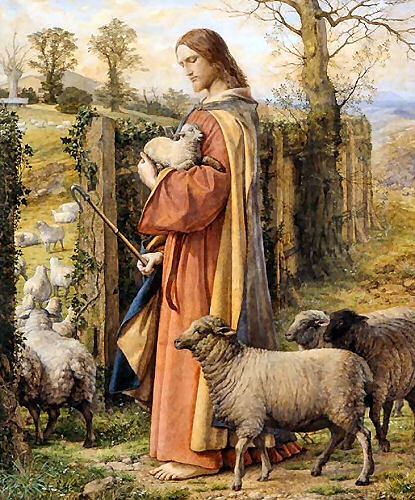
Fear not, for I am with you always…
Previous Post

September 27, 2013
Unpacking Pope Francis's Interview (Part II) UPDATED
Browse Our Archives
Select a Category Blog News Conversion Story Culture Learning Living Nature Prayer Uncategorized Working
Select a Month June 2016 May 2016 August 2015 July 2015 June 2015 May 2015 April 2015 March 2015 February 2015 January 2015 December 2014 November 2014 October 2014 September 2014 August 2014 July 2014 June 2014 May 2014 April 2014 March 2014 February 2014 January 2014 December 2013 November 2013 October 2013 September 2013 August 2013 July 2013 June 2013 May 2013 April 2013 March 2013 February 2013 January 2013 December 2012 November 2012 October 2012 September 2012 August 2012 July 2012 June 2012 May 2012 April 2012 March 2012 February 2012 January 2012 December 2011 November 2011 October 2011 September 2011 August 2011 July 2011 June 2011 May 2011 April 2011 March 2011 February 2011 January 2011 December 2010 November 2010 October 2010 September 2010 August 2010 July 2010 June 2010 May 2010 April 2010 March 2010 February 2010 January 2010 December 2009 November 2009 October 2009 September 2009 August 2009
Follow Us!
TAKE THE
Religious Wisdom Quiz
Who wrote the most letters in the New Testament?
Select your answer to see how you score.
Paul John James Peter
Related posts from Why I Am Catholic

Belated Happy Birthday To Blaise Pascal, Unofficial Saint...

Because My Brother Imran Yousef Is An American...

Joe Six-Pack, USMC, With A Few Post-Terrorist Attack...

This Is Why God Invented YouTube...
TRENDING AT PATHEOS Catholic

Rejecting Doom: Christian Hope And Human Action
Christianity is a religion of hope. We are to have hope and...

It’s What Comes From Within Which Matters
One of the most difficult things for us to understand is why...

Why I Choose the Eucharist Over the Sermon
Choose the Eucharist, Not the Sermon What are we supposed to get...

5 Design Elements Found in Spiritually Rooted Homes
Putting Spirituality Into Home Decor Our homes are more than our living...

Credo: A Story of God Told with the...
About 10 years ago, I began to imagine a personal "Credo" that...

The Anatomy of Divine Revelation in Catholic Thought
The claim that God has made Himself known to human beings is...
Ad-Free & Subscriber Log-In Subscription Support
- About Us
- 2026 Calendar
- Videos
- Podcasts
- Library of World Religions
- Faith In Media Tracker
- Advertise With Us
- Write for Us
- Privacy Policy
- Terms of Service
- Do Not Sell My Data
- Contact Us
- Radiant Digital
- Manage Newsletter Subscriptions
- Unsubscribe From Notifications
- Sitemap
Copyright 2008-2026, Patheos. All rights reserved.
Subscription Support Ad-Free & Subscriber Log-In
Follow Patheos