
BuddhistCatholicContemplativeEvangelicalGeneral ChristianHinduJewishLatter-day SaintMuslimNew VisionsProgressive Christian
Beliefs
- Buddhist
- Catholic
- Contemplative
- Evangelical
- General Christian
- Hindu
- Jewish
- Latter-day Saint
- More Voices
- Muslim
- New Visions
- Pagan
- Progressive Christian
Topics
- Religion News
- Food and Religion
- Sports and Religion
- Religious Art
- Religious Music and Entertainment
- Religious Events
- History and Religion
- Style and Religion
- Politics and Religion
- Women in Religion
- Recreation Outdoors and Religion
- Business Finance and Religion
- Careers Workplace and Religion
- Education and Religion
- Family Parenting and Religion
- Health Fitness and Religion
- Home and Religion
- Relationships and Religion
- Technology and Religion
- Travel and Religion
Columnists
- Buddhist Columnists
- Business Finance and Religion Columnists
- Careers Workplace and Religion Columnists
- Catholic Columnists
- Contemplative Columnists
- Education and Religion Columnists
- Evangelists Columnists
- Family Parenting and Religion Columnists
- General Christian Columnists
- Health Fitness and Religion Columnists
- Hindu Columnists
- History and Religion Columnists
- Home and Religion Columnists
- Jewish Columnists
- More Voices Columnists
- Latter Day Columnists
- Muslim Columnists
- New Visions Columnists
- Nonreligious Columnists
- Pagan Columnists
- Politics and Religion Columnists
- Progressive Columnists
- Recreation Outdoors and Religion Columnists
- Relationships and Religion Columnists
- Religion News Columnists
- Religious Art Columnists
- Religious Events Columnists
- Religious Music and Entertainment Columnists
- Sports and Religion Columnists
- Style and Religion Columnists
- Technology and Religion Columnists
- Travel and Religion Columnists
- Women in Religion Columnists
Resource Library
- 2026 Calendar
- Library of World Religions
- The 100 Most Holy Places on Earth
- Patheos Answers
- Podcasts
- Videos
- Faith Leaders Database
- Anglican Episcopalian
- Bahai
- Baptist
- Buddhism
- Christianity
- Confucianism
- Eastern Orthodoxy
- Hinduism
- Holiness and Pentecostal
- ISKCON
- Islam
- Judaism
- Lutheran
- Methodist
- The Church of Jesus Christ of Latter-day Saints
- New Age
- Paganism
- Presbytarian and Reformed
- Protestantism
- Religion Behind the Scenes
- Roman Catholic
- Scientology
- Shia Islam
- Sikhism
- Sufism
- Sunni Islam
- Taoism
- Zen
- See all religions
Research Tools
 Ad-Free & Subscriber Log-In Subscription Support
Ad-Free & Subscriber Log-In Subscription Support
Follow Patheos 

- Trending:
- Forgiveness
- |
- Marriage
- |
- Consciousness
- |
- Death Penalty
- |
- Election
- |
- Halloween
 Why I Am Catholic
-
More
- Home
- Because Jesus, His Disciples, and the Old Testament, Said Plenty About Hell
Because Jesus, His Disciples, and the Old Testament, Said Plenty About Hell
Last updated on: May 28, 2015 at 6:43 pm by Frank Weathers
Because Jesus, His Disciples, and the Old Testament, Said Plenty About Hell 2015-05-28T18:43:00-05:00 Frank Weathers
Patheos Explore the world's faith through different perspectives on religion and spirituality! Patheos has the views of the prevalent religions and spiritualities of the world.
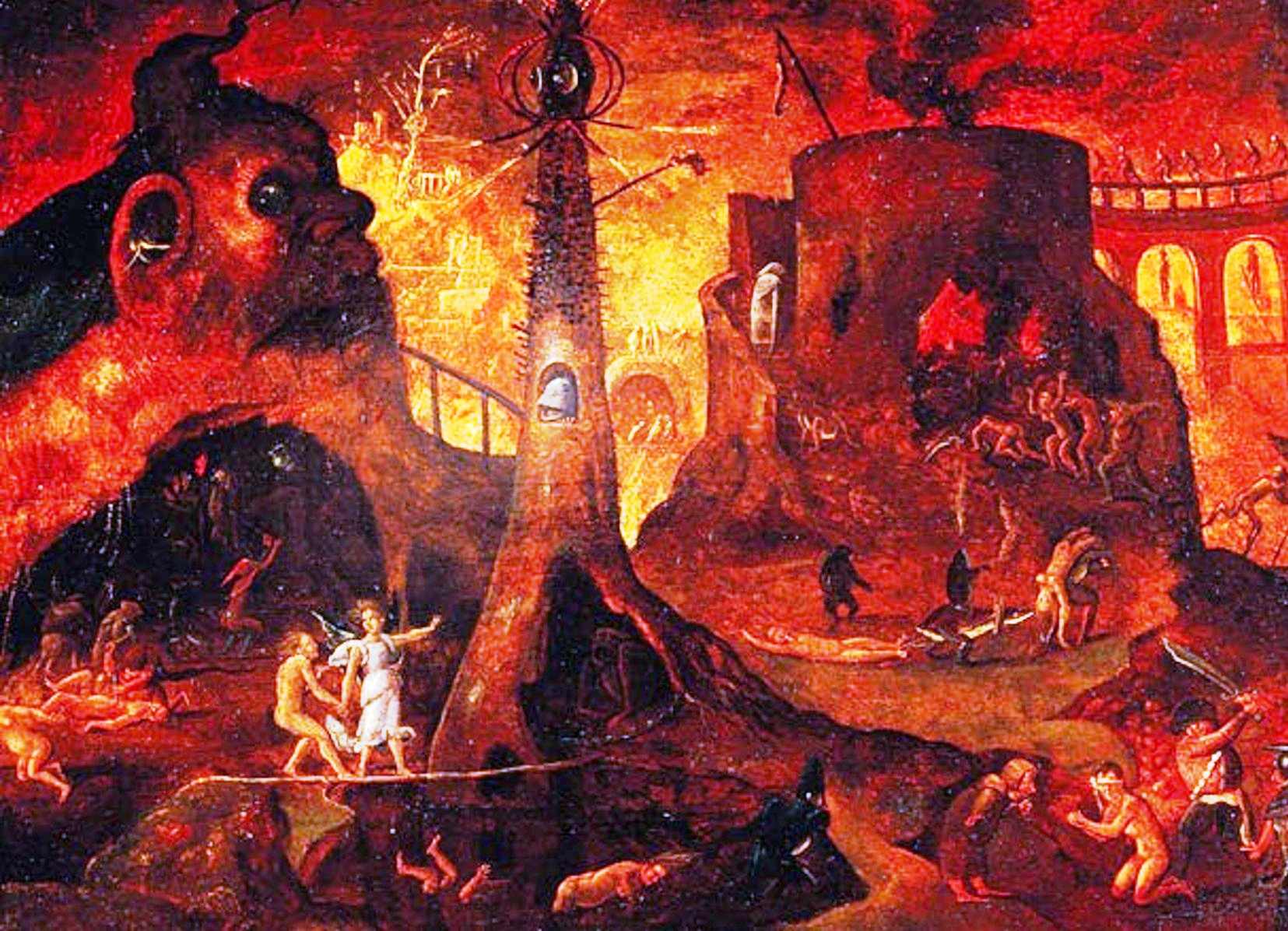
Anyone know the artist?
And once again, it’s inconvenient to the spirit of the age. But regardless of whether that is the case, the cycle of readings lead us to the passage where Jesus tells the story of Lazarus and the rich man in the gospel reading this Sunday.
I wonder how much we’ll be hearing about the hell part of the story during the homily?
Most likely, we’ll dwell upon the plight of the poor, or the merciful treatment of Lazarus as he was welcomed into the bosom of Abraham. But the rich guy sees everything from the perspective of the guy sitting on the hot side of the river.
Sure, sure, you don’t believe Hell exists. And if it did, you comfort yourself with highminded ideas about how it’s not a physical place, but more like just a really lonely place, where you just hang out in the quiet. Doing nothing. Forever.
Jesus didn’t cotton to such nonsense, and neither do I.
If you don’t believe the New Testament is true, I reckon you can ignore what follows. Or you can pretend to yourself that the following references to Hell aren’t meant to be taken literally. But before you take to that path of mental gymnastics, remember the following handy rule of thumb about the scriptures. Peter Kreeft puts it like so,
When the biblical author claims he saw something in the external world with his own eyes, or that somone else did and told him, then we are to interpret it literally. On the other hand, when a thing is not visible to the eye, we cannot interpret it literally.
Now Dr. Kreeft is quick to mention that just because something can be interpreted literally in accordance with this rule doesn’t mean that we must believe it. But when it comes to Hell, I’d say consider the source.
Jesus talks about Hell early and often. From the Sermon on the Mount we get the following,
But I say to you that if you are angry with a brother or sister, you will be liable to judgment; and if you insult a brother or sister, you will be liable to the council; and if you say, ‘You fool,’ you will be liable to the hell of fire.(Matt 5:22)
If your right eye causes you to sin, tear it out and throw it away; it is better for you to lose one of your members than for your whole body to be thrown into hell. (Matt 5:28)
And if your right hand causes you to sin, cut it off and throw it away; it is better for you to lose one of your members than for your whole body to go into hell. (Matt 5:30)
But Frank, those sound like passages from the Koran, man! Besides, Jesus is exaggerating to make his point to the crowd, right?
Which leads us to the strange case of the next citation from Matthew’s gospel,
If you won’t believe me, who will you believe?
Do not fear those who kill the body but cannot kill the soul; rather fear him who can destroy both soul and body in hell.(Matt 10:28)
And you, Capernaum, will you be exalted to heaven? No, you will be brought down to Hades. For if the deeds of power done in you had been done in Sodom, it would have remained until this day. (Matt 11:23)

Hey lookee there, Hades made its first appearence in the New Testament. Of course, how can a Catholic forget its next mention, eh?
And I tell you, you are Peter, and on this rock I will build my church, and the gates of Hades will not prevail against it.
And in case some folks missed the Sermon on the Mount, Jesus repeats the following to catch folks up,
If your hand or your foot causes you to stumble, cut it off and throw it away; it is better for you to enter life maimed or lame than to have two hands or two feet and to be thrown into the eternal fire. And if your eye causes you to stumble, tear it out and throw it away; it is better for you to enter life with one eye than to have two eyes and to be thrown into the hell of fire. (Matt 18: 8-9)
Perhaps Jesus was just scaring the common folks. Surely to the learned Pharisees, Sadducees, and priests, he’d tone things down a bit. Right?
Woe to you, scribes and Pharisees, hypocrites! For you cross sea and land to make a single convert, and you make the new convert twice as much a child of hell as yourselves.
Sounds serious. But wait, there’s more.
You snakes, you brood of vipers! How can you escape being sentenced to hell?
Sounds like he has a place in mind to me. What about the other gospel books? What do the eyewitnesses of Jesus’s words have him saying?
Looks like Mark repeats Matthew, while kicking it up a notch with Hell being the place “where their worm never dies, and the fire is never quenched.” Creepy.
Moving on to Luke’s gospel, we find Hades mentioned like it was in Matthew (Luke 10:15) and there is the Matthew 10:28 citation with a slight modification as well,
But I will warn you whom to fear: fear him who, after he has killed, has authority to cast into hell. Yes, I tell you, fear him! (Luke 12:5)
Gulp.
Good news! The gospel reading about hell you’ll hear for the twenty-sixth Sunday in Ordinary Time (tomorrow) never mentions the word “hell,” actually. That and it’s a parable so maybe it’s not an eyewitness account afterall. Let’s have a looksee (my emphasis).
Jesus said to the Pharisees:
“There was a rich man who dressed in purple garments and fine linen
and dined sumptuously each day.
And lying at his door was a poor man named Lazarus, covered with sores,
who would gladly have eaten his fill of the scraps
that fell from the rich man’s table.
Dogs even used to come and lick his sores.
When the poor man died,
he was carried away by angels to the bosom of Abraham.
The rich man also died and was buried,
and from the netherworld, where he was in torment,
he raised his eyes and saw Abraham far off
and Lazarus at his side.
And he cried out, ‘Father Abraham, have pity on me.
Send Lazarus to dip the tip of his finger in water and cool my tongue,for I am suffering torment in these flames.‘
Abraham replied,
‘My child, remember that you received
what was good during your lifetime
while Lazarus likewise received what was bad;
but now he is comforted here, whereas you are tormented.
Moreover, between us and you a great chasm is established
to prevent anyone from crossing who might wish to go
from our side to yours or from your side to ours.’
He said, ‘Then I beg you, father,
send him to my father’s house, for I have five brothers,
so that he may warn them,
lest they too come to this place of torment.’
But Abraham replied, ‘They have Moses and the prophets.
Let them listen to them.’
He said, ‘Oh no, father Abraham,
but if someone from the dead goes to them, they will repent.’
Then Abraham said, ‘If they will not listen to Moses and the prophets,
neither will they be persuaded if someone should rise from the dead.'”
You know the thing about the parables of Jesus? In order to get their point across, they are usually grounded in the real. You know, the day to day slices of life that us simple folk can remember, bounce them around inside our heads and say “Hmmmm. I think I understand.” Ideas like those gleaned from years of hearing readings from Isaiah (33:14) like this one,
The sinners in Zion are afraid;
trembling has seized the godless:
“Who among us can live with the devouring fire?
Who among us can live with everlasting flames?”
And from stories handed down from the time of the Babylonian captivity. Given all of the times Hades was mentioned in the Old Testament (22 times between Tobit, Esther, Wisdom, 2 Maccabees, Sirach, Baruch, and Daniel), see, folks in Judea had a pretty good idea what was being discussed when Jesus talked about it.
Moving right along, we learn that St. Peter, whom Jesus had called Satan once upon a time, seems to believe that hell is for real. Look no further than the Acts of the Apostles, where he quotes a Psalm of David, and in his second encyclical letter (in one whale of a long sentence).
For if God did not spare the angels when they sinned, but cast them into hell and committed them to chains of deepest darkness to be kept until the judgment; and if he did not spare the ancient world, even though he saved Noah, a herald of righteousness, with seven others, when he brought a flood on a world of the ungodly; and if by turning the cities of Sodom and Gomorrah to ashes he condemned them to extinction and made them an example of what is coming to the ungodly; and if he rescued Lot, a righteous man greatly distressed by the licentiousness of the lawless (for that righteous man, living among them day after day, was tormented in his righteous soul by their lawless deeds that he saw and heard), then the Lord knows how to rescue the godly from trial, and to keep the unrighteous under punishment until the day of judgment —especially those who indulge their flesh in depraved lust, and who despise authority.
He didn’t pull any punches, either, bringing up Sodom, Gemorrah, etc., etc. That reminds me of the time Jesus said plenty about marriage.
Peter clams up about hell from that point on. But James picks up where he let off.
And the tongue is a fire. The tongue is placed among our members as a world of iniquity; it stains the whole body, sets on fire the cycle of nature, and is itself set on fire by hell.(James 3:6)
And then there is the stuff written by the apostle whom Jesus loved, St. John. All is quiet on the subject in his gospel. But when he sets down the things he saw in the Book of Revelation, he made up for lost time, though he too doesn’t mention the word “hell” (or places that have been translated to mean hell, e.g. Gehenna, or Tartarus, etc.) exactly.
In his vision of the Risen Lord, he quotes him as saying,
I was dead, and see, I am alive forever and ever; and I have the keys of Death and of Hades. (Rev 1:18)
I looked and there was a pale green horse! Its rider’s name was Death, and Hades followed with him; they were given authority over a fourth of the earth, to kill with sword, famine, and pestilence, and by the wild animals of the earth. (Rev 6:8)
When he isn’t mentioning Hades, John seems to have settled on a different descriptive turn of phrase (emphasis mine).
And the beast was captured, and with it the false prophet who had performed in its presence the signs by which he deceived those who had received the mark of the beast and those who worshiped its image. These two were thrown alive into the lake of fire that burns with sulfur. (Rev. 19:20)
And the devil who had deceived them was thrown into the lake of fire and sulfur, where the beast and the false prophet were, and they will be tormented day and night forever and ever. (Rev 20:10)
And the sea gave up the dead that were in it, Death and Hades gave up the dead that were in them, and all were judged according to what they had done. Then Death and Hades were thrown into the lake of fire. This is the second death, the lake of fire; and anyone whose name was not found written in the book of life was thrown into the lake of fire. (Rev. 20: 13-15)
Any questions? Catholic Answers has more on the subject, and Monsignor Pope has some answers in his homily too.
As for me and my house, I’ll elaborate further on why beliving in hell makes sense in a later post. In the meantime, remember this tune?
Previous Post

September 28, 2013
Unpacking Pope Francis's Interview (Part III, the Conclusion)
Next Post
September 30, 2013 What the Basílica de la Sagrada Família Will Look Like When Finished...
Browse Our Archives
Select a Category Blog News Conversion Story Culture Learning Living Nature Prayer Uncategorized Working
Select a Month June 2016 May 2016 August 2015 July 2015 June 2015 May 2015 April 2015 March 2015 February 2015 January 2015 December 2014 November 2014 October 2014 September 2014 August 2014 July 2014 June 2014 May 2014 April 2014 March 2014 February 2014 January 2014 December 2013 November 2013 October 2013 September 2013 August 2013 July 2013 June 2013 May 2013 April 2013 March 2013 February 2013 January 2013 December 2012 November 2012 October 2012 September 2012 August 2012 July 2012 June 2012 May 2012 April 2012 March 2012 February 2012 January 2012 December 2011 November 2011 October 2011 September 2011 August 2011 July 2011 June 2011 May 2011 April 2011 March 2011 February 2011 January 2011 December 2010 November 2010 October 2010 September 2010 August 2010 July 2010 June 2010 May 2010 April 2010 March 2010 February 2010 January 2010 December 2009 November 2009 October 2009 September 2009 August 2009
Follow Us!
TAKE THE
Religious Wisdom Quiz
True or False: In Revelation, the tree of life produces twelve different kinds of fruit, yielding its fruit every month.
Select your answer to see how you score.
FALSE TRUE
Related posts from Why I Am Catholic

Belated Happy Birthday To Blaise Pascal, Unofficial Saint...

Because My Brother Imran Yousef Is An American...

Joe Six-Pack, USMC, With A Few Post-Terrorist Attack...

This Is Why God Invented YouTube...
TRENDING AT PATHEOS Catholic

Rejecting Doom: Christian Hope And Human Action
Christianity is a religion of hope. We are to have hope and...

It’s What Comes From Within Which Matters
One of the most difficult things for us to understand is why...

Why I Choose the Eucharist Over the Sermon
Choose the Eucharist, Not the Sermon What are we supposed to get...

5 Design Elements Found in Spiritually Rooted Homes
Putting Spirituality Into Home Decor Our homes are more than our living...

Credo: A Story of God Told with the...
About 10 years ago, I began to imagine a personal "Credo" that...

The Anatomy of Divine Revelation in Catholic Thought
The claim that God has made Himself known to human beings is...
Ad-Free & Subscriber Log-In Subscription Support
- About Us
- 2026 Calendar
- Videos
- Podcasts
- Library of World Religions
- Faith In Media Tracker
- Advertise With Us
- Write for Us
- Privacy Policy
- Terms of Service
- Do Not Sell My Data
- Contact Us
- Radiant Digital
- Manage Newsletter Subscriptions
- Unsubscribe From Notifications
- Sitemap
Copyright 2008-2026, Patheos. All rights reserved.
Subscription Support Ad-Free & Subscriber Log-In
Follow Patheos