
BuddhistCatholicContemplativeEvangelicalGeneral ChristianHinduJewishLatter-day SaintMuslimNew VisionsProgressive Christian
Beliefs
- Buddhist
- Catholic
- Contemplative
- Evangelical
- General Christian
- Hindu
- Jewish
- Latter-day Saint
- More Voices
- Muslim
- New Visions
- Pagan
- Progressive Christian
Topics
- Religion News
- Food and Religion
- Sports and Religion
- Religious Art
- Religious Music and Entertainment
- Religious Events
- History and Religion
- Style and Religion
- Politics and Religion
- Women in Religion
- Recreation Outdoors and Religion
- Business Finance and Religion
- Careers Workplace and Religion
- Education and Religion
- Family Parenting and Religion
- Health Fitness and Religion
- Home and Religion
- Relationships and Religion
- Technology and Religion
- Travel and Religion
Columnists
- Buddhist Columnists
- Business Finance and Religion Columnists
- Careers Workplace and Religion Columnists
- Catholic Columnists
- Contemplative Columnists
- Education and Religion Columnists
- Evangelists Columnists
- Family Parenting and Religion Columnists
- General Christian Columnists
- Health Fitness and Religion Columnists
- Hindu Columnists
- History and Religion Columnists
- Home and Religion Columnists
- Jewish Columnists
- More Voices Columnists
- Latter Day Columnists
- Muslim Columnists
- New Visions Columnists
- Nonreligious Columnists
- Pagan Columnists
- Politics and Religion Columnists
- Progressive Columnists
- Recreation Outdoors and Religion Columnists
- Relationships and Religion Columnists
- Religion News Columnists
- Religious Art Columnists
- Religious Events Columnists
- Religious Music and Entertainment Columnists
- Sports and Religion Columnists
- Style and Religion Columnists
- Technology and Religion Columnists
- Travel and Religion Columnists
- Women in Religion Columnists
Resource Library
- 2026 Calendar
- Library of World Religions
- The 100 Most Holy Places on Earth
- Patheos Answers
- Podcasts
- Videos
- Faith Leaders Database
- Anglican Episcopalian
- Bahai
- Baptist
- Buddhism
- Christianity
- Confucianism
- Eastern Orthodoxy
- Hinduism
- Holiness and Pentecostal
- ISKCON
- Islam
- Judaism
- Lutheran
- Methodist
- The Church of Jesus Christ of Latter-day Saints
- New Age
- Paganism
- Presbytarian and Reformed
- Protestantism
- Religion Behind the Scenes
- Roman Catholic
- Scientology
- Shia Islam
- Sikhism
- Sufism
- Sunni Islam
- Taoism
- Zen
- See all religions
Research Tools
 Ad-Free & Subscriber Log-In Subscription Support
Ad-Free & Subscriber Log-In Subscription Support
Follow Patheos 

- Trending:
- Forgiveness
- |
- Marriage
- |
- Consciousness
- |
- Death Penalty
- |
- Election
- |
- Halloween
 Why I Am Catholic
-
More
- Home
- The Martyrdom of Sir Thomas More (For All The Saints) UPDATED
The Martyrdom of Sir Thomas More (For All The Saints) UPDATED
Last updated on: February 4, 2015 at 9:07 am by Frank Weathers
The Martyrdom of Sir Thomas More (For All The Saints) UPDATED 2015-02-04T09:07:01-05:00 Frank Weathers
Patheos Explore the world's faith through different perspectives on religion and spirituality! Patheos has the views of the prevalent religions and spiritualities of the world.
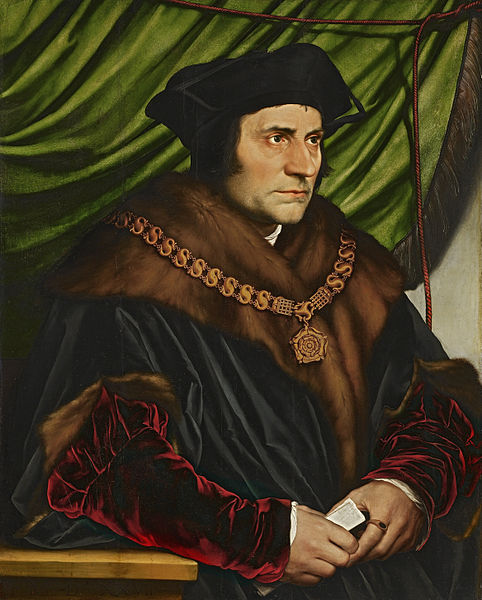
Sir Thomas More, Hans Holbein, the Younger.

Not all Christians are hypocrites all the time. The proof of that statement resides in the Church Triumphant, specifically in the witness of the martyrs for the Faith. Yes indeed, the Communion of Saints is a treasure house of role models of redeemed fallenness.
Take, for instance, St. Thomas More, patron saint of lawyers, martyr for religious freedom, whose Feast we celebrate today. On this day on the Liturgical Calendar, we also celebrate the sainthood of John Cardinal Fisher, another martyr dispatched at the hands of King Henry VIII’s authorities. Admittedly, I don’t know much about St. John Fisher, but Sir Thomas More is one of my favorites. He’s another of a long line of folks who are way smarter than me, but were Catholics nonetheless.
Here’s what the good folks over at Universalis write of him,
He was born in London, the son of a judge, and himself became an eminent lawyer. He married twice, and had four children. He was a humanist and a reformer, and his book, Utopia, depicting a society regulated by the natural virtues, is still read today.
You read that right, but he didn’t get a divorce. His first wife died while giving birth to their child. And yes, he was a humanist, before being a humanist was cool.
Thomas More was a close friend of King Henry VIII. As a judge, he was famous for his incorruptibility and impartiality, and he was made Lord Chancellor – the highest legal position in England – in 1529.
Taking a break from the Universalis bio for a moment, let me share a description of Thomas written by his friend Erasmus,
To begin then with what is least known to you, in stature he is not tall, though not remarkably short. His limbs are formed with such perfect symmetry as to leave nothing to be desired. His complexion is white, his face rather than pale and though by no means ruddy, a faint flush of pink appears beneath the whiteness of his skin. His hair is dark brown or brownish black. The eyes are grayish blue, with some spots, a kind which betokens singular talent, and among the English is considered attractive, whereas Germans generally prefer black.
Proof that even smart folks tend to judge folks on the basis of their appearance. Qoheleth says, “nothing new under the sun.” Erasmus continues,
It is said that none are so free of vice. His countenance is in harmony with his character, being always expressive of an amiable joyousness, and even an incipient laughter and, to speak candidly, it is better framed for gladness than for gravity or dignity, though without any approach to folly or buffoonery. The right shoulder is a little higher than the left, especially when he walks. This is not a defect of birth, but the result of habit such as we often contract. In the rest of his person there is nothing to offend . . .He seems born and framed for friendship, and is a most faithful and enduring friend . . .When he finds any sincere and according to his heart, he so delights in their society and conversation as to place in it the principal charm of life . . .In a word, if you want a perfect model of friendship, you will find it in no one better than in More . . .In human affairs there is nothing from which he does not extract enjoyment, even from things that are most serious. If he converses with the learned and judicious, he delights in their talent, if with the ignorant and foolish, he enjoys their stupidity. He is not even offended by professional jesters. With a wonderful dexterity he accommodates himself to every disposition. As a rule, in talking with women, even with his own wife, he is full of jokes and banter. No one is less led by the opinions of the crowd, yet no one departs less from common sense . . . (see Father Bridgett’s Life, p. 56-60, for the entire letter).
He sounds like what Erasmus called him, “a man for all seasons.” I wonder what kind of beer he likes? Back to the Universalis piece, which starts at the juicy part.
When Henry VIII demanded a divorce from Catherine of Aragon, Thomas More opposed him. He resigned the chancellorship in 1532 and retired from public life; but he could not retire from his reputation, and so it was demanded that he take an oath to support the Act of Succession, which effectively repudiated papal religious authority. He refused, and was imprisoned in the Tower of London. After the execution of John Fisher (ed. who’s Feast we also celebrate today), he was tried on the charge of high treason for denying the King’s supreme headship of the Church, found guilty, and sentenced to death. He went to his execution, on 6 July 1535, with a clear conscience and a light heart; he told the spectators that he was still “the king’s good servant – but God’s first,” and carefully adjusted his beard before he was beheaded.
He wrote a number of devotional works, some of the best of them while in prison awaiting trial. He fought his fight without acrimony, telling his judges that he wished that “we may yet hereafter in Heaven merrily all meet together to everlasting salvation.”
The execution is depicted quite accurately in the Showtime miniseries, The Tudors. Take a look.
Perhaps King Henry had hoped More would have a change of heart, be a hypocrite, knuckle under, beg for his life, and live under his thumb for the rest of his days. As we know, that did not happen. In the Shawshank Redemption, Morgan Freeman’s character consuls us to “get busy living’, or get busy dying.” St. Thomas More chose to get busy living, though he had to die to continue to do so.
Viva Cristo Rey
Related:
Καθολικός διάκονος: Fortnight for what?
Steven G. Greydanus has movie selections that coincide with the Fortnight for Freedom.
Katrina Fernandez on the straw man argument of not being a Christian because of Christian hypocrisy.
Kathy Schiffer shares Peter Singers timely *cough* idea: Catholic Institutions? Just close your doors.
Next Post

June 23, 2013 The Miraculous Incident of Balanced Media Coverage On Same-Sex Marriage...
Browse Our Archives
Select a Category Blog News Conversion Story Culture Learning Living Nature Prayer Uncategorized Working
Select a Month June 2016 May 2016 August 2015 July 2015 June 2015 May 2015 April 2015 March 2015 February 2015 January 2015 December 2014 November 2014 October 2014 September 2014 August 2014 July 2014 June 2014 May 2014 April 2014 March 2014 February 2014 January 2014 December 2013 November 2013 October 2013 September 2013 August 2013 July 2013 June 2013 May 2013 April 2013 March 2013 February 2013 January 2013 December 2012 November 2012 October 2012 September 2012 August 2012 July 2012 June 2012 May 2012 April 2012 March 2012 February 2012 January 2012 December 2011 November 2011 October 2011 September 2011 August 2011 July 2011 June 2011 May 2011 April 2011 March 2011 February 2011 January 2011 December 2010 November 2010 October 2010 September 2010 August 2010 July 2010 June 2010 May 2010 April 2010 March 2010 February 2010 January 2010 December 2009 November 2009 October 2009 September 2009 August 2009
Follow Us!
TAKE THE
Religious Wisdom Quiz
Who was the Roman emperor when Jesus was crucified?
Select your answer to see how you score.
Caligula Tiberius Nero Augustus
Related posts from Why I Am Catholic

Belated Happy Birthday To Blaise Pascal, Unofficial Saint...

Because My Brother Imran Yousef Is An American...

Joe Six-Pack, USMC, With A Few Post-Terrorist Attack...

This Is Why God Invented YouTube...
TRENDING AT PATHEOS Catholic

Rejecting Doom: Christian Hope And Human Action
Christianity is a religion of hope. We are to have hope and...

It’s What Comes From Within Which Matters
One of the most difficult things for us to understand is why...

Why I Choose the Eucharist Over the Sermon
Choose the Eucharist, Not the Sermon What are we supposed to get...

5 Design Elements Found in Spiritually Rooted Homes
Putting Spirituality Into Home Decor Our homes are more than our living...

Credo: A Story of God Told with the...
About 10 years ago, I began to imagine a personal "Credo" that...

The Anatomy of Divine Revelation in Catholic Thought
The claim that God has made Himself known to human beings is...
Ad-Free & Subscriber Log-In Subscription Support
- About Us
- 2026 Calendar
- Videos
- Podcasts
- Library of World Religions
- Faith In Media Tracker
- Advertise With Us
- Write for Us
- Privacy Policy
- Terms of Service
- Do Not Sell My Data
- Contact Us
- Radiant Digital
- Manage Newsletter Subscriptions
- Unsubscribe From Notifications
- Sitemap
Copyright 2008-2026, Patheos. All rights reserved.
Subscription Support Ad-Free & Subscriber Log-In
Follow Patheos