
BuddhistCatholicContemplativeEvangelicalGeneral ChristianHinduJewishLatter-day SaintMuslimNew VisionsProgressive Christian
Beliefs
- Buddhist
- Catholic
- Contemplative
- Evangelical
- General Christian
- Hindu
- Jewish
- Latter-day Saint
- More Voices
- Muslim
- New Visions
- Pagan
- Progressive Christian
Topics
- Religion News
- Food and Religion
- Sports and Religion
- Religious Art
- Religious Music and Entertainment
- Religious Events
- History and Religion
- Style and Religion
- Politics and Religion
- Women in Religion
- Recreation Outdoors and Religion
- Business Finance and Religion
- Careers Workplace and Religion
- Education and Religion
- Family Parenting and Religion
- Health Fitness and Religion
- Home and Religion
- Relationships and Religion
- Technology and Religion
- Travel and Religion
Columnists
- Buddhist Columnists
- Business Finance and Religion Columnists
- Careers Workplace and Religion Columnists
- Catholic Columnists
- Contemplative Columnists
- Education and Religion Columnists
- Evangelists Columnists
- Family Parenting and Religion Columnists
- General Christian Columnists
- Health Fitness and Religion Columnists
- Hindu Columnists
- History and Religion Columnists
- Home and Religion Columnists
- Jewish Columnists
- More Voices Columnists
- Latter Day Columnists
- Muslim Columnists
- New Visions Columnists
- Nonreligious Columnists
- Pagan Columnists
- Politics and Religion Columnists
- Progressive Columnists
- Recreation Outdoors and Religion Columnists
- Relationships and Religion Columnists
- Religion News Columnists
- Religious Art Columnists
- Religious Events Columnists
- Religious Music and Entertainment Columnists
- Sports and Religion Columnists
- Style and Religion Columnists
- Technology and Religion Columnists
- Travel and Religion Columnists
- Women in Religion Columnists
Resource Library
- 2026 Calendar
- Library of World Religions
- The 100 Most Holy Places on Earth
- Patheos Answers
- Podcasts
- Videos
- Faith Leaders Database
- Anglican Episcopalian
- Bahai
- Baptist
- Buddhism
- Christianity
- Confucianism
- Eastern Orthodoxy
- Hinduism
- Holiness and Pentecostal
- ISKCON
- Islam
- Judaism
- Lutheran
- Methodist
- The Church of Jesus Christ of Latter-day Saints
- New Age
- Paganism
- Presbytarian and Reformed
- Protestantism
- Religion Behind the Scenes
- Roman Catholic
- Scientology
- Shia Islam
- Sikhism
- Sufism
- Sunni Islam
- Taoism
- Zen
- See all religions
Research Tools
 Ad-Free & Subscriber Log-In Subscription Support
Ad-Free & Subscriber Log-In Subscription Support
Follow Patheos 

- Trending:
- Forgiveness
- |
- Marriage
- |
- Consciousness
- |
- Death Penalty
- |
- Election
- |
- Halloween
 Why I Am Catholic
-
More
- Home
- For Thoughts on the Trinity By Way of China, Circa 1700…
For Thoughts on the Trinity By Way of China, Circa 1700…
Last updated on: January 24, 2017 at 5:19 pm by Frank Weathers
For Thoughts on the Trinity By Way of China, Circa 1700… 2017-01-24T17:19:24-05:00 Frank Weathers
Patheos Explore the world's faith through different perspectives on religion and spirituality! Patheos has the views of the prevalent religions and spiritualities of the world.
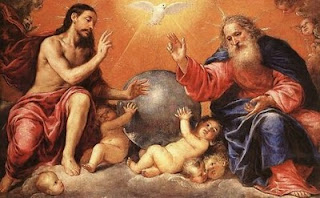
…with a little help from a few other sources.
Today is the Solemnity of the Most Holy Trinity. I have no doubt that my friend Wu Li, SJ was exposed to the Athanasian Creed. Why? Because Wu could not have written the orthodox poems below without having believed in the Mystery of the Triune God. Wu wasn’t just parroting something he had heard from his Jesuit catechists either, you see. It is obvious that he pondered this mystery in his heart.
Like all great poets, Wu parsed the words of the creed and reduced them down in a manner that leaves us better able to have faith in the mystery of God in three Persons. 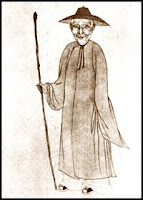 I know it helps me anyway. If through the many posts I have shared on Wu I still haven’t yet convinced you that he is a master poet, then let me step up to the plate one more time and share with you two more poems from his series Singing of the Source and Course of Holy Church. Be prepared for a couple of grand-slam home runs.
A quick note before I share the poems with you. The last time I posted verse penned by Wu, I used a stock portrait of a wise-looking, elderly Chinese man. Jonathan Chaves, the translator of these beautiful lines, sent me the portrait here noting, “there appears to be one authentic portrait of Wu Li, anonymous and probably going back to his lifetime.” The image you see here is what Professor Chaves sent me, and is the actual likeness of Wu Li, my favorite Jesuit priest.
One more bit on the difficulty of using metaphor and analogy to explain the reality of the Trinitarian God. Words often fail. St. Patrick gets grilled here for a humorous example.
And now to Wu’s thoughts on the Trinity,
In the very highest place, deep within a mansion
dwells a family perfectly united, loving and devoted.
Beyond past, beyond present, the three Persons are one;
penetrating heaven, penetrating earth,
the one family is three!Those who are known as “daily improving”
to praise the Spirit are worthy;the world possesses a wondrous flower
fit to protect the holy.On painted walls, year after year,
we contemplate their images:
pure incense rises in orderly spirals
to where their noses inhale.** * **
“The Supreme Ultimate contains three*”—
muddled words indeed!In fact, they start with primal energy
to speak of original chaos.From books of the past, we learned of old
of sincerity, wisdom, and goodness;the mysterious meaning now we understand
of Father, Son, and Holy Spirit.The Persons distinct: close at hand, consider
the flame within the mirror;the Essence is whole: far off, please note
the wheel that graces the sky.The Holy Name has been revealed,
His authority conferred;throughout the world in this human realm,
the sound of the teaching supreme!

The teaching that God is our Father, and creator of all things. That Jesus is our savior, redeemer, and our brother, unworthy as we are of this honor. And finally that the Holy Spirit brings the mystery of both the Father, and the Son, to life in us, and makes us holy, despite our stumbles.
Deo gratias.
*A note on the second poem:
The first line has quote marks around it, “The Supreme Ultimate contains three.” This is because those words (the muddled words indeed!) are a quote from a Confucian idea that Wu Li knew from the Monograph on Pitchpipes and Calendrical Affairs which is a Han Shu formulation that he was very familiar with. The translator of the poems, Jonathan Chaves says, “In describing the Han Shu formulation as “muddled,” Wu Li in his poem intends to distinquish the Christian revelation of God as three distinct persons sharing one essence from the [Confucian] idea of a primal unity self-evolving into the multiplicity of the variegated universe.” So the “muddled” words for Wu were those of Confucian thought. How’s that for interesting? What I find fascinating about Wu Li is that he steps completely out of the mainstream thought of Chinese culture because he grasped the truth of the Way and realized that it was whole, while recognizing that neo-Confucianism was not.
RELATED:
Ignatius Press shares “The Trinity: Three Persons in One Nature” by Frank Sheed. It’s well worth your time (H/T Brandon Vogt).
Pope Francis’s thoughts on the Holy Trinity.



Browse Our Archives
Select a Category Blog News Conversion Story Culture Learning Living Nature Prayer Uncategorized Working
Select a Month June 2016 May 2016 August 2015 July 2015 June 2015 May 2015 April 2015 March 2015 February 2015 January 2015 December 2014 November 2014 October 2014 September 2014 August 2014 July 2014 June 2014 May 2014 April 2014 March 2014 February 2014 January 2014 December 2013 November 2013 October 2013 September 2013 August 2013 July 2013 June 2013 May 2013 April 2013 March 2013 February 2013 January 2013 December 2012 November 2012 October 2012 September 2012 August 2012 July 2012 June 2012 May 2012 April 2012 March 2012 February 2012 January 2012 December 2011 November 2011 October 2011 September 2011 August 2011 July 2011 June 2011 May 2011 April 2011 March 2011 February 2011 January 2011 December 2010 November 2010 October 2010 September 2010 August 2010 July 2010 June 2010 May 2010 April 2010 March 2010 February 2010 January 2010 December 2009 November 2009 October 2009 September 2009 August 2009
Follow Us!
TAKE THE
Religious Wisdom Quiz
Which Jewish festival commemorates the defeat of Haman?
Select your answer to see how you score.
Booths Purim Passover Pentecost
Related posts from Why I Am Catholic

Belated Happy Birthday To Blaise Pascal, Unofficial Saint...

Because My Brother Imran Yousef Is An American...

Joe Six-Pack, USMC, With A Few Post-Terrorist Attack...

This Is Why God Invented YouTube...
TRENDING AT PATHEOS Catholic

Rejecting Doom: Christian Hope And Human Action
Christianity is a religion of hope. We are to have hope and...

It’s What Comes From Within Which Matters
One of the most difficult things for us to understand is why...

Why I Choose the Eucharist Over the Sermon
Choose the Eucharist, Not the Sermon What are we supposed to get...

5 Design Elements Found in Spiritually Rooted Homes
Putting Spirituality Into Home Decor Our homes are more than our living...

Credo: A Story of God Told with the...
About 10 years ago, I began to imagine a personal "Credo" that...

The Anatomy of Divine Revelation in Catholic Thought
The claim that God has made Himself known to human beings is...
Ad-Free & Subscriber Log-In Subscription Support
- About Us
- 2026 Calendar
- Videos
- Podcasts
- Library of World Religions
- Faith In Media Tracker
- Advertise With Us
- Write for Us
- Privacy Policy
- Terms of Service
- Do Not Sell My Data
- Contact Us
- Radiant Digital
- Manage Newsletter Subscriptions
- Unsubscribe From Notifications
- Sitemap
Copyright 2008-2026, Patheos. All rights reserved.
Subscription Support Ad-Free & Subscriber Log-In
Follow Patheos