
BuddhistCatholicContemplativeEvangelicalGeneral ChristianHinduJewishLatter-day SaintMuslimNew VisionsProgressive Christian
Beliefs
- Buddhist
- Catholic
- Contemplative
- Evangelical
- General Christian
- Hindu
- Jewish
- Latter-day Saint
- More Voices
- Muslim
- New Visions
- Pagan
- Progressive Christian
Topics
- Religion News
- Food and Religion
- Sports and Religion
- Religious Art
- Religious Music and Entertainment
- Religious Events
- History and Religion
- Style and Religion
- Politics and Religion
- Women in Religion
- Recreation Outdoors and Religion
- Business Finance and Religion
- Careers Workplace and Religion
- Education and Religion
- Family Parenting and Religion
- Health Fitness and Religion
- Home and Religion
- Relationships and Religion
- Technology and Religion
- Travel and Religion
Columnists
- Buddhist Columnists
- Business Finance and Religion Columnists
- Careers Workplace and Religion Columnists
- Catholic Columnists
- Contemplative Columnists
- Education and Religion Columnists
- Evangelists Columnists
- Family Parenting and Religion Columnists
- General Christian Columnists
- Health Fitness and Religion Columnists
- Hindu Columnists
- History and Religion Columnists
- Home and Religion Columnists
- Jewish Columnists
- More Voices Columnists
- Latter Day Columnists
- Muslim Columnists
- New Visions Columnists
- Nonreligious Columnists
- Pagan Columnists
- Politics and Religion Columnists
- Progressive Columnists
- Recreation Outdoors and Religion Columnists
- Relationships and Religion Columnists
- Religion News Columnists
- Religious Art Columnists
- Religious Events Columnists
- Religious Music and Entertainment Columnists
- Sports and Religion Columnists
- Style and Religion Columnists
- Technology and Religion Columnists
- Travel and Religion Columnists
- Women in Religion Columnists
Resource Library
- 2026 Calendar
- Library of World Religions
- The 100 Most Holy Places on Earth
- Patheos Answers
- Podcasts
- Videos
- Faith Leaders Database
- Anglican Episcopalian
- Bahai
- Baptist
- Buddhism
- Christianity
- Confucianism
- Eastern Orthodoxy
- Hinduism
- Holiness and Pentecostal
- ISKCON
- Islam
- Judaism
- Lutheran
- Methodist
- The Church of Jesus Christ of Latter-day Saints
- New Age
- Paganism
- Presbytarian and Reformed
- Protestantism
- Religion Behind the Scenes
- Roman Catholic
- Scientology
- Shia Islam
- Sikhism
- Sufism
- Sunni Islam
- Taoism
- Zen
- See all religions
Research Tools
 Ad-Free & Subscriber Log-In Subscription Support
Ad-Free & Subscriber Log-In Subscription Support
Follow Patheos 

- Trending:
- Forgiveness
- |
- Marriage
- |
- Consciousness
- |
- Death Penalty
- |
- Election
- |
- Halloween
 Why I Am Catholic
-
More
- Home
- For All the Saints: Perpetua and Felicitas
For All the Saints: Perpetua and Felicitas
Last updated on: February 4, 2015 at 9:27 am by Frank Weathers
For All the Saints: Perpetua and Felicitas 2015-02-04T09:27:28-05:00 Frank Weathers
Patheos Explore the world's faith through different perspectives on religion and spirituality! Patheos has the views of the prevalent religions and spiritualities of the world.
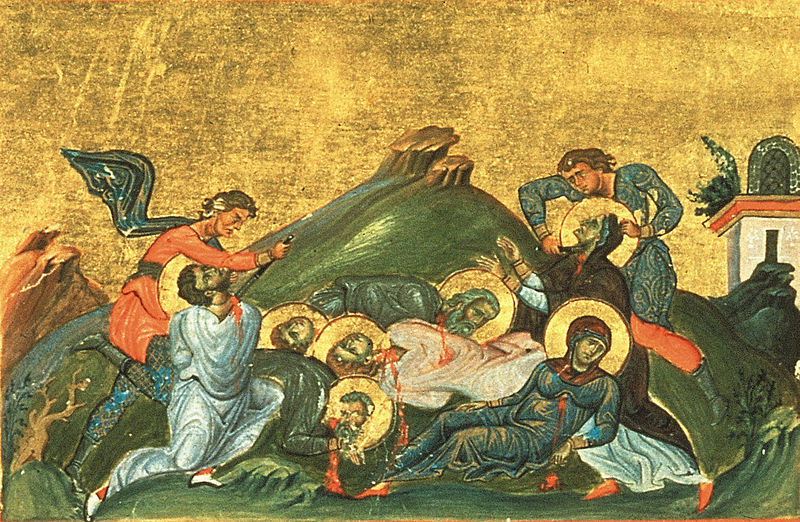
Perpetua, Felicitas, Revocatus, Saturninus and Secundulus (Public Domain)
Today is the Feast of Sts. Perpetua and Felicitas. I drummed up a few tidbits about them from the YIMCatholic Bookshelf.
The account below is related by Doctor of the Church St. Alfonso Maria de’ Liguori, from his book, Victories of the Martyrs.
This account includes the testimony of St. Perpetua herself. All you catechumens out there take note: the five catechumens were baptized in prison prior to being thrown to the wild animals so…don’t worry. If necessary, see, you won’t have to wait for the Easter Vigil to be baptized and confirmed. Priests make housecalls, after all.
SS. Perpetua and Felicitas of Carthage, with Others
March 7.
St. Augustine makes frequent and honorable mention of these saints in his works, and was wont to hold them up to the people as examples of fidelity to Jesus Christ. The Emperor Severus published an edict, commanding all Christians who refused to sacrifice to the gods to be put to death; whereupon Minutius, the proconsul of Africa, caused five young persons to be arrested at Carthage, who were as yet catechumens, and, together with them, Sts. Perpetua and Felicitas, Sts. Saturninus and Secundums.”
Perpetua was a young woman, only twenty-two years of age, who led a very devout life, was married, and had an only son. Felicitas was still younger, but also married, and a most exemplary person. The martyrs were kept for some time in a private house, guarded by soldiers; during which time the father of St. Perpetua came to see her, and, being a pagan, used all his endeavors to make her abandon the faith. In the original Acts of these martyrs we find that the occurrences which took place up to the eve of their martyrdom were written by St. Perpetua herself. The principal facts are the following:
“My father,” writes the saint, “used all his endeavors to pervert me; I resolutely answered, ‘Father, I am a Christian.’ He instantly threw himself upon me in a rage, as if to tear out my eyes, and used the most injurious language. A few days afterwards we all received the holy baptism, and were led to the public prison, where I was horrified by the darkness, the noisome smell, and the great heat occasioned by the number of prisoners. I had the happiness to have my son brought to me here, which greatly consoled me.
My brother came to see me, and desired me to pray to the Lord to let me know whether I was to obtain the crown of martyrdom. I accordingly placed myself in prayer, and saw, in a vision, a golden ladder which reached to the heavens; it was very narrow, and to the sides were fixed sharp knives and iron spikes. At the foot of this ladder was a dragon, who appeared ready to devour those that would attempt to mount it.
The first that went up was a certain Christian named Saturus, who invited me to follow him. I ascended, and found myself in a spacious garden, where I met a man of very fine aspect, who said to me: ‘Thou art welcome, my daughter.’ After this vision I knew that we were all destined to suffer martyrdom, and I told my brother so.
“My father came again to see me at the prison, and throwing himself at my feet in a flood of tears; ‘Daughter,’ he said, ‘have pity on me, a poor old man, that am thy father; have pity, at least, on thy child, and bring not ruin upon us all by thy obstinacy.’ I was pierced with grief, but remained immovable in my resolution.
“On the following day I was brought before the auditor, Hilarian, who, by reason of the death of the proconsul, acted as judge. My father appeared with me, holding my son in his arms, whereupon the judge said: ‘Perpetua, have pity on thy father and on thy son— sacrifice to the gods.’ I answered that I was a Christian, and that we were all ready to die for our faith. The judge then condemned us to be devoured by wild beasts.
“We received the sentence with joy, and were brought back to prison, where we were met by my father, who tearing his hair and his beard, threw himself upon his face on the earth, lamenting that he lived to see that day. He once endeavored to pull me off the platform, but the judge commanded him to be beaten off, and he received a blow with a stick, at which I was much grieved; but the Lord continued to grant me strength.”
Secundulus died in prison, of his sufferings, and Saturus had already obtained the crown. Felicitas desired to suffer with the rest, but she was pregnant, and the law forbade women to be put to death in that state. Her companions therefore prayed for her, and on that very day she was delivered of a daughter. The saint moaned by reason of her pains, and one of the guards said to her: “Dost thou moan? What wilt thou do when thou shalt be devoured by wild beasts?” She answered: “I now suffer by myself; but then I shall have Jesus Christ with me, and by his grace I will endure all things for his sake.”

Sts. Perpetua and Felicitas were wrapped in nets and exposed to a mad cow. St. Perpetua was first attacked, and having been tossed in the air, she fell upon her back. Then sitting up, she perceived her clothes torn, and was endeavoring to cover herself, when she was again knocked down; but recovering herself, she stretched forth her hand to raise St. Felicitas, whom she perceived prostrate upon the ground, much hurt.
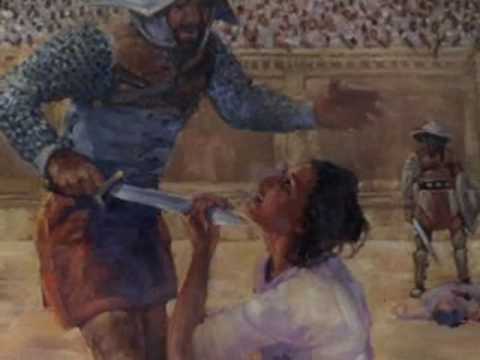
The populace were at length moved to compassion, and the two saints were led into the centre of the amphitheatre, and despatched by the gladiators. Thus did they receive, with their companions, the heavenly crown, on the 7th March, in the year 203.
St. Augustine cites the Acts of their martyrdom, and Tertullian and St. Fulgentius have passed the most magnificent encomiums on Sts. Perpetua and Felicitas. They are mentioned also in the Canon of the Mass. Their relics were brought to Rome.
****
But wait, there’s more!
St. Perpetua’s vision of Purgatory
The Acts state that Saturus suffered with the rest, and also relate a vision with which he was honored. We are assured by the same venerable authority, that St. Perpetua was favored with two other most important visions. She had a young brother, named Dinocrates, who died when he was only seven years of age, of a most hideous ulcer in the face. She recollected his death during her imprisonment; and having prayed for his repose, saw him in a vision, with the ulcer on his face, having a most squalid appearance, and endeavoring to drink from a vessel which he could not reach.
After her vision she knew that her brother was in pain, and continued to pray fervently for his relief. She was accordingly favored with a second vision, in which she saw him quite clean, refreshing himself with the water, and retaining only a scar where the ulcer had formerly been. “I knew,” she says, “from this vision, that he had been released from his pain.”
It has been thought worth while to mention these visions of St. Perpetua, as they must be most acceptable to the reader, since they show that the existence of a place of temporary punishment after death, and prayers for the departed, were doctrines of the Church as early as the year 203. Ruinart, in his ” Admonitio in passionem, SS. Perpet. et Felic, num. 6,” refutes the opinion of Valesius, that the compiler of these Acts was a Montanist, because these heretics pretended to have many supernal illustrations, and like the fanatics of our own days, extraordinary impulses from the Holy Spirit.
He also mentions a letter written to Valesius, wherein the writer endeavors to prove from his style in similar productions that Tertullian was the original compiler. Indeed, St. Perpetua herself has been most unjustly charged with Montanism by the enemies of Catholic doctrine, but the imputation is as injudicious as it is unjust, since it establishes beyond a doubt the authenticity of the Acts, which could not be denied, and palpably manifests the straits to which heresy is driven. How could the Church rank as a martyr a woman belonging to a sect universally condemned for their blasphemous errors, and loathed and abhorred for their enormous extravagances?
St. Augustine himself, although he declares (Lib. 1, de anima, ad Renatum, et Lib. 3, ad Vincent.) that the Revelations of St. Perpetua are not to be placed in the Canon of Scripture, nevertheless styles them “Divine Revelations,” and calls upon the faithful to honor them.
You may read more about Sts. Perpetua and Felicitas at the Catholic Encyclopedia. Also of interest, the complete account of the Martyrdom of Perpetua and Felicitas, as translated by Rev. R.E. Wallis, Ph.D.


Previous Post

March 7, 2013
Foreign Made Ball Bearings Defunded, But the HHS Mandate is Paid For
Browse Our Archives
Select a Category Blog News Conversion Story Culture Learning Living Nature Prayer Uncategorized Working
Select a Month June 2016 May 2016 August 2015 July 2015 June 2015 May 2015 April 2015 March 2015 February 2015 January 2015 December 2014 November 2014 October 2014 September 2014 August 2014 July 2014 June 2014 May 2014 April 2014 March 2014 February 2014 January 2014 December 2013 November 2013 October 2013 September 2013 August 2013 July 2013 June 2013 May 2013 April 2013 March 2013 February 2013 January 2013 December 2012 November 2012 October 2012 September 2012 August 2012 July 2012 June 2012 May 2012 April 2012 March 2012 February 2012 January 2012 December 2011 November 2011 October 2011 September 2011 August 2011 July 2011 June 2011 May 2011 April 2011 March 2011 February 2011 January 2011 December 2010 November 2010 October 2010 September 2010 August 2010 July 2010 June 2010 May 2010 April 2010 March 2010 February 2010 January 2010 December 2009 November 2009 October 2009 September 2009 August 2009
Follow Us!
TAKE THE
Religious Wisdom Quiz
What does the Hebrew word 'Adonai' mean?
Select your answer to see how you score.
Savior Messiah Holy One Lord/Master
Related posts from Why I Am Catholic

Belated Happy Birthday To Blaise Pascal, Unofficial Saint...

Because My Brother Imran Yousef Is An American...

Joe Six-Pack, USMC, With A Few Post-Terrorist Attack...

This Is Why God Invented YouTube...
TRENDING AT PATHEOS Catholic

The Parable Of The Sower And The Word...
One of Christ’s most famous parables is that of the sower who...

Rejecting Doom: Christian Hope And Human Action
Christianity is a religion of hope. We are to have hope and...

Why I Choose the Eucharist Over the Sermon
Choose the Eucharist, Not the Sermon What are we supposed to get...

5 Design Elements Found in Spiritually Rooted Homes
Putting Spirituality Into Home Decor Our homes are more than our living...

Credo: A Story of God Told with the...
About 10 years ago, I began to imagine a personal "Credo" that...

The Anatomy of Divine Revelation in Catholic Thought
The claim that God has made Himself known to human beings is...
Ad-Free & Subscriber Log-In Subscription Support
- About Us
- 2026 Calendar
- Videos
- Podcasts
- Library of World Religions
- Faith In Media Tracker
- Advertise With Us
- Write for Us
- Privacy Policy
- Terms of Service
- Do Not Sell My Data
- Contact Us
- Radiant Digital
- Manage Newsletter Subscriptions
- Unsubscribe From Notifications
- Sitemap
Copyright 2008-2026, Patheos. All rights reserved.
Subscription Support Ad-Free & Subscriber Log-In
Follow Patheos