
BuddhistCatholicContemplativeEvangelicalGeneral ChristianHinduJewishLatter-day SaintMuslimNew VisionsProgressive Christian
Beliefs
- Buddhist
- Catholic
- Contemplative
- Evangelical
- General Christian
- Hindu
- Jewish
- Latter-day Saint
- More Voices
- Muslim
- New Visions
- Pagan
- Progressive Christian
Topics
- Religion News
- Food and Religion
- Sports and Religion
- Religious Art
- Religious Music and Entertainment
- Religious Events
- History and Religion
- Style and Religion
- Politics and Religion
- Women in Religion
- Recreation Outdoors and Religion
- Business Finance and Religion
- Careers Workplace and Religion
- Education and Religion
- Family Parenting and Religion
- Health Fitness and Religion
- Home and Religion
- Relationships and Religion
- Technology and Religion
- Travel and Religion
Columnists
- Buddhist Columnists
- Business Finance and Religion Columnists
- Careers Workplace and Religion Columnists
- Catholic Columnists
- Contemplative Columnists
- Education and Religion Columnists
- Evangelists Columnists
- Family Parenting and Religion Columnists
- General Christian Columnists
- Health Fitness and Religion Columnists
- Hindu Columnists
- History and Religion Columnists
- Home and Religion Columnists
- Jewish Columnists
- More Voices Columnists
- Latter Day Columnists
- Muslim Columnists
- New Visions Columnists
- Nonreligious Columnists
- Pagan Columnists
- Politics and Religion Columnists
- Progressive Columnists
- Recreation Outdoors and Religion Columnists
- Relationships and Religion Columnists
- Religion News Columnists
- Religious Art Columnists
- Religious Events Columnists
- Religious Music and Entertainment Columnists
- Sports and Religion Columnists
- Style and Religion Columnists
- Technology and Religion Columnists
- Travel and Religion Columnists
- Women in Religion Columnists
Resource Library
- 2026 Calendar
- Library of World Religions
- The 100 Most Holy Places on Earth
- Patheos Answers
- Podcasts
- Videos
- Faith Leaders Database
- Anglican Episcopalian
- Bahai
- Baptist
- Buddhism
- Christianity
- Confucianism
- Eastern Orthodoxy
- Hinduism
- Holiness and Pentecostal
- ISKCON
- Islam
- Judaism
- Lutheran
- Methodist
- The Church of Jesus Christ of Latter-day Saints
- New Age
- Paganism
- Presbytarian and Reformed
- Protestantism
- Religion Behind the Scenes
- Roman Catholic
- Scientology
- Shia Islam
- Sikhism
- Sufism
- Sunni Islam
- Taoism
- Zen
- See all religions
Research Tools
 Ad-Free & Subscriber Log-In Subscription Support
Ad-Free & Subscriber Log-In Subscription Support
Follow Patheos 

- Trending:
- Forgiveness
- |
- Marriage
- |
- Consciousness
- |
- Death Penalty
- |
- Election
- |
- Halloween
 Why I Am Catholic
-
More
- Home
- A Reminder: Why the Bishops Stand Against the HHS Mandate
A Reminder: Why the Bishops Stand Against the HHS Mandate
Last updated on: April 1, 2015 at 9:38 am by Frank Weathers
A Reminder: Why the Bishops Stand Against the HHS Mandate 2015-04-01T09:38:41-05:00 Frank Weathers
Patheos Explore the world's faith through different perspectives on religion and spirituality! Patheos has the views of the prevalent religions and spiritualities of the world.
To see the future of the USCCB’s discussion of the HHS Mandate, we need to turn back to the both the recent and the distant past. Just last year, on March 14th, 2012, the Bishops published a paper entitled, United for Religious Freedom. Timothy Cardinal Dolan, in his response to the February 1 rule proposal by the Administration, referred to that document and quoted liberally from it.
Here’s a brief refresher,
…we wish to clarify what this debate is—and is not—about. This is not about access to contraception, which is ubiquitous and inexpensive, even when it is not provided by the Church’s hand and with the Church’s funds. This is not about the religious freedom of Catholics only, but also of those who recognize that their cherished beliefs may be next on the block. This is not about the Bishops’ somehow “banning contraception,” when the U.S. Supreme Court took that issue off the table two generations ago. Indeed, this is not about the Church wanting to force anybody to do anything; it is instead about the federal government forcing the Church—consisting of its faithful and all but a few of its institutions—to act against Church teachings. This is not a matter of opposition to universal health care, which has been a concern of the Bishops’ Conference since 1919, virtually at its founding. This is not a fight we want or asked for, but one forced upon us by government on its own timing. Finally, this is not a Republican or Democratic, a conservative or liberal issue; it is an American issue.
So what is it about?
An unwarranted government definition of religion.
A mandate to act against our teachings.
A violation of personal civil rights.
Read the rest for all the details on the above three problems.
Now, it should come as no surprise that Catholics across the political spectrum disagree amongst each other as to whether the latest HHS Mandate proposal is good enough to live under, or not good enough. There are those who argue that this mandate is the fault of the bishops lax teaching on the truths of human sexuality to the faithful, and there is something to be said for this assertion. It’s easy, as a fellow who wasn’t a Catholic for most of my life, to look back and think to myself, “if I only knew then, what I know now, perhaps things would have been different.”
At the same time, I clearly realize that the United States has not been, and may never be (God knows, not me), a Catholic country. She is a country who was birthed as a Judeo-Christian creature, however, and the shepherds of the Church are right to point this fact out in their latest statement regarding the mandate. And this lineage of hers must be respected, not just as a physical characteristic, like being born with black hair, or with blue eyes, but as a characteristic that nevertheless cannot be undone by the whim or caprice of a lawmakers’ pen.
I think the bishops understand this, and I think most lay people do too. Those who claim that the Administration is “ruling by decree” are putting it too simply, and quite frankly, they are ignoring the fact that the government is seeking commentary on the proposed rule. During the first go around, some 200,000 comments were received by the HHS, and the current proposal evolved as a result.
As noted in the USSCB press release on February 7, 2013,
The Feb. 1 Notice of Proposed Rulemakingfrom the U.S. Department of Health and Human Services related to the Patient Protection and Affordable Care Act (PPACA) shows some movement by the Administration but falls short of addressing U.S. bishops’ concerns.
Cardinal Dolan ended his statement hopefully, and with wisdom, as follows,
Throughout the past year, we have been assured by the Administration that we will not have to refer, pay for, or negotiate for the mandated coverage.We remain eager for the Administration to fulfill that pledge and to find acceptable solutions—we will affirm any genuine progress that is made, and we will redouble our efforts to overcome obstacles or setbacks.Thus, we welcome and will take seriously the Administration’s invitation to submit our concerns through formal comments, and we will do so in the hope that an acceptable solution can be found that respects the consciences of all.
I don’t think these discussions will be delayed and drag out for years on end, as there are too many court cases outstanding, and more being filed every week. I don’t think Catholics will be forced into a sort of “dhimmitude” either, as is being discussed by folks at First Things, and Commonweal.
What I do think we will see is a real world drama on how the different schools of law, natural law on the USCCB’s (and other plaintiffs) side, fair against the positive law positions of the Administration, as they either work out an acceptable compromise, or if they argue their cases to the Supreme Court, if it comes down to that, from these two different schools of thought.
Below is a snippet from the citation of the Internet Encyclopedia of Philosophy (a peer reviewed, on-line encyclopedia hosted by the University of Tennessee, Martin) on the political philosophy of St. Thomas Aquinas. The editors note that though Aquinas did not have a summa for politics (he died too young to approach the subject comprehensively), the Common Doctor’s thoughts on the matter should help us understand why the Church thinks the current proposal “falls short,” and how the Church sees the landscape when approaching this matter.
In his celebrated Summa Theologiae, for instance, Aquinas engages in long discussions of law, the virtue of justice, the common good, economics, and the basis of morality. Even though not presented in the context of a comprehensive political teaching, these texts provide a crucial insight into Aquinas’ understanding of politics and the place of political philosophy within his thought.
Aquinas’ celebrated doctrine of natural law no doubt plays a central role in his moral and political teaching. According to Aquinas, everything in the terrestrial world is created by God and endowed with a certain nature that defines what each sort of being is in its essence. A thing’s nature is detectable not only in its external appearance, but also and more importantly through the natural inclinations which guide it to behave in conformity with the particular nature it has. As Aquinas argues, God’s authorship and active role in prescribing and sustaining the various natures included in creation may rightfully be called a law. After defining law as “an ordinance of reason for the common good, made by someone who has care of the community, and promulgated.” (ST, I-II, 90.4), Aquinas explains that the entire universe is governed by the supreme lawgiver par excellence: “Granted that the world is ruled by Divine Providence…the whole community of the universe is governed by Divine Reason.” (ST, I-II, 91.1). Even though the world governed by God’s providence is temporal and limited, Aquinas calls the law that governs it the “eternal law.” Its eternal nature comes not from that to which it applies, but rather from whom the law is derived, namely, God. As Aquinas explains, “the very idea of the government of things in God the Ruler of the universe, has the nature of a law. And since Divine Reason’s conception of things is not subject to time but is eternal, according to Prov. viii, 23…this kind of law must be called eternal.” (Ibid.).
In the vast majority of cases, God governs his subjects through the eternal law without any possibility that that law might be disobeyed. This, of course, is because most beings in the universe (or at least in the natural world) do not possess the rational ability to act consciously in a way that is contrary to the eternal law implanted in them. Completely unique among natural things, however, are humans who, although completely subject to divine providence and the eternal law, possess the power of free choice and therefore have a radically different relation to that law. As Aquinas explains, “among all others, the rational creature is subject to Divine Providence in the most excellent way, in so far as it partakes of a share of providence, by being provident both for itself, and for others. Wherefore, it has a share of the Eternal Reason, whereby it has a natural inclination to its proper act and end.” (ST, I-II, 91.2). Because the rational creature’s relation to the eternal law is so different from that of any other created thing, Aquinas prefers to call the law that governs it by a different name. Instead of saying that humans are under the eternal law, therefore, he says they are under the natural law, and yet “the natural law is nothing else than the rational creature’s participation of the eternal law” (Ibid.). Another, equally accurate, way of stating Aquinas’ position is that the natural law is the eternal law as it applies to human beings.
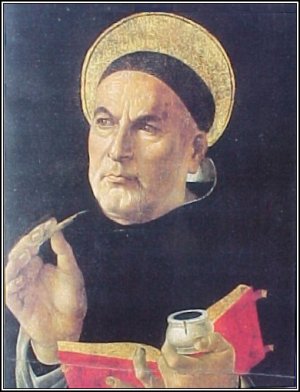
Don’t get bored and leave yet, dear reader! We’re getting to the good part, where the stand against the violation of conscience is made clear.
As the “rule and measure” of human behavior, the natural law provides the only possible basis for morality and politics. Simply stated, the natural law guides human beings through their fundamental inclinations toward the natural perfection that God, the author of the natural law, intends for them. As we have seen, however, the human subjugation to the eternal law (called the natural law) is always concomitant with a certain awareness the human subject has of the law binding him. This awareness is crucial in Aquinas’ view. Since one of the essential components of law is to be promulgated, the natural law would lose its legal character if human beings did not have the principles of that law instilled in their minds (ST, I-II, 90.4 ad 1). For this reason Aquinas considers the natural law to be a habit, not in itself, but because the principles (or precepts) of the natural law are naturally held in our minds by means of an intellectual habit, which Aquinas calls synderesis.
Synderisis denotes a natural knowledge held by all people instructing them as to the fundamental moral requirements of their human nature. As Aquinas explains, just as speculative knowledge requires there to be certain principles from which one can draw further conclusions, so also practical and moral knowledge presupposes an understanding of fundamental practical precepts from which more concrete moral directives may be derived. Whereas Aquinas calls the habit by which human beings understand the first moral principles (which are also the first principles of the natural law) synderesis (ST, Ia, 79.12), he calls the act by which one applies that understanding to concrete situations conscience (ST, Ia, 79.13). Therefore, by means of synderesis a man would know that the act of adultery is morally wrong and contrary to the natural law. By an act of conscience he would reason that intercourse with this particular woman that is not his wife is an act of adultery and should therefore be avoided. Thus understood, the natural law includes principles that are universally accessible regardless of time, place, or culture. In Aquinas’ words, it is the same in all humans (ST, I-II, 94.4), unchangeable (ST, I-II, 94.5), and cannot be abolished from the hearts of men (ST, I-II, 94.6). It is in light of this teaching that Aquinas interprets St. Paul’s argument that the “Gentiles who have not the law do by nature what the law requires, they are a law to themselves, even though they do not have the law. They show that what the law requires is written on their hearts.” (Romans 2:14-16).
That’s enough for today, class. Still, do spend some time looking at the HHS Mandate through the lens of Thomism. Doing so will serve us well while this drama plays out. Because as St. Thomas noted in the Lenten homilies he delivered in the year he departed this life (1273),
Some there are, however, who , although they believe that nature is governed and ordained by God, deny that human actions come under His Providence. They believe, in fact, that human actions are not disposed by God. Their reason is that they see that in this world the good suffer and the wicked prosper, which would seem to argue against God’s Providence in regard to mankind. Hence the words of Job are offered to apply to this view: “He walks about the poles of heaven; nor doth He consider our things.”[cf Job 22:14] But this is very foolish. They behave like one who knows nothing about medicine, and who, seeing the physician prescribing water for one invalid and wine for another (according to the requirements of the medical art), believes this to be done haphazardly, whereas it is the medical art which with good reason prescribes water for the one and wine for the other.
It is the same with God, who with good cause and by His Providence disposes such things as are necessary to man. Thus He afflicts some good men and allows certain wicked men to prosper. Anyone who believes this to be the result of chance is (and is reputed to be) a fool, since the sole cause of his conviction is that he does not know the art and reason of the divine disposition: “Would that he might show thee the secrets of wisdom, and that His law is manifold.” [Job 11:6]
We must, therefore, firmly believe that God governs and regulates not only all nature, but also the acts of men.
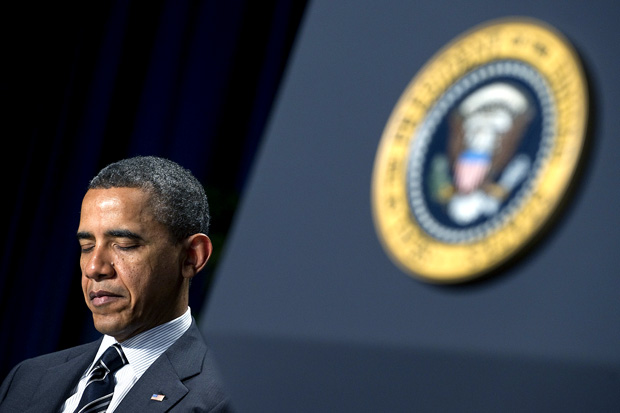
Surely, the President of the United States would agree. Otherwise, in the recently concluded National Prayer Breakfast, he never would have said,
…it’s a chance to step back for a moment, for us to come together as brothers and sisters and seek God’s face together. At a time when it’s easy to lose ourselves in the rush and clamor of our own lives, or get caught up in the noise and rancor that too often passes as politics today, these moments of prayer slow us down. They humble us. They remind us that no matter how much responsibility we have, how fancy our titles, how much power we think we hold, we are imperfect vessels. We can all benefit from turning to our Creator, listening to Him. Avoiding phony religiosity, listening to Him.
Amen.
Previous Post

February 8, 2013
Cardinal George on the Law and Politics of the HHS Mandate
Next Post
February 9, 2013 The Year of the Snake Coincides with the Year of Faith?
Browse Our Archives
Select a Category Blog News Conversion Story Culture Learning Living Nature Prayer Uncategorized Working
Select a Month June 2016 May 2016 August 2015 July 2015 June 2015 May 2015 April 2015 March 2015 February 2015 January 2015 December 2014 November 2014 October 2014 September 2014 August 2014 July 2014 June 2014 May 2014 April 2014 March 2014 February 2014 January 2014 December 2013 November 2013 October 2013 September 2013 August 2013 July 2013 June 2013 May 2013 April 2013 March 2013 February 2013 January 2013 December 2012 November 2012 October 2012 September 2012 August 2012 July 2012 June 2012 May 2012 April 2012 March 2012 February 2012 January 2012 December 2011 November 2011 October 2011 September 2011 August 2011 July 2011 June 2011 May 2011 April 2011 March 2011 February 2011 January 2011 December 2010 November 2010 October 2010 September 2010 August 2010 July 2010 June 2010 May 2010 April 2010 March 2010 February 2010 January 2010 December 2009 November 2009 October 2009 September 2009 August 2009
Follow Us!
TAKE THE
Religious Wisdom Quiz
Who touched Jesus' cloak and was healed of bleeding?
Select your answer to see how you score.
Jairus' daughter Martha A centurion A woman in the crowd
Related posts from Why I Am Catholic

Belated Happy Birthday To Blaise Pascal, Unofficial Saint...

Because My Brother Imran Yousef Is An American...

Joe Six-Pack, USMC, With A Few Post-Terrorist Attack...

This Is Why God Invented YouTube...
TRENDING AT PATHEOS Catholic

Rejecting Doom: Christian Hope And Human Action
Christianity is a religion of hope. We are to have hope and...

It’s What Comes From Within Which Matters
One of the most difficult things for us to understand is why...

Why I Choose the Eucharist Over the Sermon
Choose the Eucharist, Not the Sermon What are we supposed to get...

5 Design Elements Found in Spiritually Rooted Homes
Putting Spirituality Into Home Decor Our homes are more than our living...

Credo: A Story of God Told with the...
About 10 years ago, I began to imagine a personal "Credo" that...

The Anatomy of Divine Revelation in Catholic Thought
The claim that God has made Himself known to human beings is...
Ad-Free & Subscriber Log-In Subscription Support
- About Us
- 2026 Calendar
- Videos
- Podcasts
- Library of World Religions
- Faith In Media Tracker
- Advertise With Us
- Write for Us
- Privacy Policy
- Terms of Service
- Do Not Sell My Data
- Contact Us
- Radiant Digital
- Manage Newsletter Subscriptions
- Unsubscribe From Notifications
- Sitemap
Copyright 2008-2026, Patheos. All rights reserved.
Subscription Support Ad-Free & Subscriber Log-In
Follow Patheos