
BuddhistCatholicContemplativeEvangelicalGeneral ChristianHinduJewishLatter-day SaintMuslimNew VisionsProgressive Christian
Beliefs
- Buddhist
- Catholic
- Contemplative
- Evangelical
- General Christian
- Hindu
- Jewish
- Latter-day Saint
- More Voices
- Muslim
- New Visions
- Pagan
- Progressive Christian
Topics
- Religion News
- Food and Religion
- Sports and Religion
- Religious Art
- Religious Music and Entertainment
- Religious Events
- History and Religion
- Style and Religion
- Politics and Religion
- Women in Religion
- Recreation Outdoors and Religion
- Business Finance and Religion
- Careers Workplace and Religion
- Education and Religion
- Family Parenting and Religion
- Health Fitness and Religion
- Home and Religion
- Relationships and Religion
- Technology and Religion
- Travel and Religion
Columnists
- Buddhist Columnists
- Business Finance and Religion Columnists
- Careers Workplace and Religion Columnists
- Catholic Columnists
- Contemplative Columnists
- Education and Religion Columnists
- Evangelists Columnists
- Family Parenting and Religion Columnists
- General Christian Columnists
- Health Fitness and Religion Columnists
- Hindu Columnists
- History and Religion Columnists
- Home and Religion Columnists
- Jewish Columnists
- More Voices Columnists
- Latter Day Columnists
- Muslim Columnists
- New Visions Columnists
- Nonreligious Columnists
- Pagan Columnists
- Politics and Religion Columnists
- Progressive Columnists
- Recreation Outdoors and Religion Columnists
- Relationships and Religion Columnists
- Religion News Columnists
- Religious Art Columnists
- Religious Events Columnists
- Religious Music and Entertainment Columnists
- Sports and Religion Columnists
- Style and Religion Columnists
- Technology and Religion Columnists
- Travel and Religion Columnists
- Women in Religion Columnists
Resource Library
- 2026 Calendar
- Library of World Religions
- The 100 Most Holy Places on Earth
- Patheos Answers
- Podcasts
- Videos
- Faith Leaders Database
- Anglican Episcopalian
- Bahai
- Baptist
- Buddhism
- Christianity
- Confucianism
- Eastern Orthodoxy
- Hinduism
- Holiness and Pentecostal
- ISKCON
- Islam
- Judaism
- Lutheran
- Methodist
- The Church of Jesus Christ of Latter-day Saints
- New Age
- Paganism
- Presbytarian and Reformed
- Protestantism
- Religion Behind the Scenes
- Roman Catholic
- Scientology
- Shia Islam
- Sikhism
- Sufism
- Sunni Islam
- Taoism
- Zen
- See all religions
Research Tools
 Ad-Free & Subscriber Log-In Subscription Support
Ad-Free & Subscriber Log-In Subscription Support
Follow Patheos 

- Trending:
- Forgiveness
- |
- Marriage
- |
- Consciousness
- |
- Death Penalty
- |
- Election
- |
- Halloween
 Why I Am Catholic
-
More
- Home
- For Thoughts on Atheism by the Father of Empiricism UPDATED
For Thoughts on Atheism by the Father of Empiricism UPDATED
Last updated on: January 22, 2015 at 7:56 pm by Frank Weathers
For Thoughts on Atheism by the Father of Empiricism UPDATED 2015-01-22T19:56:24-05:00 Frank Weathers
Patheos Explore the world's faith through different perspectives on religion and spirituality! Patheos has the views of the prevalent religions and spiritualities of the world.
Remember my affection for the Harvard Classics, the Five Foot Shelf of Books? Admittedly, I haven’t looked them over much since I became a Catholic. Not because I’ve outgrown them, but because there have been far too many other books to occupy my time since the spring of 2008. Mostly stuff from authors whose names begin with “S”, as St. Philip Neri suggested when he counseled that reading the works of the saints is profitable.
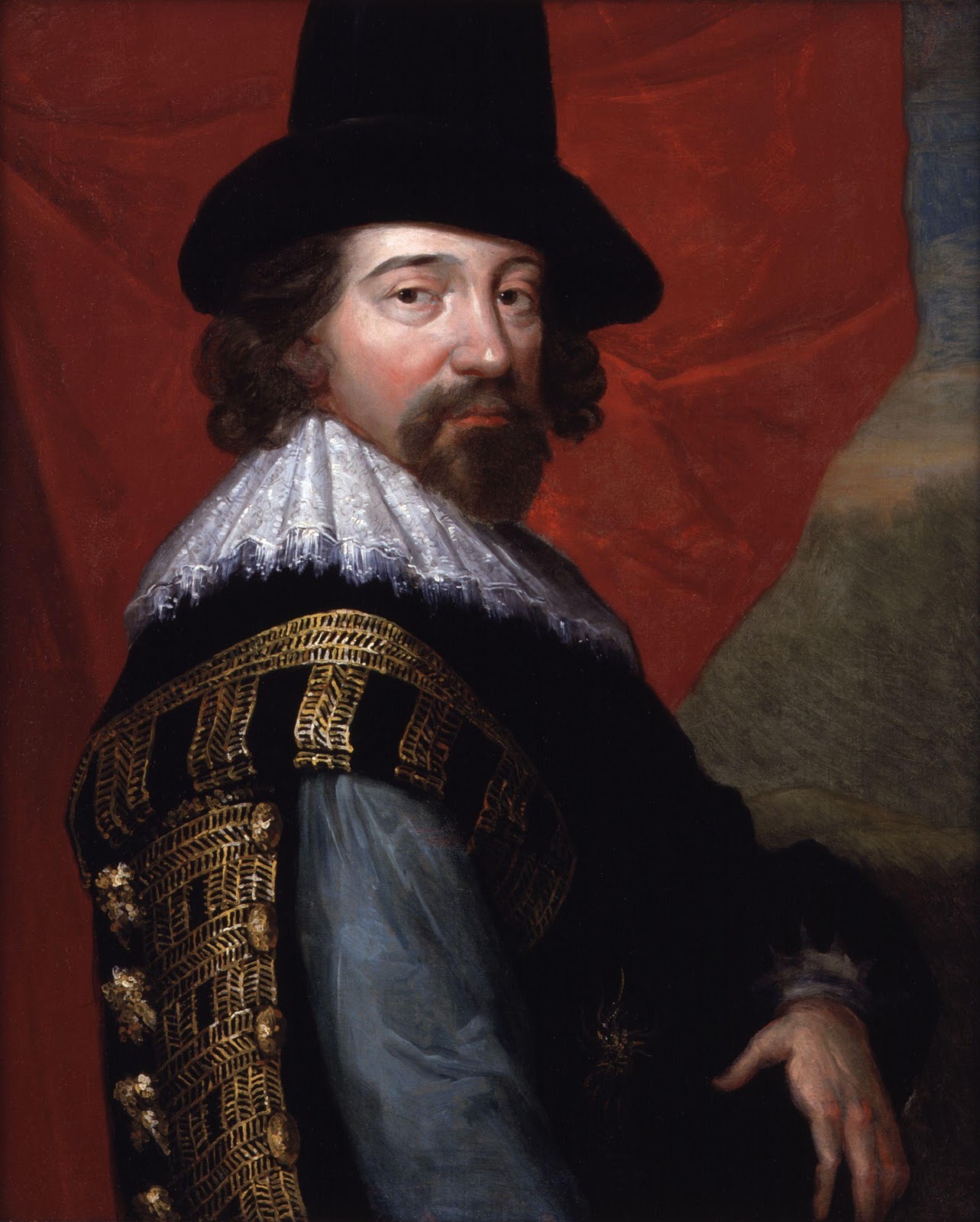
But I dipped a toe back into the HCFFSB water today and found these thoughts of Sir Francis Bacon. I found them right here in volume #3, which Bacon shares with John Milton’s Areopagitica (?) and Tractate on Education (yawn) and a Sir Thomas Browe’s Religio Medici (again, I have no idea but it must be important or it wouldn’t be here!).
Sure, you’ll argue, Bacon wasn’t a Catholic. However, as the Catholic Encyclopedia citation notes,
Bacon’s position in regard to revelation is well known. Reason can attain no positive knowledge of God. This must come by faith alone. Religion is above reason, but is not opposed by it. On the contrary it is the office of reason to meet the objections and refute the arguments that are urged against the truths of revelation, whether Bacon was really a rationalist or a believer has been disputed. As a statesman, he was an Anglican and Erastian. As a philosopher, religion does not come within his purview. But there are passages in his writings that show a decidedly reverent and religious spirit, especially in some of the “Essays”.
You can say that again. Like in essay #16 (of fifty-nine) from his Essays, Civil and Moral. Though not an especially noteworthy scientist himself (he had no famous discoveries, etc.), Bacon is noted for being one of the founders of the modern scientific method. He is even known as the father of empiricism. Besides, he was more of a polymath than a specialist. That and he’s got practically the coolest last name going.
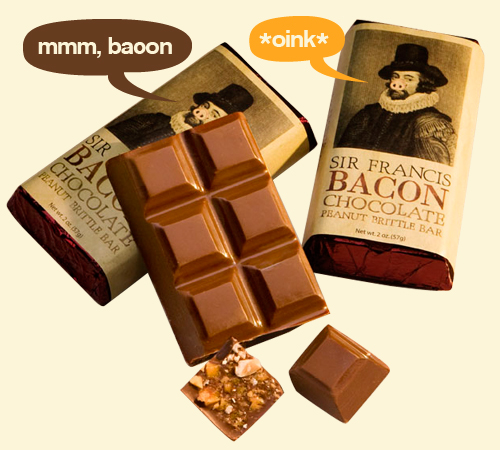
But contrary to what some folks would have you believe about Bacon (for instance, that he refuted Christianity, etc.) let’s see what he actually thought about atheism in his own words, shall we?
XVI On Atheisim by Sir Francis Bacon
I had rather believe all the fables in the The Golden Legend (a 13th century collection of saints’ lives), and the Talmud (The body of Jewish traditional law), and the Alcoran (the Koran, the sacred book of Islam), than that this universal frame is without a mind. And therefore God never wrought miracle to refute atheism, because his ordinary works convince it.
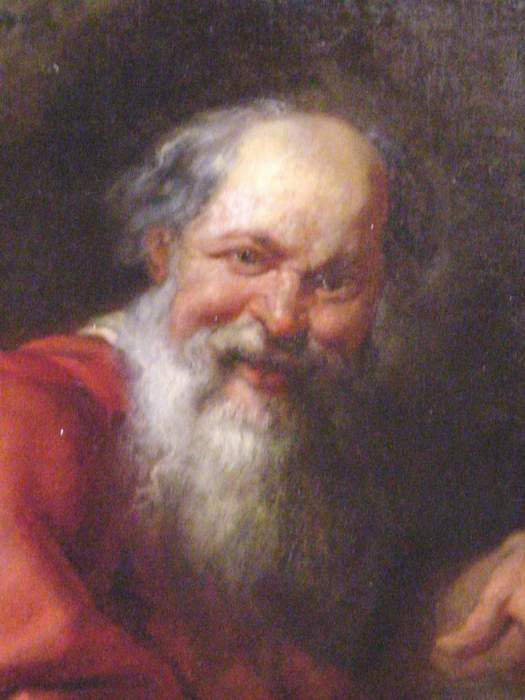
Democritus bears an uncanny resemblance to Santa Claus
It is true, that a little philosophy inclineth man’s mind to atheism; but depth in philosophy bringeth men’s minds about to religion. For while the mind of man looketh upon second causes scattered, it may sometimes rest in them, and go no further; but when it beholdeth the chain of them, confederate and linked together, it must needs fly to Providence and Deity. Nay, even that school which is most accused of atheism doth most demonstrate religion; that is, the school of Leucippus and Democritus and Epicurus.
Engaging in a little name dropping, eh? What, pray tell, are you getting at, Francis?
For it is a thousand times more credible, that four mutable elements, and one immutable fifth essence, duly and eternally placed, need no God, than that an army of infinite small portions or seeds unplaced, should have produced this order and beauty without a divine marshal. The Scripture saith, The fool hath said in his heart, there is no God; it is not said, The fool hath thought in his heart; so as he rather saith it by rote to himself, as that he would have, than that he can thoroughly believe it, or be persuaded of it. For none deny there is a God, but those for whom it profiteth that there were no God.
Brace yourselves. Francis is about to throw down the guantlet, or lift the curtain on the Great Oz, or something.
It appeareth in nothing more, that atheism is rather in the lip than in the heart of man, than by this; that atheists will ever be talking of that their opinion, as if they fainted in it within themselves, and would be glad to be strengthened by the consent of others. Nay more, you shall have atheists strive to get disciples, as it fareth with other sects. And, which is most of all, you shall have of them that will suffer for atheism, and not recant; whereas if they did truly think that there were no such thing as God, why should they trouble themselves?
Well, whaddayaknow? Ol’ Frankie had read the New Evangelical Atheists’ playbook a long, long time ago. Qoheleth is grinning like a Cheshire cat. I’ll just get out of the way, as the takedown begins.
Epicurus is charged that he did but dissemble for his credit’s sake, when he affirmed there were blessed natures, but such as enjoyed themselves without having respect to the government of the world. Wherein they say he did temporize; though in secret he thought there was no God. But certainly he is traduced; for his words are noble and divine: Non deos vulgi negare profanum; sed vulgi opiniones diis applicare profanum [There is no profanity in refusing to believe in the gods of the people: the profanity is in believing of the gods what the people believe of them].
Plato could have said no more. And although he had the confidence to deny the administration, he had not the power to deny the nature. The Indians of the West have names for their particular gods, though they have no name for God: as if the heathens should have had the names Jupiter, Apollo, Mars, etc. but not the word Deus; which shows that even those barbarous people have the notion, though they have not the latitude and extent of it. So that against atheists the very savages take part with the very subtlest philosophers.
Neat call on reminding folks about Wakan Tanka, “the Great Spirit” aka “the Great Mystery.” What else have you got Francis? By the way, I’m happy to provide the links that weren’t available when you wrote this.
The contemplative atheist is rare: a Diagoras, a Bion, a Lucian perhaps, and some others; and yet they seem to be more than they are; for that all that impugn a received religion or superstition are by the adverse part branded with the name of atheists. But the great atheists indeed are hypocrites; which are ever handling holy things, but without feeling; so as they must needs be cauterized in the end.
Ouch, Francis. You’re not pulling any punches, are you? Tell us what you really think. Speaking of thinking, in your opinion then, what are the causes of atheism?
The causes of atheism are: divisions in religion, if they be many; for any one main division addeth zeal to both sides; but many divisions introduce atheism. Another is, scandal of priests; when it is come to that which St. Bernard saith, One cannot now say the priest is as the people, for the truth is that the people are not so bad as the priest. A third is, custom of profane scoffing in holy matters; which doth by little and little deface the reverence of religion. And lastly, learned times, specially with peace and prosperity; for troubles and adversities do more bow men’s minds to religion.
Division in religion? Check. Scandals among clergy? Check. Scoffing at believers? Check. Learned times? Ain’t times never been more learned than nowadays. Did you take a ride on a time machine Francis? Do you know Bill and Ted from San Dimas? Just asking.
So what, in your opinion, results from all this confusion?
They that deny God destroy man’s nobility; for certainly man is of kin to the beasts by his body; and, if he be not of kin to God by his spirit, he is a base and ignoble creature. It destroys likewise magnanimity, and the raising of human nature; for take an example of a dog, and mark what a generosity and courage he will put on when he finds himself maintained by a man; who to him is instead of a God, or better nature; which courage is manifestly such as that creature, without that confidence of a better nature than his own, could never attain. So man, when he resteth and assureth himself upon divine protection and favor, gathered a force and faith which human nature in itself could not obtain.
Therefore, as atheism is in all respects hateful, so in this, that it depriveth human nature of the means to exalt itself above human frailty. As it is in particular persons, so it is in nations. Never was there such a state for magnanimity as Rome. Of this state hear what Cicero saith:
Pride ourselves as we may upon our country, yet are we not in number superior to the Spaniards, nor in strength to the Gauls, nor in cunning to the Carthaginians, not to the Greeks in arts, nor to the Italians and Latins themselves in the homely and native sense which belongs to his nation and land; it is in piety only and religion, and the wisdom of regarding the providence of the immortal gods as that which rules and governs all things, that we have surpassed all nations and peoples.
End of essay #16.
Francis? I’m not going to let you leave us with Cicero’s genuflecting to the Pagan gods. I’m not quite satisfied with that ending so I’ll include another of your quotes here,
Of all virtues and dignities of the mind, goodness is the greatest, being the character of the Deity; and without it, man is a busy, mischievous, wretched thing.
Now you’re talkin’. All this talk of Bacon reminds me of something…
UPDATE:
Fast Forward: Rude and Uninformed. A reflection on a recent billboard campaign by Atheist Humanists.

Previous Post

December 20, 2012
Your Apocalyptic News Source (and Soundtrack) For Tomorrow...
Next Post
December 21, 2012 O Oriens (Radiant Dawn)
Browse Our Archives
Select a Category Blog News Conversion Story Culture Learning Living Nature Prayer Uncategorized Working
Select a Month June 2016 May 2016 August 2015 July 2015 June 2015 May 2015 April 2015 March 2015 February 2015 January 2015 December 2014 November 2014 October 2014 September 2014 August 2014 July 2014 June 2014 May 2014 April 2014 March 2014 February 2014 January 2014 December 2013 November 2013 October 2013 September 2013 August 2013 July 2013 June 2013 May 2013 April 2013 March 2013 February 2013 January 2013 December 2012 November 2012 October 2012 September 2012 August 2012 July 2012 June 2012 May 2012 April 2012 March 2012 February 2012 January 2012 December 2011 November 2011 October 2011 September 2011 August 2011 July 2011 June 2011 May 2011 April 2011 March 2011 February 2011 January 2011 December 2010 November 2010 October 2010 September 2010 August 2010 July 2010 June 2010 May 2010 April 2010 March 2010 February 2010 January 2010 December 2009 November 2009 October 2009 September 2009 August 2009
Follow Us!
TAKE THE
Religious Wisdom Quiz
What does "Beersheba" mean in Hebrew?
Select your answer to see how you score.
Place of Bread Well of the Oath City of Peace Dwelling of the Lord
Related posts from Why I Am Catholic

Belated Happy Birthday To Blaise Pascal, Unofficial Saint...

Because My Brother Imran Yousef Is An American...

Joe Six-Pack, USMC, With A Few Post-Terrorist Attack...

This Is Why God Invented YouTube...
TRENDING AT PATHEOS Catholic

Rejecting Doom: Christian Hope And Human Action
Christianity is a religion of hope. We are to have hope and...

It’s What Comes From Within Which Matters
One of the most difficult things for us to understand is why...

Why I Choose the Eucharist Over the Sermon
Choose the Eucharist, Not the Sermon What are we supposed to get...

5 Design Elements Found in Spiritually Rooted Homes
Putting Spirituality Into Home Decor Our homes are more than our living...

Credo: A Story of God Told with the...
About 10 years ago, I began to imagine a personal "Credo" that...

The Anatomy of Divine Revelation in Catholic Thought
The claim that God has made Himself known to human beings is...
Ad-Free & Subscriber Log-In Subscription Support
- About Us
- 2026 Calendar
- Videos
- Podcasts
- Library of World Religions
- Faith In Media Tracker
- Advertise With Us
- Write for Us
- Privacy Policy
- Terms of Service
- Do Not Sell My Data
- Contact Us
- Radiant Digital
- Manage Newsletter Subscriptions
- Unsubscribe From Notifications
- Sitemap
Copyright 2008-2026, Patheos. All rights reserved.
Subscription Support Ad-Free & Subscriber Log-In
Follow Patheos