
BuddhistCatholicContemplativeEvangelicalGeneral ChristianHinduJewishLatter-day SaintMuslimNew VisionsProgressive Christian
Beliefs
- Buddhist
- Catholic
- Contemplative
- Evangelical
- General Christian
- Hindu
- Jewish
- Latter-day Saint
- More Voices
- Muslim
- New Visions
- Pagan
- Progressive Christian
Topics
- Religion News
- Food and Religion
- Sports and Religion
- Religious Art
- Religious Music and Entertainment
- Religious Events
- History and Religion
- Style and Religion
- Politics and Religion
- Women in Religion
- Recreation Outdoors and Religion
- Business Finance and Religion
- Careers Workplace and Religion
- Education and Religion
- Family Parenting and Religion
- Health Fitness and Religion
- Home and Religion
- Relationships and Religion
- Technology and Religion
- Travel and Religion
Columnists
- Buddhist Columnists
- Business Finance and Religion Columnists
- Careers Workplace and Religion Columnists
- Catholic Columnists
- Contemplative Columnists
- Education and Religion Columnists
- Evangelists Columnists
- Family Parenting and Religion Columnists
- General Christian Columnists
- Health Fitness and Religion Columnists
- Hindu Columnists
- History and Religion Columnists
- Home and Religion Columnists
- Jewish Columnists
- More Voices Columnists
- Latter Day Columnists
- Muslim Columnists
- New Visions Columnists
- Nonreligious Columnists
- Pagan Columnists
- Politics and Religion Columnists
- Progressive Columnists
- Recreation Outdoors and Religion Columnists
- Relationships and Religion Columnists
- Religion News Columnists
- Religious Art Columnists
- Religious Events Columnists
- Religious Music and Entertainment Columnists
- Sports and Religion Columnists
- Style and Religion Columnists
- Technology and Religion Columnists
- Travel and Religion Columnists
- Women in Religion Columnists
Resource Library
- 2026 Calendar
- Library of World Religions
- The 100 Most Holy Places on Earth
- Patheos Answers
- Podcasts
- Videos
- Faith Leaders Database
- Anglican Episcopalian
- Bahai
- Baptist
- Buddhism
- Christianity
- Confucianism
- Eastern Orthodoxy
- Hinduism
- Holiness and Pentecostal
- ISKCON
- Islam
- Judaism
- Lutheran
- Methodist
- The Church of Jesus Christ of Latter-day Saints
- New Age
- Paganism
- Presbytarian and Reformed
- Protestantism
- Religion Behind the Scenes
- Roman Catholic
- Scientology
- Shia Islam
- Sikhism
- Sufism
- Sunni Islam
- Taoism
- Zen
- See all religions
Research Tools
 Ad-Free & Subscriber Log-In Subscription Support
Ad-Free & Subscriber Log-In Subscription Support
Follow Patheos 

- Trending:
- Forgiveness
- |
- Marriage
- |
- Consciousness
- |
- Death Penalty
- |
- Election
- |
- Halloween
 Why I Am Catholic
-
More
- Home
- Because the Dalai Lama Says Things Like This UPDATED
Because the Dalai Lama Says Things Like This UPDATED
Last updated on: June 7, 2015 at 10:39 pm by Frank Weathers
Because the Dalai Lama Says Things Like This UPDATED 2015-06-07T22:39:13-05:00 Frank Weathers
Patheos Explore the world's faith through different perspectives on religion and spirituality! Patheos has the views of the prevalent religions and spiritualities of the world.
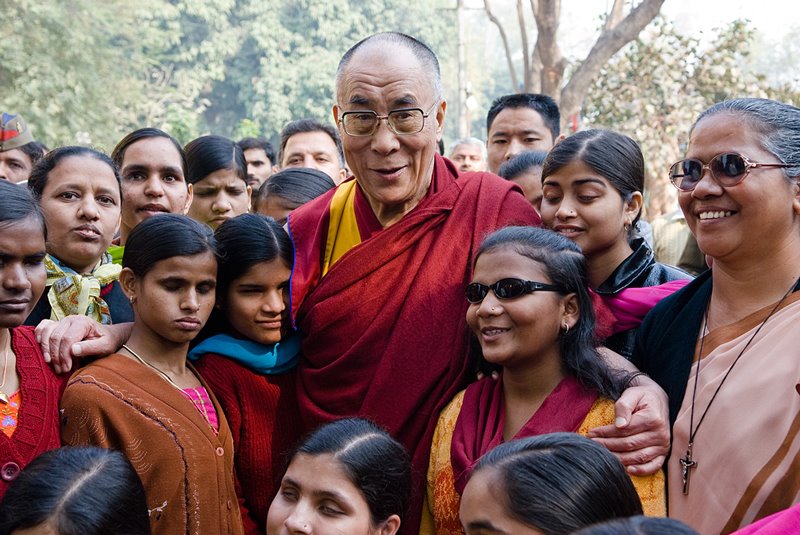
Which points out to me that though he (perhaps) will be perceived as being on the right/correct side of history, he’ll still be just another casualty in the train wreck of relativism.
All the world’s major religions, with their emphasis on love, compassion, patience, tolerance, and forgiveness can and do promote inner values. But the reality of the world today is that grounding ethics in religion is no longer adequate. This is why I am increasingly convinced that the time has come to find a way of thinking about spirituality and ethics beyond religion altogether.
Sounds like anarchy to me. What do I know that the 61,789(and climbing) folks (in four hours) that liked this thought on Facebook don’t know? Something G.K. Chesterton observed regarding our proclivity to throw in the towel and cry uncle.
The Christian ideal has not been tried and found wanting. It has been found difficult; and left untried.
I don’t think I’m going out on a limb when I say that Chesterton’s statement is true. I only have to look in a mirror, and dip into the pool of my own memory for a few laps, to see the stark proof of this statement. And isn’t that what Chesterton did too? The quote comes from an essay entitled What’s Wrong with the World and I think the buildup to it is worth having a look at.
The scene is the martyrdom of St. Thomas Beckett, who had the audacity to tell a king “No!” when he erred,
When four knights scattered the blood and brains of St. Thomas of Canterbury, it was not only a sign of anger but of a sort of black admiration. They wished for his blood, but they wished even more for his brains. Such a blow will remain forever unintelligible unless we realize what the brains of St. Thomas were thinking about just before they were distributed over the floor. They were thinking about the great mediaeval conception that the church is the judge of the world. Becket objected to a priest being tried even by the Lord Chief Justice. And his reason was simple: because the Lord Chief Justice was being tried by the priest. The judiciary was itself sub-judice. The kings were themselves in the dock. The idea was to create an invisible kingdom, without armies or prisons, but with complete freedom to condemn publicly all the kingdoms of the earth. Whether such a supreme church would have cured society we cannot affirm definitely; because the church never was a supreme church. We only know that in England at any rate the princes conquered the saints. What the world wanted we see before us; and some of us call it a failure. But we cannot call what the church wanted a failure, simply because the church failed. Tracy struck a little too soon. England had not yet made the great Protestant discovery that the king can do no wrong. The king was whipped in the cathedral ; a performance which I recommend to those who regret the unpopularity of church-going. But the discovery was made; and Henry VIII scattered Becket’s bones as easily as Tracy had scattered his brains.
Of course, I mean that Catholicism was not tried; plenty of Catholics were tried, and found guilty. My point is that the world did not tire of the church’s ideal, but of its reality. Monasteries were impugned not for the chastity of monks, but for the unchastity of monks. Christianity was unpopular not because of the humility, but of the arrogance of Christians. Certainly, if the church failed it was largely through the churchmen. But at the same time hostile elements had certainly begun to end it long before it could have done its work. In the nature of things it needed a common scheme of life and thought in Europe. Yet the mediaeval system began to be broken to pieces intellectually, long before it showed the slightest hint of falling to pieces morally. The huge early heresies, like the Albigenses, had not the faintest excuse in moral superiority. And it is actually true that the Reformation began to tear Europe apart before the Catholic Church had had time to pull it together. The Prussians, for instance, were not converted to Christianity at all until quite close to the Reformation. The poor creatures hardly had time to become Catholics before they were told to become Protestants. This explains a great deal of their subsequent conduct. But I have only taken this as the first and most evident case of the general truth: that the great ideals of the past failed not by being outlived (which must mean over-lived), but by not being lived enough. Mankind has not passed through the Middle Ages. Rather mankind has retreated from the Middle Ages in reaction and rout. The Christian ideal has not been tried and found wanting. It has been found difficult; and left untried.
Yes, the emphasis is mine. But wait, there is more. The Dalai Lama, see, is a good and wise man. He’s able to compose Twitter length aphorisms that are pleasing to the mind. And yet, like cotton candy, they melt in your mouth and leave the soul unsatisfied. Why is that? Because we recognize another signal truth, and Chesterton teases it out. We’re slothful dilettantes who rarely finish what we’ve started. His segue into the secular religious sphere of politics makes this abundantly clear.
It is, of course, the same in the case of the French Revolution. A great part of our present perplexity arises from the fact that the French Revolution has half succeeded and half failed. In one sense, Valmy was the decisive battle of the West, and in another Trafalgar. We have, indeed, destroyed the largest territorial tyrannies, and created a free peasantry in almost all Christian countries except England; of which we shall say more anon. But representative government, the one universal relic, is a very poor fragment of the full republican idea. The theory of the French Revolution presupposed two things in government, things which it achieved at the time, but which it has certainly not bequeathed to its imitators in England, Germany, and America. The first of these was the idea of honorable poverty; that a statesman must be something of a stoic; the second was the idea of extreme publicity. Many imaginative English writers, including Carlyle, seem quite unable to imagine how it was that men like Robespierre and Marat were ardently admired. The best answer is that they were admired for being poor—poor when they might have been rich.
No one will pretend that this ideal exists at all in the haute politique of this country. Our national claim to political incorruptibility is actually based on exactly the opposite argument; it is based on the theory that wealthy men in assured positions will have no temptation to financial trickery. Whether the history of the English aristocracy, from the spoliation of the monasteries to the annexation of the mines, entirely supports this theory I am not now inquiring; but certainly it is our theory, that wealth will be a protection against political corruption. The English statesman is bribed not to be bribed. He is born with a silver spoon in his mouth, so that he may never afterwards be found with the silver spoons in his pocket. So strong is our faith in this protection by plutocracy, that we are more and more trusting our empire in the hands of families which inherit wealth without either blood or manners. Some of our political houses are parvenue by pedigree; they hand on vulgarity like a coat-of-arms. In the case of many a modern statesman to say that he is born with a silver spoon in his mouth, is at once inadequate and excessive. He is born with a silver knife in his mouth. But all this only illustrates the English theory that poverty is perilous for a politician.
It will be the same if we compare the conditions that have come about with the Revolution legend touching publicity. The old democratic doctrine was that the more light that was let in to all departments of State, the easier it was for a righteous indignation to move promptly against wrong. In other words, monarchs were to live in glass houses, that mobs might throw stones. Again, no admirer of existing English politics (if there is any admirer of existing English politics) will really pretend that this ideal of publicity is exhausted, or even attempted. Obviously public life grows more private every day. The French have, indeed, continued the tradition of revealing secrets and making scandals; hence they are more flagrant and palpable than we, not in sin, but in the confession of sin. The first trial of Dreyfus might have happened in England; it is exactly the second trial that would have been legally impossible. But, indeed, if we wish to realize how far we fall short of the original republican outline, the sharpest way to test it is to note how far we fall short even of the republican element in the older regime. Not only are we less democratic than Danton and Condorcet, but we are in many ways less democratic than Choiseuil and Marie Antoinette. The richest nobles before the revolt were needy middle-class people compared with our Rothschilds and Roseberys. And in the matter of publicity the old French monarchy was infinitely more democratic than any of the monarchies of to-day. Practically anybody who chose could walk into the palace and see the king playing with his children, or paring his nails. The people possessed the monarch, as the people possess Primrose Hill; that is, they cannot move it, but they can sprawl all over it. The old French monarchy was founded on the excellent principle that a cat may look at a king. But nowadays a cat may not look at a king; unless it is a very tame cat. Even where the press is free for criticism it is only used for adulation. The substantial difference comes to something uncommonly like this: Eighteenth century tyranny meant that you could say “The K— of Br rd is a profligate.” Twentieth century liberty really means that you are allowed to say “The King of Brentford is a model family man.”
But we have delayed the main argument too long for the parenthetical purpose of showing that the great democratic dream, like the great mediaeval dream, has in a strict and practical sense been a dream unfulfilled. Whatever is the matter with modern England it is not that we have carried out too literally, or achieved with disappointing completeness, either the Catholicism of Becket or the equality of Marat. Now I have taken these two cases merely because they are typical of ten thousand other cases; the world is full of these unfulfilled ideas, these uncompleted temples. History does not consist of completed and crumbling ruins; rather it consists of half-built villas abandoned by a bankrupt-builder. This world is more like an unfinished suburb than a deserted cemetery.
Sorry to keep you reading Chesterton, but fast-forwarding to that very last sentence would have been criminal, don’t you think? “This world is more like an unfinished suburb than a deserted cemetery” is the Chesterton quote no one cites, but it’s the one that the Dalai Lama and I need to ponder.
I wonder if he’s ever heard of Maggie’s drawers?
UPDATE: See the follow-up post to this one, here.
Previous Post

September 9, 2012
Coming Soon to iTunes: Pope Benedict XVI
Next Post
September 11, 2012 Blessed Are They Who Mourn...
Browse Our Archives
Select a Category Blog News Conversion Story Culture Learning Living Nature Prayer Uncategorized Working
Select a Month June 2016 May 2016 August 2015 July 2015 June 2015 May 2015 April 2015 March 2015 February 2015 January 2015 December 2014 November 2014 October 2014 September 2014 August 2014 July 2014 June 2014 May 2014 April 2014 March 2014 February 2014 January 2014 December 2013 November 2013 October 2013 September 2013 August 2013 July 2013 June 2013 May 2013 April 2013 March 2013 February 2013 January 2013 December 2012 November 2012 October 2012 September 2012 August 2012 July 2012 June 2012 May 2012 April 2012 March 2012 February 2012 January 2012 December 2011 November 2011 October 2011 September 2011 August 2011 July 2011 June 2011 May 2011 April 2011 March 2011 February 2011 January 2011 December 2010 November 2010 October 2010 September 2010 August 2010 July 2010 June 2010 May 2010 April 2010 March 2010 February 2010 January 2010 December 2009 November 2009 October 2009 September 2009 August 2009
Follow Us!
TAKE THE
Religious Wisdom Quiz
Which Psalm opens with "Blessed is the man"?
Select your answer to see how you score.
Psalm 119 Psalm 23 Psalm 51 Psalm 1
Related posts from Why I Am Catholic

Belated Happy Birthday To Blaise Pascal, Unofficial Saint...

Because My Brother Imran Yousef Is An American...

Joe Six-Pack, USMC, With A Few Post-Terrorist Attack...

This Is Why God Invented YouTube...
TRENDING AT PATHEOS Catholic

Rejecting Doom: Christian Hope And Human Action
Christianity is a religion of hope. We are to have hope and...

It’s What Comes From Within Which Matters
One of the most difficult things for us to understand is why...

Why I Choose the Eucharist Over the Sermon
Choose the Eucharist, Not the Sermon What are we supposed to get...

5 Design Elements Found in Spiritually Rooted Homes
Putting Spirituality Into Home Decor Our homes are more than our living...

Credo: A Story of God Told with the...
About 10 years ago, I began to imagine a personal "Credo" that...

The Anatomy of Divine Revelation in Catholic Thought
The claim that God has made Himself known to human beings is...
Ad-Free & Subscriber Log-In Subscription Support
- About Us
- 2026 Calendar
- Videos
- Podcasts
- Library of World Religions
- Faith In Media Tracker
- Advertise With Us
- Write for Us
- Privacy Policy
- Terms of Service
- Do Not Sell My Data
- Contact Us
- Radiant Digital
- Manage Newsletter Subscriptions
- Unsubscribe From Notifications
- Sitemap
Copyright 2008-2026, Patheos. All rights reserved.
Subscription Support Ad-Free & Subscriber Log-In
Follow Patheos