
BuddhistCatholicContemplativeEvangelicalGeneral ChristianHinduJewishLatter-day SaintMuslimNew VisionsProgressive Christian
Beliefs
- Buddhist
- Catholic
- Contemplative
- Evangelical
- General Christian
- Hindu
- Jewish
- Latter-day Saint
- More Voices
- Muslim
- New Visions
- Pagan
- Progressive Christian
Topics
- Religion News
- Food and Religion
- Sports and Religion
- Religious Art
- Religious Music and Entertainment
- Religious Events
- History and Religion
- Style and Religion
- Politics and Religion
- Women in Religion
- Recreation Outdoors and Religion
- Business Finance and Religion
- Careers Workplace and Religion
- Education and Religion
- Family Parenting and Religion
- Health Fitness and Religion
- Home and Religion
- Relationships and Religion
- Technology and Religion
- Travel and Religion
Columnists
- Buddhist Columnists
- Business Finance and Religion Columnists
- Careers Workplace and Religion Columnists
- Catholic Columnists
- Contemplative Columnists
- Education and Religion Columnists
- Evangelists Columnists
- Family Parenting and Religion Columnists
- General Christian Columnists
- Health Fitness and Religion Columnists
- Hindu Columnists
- History and Religion Columnists
- Home and Religion Columnists
- Jewish Columnists
- More Voices Columnists
- Latter Day Columnists
- Muslim Columnists
- New Visions Columnists
- Nonreligious Columnists
- Pagan Columnists
- Politics and Religion Columnists
- Progressive Columnists
- Recreation Outdoors and Religion Columnists
- Relationships and Religion Columnists
- Religion News Columnists
- Religious Art Columnists
- Religious Events Columnists
- Religious Music and Entertainment Columnists
- Sports and Religion Columnists
- Style and Religion Columnists
- Technology and Religion Columnists
- Travel and Religion Columnists
- Women in Religion Columnists
Resource Library
- 2026 Calendar
- Library of World Religions
- The 100 Most Holy Places on Earth
- Patheos Answers
- Podcasts
- Videos
- Faith Leaders Database
- Anglican Episcopalian
- Bahai
- Baptist
- Buddhism
- Christianity
- Confucianism
- Eastern Orthodoxy
- Hinduism
- Holiness and Pentecostal
- ISKCON
- Islam
- Judaism
- Lutheran
- Methodist
- The Church of Jesus Christ of Latter-day Saints
- New Age
- Paganism
- Presbytarian and Reformed
- Protestantism
- Religion Behind the Scenes
- Roman Catholic
- Scientology
- Shia Islam
- Sikhism
- Sufism
- Sunni Islam
- Taoism
- Zen
- See all religions
Research Tools
 Ad-Free & Subscriber Log-In Subscription Support
Ad-Free & Subscriber Log-In Subscription Support
Follow Patheos 

- Trending:
- Forgiveness
- |
- Marriage
- |
- Consciousness
- |
- Death Penalty
- |
- Election
- |
- Halloween
 Why I Am Catholic
-
More
- Home
- To Let the Democracy of the Dead Teach Me How to Vote Like A Catholic UPDATED
To Let the Democracy of the Dead Teach Me How to Vote Like A Catholic UPDATED
Last updated on: January 24, 2017 at 5:54 pm by Frank Weathers
To Let the Democracy of the Dead Teach Me How to Vote Like A Catholic UPDATED 2017-01-24T17:54:38-05:00 Frank Weathers
Patheos Explore the world's faith through different perspectives on religion and spirituality! Patheos has the views of the prevalent religions and spiritualities of the world.
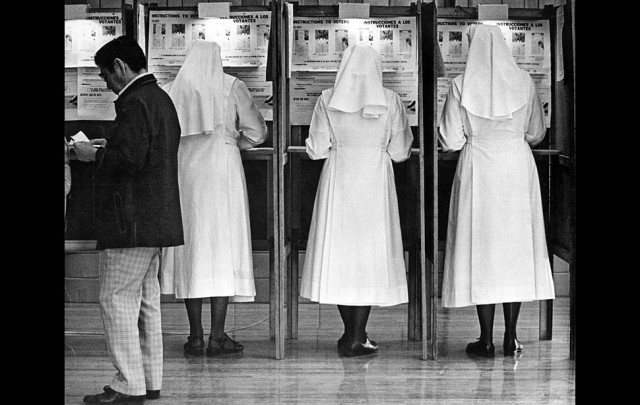
Are you dissatisfied with the book-length voting guides put out by the USSCB? Do you find it lacks both brevity and clarity? Are you skeptical of the guides put out by Catholic shills of the Left and of the Right as well? Are you tired of the same old stale arguments in the blog-o-sphere between the folks who can seemingly find no candidates worthy of their vote, doing battle with those who attempt to turn their pet candidates into demi-gods?
Join the club. If you weren’t, I’d think there was something wrong with you. Stop the insanity, you say? I’m all for that. But guess what you can’t do? You can’t just pack it up and beat feet like the Desert Fathers and color yourself gone from this whole train wreck called responsible citizenship.
In the scheme of things, you understand, folks having the right to vote is practically a brand new development on the world stage. But it isn’t so brand new that we have to keep perpetually reinventing the wheel all the time either. Snap out of it, you lubbers! Because after King John signed the Magna Carta (1215), on through to the Glorious Revolution (1688), until the period when the American Experiment began in earnest after July 4, 1776, right up until 15 seconds ago, the citizenry is responsible for the government it has, and the government it gets.
I said a few weeks ago that the only real hope for change is to get involved. The silly notion that you can effect change just by pulling a lever, or clicking on the screen, in a ballot box on election day every two, or four years, and call yourself a good citizen, is in direct opposition to your Christian duty to be accountable as said “good citizen.”
Don’t believe me? Well looky here. The following thoughts are from a book entitled The State and the Church, and they belong to Fr. John A Ryan, DD, formerly the Professor of Moral Theology at the Catholic University of America. Fr. Ryan authored numerous books, such as A Living Wage, Distributive Justice, Social Reconstruction, and others. Joining him in this effort to explain the rights, duties, and obligations of citizenship is Moorhouse F.X. Millar, SJ.
This fine volume was published in 1922, and as is the case with the writings of G.K. Chesterton from the same time period, I daresay that the counsel contained in its pages is as applicable today as it was when it was first published. Because there is nothing new under the sun, and the fact that many of us seem to believe that “this time is different,” and “everything is a mess” all of a sudden, reminds me of Yogi Berra’s famous quip that “it’s déjà vu all over again.”
When it comes to voting, Padre Ryan, may he enjoy the Beatific Vision, lays it all out for us here. Be advised, there are no half-baked thoughts in the paragraphs below (italics and bold are my highlights). Padre Ryan has the floor…
From Chapter 13, The Duties of the Citizen.
The second class of duties incumbent on the citizen results from his electoral functions. In a republic, legislation and administration depend finally upon the intelligence and morality of the voters. They have it in their power to make the government a good one or a bad one. Whether the common good will be promoted or injured, depends upon the kind of laws enacted and the manner in which they are administered; but the character of the laws and the administration is primarily determined by the way in which the citizens discharge their function of choosing legislators and administrators. Therefore, this function is of the gravest importance and the obligation which it imposes is likewise grave.
It must be admitted that the importance and gravity of this obligation is frequently ignored by Catholics, as well as by other citizens. Writing of Great Britain, the Rev. Thomas Wright declares: “There are large numbers of Catholics in this land with but little appreciation of the strong interrelation which exists between true citizenship and Christianity. . . . Many excuses, it must be owned, may be alleged in extenuation of the apathy of Catholics toward their civic obligations in these lands. Time, however, has undermined the substance of these apologetic pleas. Catholics are now able to appeal to no sufficient cause why they should stand aloof from public affairs, or why, participating in them, they need indiscriminately follow the policies of parties without thought or test of their moral justification.”
These observations may be applied in full measure to the Catholics of the United States. Like their coreligionists of Great Britain, they can show historical conditions to extenuate, if not to justify, their neglect of political obligations. Very many, if not the majority, of them are persons, or the descendants of persons, who came from countries whose governments treated Catholics unfairly and allowed them very little participation in public affairs. As a consequence, a large proportion of American Catholics have been, until quite recently, possessed of what has been happily characterized as “the psychology of persecution.” They have looked upon government with a certain measure of distrust, and, therefore, have been predisposed to ignore or to minimize their electoral responsibility. Many of them have easily and complacently accepted the cynical judgment that “politics is a rotten business,” and have either held aloof or permitted their political influence to be utilized by special and unworthy interests.
The Catholic teaching on the duty of exercising the voting franchise, as stated in the authoritative manuals of moral theology, may be summed up as follows:
The obligation of taking part in the election of candidates for civil offices, is an obligation of legal justice. The citizens are bound to promote the common good in all reasonable ways. The franchise enables them to further or to hinder the common weal greatly and fundamentally, inasmuch asthe quality of the government depends upon the kind of officials they elect. Not only questions of politics, but social, industrial, educational, moral and religious subjects are regulated by legislative bodies and administered by executives. Therefore, the matter is of grave importance, and the obligation of the citizen to participate in the election and to support fit candidates is correspondingly grave. According to Tanquerey, the elector cannot free himself from this obligation by any slight cause or reason, such as, going hunting, or criticism by his neighbors. The excusing cause needs to be of a grave nature, such as loss of one’s means of livelihood. A slight cause will relieve the citizen from the obligation of voting only when he is morally certain that he cannot affect the immediate result. Even then, he ought to take part in the election to show good example, and to hasten the day when the cause which he supports will command a majority of the voters.
Just as the official is obliged to refrain from promoting the interests of individuals as against the common good, so the elector is morally bound to cast his vote for the common welfare, instead of for the benefit of private persons or groups. This principle is very often forgotten by well-meaning citizens; for example, by giving their political support to a friend, or to a member of their own race or religion, when he has not the required moral or intellectual equipment, or when he is the upholder of socially harmful policies. Too often in such situations the honest citizen salves his conscience with the excuse that the opposing candidate “is just as bad.” Were this the fact one might legitimately determine one’s choice on the basis of personal friendship, or racial or religious affiliation, or other extrinsic considerations; but the general fact is that voters who adopt this course do not take adequate care to find out whether the candidate of the opposition is in reality “just as bad.”
They too easily decide the question on the basis of their inclinations and predilections.
Closely connected with this unjustifiable practice is that of ignoring principles and policies in the exercise of the franchise. “Vote for a good man, regardless of party,” is a plausible but essentially inadequate political rule. A distinction should be drawn between legislative offices and those which are merely administrative. In choosing a city treasurer or a county auditor, the only pertinent qualifications are honesty, intellectual capacity and technical equipment. There is involved no question of legislative policy. When the office to be filled is that of Governor of a State, President of the United States, member of a State legislature, or congressman, other qualifications are essential in addition to those just mentioned. The “good man” may have some very harmful views concerning political and industrial policies. He may sincerely favor national imperialism and jingoism, or legislation to promote the undue aggrandizement of one social class or the oppression of another social class. Obviously the citizen does not fulfil his duty of promoting the common good when he votes for a “good man” of this sort. Sometimes the common welfare will suffer less through the election of a man whose political policies are right but whose moral or intellectual equipment is deficient, than through the elevation of a “good man” who gives his adhesion to wrong policies.
It is sometimes said that the good man in other relations of life is always the best kind of a citizen. This statement is only a half truth. The unqualified propagation and acceptance of it is a serious obstacle to the improvement of citizenship. Fidelity to one’s duties as husband, father, son, brother, neighbor, employer, employee, buyer, seller, debtor, creditor, professional man, and client,—does, indeed, contribute very greatly toward the common welfare. Actions performed under the direction of the domestic and social virtues necessarily promote individual and social happiness, just as the opposite actions are an injury to the commonwealth. Nevertheless, these virtues are not a complete equipment for all the duties of citizenship. They do not of themselves provide the citizen with that specific knowledge which he requires as a voter, nor with that civic consciousness which is essential to good citizenship. Just as an honest employer may treat his employees unjustly because he is unacquainted with those moral principles which apply specifically to industrial relations, or because he has an insufficient knowledge of the living conditions and needs of the workers, so the virtuous citizen may fail in his duties to the State because he does not realize the importance of this particular responsibility, or because he lacks the specific political knowledge which would enable him to exercise his suffrage for the best interests of the commonwealth. In this category are the man who does not realize how fundamentally good government depends upon the electors, the man who lazily assumes that politics is necessarily corrupt, and the man who thinks it sufficient to vote for good men, without any reference to the helpfulness or harmfulness of their political principles and policies.
In a word, the good man is not a good citizen unless he possesses the specific knowledge essential to good citizenship. This comprises adequate perception of the citizen’s power and responsibility, and a reasonable degree of acquaintance with political institutions, personages, and policies.The good citizen recognizes all these obligations and makes reasonable and continuous efforts to fulfil them. Such a man, and only such a man, possesses an adequate civic consciousness.
Worth quoting are the following extracts from a letter addressed to his people, in the year 1921, by the late Cardinal Amette, Archbishop of Paris:
“In the joint letter which they recently addressed to the French Catholics, the bishops of France said: ‘It is a duty of conscience for all citizens honored with the right of suffrage to vote honestly and wisely with the sole aim of benefiting the country. The citizen is subject to the divine law as is the Christian. Of our votes, as of all our actions, God will demand an account. The duty of voting is so much the more binding upon conscience because on its good or evil exercise depend the gravest interests of the country and of religion.’
“It is your duty to vote. To neglect to do so would be a culpable abdication of duty on your part. It is your duty to vote honestly; that is to say, for men worthy of your esteem and trust. It is your duty to vote wisely; that is to say, in such a way as not to waste your votes. It would be better to cast them for candidates who, although not giving complete satisfaction to all our legitimate demands, would lead us to expect from them a line of conduct useful to the country, rather than to keep your votes for others whose program would indeed be more perfect, but whose almost certain defeat might open the door to the enemies of religion and of the social order.”
Tanquerey points out that, in order to be able to vote rightly and intelligently, in order to possess the specific knowledge requisite for this purpose, upright citizens should organize and participate in political associations. This is obvious. Men unite in trade unions, manufacturers’ associations, chambers of commerce, and professional societies of various kinds for the promotion of their economic interests. Hundreds of thousands of good men, thus occupationally organized, fail to see the necessity of organizing politically for the protection of their civic interestsand the effective performance of their duties to the commonwealth. The conduct of political organizations they leave to professional politicans who are usually in the service of selfish private interests. When the inactive citizens see the evil results of this arrangement, they attempt to justify their aloofness by the reflection that politics is essentially corrupt. This lazy pessimism is not warranted by anything inherent in political affairs. It represents a vain attempt to evade moral responsibility. If politics is rotten, a large part of the responsibility rests upon well meaning but indolent citizens.
In view of the fundamental and immense importance to the State of the voting function, and since the electors are in a practical sense the primary political authority, it would seem that the electoral duties of the citizens are not merely duties of legal justice. It would seem that, like the obligations of public officials they also fall under the head of strict or commutative justice. A group of legislators inflict injury upon the community by a bad law, thereby violating strict justice: Are not the citizens who elected them guilty of the same kind of injustice, in so far as they foresaw this possibility? The difference between their offence and that of the legislators seems to be one of degree, not one of kind.
Among the electoral duties of the citizen is that of becoming a candidate for public office in some circumstances. Of course, this applies only to that small minority who are competent. In certain situations, says Noldin, an upright Catholic is bound by a grave obligation to become a candidate for an administrative or legislative office; that is, when his election is certain, when he is able to avert grave evils from the community, when he can accept the office without grave inconvenience to himself, and when no other equally competent candidate is available. In as much as the issues involved in such a situation are of much graver consequence than those dependent upon the ballot of the private citizen, the man who refuses to become a candidate for office will need a much graver reason to excuse him than will the citizen who merely neglects to vote.
Read the whole chapter. Read the whole book if need be. But just remember that the authority to govern comes from God, and as wacky as the notion is, He has deigned to allow temporal power to be derived from the will of the people nowadays. Don’t like the mess in the political parties, the system, and in the Executive, Legislative, and Judicial branches? Don’t like fraud, waste, and creeping tyranny? Look in the mirror for the person/s responsible.
Scary isn’t it?
Mother Mary, Sts. John Fisher and Thomas More, pray for us.
UPDATE: Mark Shea ponders proportional reasons (see post above and here, and here) for supporting R2: “What I have not settled in my own mind is the question of whether Obama’s war on the Church is the game changer that makes a vote for the Plastic Android a valid proportional reason. But it is something I am mulling.”
Vote in the YIMCatholic Presidential Straw Poll.

Previous Post

August 13, 2012
If God Is A Bullet... (Music for Mondays)
Next Post
August 15, 2012 An Idea Mark Shea Can Appreciate...
Browse Our Archives
Select a Category Blog News Conversion Story Culture Learning Living Nature Prayer Uncategorized Working
Select a Month June 2016 May 2016 August 2015 July 2015 June 2015 May 2015 April 2015 March 2015 February 2015 January 2015 December 2014 November 2014 October 2014 September 2014 August 2014 July 2014 June 2014 May 2014 April 2014 March 2014 February 2014 January 2014 December 2013 November 2013 October 2013 September 2013 August 2013 July 2013 June 2013 May 2013 April 2013 March 2013 February 2013 January 2013 December 2012 November 2012 October 2012 September 2012 August 2012 July 2012 June 2012 May 2012 April 2012 March 2012 February 2012 January 2012 December 2011 November 2011 October 2011 September 2011 August 2011 July 2011 June 2011 May 2011 April 2011 March 2011 February 2011 January 2011 December 2010 November 2010 October 2010 September 2010 August 2010 July 2010 June 2010 May 2010 April 2010 March 2010 February 2010 January 2010 December 2009 November 2009 October 2009 September 2009 August 2009
Follow Us!
TAKE THE
Religious Wisdom Quiz
How old was Jesus when He started His ministry?
Select your answer to see how you score.
21 30 35 28
Related posts from Why I Am Catholic

Belated Happy Birthday To Blaise Pascal, Unofficial Saint...

Because My Brother Imran Yousef Is An American...

Joe Six-Pack, USMC, With A Few Post-Terrorist Attack...

This Is Why God Invented YouTube...
TRENDING AT PATHEOS Catholic

Creation, Preservation, and Teleology in Catholic Theology
As I write this, it is very early Monday morning. Like millions...

The Parable Of The Sower And The Word...
One of Christ’s most famous parables is that of the sower who...

Rejecting Doom: Christian Hope And Human Action
Christianity is a religion of hope. We are to have hope and...

Why I Choose the Eucharist Over the Sermon
Choose the Eucharist, Not the Sermon What are we supposed to get...

5 Design Elements Found in Spiritually Rooted Homes
Putting Spirituality Into Home Decor Our homes are more than our living...

Credo: A Story of God Told with the...
About 10 years ago, I began to imagine a personal "Credo" that...
Ad-Free & Subscriber Log-In Subscription Support
- About Us
- 2026 Calendar
- Videos
- Podcasts
- Library of World Religions
- Faith In Media Tracker
- Advertise With Us
- Write for Us
- Privacy Policy
- Terms of Service
- Do Not Sell My Data
- Contact Us
- Radiant Digital
- Manage Newsletter Subscriptions
- Unsubscribe From Notifications
- Sitemap
Copyright 2008-2026, Patheos. All rights reserved.
Subscription Support Ad-Free & Subscriber Log-In
Follow Patheos