
BuddhistCatholicContemplativeEvangelicalGeneral ChristianHinduJewishLatter-day SaintMuslimNew VisionsProgressive Christian
Beliefs
- Buddhist
- Catholic
- Contemplative
- Evangelical
- General Christian
- Hindu
- Jewish
- Latter-day Saint
- More Voices
- Muslim
- New Visions
- Pagan
- Progressive Christian
Topics
- Religion News
- Food and Religion
- Sports and Religion
- Religious Art
- Religious Music and Entertainment
- Religious Events
- History and Religion
- Style and Religion
- Politics and Religion
- Women in Religion
- Recreation Outdoors and Religion
- Business Finance and Religion
- Careers Workplace and Religion
- Education and Religion
- Family Parenting and Religion
- Health Fitness and Religion
- Home and Religion
- Relationships and Religion
- Technology and Religion
- Travel and Religion
Columnists
- Buddhist Columnists
- Business Finance and Religion Columnists
- Careers Workplace and Religion Columnists
- Catholic Columnists
- Contemplative Columnists
- Education and Religion Columnists
- Evangelists Columnists
- Family Parenting and Religion Columnists
- General Christian Columnists
- Health Fitness and Religion Columnists
- Hindu Columnists
- History and Religion Columnists
- Home and Religion Columnists
- Jewish Columnists
- More Voices Columnists
- Latter Day Columnists
- Muslim Columnists
- New Visions Columnists
- Nonreligious Columnists
- Pagan Columnists
- Politics and Religion Columnists
- Progressive Columnists
- Recreation Outdoors and Religion Columnists
- Relationships and Religion Columnists
- Religion News Columnists
- Religious Art Columnists
- Religious Events Columnists
- Religious Music and Entertainment Columnists
- Sports and Religion Columnists
- Style and Religion Columnists
- Technology and Religion Columnists
- Travel and Religion Columnists
- Women in Religion Columnists
Resource Library
- 2026 Calendar
- Library of World Religions
- The 100 Most Holy Places on Earth
- Patheos Answers
- Podcasts
- Videos
- Faith Leaders Database
- Anglican Episcopalian
- Bahai
- Baptist
- Buddhism
- Christianity
- Confucianism
- Eastern Orthodoxy
- Hinduism
- Holiness and Pentecostal
- ISKCON
- Islam
- Judaism
- Lutheran
- Methodist
- The Church of Jesus Christ of Latter-day Saints
- New Age
- Paganism
- Presbytarian and Reformed
- Protestantism
- Religion Behind the Scenes
- Roman Catholic
- Scientology
- Shia Islam
- Sikhism
- Sufism
- Sunni Islam
- Taoism
- Zen
- See all religions
Research Tools
 Ad-Free & Subscriber Log-In Subscription Support
Ad-Free & Subscriber Log-In Subscription Support
Follow Patheos 

- Trending:
- Forgiveness
- |
- Marriage
- |
- Consciousness
- |
- Death Penalty
- |
- Election
- |
- Halloween
 Why I Am Catholic
-
More
- Home
- The Bishops Give Us A History Lesson On Religious Liberty And A Call For Prayer
The Bishops Give Us A History Lesson On Religious Liberty And A Call For Prayer
Last updated on: January 24, 2017 at 5:56 pm by Frank Weathers
The Bishops Give Us A History Lesson On Religious Liberty And A Call For Prayer 2017-01-24T17:56:30-05:00 Frank Weathers
Patheos Explore the world's faith through different perspectives on religion and spirituality! Patheos has the views of the prevalent religions and spiritualities of the world.
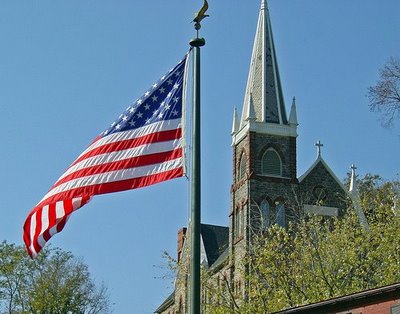
You would have to have been living under a rock not to know that religious liberty has come under fire here in the United States. Those who believe that the Catholic Church is wrong to get involved in the politics surrounding the HHS Mandate, for instance, have unwittingly bought into the argument that there is a “wall of separation” between Church and State, and that one should be completely separate from the other.
But the bishops, in a step that is unprecedented, have unanimously responded to the HHS Mandate, and other threats to religious liberty, with firm resolve. That fact alone should wake folks up to the idea that this time, it really is different. Or perhaps it just is, as Yogi Barra once said, déjà vu all over again.
So regardless of where your own personal political beliefs lie upon the spectrum between the left and the right, the geography of blue states or red states, and between the chasm that yawns between the liberal viewpoint and the conservative position, perhaps you need to just be reminded of the history of religious freedom in this country.
For to be ignorant of what we have, and how it came about, is to be ignorant of why what the government is attempting to do now is unprecedented, and why it must be fought. Ignorance of religious liberty, and whence it comes, is to be without a compass in a storm tossed sea.
So the bishops, by way of the Ad-hoc Committee for Religious Liberty, have put together a little current events brief on the state of religious liberty in America, complete with a history lesson, examples of where we are besieged, complete with footnotes, along with a prayer request issued to the faithful. Because ignorance is not bliss.
Here is a portion I found of special interest, as it dovetails with much of what I’ve been sharing of late from Bishop Thomas J. Curry’s work,
Religious Liberty Is More Than Freedom of Worship
Religious liberty is not only about our ability to go to Mass on Sunday or pray the Rosary at home. It is about whether we can make our contribution to the common good of all Americans. Can we do the good works our faith calls us to do, without having to compromise that very same faith? Without religious liberty properly understood, all Americans suffer, deprived of the essential contribution in education, health care, feeding the hungry, civil rights, and social services that religious Americans make every day, both here at home and overseas.
What is at stake is whether America will continue to have a free, creative, and robust civil society—or whether the state alone will determine who gets to contribute to the common good, and how they get to do it. Religious believers are part of American civil society, which includes neighbors helping each other, community associations, fraternal service clubs, sports leagues, and youth groups. All these Americans make their contribution to our common life, and they do not need the permission of the government to do so. Restrictions on religious liberty are an attack on civil society and the American genius for voluntary associations.
The Union of Orthodox Jewish Congregations of America issued a statement about the administration’s contraception and sterilization mandate that captured exactly the danger that we face:
Most troubling, is the Administration’s underlying rationale for its decision, which appears to be a view that if a religious entity is not insular, but engaged with broader society, it loses its “religious” character and liberties. Many faiths firmly believe in being open to and engaged with broader society and fellow citizens of other faiths. The Administration’s ruling makes the price of such an outward approach the violation of an organization’s religious principles. This is deeply disappointing.5
This is not a Catholic issue. This is not a Jewish issue. This is not an Orthodox, Mormon, or Muslim issue. It is an American issue.
The Most Cherished of American Freedoms
In 1634, a mix of Catholic and Protestant settlers arrived at St. Clement’s Island in Southern Maryland from England aboard the Ark and the Dove. They had come at the invitation of the Catholic Lord Baltimore, who had been granted Maryland by the Protestant King Charles I of England. While Catholics and Protestants were killing each other in Europe, Lord Baltimore imagined Maryland as a society where people of different faiths could live together peacefully. This vision was soon codified in Maryland’s 1649 Act Concerning Religion (also called the “Toleration Act”), which was the first law in our nation’s history to protect an individual’s right to freedom of conscience.
Maryland’s early history teaches us that, like any freedom, religious liberty requires constant vigilance and protection, or it will disappear. Maryland’s experiment in religious toleration ended within a few decades. The colony was placed under royal control, and the Church of England became the established religion. Discriminatory laws, including the loss of political rights, were enacted against those who refused to conform. Catholic chapels were closed, and Catholics were restricted to practicing their faith in their homes. The Catholic community lived under these conditions until the American Revolution.
By the end of the 18th century, our nation’s founders embraced freedom of religion as an essential condition of a free and democratic society. James Madison, often called the Father of the Constitution, described conscience as “the most sacred of all property.”6 He wrote that “the Religion then of every man must be left to the conviction and conscience of every man; and it is the right of every man to exercise it as these may dictate.”7 George Washington wrote that “the establishment of Civil and Religious Liberty was the Motive that induced me to the field of battle.”8 Thomas Jefferson assured the Ursuline Sisters—who had been serving a mostly non-Catholic population by running a hospital, an orphanage, and schools in Louisiana since 1727—that the principles of the Constitution were a “sure guarantee” that their ministry would be free “to govern itself according to its own voluntary rules, without interference from the civil authority.”9
It is therefore fitting that when the Bill of Rights was ratified, religious freedom had the distinction of being the First Amendment. Religious liberty is indeed the first liberty. The First Amendment guarantees that “Congress shall make no law respecting an establishment of religion, or prohibiting the free exercise thereof.”
Recently, in a unanimous Supreme Court judgment affirming the importance of that first freedom, the Chief Justice of the United States explained that religious liberty is not just the first freedom for Americans; rather it is the first in the history of democratic freedom, tracing its origins back the first clauses of the Magna Carta of 1215 and beyond. In a telling example, Chief Justice Roberts illustrated our history of religious liberty in light of a Catholic issue decided upon by James Madison, who guided the Bill of Rights through Congress and is known as the architect of the First Amendment:
[In 1806] John Carroll, the first Catholic bishop in the United States, solicited the Executive’s opinion on who should be appointed to direct the affairs of the Catholic Church in the territory newly acquired by the Louisiana Purchase. After consulting with President Jefferson, then-Secretary of State James Madison responded that the selection of church “functionaries” was an “entirely ecclesiastical” matter left to the Church’s own judgment. The “scrupulous policy of the Constitution in guarding against a political interference with religious affairs,” Madison explained, prevented the Government from rendering an opinion on the “selection of ecclesiastical individuals.”10
That is our American heritage, our most cherished freedom. It is the first freedom because if we are not free in our conscience and our practice of religion, all other freedoms are fragile. If citizens are not free in their own consciences, how can they be free in relation to others, or to the state? If our obligations and duties to God are impeded, or even worse, contradicted by the government, then we can no longer claim to be a land of the free, and a beacon of hope for the world.
Our Christian Teaching
During the civil rights movement of the 1950s and 1960s, Americans shone the light of the Gospel on a dark history of slavery, segregation, and racial bigotry. The civil rights movement was an essentially religious movement, a call to awaken consciences, not only an appeal to the Constitution for America to honor its heritage of liberty.
In his famous “Letter from Birmingham Jail” in 1963, Rev. Martin Luther King Jr. boldly said, “The goal of America is freedom.” As a Christian pastor, he argued that to call America to the full measure of that freedom was the specific contribution Christians are obliged to make. He rooted his legal and constitutional arguments about justice in the long Christian tradition:
I would agree with Saint Augustine that “An unjust law is no law at all.” Now what is the difference between the two? How does one determine when a law is just or unjust? A just law is a man-made code that squares with the moral law or the law of God. An unjust law is a code that is out of harmony with the moral law. To put it in the terms of Saint Thomas Aquinas, an unjust law is a human law that is not rooted in eternal law and natural law.11
It is a sobering thing to contemplate our government enacting an unjust law. An unjust law cannot be obeyed. In the face of an unjust law, an accommodation is not to be sought, especially by resorting to equivocal words and deceptive practices. If we face today the prospect of unjust laws, then Catholics in America, in solidarity with our fellow citizens, must have the courage not to obey them. No American desires this. No Catholic welcomes it. But if it should fall upon us, we must discharge it as a duty of citizenship and an obligation of faith.
It is essential to understand the distinction between conscientious objection and an unjust law. Conscientious objection permits some relief to those who object to a just law for reasons of conscience—conscription being the most well-known example. An unjust law is “no law at all.” It cannot be obeyed, and therefore one does not seek relief from it, but rather its repeal.
The Christian church does not ask for a special treatment, simply the rights of religious freedom for all citizens. Rev. King also explained that the church is neither the master nor the servant of the state, but its conscience, guide, and critic.
As Catholics, we know that our history has shadows too in terms of religious liberty, when we did not extend to others the proper respect for this first freedom. But the teaching of the Church is absolutely clear about religious liberty:
The human person has a right to religious freedom. This freedom means that all men are to be immune from coercion on the part of individuals or of social groups and of any human power, in such wise that in matters religious no one is to be forced to act in a manner contrary to his own beliefs … whether privately or publicly, whether alone or in association with others, within due limits. . . . This right of the human person to religious freedom is to be recognized in the constitutional law whereby society is governed. Thus it is to become a civil right.12
As Catholics, we are obliged to defend the right to religious liberty for ourselves and for others. We are happily joined in this by our fellow Christians and believers of other faiths.
The bishops call upon us to pray for the following prayer as well,
Almighty God, Father of all nations,
For freedom you have set us free in Christ Jesus (Gal 5:1).
We praise and bless you for the gift of religious liberty,
the foundation of human rights, justice, and the common good.
Grant to our leaders the wisdom to protect and promote our liberties;By your grace may we have the courage to defend them, for ourselves and for all those who live in this blessed land.
We ask this through the intercession of Mary Immaculate, our patroness, and in the name of your Son, our Lord Jesus Christ, in the unity of the Holy Spirit, with whom you live and reign, one God, for ever and ever. Amen.
There is much more, so please read it all. Print it out. Share it with your friends, family, and co-workers.
Previous Post

April 11, 2012
Phil Collins Shares My Thoughts On Google+
Browse Our Archives
Select a Category Blog News Conversion Story Culture Learning Living Nature Prayer Uncategorized Working
Select a Month June 2016 May 2016 August 2015 July 2015 June 2015 May 2015 April 2015 March 2015 February 2015 January 2015 December 2014 November 2014 October 2014 September 2014 August 2014 July 2014 June 2014 May 2014 April 2014 March 2014 February 2014 January 2014 December 2013 November 2013 October 2013 September 2013 August 2013 July 2013 June 2013 May 2013 April 2013 March 2013 February 2013 January 2013 December 2012 November 2012 October 2012 September 2012 August 2012 July 2012 June 2012 May 2012 April 2012 March 2012 February 2012 January 2012 December 2011 November 2011 October 2011 September 2011 August 2011 July 2011 June 2011 May 2011 April 2011 March 2011 February 2011 January 2011 December 2010 November 2010 October 2010 September 2010 August 2010 July 2010 June 2010 May 2010 April 2010 March 2010 February 2010 January 2010 December 2009 November 2009 October 2009 September 2009 August 2009
Follow Us!
TAKE THE
Religious Wisdom Quiz
Who was known as "the disciple whom Jesus loved"?
Select your answer to see how you score.
James Thomas John Peter
Related posts from Why I Am Catholic

Belated Happy Birthday To Blaise Pascal, Unofficial Saint...

Because My Brother Imran Yousef Is An American...

Joe Six-Pack, USMC, With A Few Post-Terrorist Attack...

This Is Why God Invented YouTube...
TRENDING AT PATHEOS Catholic

Rejecting Doom: Christian Hope And Human Action
Christianity is a religion of hope. We are to have hope and...

It’s What Comes From Within Which Matters
One of the most difficult things for us to understand is why...

Why I Choose the Eucharist Over the Sermon
Choose the Eucharist, Not the Sermon What are we supposed to get...

5 Design Elements Found in Spiritually Rooted Homes
Putting Spirituality Into Home Decor Our homes are more than our living...

Credo: A Story of God Told with the...
About 10 years ago, I began to imagine a personal "Credo" that...

The Anatomy of Divine Revelation in Catholic Thought
The claim that God has made Himself known to human beings is...
Ad-Free & Subscriber Log-In Subscription Support
- About Us
- 2026 Calendar
- Videos
- Podcasts
- Library of World Religions
- Faith In Media Tracker
- Advertise With Us
- Write for Us
- Privacy Policy
- Terms of Service
- Do Not Sell My Data
- Contact Us
- Radiant Digital
- Manage Newsletter Subscriptions
- Unsubscribe From Notifications
- Sitemap
Copyright 2008-2026, Patheos. All rights reserved.
Subscription Support Ad-Free & Subscriber Log-In
Follow Patheos