
BuddhistCatholicContemplativeEvangelicalGeneral ChristianHinduJewishLatter-day SaintMuslimNew VisionsProgressive Christian
Beliefs
- Buddhist
- Catholic
- Contemplative
- Evangelical
- General Christian
- Hindu
- Jewish
- Latter-day Saint
- More Voices
- Muslim
- New Visions
- Pagan
- Progressive Christian
Topics
- Religion News
- Food and Religion
- Sports and Religion
- Religious Art
- Religious Music and Entertainment
- Religious Events
- History and Religion
- Style and Religion
- Politics and Religion
- Women in Religion
- Recreation Outdoors and Religion
- Business Finance and Religion
- Careers Workplace and Religion
- Education and Religion
- Family Parenting and Religion
- Health Fitness and Religion
- Home and Religion
- Relationships and Religion
- Technology and Religion
- Travel and Religion
Columnists
- Buddhist Columnists
- Business Finance and Religion Columnists
- Careers Workplace and Religion Columnists
- Catholic Columnists
- Contemplative Columnists
- Education and Religion Columnists
- Evangelists Columnists
- Family Parenting and Religion Columnists
- General Christian Columnists
- Health Fitness and Religion Columnists
- Hindu Columnists
- History and Religion Columnists
- Home and Religion Columnists
- Jewish Columnists
- More Voices Columnists
- Latter Day Columnists
- Muslim Columnists
- New Visions Columnists
- Nonreligious Columnists
- Pagan Columnists
- Politics and Religion Columnists
- Progressive Columnists
- Recreation Outdoors and Religion Columnists
- Relationships and Religion Columnists
- Religion News Columnists
- Religious Art Columnists
- Religious Events Columnists
- Religious Music and Entertainment Columnists
- Sports and Religion Columnists
- Style and Religion Columnists
- Technology and Religion Columnists
- Travel and Religion Columnists
- Women in Religion Columnists
Resource Library
- 2026 Calendar
- Library of World Religions
- The 100 Most Holy Places on Earth
- Patheos Answers
- Podcasts
- Videos
- Faith Leaders Database
- Anglican Episcopalian
- Bahai
- Baptist
- Buddhism
- Christianity
- Confucianism
- Eastern Orthodoxy
- Hinduism
- Holiness and Pentecostal
- ISKCON
- Islam
- Judaism
- Lutheran
- Methodist
- The Church of Jesus Christ of Latter-day Saints
- New Age
- Paganism
- Presbytarian and Reformed
- Protestantism
- Religion Behind the Scenes
- Roman Catholic
- Scientology
- Shia Islam
- Sikhism
- Sufism
- Sunni Islam
- Taoism
- Zen
- See all religions
Research Tools
 Ad-Free & Subscriber Log-In Subscription Support
Ad-Free & Subscriber Log-In Subscription Support
Follow Patheos 

- Trending:
- Forgiveness
- |
- Marriage
- |
- Consciousness
- |
- Death Penalty
- |
- Election
- |
- Halloween
 Why I Am Catholic
-
More
- Home
- Because of the Lie of Overpopulation
Because of the Lie of Overpopulation
Last updated on: April 1, 2015 at 9:46 am by Frank Weathers
Because of the Lie of Overpopulation 2015-04-01T09:46:52-05:00 Frank Weathers
Patheos Explore the world's faith through different perspectives on religion and spirituality! Patheos has the views of the prevalent religions and spiritualities of the world.
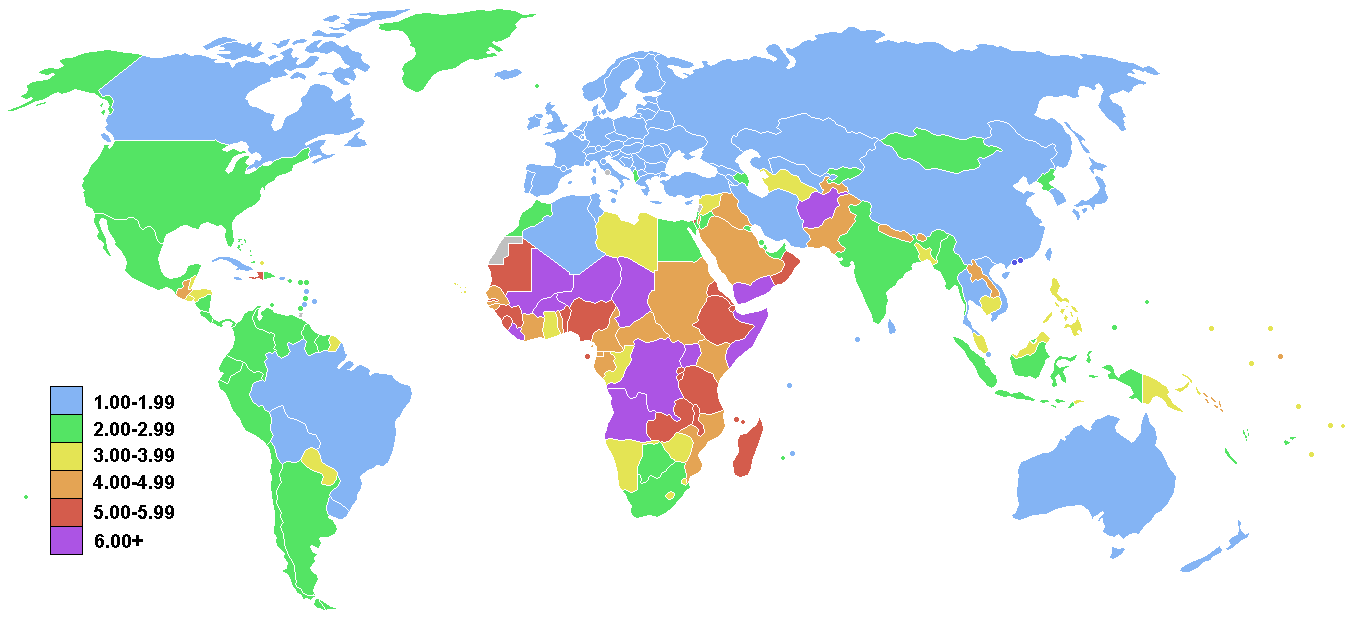
Looking at the map above, I recall the whole Blue State/Red State trope here in the U.S., but with a twist: if you live in a Blue State in the map above, you are facing extinction. But it doesn’t have to be that way.
I almost titled this post, “The Myth of Overpopulation,” but I didn’t because I think the word myth would have been used improperly if I did. Checking the Merriam-Webster dictionary, I find the following definitions for the word,
Definition of MYTH
1
a : a usually traditional story of ostensibly historical events that serves to unfold part of the world view of a people or explain a practice, belief, or natural phenomenon
b : parable, allegory2
a : a popular belief or tradition that has grown up around something or someone; especially : one embodying the ideals and institutions of a society or segment of society
b : an unfounded or false notion3
: a person or thing having only an imaginary or unverifiable existence4
: the whole body of myths
It turns out that I could have used the word in the narrow sense found in 2 b) an unfounded or false notion, but I think I’ll just stick with the word lie instead. It’s clearer, you see. Less ambiguous, nebulous, or opaque. Besides, a myth can be true, as J.R.R.Tolkien argued persuasively to Jack Lewis.
No, I’ll stick with the word lie, and share the following article by David P. Goldman, (h/t to Edward Feser’s link post) published in the Asia Times Online. Goldman, writing as “Spengler”, is the author of How Civilizations Die (And Why Islam is Dying Too). Here is a brief excerpt from the preface of that book.
But why are Muslims – and Europeans, and Japanese – living under a societal death sentence? Why are populations collapsing in the modern world? Demographers have identified several different factors associated with population decline: urbanization, education and literacy, the modernization of traditional societies. Children in traditional society had an economic value, as agricultural labor and as providers for elderly parents; urbanization and pension systems turned children into a cost rather than a source of income. And female literacy is a powerful predictor of population decline among the world’s countries. Mainly poor and illiterate women in Mali and Niger bear eight children in a lifetime, while literate and affluent women in the industrial world bear one or two.
But what determines whether it is one child or two? Children also have a spiritual value. That is why the degree of religious faith explains a great deal of the variation in population growth rates among the countries of the world. The industrial world’s lowest fertility rates are encountered among the nations of Eastern Europe where atheism was the official ideology for generations. The highest fertility rates are found in countries with a high degree of religious faith, namely the United States and Israel. And demographers have identified religion as a crucial factor in the differences among populations within countries. When faith goes, fertility vanishes, too. The death-spiral of birth rates in most of the industrial world has forced demographers to think in terms of faith. Dozens of new studies document the link between religious belief and fertility.
But why do some religions seem to provide better protection against the sterilizing effects of modernity than others? The fastest demographic decline ever registered in recorded history is taking place today in Muslim countries; demographic winter is descending fastest in the fifth of the world where religion most appears to dominate. And even more puzzling: why does one religion (Christianity) seem to inoculate a people against demographic decline in one place (America) but not in another (Europe)? In many parts of the world, what once looked like an indestructible rock of faith has melted in the hot light of modernity. In others, modernity has only added compost for the growth of faith. Apparently some kinds of faith will survive in the modern world, and others will fail.
Strategic analysts and politicians are poorly equipped to understand these new and disturbing circumstances, with their overarching implications for political strategy and economics. To make sense of the world today we must do better than secular political science, which pigeon-holes faith as one more belief-structure among the other belief-structures in its collection of specimens.
Our political science is uniquely ill-equipped to make sense of a global crisis whose ultimate cause is spiritual. But this was not always so. From the advent of Christianity to the seventeenth-century Enlightenment, the West saw politics through the lens of faith. St Augustine’s fifth-century treatise The City of God looked through the state to the underlying civil society, and understood that civil society as a congregation – a body bound together by common loves, as opposed to Cicero’s state founded only on common interests. (In the concluding chapter, we will consider Augustine’s view as a lodestar for an American foreign policy that realistically addresses the threats created by the imminent demographic collapse of nations.)
We might call Augustine’s view “theopolitics.” A millennium later, Niccolo Machiavelli and Thomas Hobbes changed the subject, to the individual’s desire for power, wealth, and personal survival. Hobbes, the 17th-century grandfather of modern political science, introduced a radically truncated anthropology, centered on the individual’s struggle for survival. The state, he argued, was a compact among individuals who survival prospects were poor in a “state of nature”; thus they ceded their individual rights to a sovereign in return for protection. A century later Montesquieu added differences in climate, terrain, and resources to the mix. The modern view of atomized man motivated only by the pursuit of material advantage is loosely known as “geopolitics”.
The full article is three pages long, but you really should go read the rest. Irony Alert: You may see advertisements touting the availability of “soulful Russian women.” As I recall, the fertility of women in the former Soviet Union had fallen off a cliff.
But forget my “recollections” and just check out the CIA World Factbook citation on World Fertility Rates. Again, if you really want to be a radical, a real “boat rocker,” decide that you want to settle down, get married, and have kids. And stop trying to prevent other folks from having babies, stop advocating abortion, and golly, when it is all said and done, just admit that the Catholic Church is right on issues of life.
If I’ve said it once, I’ve said it a million times: life makes the world go ’round. But God said it first, and then acted upon His Word when he pitched his tent among us.
A thief comes only to steal and slaughter and destroy; I came so that they might have life and have it more abundantly.
Believe the lie, or believe God. Even Mammon believes, and trembles in fear.
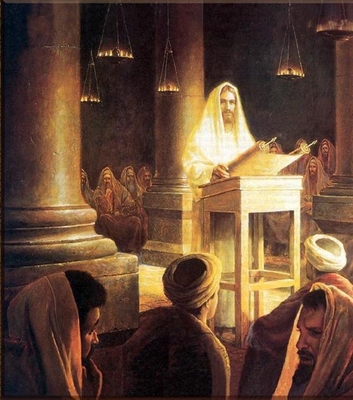
Jesus teaches with authority
Related: Because of the Church’s Position on Abortion
Previous Post

February 18, 2012
Why We Should Follow Our Bishops Now And Lead Them Too
Next Post
February 20, 2012 Fr. Leo Gives the POTUS the Finger on the HHS Mandate?
Browse Our Archives
Select a Category Blog News Conversion Story Culture Learning Living Nature Prayer Uncategorized Working
Select a Month June 2016 May 2016 August 2015 July 2015 June 2015 May 2015 April 2015 March 2015 February 2015 January 2015 December 2014 November 2014 October 2014 September 2014 August 2014 July 2014 June 2014 May 2014 April 2014 March 2014 February 2014 January 2014 December 2013 November 2013 October 2013 September 2013 August 2013 July 2013 June 2013 May 2013 April 2013 March 2013 February 2013 January 2013 December 2012 November 2012 October 2012 September 2012 August 2012 July 2012 June 2012 May 2012 April 2012 March 2012 February 2012 January 2012 December 2011 November 2011 October 2011 September 2011 August 2011 July 2011 June 2011 May 2011 April 2011 March 2011 February 2011 January 2011 December 2010 November 2010 October 2010 September 2010 August 2010 July 2010 June 2010 May 2010 April 2010 March 2010 February 2010 January 2010 December 2009 November 2009 October 2009 September 2009 August 2009
Follow Us!
TAKE THE
Religious Wisdom Quiz
What city’s walls fell after the Israelites marched around them?
Select your answer to see how you score.
Jericho Nineveh Jerusalem Babylon
Related posts from Why I Am Catholic

Belated Happy Birthday To Blaise Pascal, Unofficial Saint...

Because My Brother Imran Yousef Is An American...

Joe Six-Pack, USMC, With A Few Post-Terrorist Attack...

HHS Forced Sex Changes? There Ain't No Fait...
TRENDING AT PATHEOS Catholic

Creation, Preservation, and Teleology in Catholic Theology
As I write this, it is very early Monday morning. Like millions...

The Parable Of The Sower And The Word...
One of Christ’s most famous parables is that of the sower who...

Rejecting Doom: Christian Hope And Human Action
Christianity is a religion of hope. We are to have hope and...

Why I Choose the Eucharist Over the Sermon
Choose the Eucharist, Not the Sermon What are we supposed to get...

5 Design Elements Found in Spiritually Rooted Homes
Putting Spirituality Into Home Decor Our homes are more than our living...

Credo: A Story of God Told with the...
About 10 years ago, I began to imagine a personal "Credo" that...
Ad-Free & Subscriber Log-In Subscription Support
- About Us
- 2026 Calendar
- Videos
- Podcasts
- Library of World Religions
- Faith In Media Tracker
- Advertise With Us
- Write for Us
- Privacy Policy
- Terms of Service
- Do Not Sell My Data
- Contact Us
- Radiant Digital
- Manage Newsletter Subscriptions
- Unsubscribe From Notifications
- Sitemap
Copyright 2008-2026, Patheos. All rights reserved.
Subscription Support Ad-Free & Subscriber Log-In
Follow Patheos