
BuddhistCatholicContemplativeEvangelicalGeneral ChristianHinduJewishLatter-day SaintMuslimNew VisionsProgressive Christian
Beliefs
- Buddhist
- Catholic
- Contemplative
- Evangelical
- General Christian
- Hindu
- Jewish
- Latter-day Saint
- More Voices
- Muslim
- New Visions
- Pagan
- Progressive Christian
Topics
- Religion News
- Food and Religion
- Sports and Religion
- Religious Art
- Religious Music and Entertainment
- Religious Events
- History and Religion
- Style and Religion
- Politics and Religion
- Women in Religion
- Recreation Outdoors and Religion
- Business Finance and Religion
- Careers Workplace and Religion
- Education and Religion
- Family Parenting and Religion
- Health Fitness and Religion
- Home and Religion
- Relationships and Religion
- Technology and Religion
- Travel and Religion
Columnists
- Buddhist Columnists
- Business Finance and Religion Columnists
- Careers Workplace and Religion Columnists
- Catholic Columnists
- Contemplative Columnists
- Education and Religion Columnists
- Evangelists Columnists
- Family Parenting and Religion Columnists
- General Christian Columnists
- Health Fitness and Religion Columnists
- Hindu Columnists
- History and Religion Columnists
- Home and Religion Columnists
- Jewish Columnists
- More Voices Columnists
- Latter Day Columnists
- Muslim Columnists
- New Visions Columnists
- Nonreligious Columnists
- Pagan Columnists
- Politics and Religion Columnists
- Progressive Columnists
- Recreation Outdoors and Religion Columnists
- Relationships and Religion Columnists
- Religion News Columnists
- Religious Art Columnists
- Religious Events Columnists
- Religious Music and Entertainment Columnists
- Sports and Religion Columnists
- Style and Religion Columnists
- Technology and Religion Columnists
- Travel and Religion Columnists
- Women in Religion Columnists
Resource Library
- 2026 Calendar
- Library of World Religions
- The 100 Most Holy Places on Earth
- Patheos Answers
- Podcasts
- Videos
- Faith Leaders Database
- Anglican Episcopalian
- Bahai
- Baptist
- Buddhism
- Christianity
- Confucianism
- Eastern Orthodoxy
- Hinduism
- Holiness and Pentecostal
- ISKCON
- Islam
- Judaism
- Lutheran
- Methodist
- The Church of Jesus Christ of Latter-day Saints
- New Age
- Paganism
- Presbytarian and Reformed
- Protestantism
- Religion Behind the Scenes
- Roman Catholic
- Scientology
- Shia Islam
- Sikhism
- Sufism
- Sunni Islam
- Taoism
- Zen
- See all religions
Research Tools
 Ad-Free & Subscriber Log-In Subscription Support
Ad-Free & Subscriber Log-In Subscription Support
Follow Patheos 

- Trending:
- Forgiveness
- |
- Marriage
- |
- Consciousness
- |
- Death Penalty
- |
- Election
- |
- Halloween
 Why I Am Catholic
-
More
- Home
- Gone Readin’ About the History of the “Holy Places”
Gone Readin’ About the History of the “Holy Places”
Last updated on: January 24, 2017 at 6:15 pm by Frank Weathers
Gone Readin’ About the History of the “Holy Places” 2017-01-24T18:15:34-05:00 Frank Weathers
Patheos Explore the world's faith through different perspectives on religion and spirituality! Patheos has the views of the prevalent religions and spiritualities of the world.
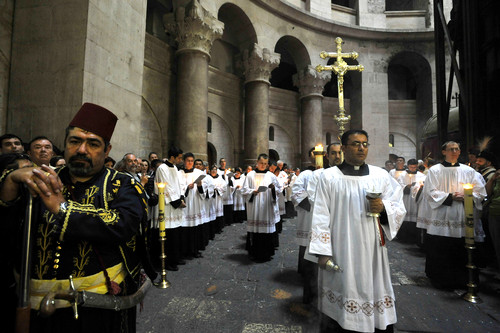
I have to admit to you, dear reader, that I am ignorant about much regarding the way “things” are. The world is a very complex place, and this is mostly through our own, dare I say it, grievous faults. And I also need to let you know that the semi-annual fracus in the Holy Places, like the one I shared with you yesterday, both sadden me and excite my interest in learning how they came about.
‘Tis true that trying in vain to flee from the chains of human history, one cannot forgot that history is also His Story. Curiosity killed the cat, and that fight in the Church of the Nativity killed what little sympathy I ever had for Orthodox Christianity’s claims to being one, holy, and apostolic.
If you ever wondered if I ever personally considered being Orthodox, what with my digging the Desert Fathers, and the Way of the Pilgrim and all, the answer is a resounding no. And it’s not because of the fisticuffs and brooms being thrown about in the Holy Places, but because the Orthodox broke away from Rome, early, and often. As I was searching for the True Church, see, I wasn’t about to go following the guys who tossed the See of Peter overboard. Besides, I learned there are Eastern Churches that are still faithful to Rome, so if I ever felt the “call of the East,” there is a Catholic way to explore that route.
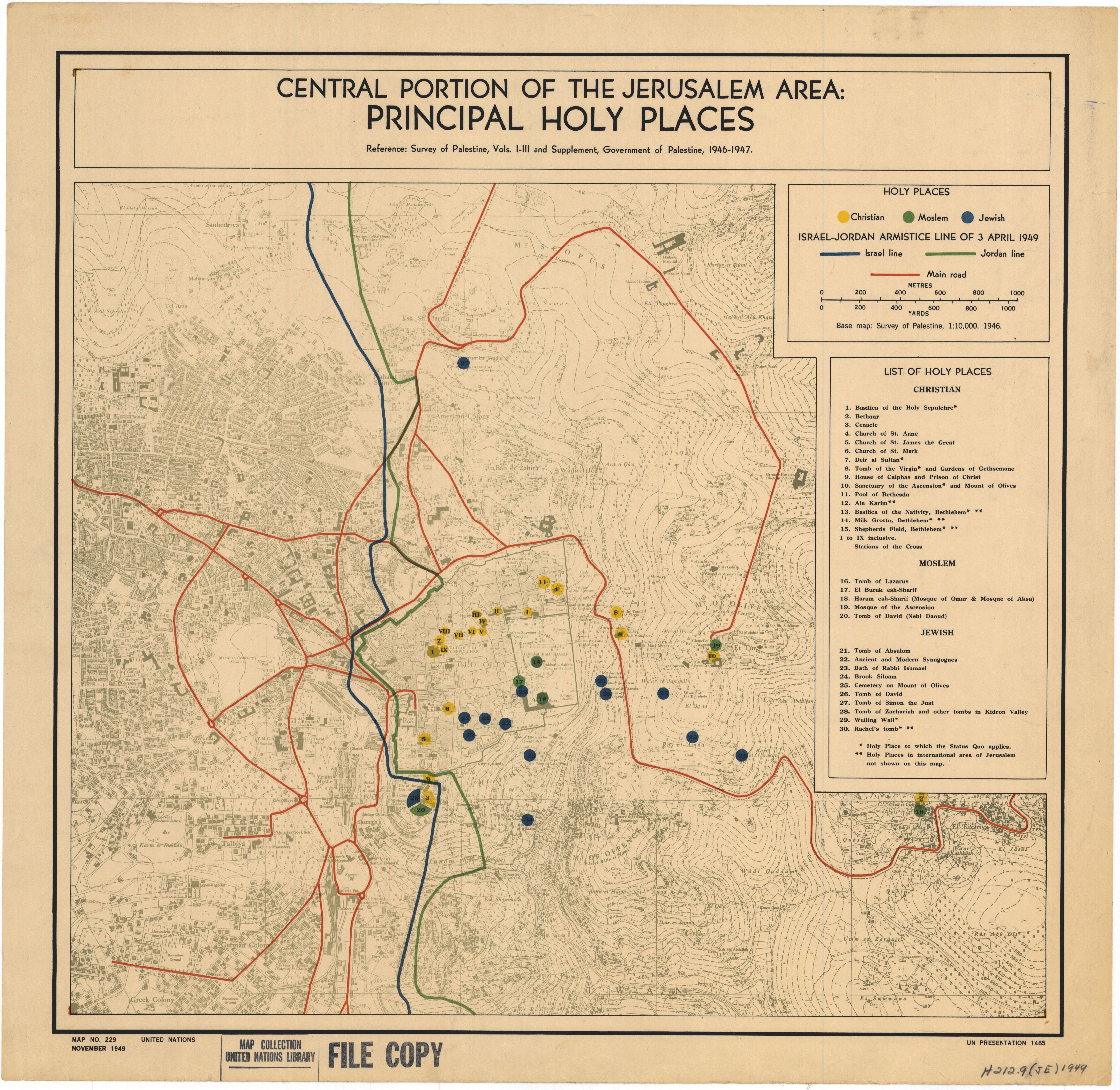
And so I’ve gone off to read about the history of the Holy Places in an effort to try and grasp why “things” are the way they are over there. I probably won’t be back until after New Years. Of course, my learning about the situation there won’t change anything one iota. But you are welcome to join me if you like.
I found the memorandum written in 1929 by L.G.A. Cust, entitled The Status Quo in the Holy Places, and I’ll get you started on it below. Cust had been the British District Officer stationed in Jerusalem when the British Mandate took effect in 1920. This came about when the League of Nations transferred the area of Palestine out of the hands of the Ottoman Empire and brought it under the control of the British Crown. Later, in 1948, the state of Israel declared it’s independence when the Briitish ended their mandate on 14 May, 1948.
I understand that even to this day, this memorandum is referred to constantly by all of the parties involved in administering the Holy Places. Fascinating reading is coming your way.
THE STATUS QUO. ITS ORIGIN AND HISTORY TILL THE PRESENT TIME.
To form a just appreciation of what is signified by the Status Quo in the Holy Places and thus arrive at a clear understanding of the various rights and privileges that arise from it, it is necessary to trace the development of the Church from its earliest days. For in all its salient features the Status Quo is the logical outcome of some occurrence in history, until gradually the present complicated network of rights and privileges is produced.
It is natural that the actual scenes connected with the Life on earth of Our Lord must from earliest times have been of surpassing interest to His followers, and there has been no important event connected with the history of the Church that has not had its repercussion in the Holy Places.
A fundamental reason for the present state of affairs is the fact that, except for limited periods, the Holy Places were for 13 centuries under the dominion of a non-Christian power from whom concessions were obtainable by diplomatic pressure or other influences. A remarkable feature, however, of the Moslem domination is the tolerance displayed on all but very rare occasions towards the Christians. The barbarian invaders of Syria and Palestine, such as the Persians and the Charismians spread widespread destruction, and the mad Caliph al-Hakem destroyed with scientific thoroughness the second Church of the Holy Sepulchre, but the original Arab invaders and the Saracens later acted in the spirit of protectors rather than conquerors. This magnanimous attitude was doubtless encouraged in some degree by the fact that the Holy Places, and the contentions of the different Christian sects on their account, were profitable sources of income, but in Moslem eyes the Christians (like the Jews) are Kitabis, i.e. People of the Book, worshippers of the true God, but not in the right way, and whom the Prophet ordained should not be persecuted.
In strong contrast is the rivalry of the Christian Churches and Powers. The history of the Holy Places is one long story of bitter animosities and contentions, in which outside influences take part in an increasing degree, until the scenes of Our Lord’s life on earth become a political shuttlecock, and eventually the cause of international conflict. If the Holy Places and the rights pertaining thereto are an ” expression of men’s feelings about Him whose story hallowed those sites,” they are also an index of the corruptions and intrigues of despots and chancelleries during eight hundred years. The logical results have been the spirit of distrust and suspicion, and the attitude of intractability in all matters, even if only of the most trivial importance, concerning the Holy Places.
A. Early Period.
In the earliest days the Church was one and undivided. Administratively it was split up into three great Patriarchates : Rome, Antioch, and Alexandria. Jerusalem, under its Roman name of Aelia Capitolina, was a bishopric in the Patriarchate of Antioch depending on the Metropolis of Caesarea, at that time the administrative centre as well. Such was the position when Constantine founded the great Churches of the Anastasis and the Nativity.
By the Edict of Milan in A.D. 313, Christianity had become the official religion of the Roman Empire, and the body politic of the Church set about organising itself. Seven great Councils were held, all of which were fraught with matters of great import for the future history of the Church.
At the Council of Nicaea we find the Bishop of the Holy City, who had already obtained a form of honorary primacy, being accorded ” the succession of honour.” At the First Council of Constantinople, the newly elevated Capital of the Empire was created a fourth Patriarchate. At the Council of Ephesus, Bishop Juvenal of Jerusalem attempted to obtain like privileges; he failed then, but succeeded a little later at Chalcedon, and so Jerusalem became the fifth Patriarchate. The venerable antiquity of the Jerusalem Patriarchate is therefore apparent.
These Councils, however, produced the heresies to which the lesser Eastern Churches trace their origin. After the Council of Ephesus the heresy of Nestorius broke off a large portion of the Patriarchate of Antioch, and the Council of Chalcedon saw the rise of Mono-physism, and the separatist Churches of this communion, the Armenian, Coptic, Syrian Jacobite, and Abyssinian.
I told you it was fascinating! Follow along with me on a journey into the past.
Previous Post

December 28, 2011
A Wacky Idea for Cleaning the Sacred Sites in the Holy Land- UPDATED
Next Post
December 30, 2011 Speaking of Errors and Being "In the Know,"
Browse Our Archives
Select a Category Blog News Conversion Story Culture Learning Living Nature Prayer Uncategorized Working
Select a Month June 2016 May 2016 August 2015 July 2015 June 2015 May 2015 April 2015 March 2015 February 2015 January 2015 December 2014 November 2014 October 2014 September 2014 August 2014 July 2014 June 2014 May 2014 April 2014 March 2014 February 2014 January 2014 December 2013 November 2013 October 2013 September 2013 August 2013 July 2013 June 2013 May 2013 April 2013 March 2013 February 2013 January 2013 December 2012 November 2012 October 2012 September 2012 August 2012 July 2012 June 2012 May 2012 April 2012 March 2012 February 2012 January 2012 December 2011 November 2011 October 2011 September 2011 August 2011 July 2011 June 2011 May 2011 April 2011 March 2011 February 2011 January 2011 December 2010 November 2010 October 2010 September 2010 August 2010 July 2010 June 2010 May 2010 April 2010 March 2010 February 2010 January 2010 December 2009 November 2009 October 2009 September 2009 August 2009
Follow Us!
TAKE THE
Religious Wisdom Quiz
Who was Timothy's mother?
Select your answer to see how you score.
Priscilla Eunice Lois Mary
Related posts from Why I Am Catholic

Belated Happy Birthday To Blaise Pascal, Unofficial Saint...

Because My Brother Imran Yousef Is An American...

Joe Six-Pack, USMC, With A Few Post-Terrorist Attack...
HHS Forced Sex Changes? There Ain't No Fait...
TRENDING AT PATHEOS Catholic

Rejecting Doom: Christian Hope And Human Action
Christianity is a religion of hope. We are to have hope and...

It’s What Comes From Within Which Matters
One of the most difficult things for us to understand is why...

Why I Choose the Eucharist Over the Sermon
Choose the Eucharist, Not the Sermon What are we supposed to get...

5 Design Elements Found in Spiritually Rooted Homes
Putting Spirituality Into Home Decor Our homes are more than our living...

Credo: A Story of God Told with the...
About 10 years ago, I began to imagine a personal "Credo" that...

The Anatomy of Divine Revelation in Catholic Thought
The claim that God has made Himself known to human beings is...
Ad-Free & Subscriber Log-In Subscription Support
- About Us
- 2026 Calendar
- Videos
- Podcasts
- Library of World Religions
- Faith In Media Tracker
- Advertise With Us
- Write for Us
- Privacy Policy
- Terms of Service
- Do Not Sell My Data
- Contact Us
- Radiant Digital
- Manage Newsletter Subscriptions
- Unsubscribe From Notifications
- Sitemap
Copyright 2008-2026, Patheos. All rights reserved.
Subscription Support Ad-Free & Subscriber Log-In
Follow Patheos