
BuddhistCatholicContemplativeEvangelicalGeneral ChristianHinduJewishLatter-day SaintMuslimNew VisionsProgressive Christian
Beliefs
- Buddhist
- Catholic
- Contemplative
- Evangelical
- General Christian
- Hindu
- Jewish
- Latter-day Saint
- More Voices
- Muslim
- New Visions
- Pagan
- Progressive Christian
Topics
- Religion News
- Food and Religion
- Sports and Religion
- Religious Art
- Religious Music and Entertainment
- Religious Events
- History and Religion
- Style and Religion
- Politics and Religion
- Women in Religion
- Recreation Outdoors and Religion
- Business Finance and Religion
- Careers Workplace and Religion
- Education and Religion
- Family Parenting and Religion
- Health Fitness and Religion
- Home and Religion
- Relationships and Religion
- Technology and Religion
- Travel and Religion
Columnists
- Buddhist Columnists
- Business Finance and Religion Columnists
- Careers Workplace and Religion Columnists
- Catholic Columnists
- Contemplative Columnists
- Education and Religion Columnists
- Evangelists Columnists
- Family Parenting and Religion Columnists
- General Christian Columnists
- Health Fitness and Religion Columnists
- Hindu Columnists
- History and Religion Columnists
- Home and Religion Columnists
- Jewish Columnists
- More Voices Columnists
- Latter Day Columnists
- Muslim Columnists
- New Visions Columnists
- Nonreligious Columnists
- Pagan Columnists
- Politics and Religion Columnists
- Progressive Columnists
- Recreation Outdoors and Religion Columnists
- Relationships and Religion Columnists
- Religion News Columnists
- Religious Art Columnists
- Religious Events Columnists
- Religious Music and Entertainment Columnists
- Sports and Religion Columnists
- Style and Religion Columnists
- Technology and Religion Columnists
- Travel and Religion Columnists
- Women in Religion Columnists
Resource Library
- 2026 Calendar
- Library of World Religions
- The 100 Most Holy Places on Earth
- Patheos Answers
- Podcasts
- Videos
- Faith Leaders Database
- Anglican Episcopalian
- Bahai
- Baptist
- Buddhism
- Christianity
- Confucianism
- Eastern Orthodoxy
- Hinduism
- Holiness and Pentecostal
- ISKCON
- Islam
- Judaism
- Lutheran
- Methodist
- The Church of Jesus Christ of Latter-day Saints
- New Age
- Paganism
- Presbytarian and Reformed
- Protestantism
- Religion Behind the Scenes
- Roman Catholic
- Scientology
- Shia Islam
- Sikhism
- Sufism
- Sunni Islam
- Taoism
- Zen
- See all religions
Research Tools
 Ad-Free & Subscriber Log-In Subscription Support
Ad-Free & Subscriber Log-In Subscription Support
Follow Patheos 

- Trending:
- Forgiveness
- |
- Marriage
- |
- Consciousness
- |
- Death Penalty
- |
- Election
- |
- Halloween
 Why I Am Catholic
-
More
- Home
- “Occupy Wall Street” Insider’s Perspective: Mammon Is Very Concerned
“Occupy Wall Street” Insider’s Perspective: Mammon Is Very Concerned
Last updated on: January 24, 2017 at 6:19 pm by Frank Weathers
“Occupy Wall Street” Insider’s Perspective: Mammon Is Very Concerned 2017-01-24T18:19:23-05:00 Frank Weathers
Patheos Explore the world's faith through different perspectives on religion and spirituality! Patheos has the views of the prevalent religions and spiritualities of the world.
Yesterday, along with Stephen Colbert, I had a little fun with the Occupy Wall Street protests. Enjoying Colbert’s humor by no means throws me in with the camp of the “unconcerned” who perhaps think these protests are a complete waste of time.
Instead, line me up with the folks who say, “Houston, we have a problem.” And though I can quote Catholic teachings on private property, private enterprise, etc., all day long (and I’m hungry to learn more), I haven’t exactly shied away from sharing blunt facts on the wide disparities American citizens have endured over the last 35 years.

Mammon über alles
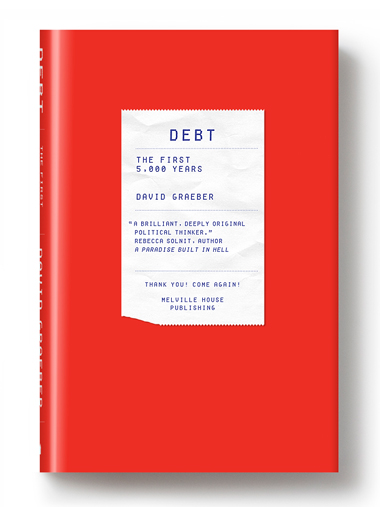
A little over two months ago, I shared some thoughts with you about the Old Testament concept of the Jubilee, written by the author of the book on the history of debt you see above. That fellow is named David Graeber, and what follows is an interview he gave recently with Kevin Depew, former Editor-in-Chief of the financial infotainment website Minyanville.
It turns out that Graeber became involved with the Occupy Wall Street movement shortly before I posted his thoughts on the Jubilee back in August. Since then, the movement has spread to over 1200 cities ’round the globe. This interview, which was just posted today as a podcast, as well as via transcript, may be of interest to you.
Because certainly, something is rotten in the state of Denmark . Otherwise, we wouldn’t be interested in Greek debt default fears and “what it all means.” Spending a few minutes with Depew and Graebel, with a commitment to doing so with softened hearts and open minds, may help clarify a few things about the Occupy Wall Street movement for you. I’ll turn it over now to Kevin Depew.
****
“Money is the root of all evil” – so goes the old adage. In today’s hyper-connected globalized market, a more accurate aphorism might be “debt is the root of all evil.” We see this in the crushing Greek and American sovereign debt, in the housing market where scores of homeowners are being foreclosed upon because they are unable to pay their mortgages, and in the amount of loans students have to take on to go to college these days – all of these different debts threaten to take down the house of cards that is our hyper-connected global financial market.
But why is it that when countries in bad shape restructure debt or when corporations drowning in debt declare bankruptcy, they are applauded, but when you and I fail to pay up on what we owe to banks or when we become bankrupt, it is seen as a moral failing? That’s the paradox David Graeber explores in his new book, Debt: The First 5,000 Years.
Kevin Depew
Okay, I’m Kevin Depew from Minyanville and joining me on this podcast is David Graeber, author of the new book, Debt: The First 5,000 Years. Welcome, David.David Graeber
Thanks.Kevin Depew
Now, just in a way of providing some of your background for our listeners. David teaches anthropology at Goldsmiths, University of London and has written numerous books on a wide range of anthropological and economic topics. He’s written for Harper’s, The Nation, [Mute] and the New Left Review, and you’re frequently introduced by the media as a, quote, “activist and anarchist,” end quote. How’s that for an introduction?David Graeber
Well, that’s more or less right.Kevin Depew
Okay. Well, David, I want to talk to you about Occupy Wall Street, of course, and what’s happening with this global movement. But business first. Your book, Debt: The First 5,000 Years, tell me about how the book came about.David Graeber
Well, I’d been actually, in a way, it emerges from my involvement in other activist projects. I was involved for many years in the global justice movement and one of the big issues there was the Drop the Debt campaign, structural adjustment policies, all those things that we’re really mobilizing against were enforced through debt.And one of the things that really fascinated me was the moral power of the idea of debt. I would tell stories to people, very sympathetic people, liberal lawyers, well-meaning do-gooder types, and you’d tell these stories about horrible things. You know, in Madagascar, for example, the IMF came in with these policies, you have to cut the budgets because, god knows, we can’t reduce the interest payments you owe to Citibank (C), they owed all this money. And they had to do things like get rid of mosquito eradication programs, as a result that malaria returned to parts of the country where it had been wiped out for a hundred years and tens of thousands of people died and you had dead babies being buried and weeping mothers. I was there, I saw this sort of thing. You described this people and the reaction would be, well, that’s terrible, but surely people have to pay their debts. You’re not suggesting they cancel it or default, that would be outrageous.
And it seems like, it’s hard to imagine any other issue where people try to come up with excuses for doing things that would kill 10,000 babies. But here they were doing it.
So what is that strange, moral power that the idea of debt has over us that seems to trump any other form of morality. That’s one of the questions that I was trying to answer in the book.
Kevin Depew
If I can just read a couple of sentences from the book, because…David Graeber
Sure.Kevin Depew
I was fortunate to get it earlier in the spring when your publisher sent me a review copy. And it really is a fascinating book, so I’ve recommended it to so many people, because it’s a completely different way of looking at debt and most of us, especially in the financial media, were used to approaching this from within the structure, within the framework we deal with and looking at it in pure economic terms when you bring this other, anthropological attachment and approach to it.If I could just, these are a couple of sentences from the book and this is near the end, I don’t think it gives much away, but it touches on exactly what you just talked about. And this is David writing, quote:
“It seems to me that we’re long overdue for some kind of biblical-style jubilee, one that would affect both international debt and consumer debt. It would be salutary, not just because it would relieve so much genuine human suffering, but also because it would be our way of reminding ourselves that money is not ineffable, that paying one’s debts is not the essence of morality. That all these things are human arrangements and, if democracy is to mean anything, it is to the ability for all to agree to arrange things in a different way.”
End quote.
Now, I read that because it touches on, how did we get to this point where debt indeed became this—it goes on, at least until recently with Occupy Wall Street, it goes without question that it’s a code of morality that we have to live up to. How did we get to this point?
David Graeber
It’s a really interesting question and the best answer I could come up with, after surveying 5,000 years of religious texts, moral texts, economic texts, political texts, pretty much everything there was to bring to bear on the subject, was it has a lot to do with war and violence.The very origins of money have, certainly coins, have much more to do with war mobilization, states conquering places, than they do with actual trade, which tended to be conducted as credit arrangements, but were inherently more flexible than the ones we have today. That sort of inviolability comes more from the process of shaking people down than from the process of actually people making deals and arrangements with one another.
And there’s a stream—so that very morality of debt has a lot to do with it. For example, in almost all the great world religions, they talk about debt as if paying your debts is morality. In fact, even the word for debt, sin and guilt are often the same. That’s true in Sanskrit, that’s true in Aramaic. The Lord’s Prayer doesn’t actually say, “Forgive us our trespasses,” it says “Forgive us our debts just as we forgive our debtors.” Of course, the trick is, you don’t actually forgive your debtors, do you?
Read the rest, and more stories on the OWS movement, over at Minyanville. Also, interesting discussions over at Mark Shea’s place.
Previous Post

November 3, 2011
Everything You Wanted to Know about the Banner
Next Post
November 4, 2011 Harry S. Truman, Mammon, and Déjà Vu, All Over Again
Browse Our Archives
Select a Category Blog News Conversion Story Culture Learning Living Nature Prayer Uncategorized Working
Select a Month June 2016 May 2016 August 2015 July 2015 June 2015 May 2015 April 2015 March 2015 February 2015 January 2015 December 2014 November 2014 October 2014 September 2014 August 2014 July 2014 June 2014 May 2014 April 2014 March 2014 February 2014 January 2014 December 2013 November 2013 October 2013 September 2013 August 2013 July 2013 June 2013 May 2013 April 2013 March 2013 February 2013 January 2013 December 2012 November 2012 October 2012 September 2012 August 2012 July 2012 June 2012 May 2012 April 2012 March 2012 February 2012 January 2012 December 2011 November 2011 October 2011 September 2011 August 2011 July 2011 June 2011 May 2011 April 2011 March 2011 February 2011 January 2011 December 2010 November 2010 October 2010 September 2010 August 2010 July 2010 June 2010 May 2010 April 2010 March 2010 February 2010 January 2010 December 2009 November 2009 October 2009 September 2009 August 2009
Follow Us!
TAKE THE
Religious Wisdom Quiz
Not by might nor by power, but by my Spirit, says the Lord Almighty. What seemingly impossible task will be accomplished?
Select your answer to see how you score.
Rebuilding Jerusalem Completing the temple Defeating Israel's enemies The Gathering of Israel
Related posts from Why I Am Catholic

Belated Happy Birthday To Blaise Pascal, Unofficial Saint...

Because My Brother Imran Yousef Is An American...

Joe Six-Pack, USMC, With A Few Post-Terrorist Attack...

This Is Why God Invented YouTube...
TRENDING AT PATHEOS Catholic

Rejecting Doom: Christian Hope And Human Action
Christianity is a religion of hope. We are to have hope and...

It’s What Comes From Within Which Matters
One of the most difficult things for us to understand is why...

Why I Choose the Eucharist Over the Sermon
Choose the Eucharist, Not the Sermon What are we supposed to get...

5 Design Elements Found in Spiritually Rooted Homes
Putting Spirituality Into Home Decor Our homes are more than our living...

Credo: A Story of God Told with the...
About 10 years ago, I began to imagine a personal "Credo" that...

The Anatomy of Divine Revelation in Catholic Thought
The claim that God has made Himself known to human beings is...
Ad-Free & Subscriber Log-In Subscription Support
- About Us
- 2026 Calendar
- Videos
- Podcasts
- Library of World Religions
- Faith In Media Tracker
- Advertise With Us
- Write for Us
- Privacy Policy
- Terms of Service
- Do Not Sell My Data
- Contact Us
- Radiant Digital
- Manage Newsletter Subscriptions
- Unsubscribe From Notifications
- Sitemap
Copyright 2008-2026, Patheos. All rights reserved.
Subscription Support Ad-Free & Subscriber Log-In
Follow Patheos