
BuddhistCatholicContemplativeEvangelicalGeneral ChristianHinduJewishLatter-day SaintMuslimNew VisionsProgressive Christian
Beliefs
- Buddhist
- Catholic
- Contemplative
- Evangelical
- General Christian
- Hindu
- Jewish
- Latter-day Saint
- More Voices
- Muslim
- New Visions
- Pagan
- Progressive Christian
Topics
- Religion News
- Food and Religion
- Sports and Religion
- Religious Art
- Religious Music and Entertainment
- Religious Events
- History and Religion
- Style and Religion
- Politics and Religion
- Women in Religion
- Recreation Outdoors and Religion
- Business Finance and Religion
- Careers Workplace and Religion
- Education and Religion
- Family Parenting and Religion
- Health Fitness and Religion
- Home and Religion
- Relationships and Religion
- Technology and Religion
- Travel and Religion
Columnists
- Buddhist Columnists
- Business Finance and Religion Columnists
- Careers Workplace and Religion Columnists
- Catholic Columnists
- Contemplative Columnists
- Education and Religion Columnists
- Evangelists Columnists
- Family Parenting and Religion Columnists
- General Christian Columnists
- Health Fitness and Religion Columnists
- Hindu Columnists
- History and Religion Columnists
- Home and Religion Columnists
- Jewish Columnists
- More Voices Columnists
- Latter Day Columnists
- Muslim Columnists
- New Visions Columnists
- Nonreligious Columnists
- Pagan Columnists
- Politics and Religion Columnists
- Progressive Columnists
- Recreation Outdoors and Religion Columnists
- Relationships and Religion Columnists
- Religion News Columnists
- Religious Art Columnists
- Religious Events Columnists
- Religious Music and Entertainment Columnists
- Sports and Religion Columnists
- Style and Religion Columnists
- Technology and Religion Columnists
- Travel and Religion Columnists
- Women in Religion Columnists
Resource Library
- 2026 Calendar
- Library of World Religions
- The 100 Most Holy Places on Earth
- Patheos Answers
- Podcasts
- Videos
- Faith Leaders Database
- Anglican Episcopalian
- Bahai
- Baptist
- Buddhism
- Christianity
- Confucianism
- Eastern Orthodoxy
- Hinduism
- Holiness and Pentecostal
- ISKCON
- Islam
- Judaism
- Lutheran
- Methodist
- The Church of Jesus Christ of Latter-day Saints
- New Age
- Paganism
- Presbytarian and Reformed
- Protestantism
- Religion Behind the Scenes
- Roman Catholic
- Scientology
- Shia Islam
- Sikhism
- Sufism
- Sunni Islam
- Taoism
- Zen
- See all religions
Research Tools
 Ad-Free & Subscriber Log-In Subscription Support
Ad-Free & Subscriber Log-In Subscription Support
Follow Patheos 

- Trending:
- Forgiveness
- |
- Marriage
- |
- Consciousness
- |
- Death Penalty
- |
- Election
- |
- Halloween
 Why I Am Catholic
-
More
- Home
- Because the Church is Paradoxically Intolerant and Tolerant
Because the Church is Paradoxically Intolerant and Tolerant
Last updated on: June 7, 2015 at 10:39 pm by Frank Weathers
Because the Church is Paradoxically Intolerant and Tolerant 2015-06-07T22:39:00-05:00 Frank Weathers
Patheos Explore the world's faith through different perspectives on religion and spirituality! Patheos has the views of the prevalent religions and spiritualities of the world.

This isn’t the first post I’ve written on paradoxes of the Catholic faith, nor will it be the last. Remember the one on the Church being paradoxically consistent (and vice versa)? Or how about the one on the “Master of Paradoxes,” St. John of the Cross? Like a bull through a china shop, I’ve again let the cat out of the bag with a title that says everything that I’m about to share with you on the modern “virtue” of tolerance.
As it turns out, the idea of tolerance may be modern, but it is not a virtue. Not in the Catholic sense anyway. Do a search for the word “tolerance” in the Catechism and you will come up empty. Ditto in the Compendium of the Social Doctrine of the Church. Guess why that is? Because when searching for this word in the Bible, even through 18 different translations, it only comes up twice, and interestingly these two verses are from the New Testament (in St. Paul’s letters to the Romans and the Ephesians).
But the word does not appear in Catholic translations of the scriptures at all. Instead of tolerance, see, the Church prefers the word forbearance. The gospel witness does claim Jesus uses the word “tolerable,” though not in a positive way. Take a look,
If anyone will not welcome you or listen to your words, shake off the dust from your feet as you leave that house or town. Truly I tell you, it will be more tolerable for the land of Sodom and Gomorrah on the day of judgment than for that town.
See? Where is “tolerant Jesus?” As for His Church, she’s obviously intolerant! Some folks think this is great. Others think of this as yet another indictment against the Church. Neither are quite right.
Today’s readings point the way toward shedding light on this paradox. Monsignor Charles Pope shared thoughts on today’s readings with a post entitled The Call to Compassionate Christian Correction. Seriously, what more can I, a layman who sometimes goes by the pseudonym “Joe Six-Pack,” bring to the table that Monsignor Pope has not? Probably nothing, but here goes.
The Church is intolerant of sin and she is intolerant of error. Would you expect anything less from the pillar of truth? Because truth, see, is what she proclaims. And where has she found this truth? Through the Triune God in the Persons of God the Father, His son Jesus Christ, and the Holy Spirit, who also happened to inspire the scriptures. This is where many have given up on her, because much as Pontius Pilate did when he was questioning Jesus, many ask (and some simply state) “what is truth?” And it isn’t a stretch to say that “sin” has fallen out of favor with the world nowadays. For example, the Church’s definition of sexual sins are today just another idea of a normal lifestyle for some folks.
So the first reading from the profit Ezekiel likens the Church to a watchman, and we are the Church. As I can say from years of experience, standing watch is no fun. And as God makes known in the scripture passage in Ezekiel today,
If I tell the wicked, “O wicked one, you shall surely die,” and you do not speak out to dissuade the wicked from his way, the wicked shall die for his guilt, but I will hold you responsible for his death.
This sounds like the No-Win situation from the Star Trek movie franchise. You know, the Kobayashi Maru scenario? And it is except for the following work-around,
But if you warn the wicked, trying to turn him from his way, and he refuses to turn from his way, he shall die for his guilt, but you shall save yourself.

Whew—a way to beat the no-win scenario! But uh-oh, there is a catch. You’ll be about as appreciated as the hall monitor was back from your days in school. And if you’re not careful, you’ll have lost those who don’t believe in God at all as well as those who do but who say “who are you calling wicked?” Pitch forks, torches, and signs waving the words “judge not” will come a calling. They’ll be circling the wagons around the perimeter, and then breaking out the battering rams in order to cleanse themselves of the pesky folks who bring this stuff to their attention. You might as well tie a red meat necklace around your neck and walk through the lions cage at your local zoo holding a sign that says “Martyrdom or Bust!”
Gulp! That’s where it led Christ and eleven of the Apostles, and hundreds of saints.
Speaking of St. Paul’s letter to the Romans, that’s exactly where the second reading hails from. Therein, he is inspired to write,
Owe nothing to anyone, except to love one another; for the one who loves another has fulfilled the law. The commandments, “You shall not commit adultery; you shall not kill; you shall not steal; you shall not covet,” and whatever other commandment there may be, are summed up in this saying, namely, “You shall love your neighbor as yourself.” Love does no evil to the neighbor; hence, love is the fulfillment of the law.
Monsignor Pope does a much better job than I could to explain this in his post on compassionate correction. Here’s what I told my kids this morning though: your parents love you, and yet we don’t allow you to just do whatever you like to do, whenever you like to do it, do we? No. That is what parents are for. We love you enough to teach you right from wrong and bring you up to know the difference between the two. And when you start dancing along the ragged edge, we’ll reel you back in, sit you down, and set you straight. That is what the Church does as well, and why we call her Our Mother.
Sliding on down the slippery slope of rookie scriptural reflections, this brings me to today’s Gospel reading. As the good monsignor notes, this is one of the proof texts for the legitimacy of the process of excommunication. But it is more than that. It is a text on the importance of reconciling with one another. It is a realistic text, spoken with the knowledge that oftentimes personal reconciliation efforts will be repulsed.
But we also meet up with this paradox on the instruction on how to treat folks who will not reconcile themselves in the manner described, and we must juxtapose it with the way Jesus himself actually treated Gentiles and tax collectors: he sat down with them and ate with them, much to the consternation of the Pharisees. In the next chapter after today’s reading, Jesus tells a little parable to the chief priests and elders at the temple,
“What is your opinion? A man had two sons. He came to the first and said, ‘Son, go out and work in the vineyard today.’ He said in reply, ‘I will not,’ but afterwards he changed his mind and went. The man came to the other son and gave the same order. He said in reply, ‘Yes, sir,’ but did not go. Which of the two did his father’s will?” They answered, “The first.” Jesus said to them, “Amen, I say to you, tax collectors and prostitutes are entering the kingdom of God before you. When John came to you in the way of righteousness, you did not believe him; but tax collectors and prostitutes did. Yet even when you saw that, you did not later change your minds and believe him.”
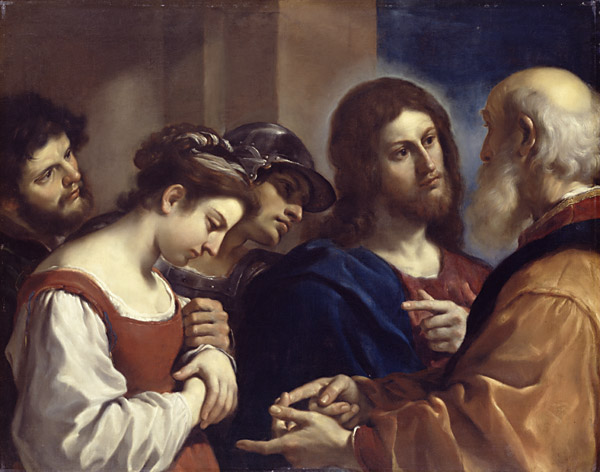 Guercino’s Christ and the
Woman taken in adultery
Need some more examples? Remember the tax collector named Matthew? How about Zacchaeus? Or a certain Samaritan woman at a well. And need I remind you of the woman accused of adultery? And Our Lord ends this passage with thoughts on the importance of, and the effectiveness of, prayer and how it brings Him into our midst. Powerful stuff!
Guess how many times the word “peace” is found in the scriptures?
Which brings us fully around this paradoxical circle to a startling truth: the Church, though intolerant of sin and error, is benevolently tolerant of sinners, and those of us who err, which is every single one of us. In fact, just like Christ, the Church loves us like a mother. And like a parent who has taught their child right from wrong, she stands ready to continue to provide for that child through thick and thin. Unlike our temporal parents though, She lives forever and stands by to provide succor and comfort to us all of the days of our lives. And as the psalmist sings today, I recommend that,
If today you hear his voice, harden not your hearts.
See? Just another long winded post outlining another paradoxical reason “why I am Catholic.”
The Compendium of the Social Doctrine of the Church in its entirety can be found here. Image credit for lead photograph: Graceway Media.

Previous Post

September 2, 2011
For Your Holiday Friday Night at the Movies: Soul Surfer
Next Post
September 8, 2011 Because This Makes Me Speechless
Browse Our Archives
Select a Category Blog News Conversion Story Culture Learning Living Nature Prayer Uncategorized Working
Select a Month June 2016 May 2016 August 2015 July 2015 June 2015 May 2015 April 2015 March 2015 February 2015 January 2015 December 2014 November 2014 October 2014 September 2014 August 2014 July 2014 June 2014 May 2014 April 2014 March 2014 February 2014 January 2014 December 2013 November 2013 October 2013 September 2013 August 2013 July 2013 June 2013 May 2013 April 2013 March 2013 February 2013 January 2013 December 2012 November 2012 October 2012 September 2012 August 2012 July 2012 June 2012 May 2012 April 2012 March 2012 February 2012 January 2012 December 2011 November 2011 October 2011 September 2011 August 2011 July 2011 June 2011 May 2011 April 2011 March 2011 February 2011 January 2011 December 2010 November 2010 October 2010 September 2010 August 2010 July 2010 June 2010 May 2010 April 2010 March 2010 February 2010 January 2010 December 2009 November 2009 October 2009 September 2009 August 2009
Follow Us!
TAKE THE
Religious Wisdom Quiz
What Christian group follows the Augsburg Confession?
Select your answer to see how you score.
Methodists Lutherans Pentecostals Presbyterians
Related posts from Why I Am Catholic

Belated Happy Birthday To Blaise Pascal, Unofficial Saint...

Because My Brother Imran Yousef Is An American...

Joe Six-Pack, USMC, With A Few Post-Terrorist Attack...

This Is Why God Invented YouTube...
TRENDING AT PATHEOS Catholic

Rejecting Doom: Christian Hope And Human Action
Christianity is a religion of hope. We are to have hope and...

It’s What Comes From Within Which Matters
One of the most difficult things for us to understand is why...

Why I Choose the Eucharist Over the Sermon
Choose the Eucharist, Not the Sermon What are we supposed to get...

5 Design Elements Found in Spiritually Rooted Homes
Putting Spirituality Into Home Decor Our homes are more than our living...

Credo: A Story of God Told with the...
About 10 years ago, I began to imagine a personal "Credo" that...

The Anatomy of Divine Revelation in Catholic Thought
The claim that God has made Himself known to human beings is...
Ad-Free & Subscriber Log-In Subscription Support
- About Us
- 2026 Calendar
- Videos
- Podcasts
- Library of World Religions
- Faith In Media Tracker
- Advertise With Us
- Write for Us
- Privacy Policy
- Terms of Service
- Do Not Sell My Data
- Contact Us
- Radiant Digital
- Manage Newsletter Subscriptions
- Unsubscribe From Notifications
- Sitemap
Copyright 2008-2026, Patheos. All rights reserved.
Subscription Support Ad-Free & Subscriber Log-In
Follow Patheos