
BuddhistCatholicContemplativeEvangelicalGeneral ChristianHinduJewishLatter-day SaintMuslimNew VisionsProgressive Christian
Beliefs
- Buddhist
- Catholic
- Contemplative
- Evangelical
- General Christian
- Hindu
- Jewish
- Latter-day Saint
- More Voices
- Muslim
- New Visions
- Pagan
- Progressive Christian
Topics
- Religion News
- Food and Religion
- Sports and Religion
- Religious Art
- Religious Music and Entertainment
- Religious Events
- History and Religion
- Style and Religion
- Politics and Religion
- Women in Religion
- Recreation Outdoors and Religion
- Business Finance and Religion
- Careers Workplace and Religion
- Education and Religion
- Family Parenting and Religion
- Health Fitness and Religion
- Home and Religion
- Relationships and Religion
- Technology and Religion
- Travel and Religion
Columnists
- Buddhist Columnists
- Business Finance and Religion Columnists
- Careers Workplace and Religion Columnists
- Catholic Columnists
- Contemplative Columnists
- Education and Religion Columnists
- Evangelists Columnists
- Family Parenting and Religion Columnists
- General Christian Columnists
- Health Fitness and Religion Columnists
- Hindu Columnists
- History and Religion Columnists
- Home and Religion Columnists
- Jewish Columnists
- More Voices Columnists
- Latter Day Columnists
- Muslim Columnists
- New Visions Columnists
- Nonreligious Columnists
- Pagan Columnists
- Politics and Religion Columnists
- Progressive Columnists
- Recreation Outdoors and Religion Columnists
- Relationships and Religion Columnists
- Religion News Columnists
- Religious Art Columnists
- Religious Events Columnists
- Religious Music and Entertainment Columnists
- Sports and Religion Columnists
- Style and Religion Columnists
- Technology and Religion Columnists
- Travel and Religion Columnists
- Women in Religion Columnists
Resource Library
- 2026 Calendar
- Library of World Religions
- The 100 Most Holy Places on Earth
- Patheos Answers
- Podcasts
- Videos
- Faith Leaders Database
- Anglican Episcopalian
- Bahai
- Baptist
- Buddhism
- Christianity
- Confucianism
- Eastern Orthodoxy
- Hinduism
- Holiness and Pentecostal
- ISKCON
- Islam
- Judaism
- Lutheran
- Methodist
- The Church of Jesus Christ of Latter-day Saints
- New Age
- Paganism
- Presbytarian and Reformed
- Protestantism
- Religion Behind the Scenes
- Roman Catholic
- Scientology
- Shia Islam
- Sikhism
- Sufism
- Sunni Islam
- Taoism
- Zen
- See all religions
Research Tools
 Ad-Free & Subscriber Log-In Subscription Support
Ad-Free & Subscriber Log-In Subscription Support
Follow Patheos 

- Trending:
- Forgiveness
- |
- Marriage
- |
- Consciousness
- |
- Death Penalty
- |
- Election
- |
- Halloween
 Why I Am Catholic
-
More
- Home
- Thoughts on the Economy: Catholic, and Not
Thoughts on the Economy: Catholic, and Not
Last updated on: January 22, 2015 at 12:38 pm by Frank Weathers
Thoughts on the Economy: Catholic, and Not 2015-01-22T12:38:29-05:00 Frank Weathers
Patheos Explore the world's faith through different perspectives on religion and spirituality! Patheos has the views of the prevalent religions and spiritualities of the world.
Ok, class. Today’s lesson is on a little thing called “regression to the mean.” That’s a fancy way of saying that when something gets out of whack, you know, like when one thing shoots for the stars while everything else is holding steady, see, well, it will move back to where it belongs. And usually suddenly. Like a bursting bubble, which by now everyone with a pulse and a 401k is familiar with. Right?

So lookee there at the graph above. No, those aren’t the returns of the stock market indices of Japan, France, Sweden and the United States. It’s better than that. It’s a graph of the percentage of Total National Income that the top 1% of income earners gleaned from their labors in each of those countries. The other 99% of us aren’t represented in this particular series. See how usually the “top tier” pulls down about 8-9% of a nations gross income? Not in the U.S., no siree. We can beat that! Let shoot for more like 18%.
Statisticians would call that more than a couple of standard deviations above normal. You know, like housing prices were a few years back. Which means one thing: it ain’t a gonna last. Castles in the air, are made of just that. And then there’s the old market maxim,
Pigs get fat, but hogs get slaughtered.
Now, I believe in a few things unequivocally: God, Death, Taxes, and Regression to the Mean (RTM). The income distribution in the United States is definitely “out of whack.” And that’s not just my Joe Six-Pack opinion, but a fact. And as RTM is sort of like the law of gravity, in markets anyway, the sheer weight of the injustice in skewness will be righted one way, or another.
But I’m a nobody, so let me find some somebodies that you might listen to instead (if the graph isn’t speaking loudly enough!).
Pope Benedict XVI:
The economy doesn’t function with market self-regulation but needs an ethical reason to work for mankind. Man must be at the center of the economy, and the economy cannot be measured only by maximization of profit but rather according to the common good.
He said that yesterday, enroute to World Youth Day. But that’s to be expected right? Il Papa believes in mercy and justice, as his encyclical Caritas in veritate makes that pretty clear. There’s more in today’s papers.
How about some opinions of a couple of big-time money men? Surely you saw Warren Buffet’s op-ed piece in the NY Times, right. Bah! You hiss…easy for him to say. Besides, you rationalize, he’s supports policies I find repugnant (true) so I’ll discount what he is saying. Okey dokey. Here’s another fellow’s opinion. Goes by the name of Jeremy Grantham and he runs Grantham, Mayer and Otterloo, a respected money management firm in Boston. Here’s what he has to say about that graph above (and more below),
Personal income progress is very modest. Productivity has been very high – remarkably so compared to the rest of the developed world average – but the U.S. continues its odd and long history of flowing all economic gains to corporations and the very rich and basically none to the average hour worked. Therefore, it should come as no surprise that we are facing weak demand.
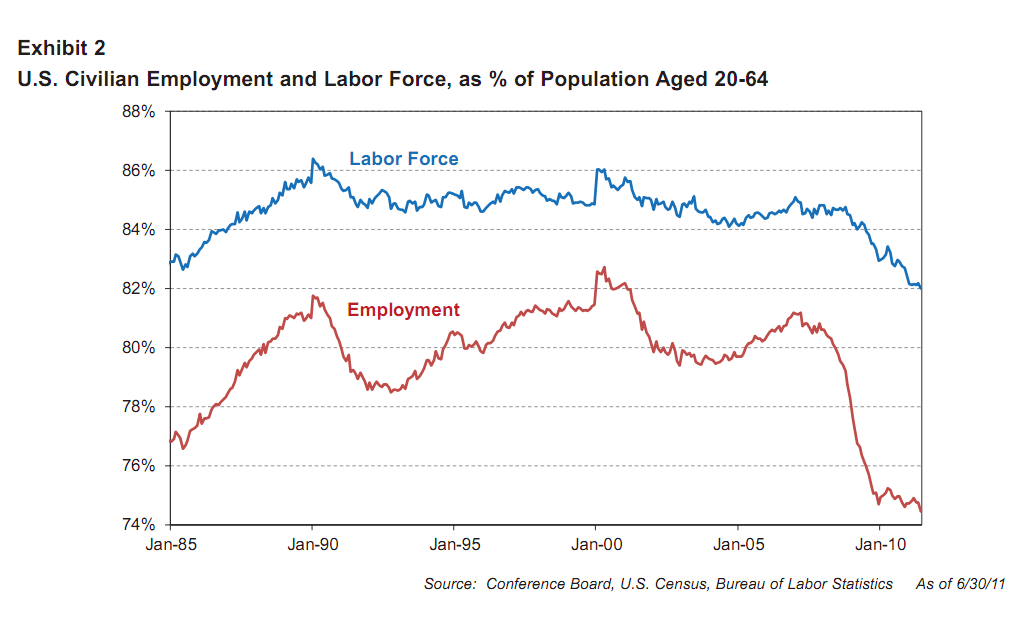
For 30 years to the year 2000, consumers compensated for their lack of progress in hourly wages partly by working harder and longer and in greater numbers (i.e., a higher participation rate) and partly by borrowing. But in the 10 years after 2000, the participation rate in the workforce has dropped dramatically (see Exhibit 2) and hours worked per person has flattened so that the only way for individuals to grow their consumption more recently was by borrowing even more and, to some extent, by speculating in housing. Rising house prices provided the (apparently) real backing for more debt and, even where that backing did not exist, the ingenuity (and, we must admit, greed) of the financial system still supplied the debt.
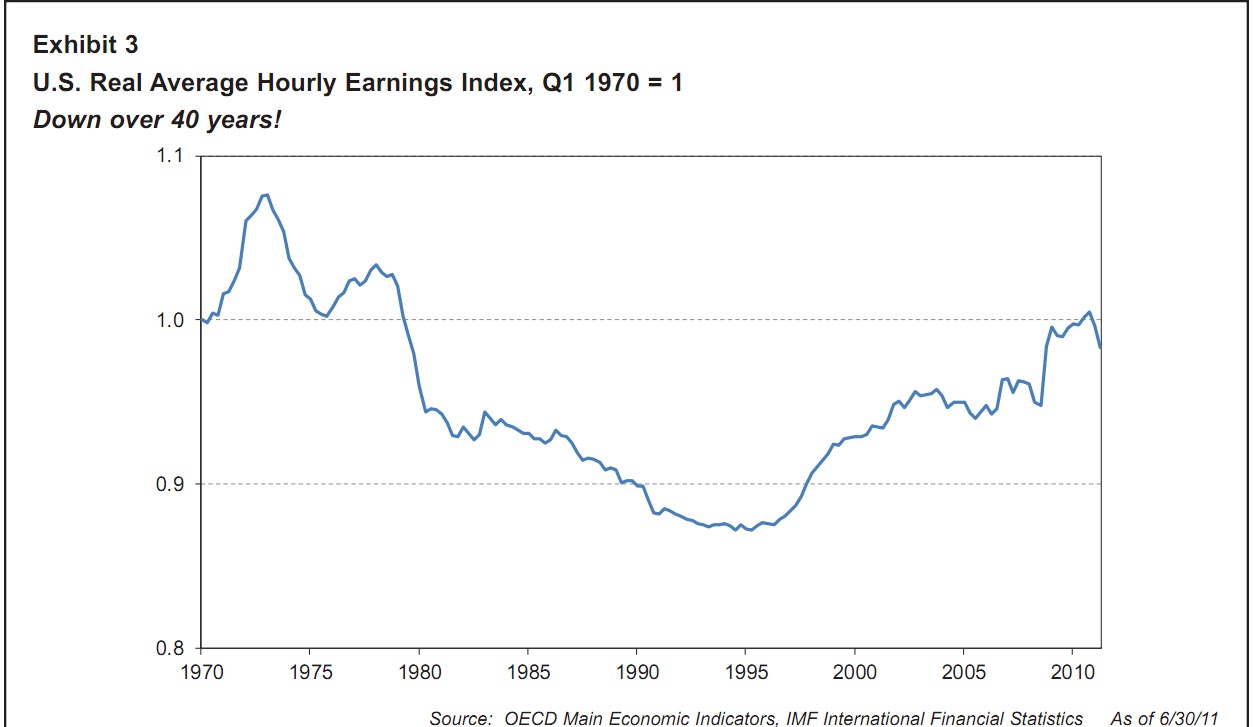
And all of that has gone. And since creating and destroying illusions seems a wretched way to proceed, we can hope (non-mortgage brokers anyway) that it does not return. Today the artificial sugar-coating of increasing debt has been removed and we must live with the reality that an average hour’s work has not received a material increase for 40 years (see Exhibit 3). Without increased debt and without gains in hourly wages, how can there be sustained broad gains in consumption? Only Chanel suits, Hermes scarves, BMWs, and their ilk have very strong sales, and these top-end items are just too small a fraction to carry the day.
If we want to dig out of our current morass, don’t we have to change this equation and isn’t the most direct way of doing this to divide the pie more evenly? That would mean lower income and sales taxes for the bottom 75% of earners and higher taxes for the top 10%! We have allowed the vagaries of globalization and the plentiful supply of cheap Chinese labor to determine our income distribution, which has become steadily steeper, to the point where we have become one of the least
egalitarian developed societies.Wouldn’t it be better for us to decide deliberately and by ourselves that income distribution which creates the best balance of social justice and incentive to work? I am not suggesting that we become some goody two-shoes Scandinavian country. But how about going back to the levels of income equality that existed under the Presidency of that notable Pinko, Dwight Eisenhower (see Exhibit 4 Ed., Top of the post). And don’t think for a second that this more equal income distribution somehow interfered with economic growth: the 50s and 60s were the heyday of sustained U.S. economic gains.
Golly gee, Wally, I mean Jeremy…you’ve got a point. And maybe we should actually make stuff again! In fact, our next guest will state the obvious: if everyone is wealthier, the economy would be more vibrant. But why is everyone (political candidates, pundits, et al.,) squawking like they can never raise taxes, you know, like ever? Follow the money, is all I can say. Jack Bogle, the founder of the Vanguard Group, has a hypotheses that has merit: a sea change in capitalism.
Sounds like a movie, doesn’t it? The Rise of the Planet of the Agents! As Grantham points out further, the gravy train keeps on a rolling, and Atlas hasn’t shrugged, but has cozyed up to Caesar instead.
Looking at corporate profit margins, one could argue the same for them – that they do not seem to be connected to economic reality. A sub average economic recovery, threatening to become painfully sub average, has not stopped corporate profits from quickly rising to a level that is about as high as they have ever gotten. The average worker, with flat wages for decades and with 16% to 18% of the workforce either out of work (9%), discouraged to look for work (4%), or forced to work only part-time (5%), must feel as if he (or she) is in a depression (see Exhibit 2).
It looks likely to take several years before normal employment is reached. Corporations are spending on capital equipment but are doing little in the way of domestic recruiting. Profit margins in the financial system were protected, along with bonuses, which in some cases set records last year despite the undeniable fact that these were the guys who helped bring the Western world to its knees. Ah, justice! There never was – and perhaps, with luck, never will be again – such a terrible comparison between the economic well-being of corporations and their officers and the economic ill-being of their ordinary employees.
Read the whole report. And then juxtapose it against the thoughts of the head of the Vatican’s bank, Ettore Gotti Tedeschi, who talks of the neutrality of money. Here’s an excerpt from his interview with The Catholic World Report,
Yet, according to some analysts, human selfishness inevitably leads people to concentrate wealth in the hands of just a few.
Tedeschi: Actually, hoarding wealth isn’t selfishness, it’s stupidity. Just think about it: whether you produce cars or books or newspapers, when is it that you get rich? When people buy a lot of cars, or books, or newspapers. This can happen only when everyone, or at least most people, have purchasing power. So when everyone is rich on average, they will buy two cars, whole libraries, six newspapers a day…. But people living at a level of minimum subsistence will resort to buying a used car and only one newspaper, on Sundays, when they have time to read.
This is why one can’t stay rich if there are only two or three in his or her community who are rich. Only in authoritarian countries with vast natural resources, all of which are in the hands of only one or two families, can poverty remain side-by-side with isolated wealth. But in a globalized world, in a democracy which is truly democratic, including in its social relationships, such an imbalance cannot endure. Democracies create the environments that allow the laws of economics to have full play, so if a rich person makes everyone else rich, then he or she can stay rich too.
This must be why, in an interview, you once said: “To be rich is not a defect, to be poor is not a merit.”
Tedeschi: Here I was making a rather paradoxical point. How can a rich man get to heaven, if it is as impossible as a camel’s attempting to get through the eye of a needle? To answer this we should first of all ask ourselves what it means to create wealth. Man, who was born to work, but also to think, if successful in thinking and working, produces results, which are called wealth and progress. People have different kinds of aptitudes, some more obvious and some less.
We are not all alike. Just think of artists, musicians…it’s a matter of natural gifts. Among the possible talents there are those of the businessman who knows how to manage an idea, formulating it in a product and translating it into the ability to produce wealth, to create jobs, to advance well-being and innovation. I say that this gentleman has in himself something of the saint, something grand, which not only should not be discouraged, but ought to be actively supported. This is why I think that many businessmen are worthy of beatification! They have created wealth, which is also of service to those who do not have this talent, helping them to better their lives.
And his thoughts on Max Weber and his Capitalism Success = Protestant Work ethic?
What is the difference with Max Weber’s reasoning and the Catholic understanding of these issues?
Tedeschi: Weber interpreted the birth of capitalism in the Protestant world according to a very interesting and logical analysis which, regrettably, has been registered in history books as the sole truth about the birth of modern-day economics. Basically, what Weber says is that the humus, or intellectual environment, that engendered modern capitalism, with the Industrial Revolution, was to be found in the so-called Protestant world. In his opinion Catholic teaching created an attitude toward eternal life, based on an immanent vision of the supernatural, that deprived the Catholic mindset of the energy necessary to forge ahead with industrial development.
This claim, that the energies that produced capitalism were spawned by the Protestant milieu, has led to a rather partial and therefore warped interpretation of history, which has come to be the only interpretation around. But, of course, I wasn’t there in 1905 to discuss things with him!
You’ll want to read the whole thing. But always keep in mind that despite the pronouncements and encyclicals, etc., which you should read to inform yourself on the thoughts of the Church, action politically to make changes in our system is the province of the laity. The Pope, Bishops and Priests are merely a handful of voters, you see. This is where we have to push and prod our political leaders to change the status quo, via the ballot box, e-mails, letters, etc. and advocate decisions that do the opposite of what Grantham writes,
Economic policy making has been stuck between half-hearted Keynesian stimulus, mostly chosen, apparently, to avoid projects with a high social return on investment, and ill-timed “Austrian” cut-backs. Clearly, this mishmash has not been effective at job creation. Conversely, we were great at job destruction: no other country laid off workers with such panic. Where Dutch and German companies, among others, tried to protect their workers’ social capital by limiting firing, we protected short-term profits.
Yipee! How shortsighted of us. How about a song. Remember these guys (and these days)?

Previous Post

August 18, 2011
Thoughts on the Vicissitudes of Michael Voris & Co. UPDATED
Next Post
August 19, 2011 I Hear Guitars...And Lot's of Reverence.
Browse Our Archives
Select a Category Blog News Conversion Story Culture Learning Living Nature Prayer Uncategorized Working
Select a Month June 2016 May 2016 August 2015 July 2015 June 2015 May 2015 April 2015 March 2015 February 2015 January 2015 December 2014 November 2014 October 2014 September 2014 August 2014 July 2014 June 2014 May 2014 April 2014 March 2014 February 2014 January 2014 December 2013 November 2013 October 2013 September 2013 August 2013 July 2013 June 2013 May 2013 April 2013 March 2013 February 2013 January 2013 December 2012 November 2012 October 2012 September 2012 August 2012 July 2012 June 2012 May 2012 April 2012 March 2012 February 2012 January 2012 December 2011 November 2011 October 2011 September 2011 August 2011 July 2011 June 2011 May 2011 April 2011 March 2011 February 2011 January 2011 December 2010 November 2010 October 2010 September 2010 August 2010 July 2010 June 2010 May 2010 April 2010 March 2010 February 2010 January 2010 December 2009 November 2009 October 2009 September 2009 August 2009
Follow Us!
TAKE THE
Religious Wisdom Quiz
What animal did Peter see in vision?
Select your answer to see how you score.
Lions Sheep Goats Clean and unclean animals
Related posts from Why I Am Catholic

Belated Happy Birthday To Blaise Pascal, Unofficial Saint...

Because My Brother Imran Yousef Is An American...

Joe Six-Pack, USMC, With A Few Post-Terrorist Attack...

This Is Why God Invented YouTube...
TRENDING AT PATHEOS Catholic

Rejecting Doom: Christian Hope And Human Action
Christianity is a religion of hope. We are to have hope and...

It’s What Comes From Within Which Matters
One of the most difficult things for us to understand is why...

Why I Choose the Eucharist Over the Sermon
Choose the Eucharist, Not the Sermon What are we supposed to get...

5 Design Elements Found in Spiritually Rooted Homes
Putting Spirituality Into Home Decor Our homes are more than our living...

Credo: A Story of God Told with the...
About 10 years ago, I began to imagine a personal "Credo" that...

The Anatomy of Divine Revelation in Catholic Thought
The claim that God has made Himself known to human beings is...
Ad-Free & Subscriber Log-In Subscription Support
- About Us
- 2026 Calendar
- Videos
- Podcasts
- Library of World Religions
- Faith In Media Tracker
- Advertise With Us
- Write for Us
- Privacy Policy
- Terms of Service
- Do Not Sell My Data
- Contact Us
- Radiant Digital
- Manage Newsletter Subscriptions
- Unsubscribe From Notifications
- Sitemap
Copyright 2008-2026, Patheos. All rights reserved.
Subscription Support Ad-Free & Subscriber Log-In
Follow Patheos