
BuddhistCatholicContemplativeEvangelicalGeneral ChristianHinduJewishLatter-day SaintMuslimNew VisionsProgressive Christian
Beliefs
- Buddhist
- Catholic
- Contemplative
- Evangelical
- General Christian
- Hindu
- Jewish
- Latter-day Saint
- More Voices
- Muslim
- New Visions
- Pagan
- Progressive Christian
Topics
- Religion News
- Food and Religion
- Sports and Religion
- Religious Art
- Religious Music and Entertainment
- Religious Events
- History and Religion
- Style and Religion
- Politics and Religion
- Women in Religion
- Recreation Outdoors and Religion
- Business Finance and Religion
- Careers Workplace and Religion
- Education and Religion
- Family Parenting and Religion
- Health Fitness and Religion
- Home and Religion
- Relationships and Religion
- Technology and Religion
- Travel and Religion
Columnists
- Buddhist Columnists
- Business Finance and Religion Columnists
- Careers Workplace and Religion Columnists
- Catholic Columnists
- Contemplative Columnists
- Education and Religion Columnists
- Evangelists Columnists
- Family Parenting and Religion Columnists
- General Christian Columnists
- Health Fitness and Religion Columnists
- Hindu Columnists
- History and Religion Columnists
- Home and Religion Columnists
- Jewish Columnists
- More Voices Columnists
- Latter Day Columnists
- Muslim Columnists
- New Visions Columnists
- Nonreligious Columnists
- Pagan Columnists
- Politics and Religion Columnists
- Progressive Columnists
- Recreation Outdoors and Religion Columnists
- Relationships and Religion Columnists
- Religion News Columnists
- Religious Art Columnists
- Religious Events Columnists
- Religious Music and Entertainment Columnists
- Sports and Religion Columnists
- Style and Religion Columnists
- Technology and Religion Columnists
- Travel and Religion Columnists
- Women in Religion Columnists
Resource Library
- 2026 Calendar
- Library of World Religions
- The 100 Most Holy Places on Earth
- Patheos Answers
- Podcasts
- Videos
- Faith Leaders Database
- Anglican Episcopalian
- Bahai
- Baptist
- Buddhism
- Christianity
- Confucianism
- Eastern Orthodoxy
- Hinduism
- Holiness and Pentecostal
- ISKCON
- Islam
- Judaism
- Lutheran
- Methodist
- The Church of Jesus Christ of Latter-day Saints
- New Age
- Paganism
- Presbytarian and Reformed
- Protestantism
- Religion Behind the Scenes
- Roman Catholic
- Scientology
- Shia Islam
- Sikhism
- Sufism
- Sunni Islam
- Taoism
- Zen
- See all religions
Research Tools
 Ad-Free & Subscriber Log-In Subscription Support
Ad-Free & Subscriber Log-In Subscription Support
Follow Patheos 

- Trending:
- Forgiveness
- |
- Marriage
- |
- Consciousness
- |
- Death Penalty
- |
- Election
- |
- Halloween
 Why I Am Catholic
-
More
- Home
- For Thoughts from the Guide for Catechists, With a Little Help From My Friends
For Thoughts from the Guide for Catechists, With a Little Help From My Friends
Last updated on: January 27, 2015 at 1:08 pm by Frank Weathers
For Thoughts from the Guide for Catechists, With a Little Help From My Friends 2015-01-27T13:08:42-05:00 Frank Weathers
Patheos Explore the world's faith through different perspectives on religion and spirituality! Patheos has the views of the prevalent religions and spiritualities of the world.
The next time the Easter Vigil rolls around, I will have been a Catholic 4 full years. But those of you who have followed my conversion story know that I sat in the pews with my wife, and later with my children, for close to 18 years, and that I started exploring the faith in earnest in the Fall of 2006.
Eventually, around the Summer of 2007, I read The Seven Storey Mountain, Thomas Merton’s conversion story that was published in 1948. It turns out that 1948 is also the year that Lou Tseng-Tsiang published his Ways of Confucius and of Christ, and his friend John C. H. Wu published his From Confucianism to Catholicism a year later in 1949. More on this synchronicity shortly.
After reading Merton’s best seller, I started reading almost everything I could get my hands on that he had written. In pretty close succession, I read the following:
No Man Is an Island, The New Man, Seeds of Contemplation, The New Seeds of Contemplation, The Wisdom of the Desert:Sayings of the Desert Fathers, Contemplative Prayer. I even looked at Zen and the Birds of Appetite, briefly but then moved on to other authors whose names began with an “S.” (Like St. Anthony, St. Anthanasius, etc.)
I may be a rookie Catholic, but I quickly bumped into the contingent of our brethren who believe Thomas Merton was not a good Catholic. I’m not claiming to be an expert on Merton’s work either. I’m just a guy who has read a goodly amount of his stuff, and who has a wee bit of smarts in my skull, thanks be to God (having survived a wicked head trauma, I could just as easily have wound up a vegetable, if the Lord had willed that).
The critics claim that Merton went loopy over Eastern religions, see, and that is really quite dangerous, or so I am told. Here is an example of one such person’s opinion. It is that of a Jesuit theologian named John A. Hardon,
Thomas Merton, I do believe was never intellectually converted to Christianity. He became a Trappist Monk, became a priest and wrote many books. So his conversion is Seven Storey Mountain. He became very famous, mainly because of his writing. But also, because his ideas, it goes back already to the fifties and sixties. His ideas were very sympathetic with Oriental thought.
So he got a bit of a bad reputation for being sympathetic “with Oriental thought,” huh? Golly, there are only a couple billion Orientals on the globe so maybe Merton had a point? Maybe Hardon has a misguided one? Because this sounds like what happened to one of my favorite Marines, a fellow by the name of Evans Carlson. Carlson had gone to China as a Marine Officer in the 1930’s. He had immersed himself into the culture there, and had been an advisor assigned to Mao Tsedongs Red Army. Uh-oh, wrong army, that. And as a result, it was almost a career killer for Carlson.
 Evans Carlson
Hanging around with Mao, Zhou Enlai and Deng Xiaoping didn’t sit well when the U.S. decided to back the Nationalists under Chiang Kai-shek. But Carlson was no Communist. He was the son of a New England Protestant preacher. And all Carlson cared about was learning how the Communist guerillas under Mao were wreaking havoc on the Japanese. Seeing no hope for his career, he resigned his commission, and wrote a book about his experience and hit the lecture circuit about the Japanese threat.
Carlson later was recommissioned (oops, we need you back!) and led the first offensive raid against Japan when he and his small band of Marine Raiders landed on Makin Island. President Roosevelt’s son went on that mission too. The success of that raid salvaged Carlson’s career. This reminds me very much of the risks associated with the unorthodox pursuit of orthodoxy. It is easy to make enemies that way, especially if you are a hero, or become very well known. Envious colleagues become stumbling blocks to you, as happened to Carlson.
Carlson developed the modern Marine Corps Rifle Squad, which helped win World War II and still basically exists unchanged to this day. And he brought a Chinese phrase into the lexicon of the Marine Corps that all Marines know: Gung-Ho! The phrase means “work together!” and he had learned it from his experience in Mao’s army. Marines either love or hate the phrase, depending on their mood. Sometimes we shorten it to “gungy” and use it as an adjective. “Weathers? I hate that guy! He’s too gungy” in the negative or “Whoa, Dan Daly? That guy was gungy!” for the positive use of it, see?
Flash forward to the reputation of Thomas Merton. I pretty much ignored all the hoopla and the naysaying, because of my experience with his writings (see list above), and my thinking that he was being perhaps unfairly maligned, much like Carlson was. In every book of Merton’s that I had read, he came off as a straight-shooter, no question in my little mind.
Nowadays, I’m reading everything I can get my hands on that has been written by my friends Lou Tseng-Tsiang and John C.H. Wu. It turns out that later on, they were also both correspondents of Merton’s too. Remember the timing of their works being published all around the same time? That probably had something to do with their all getting to know one another. It’s a small world in Catholic publishing, then as it is now. And thinking about how to bring Christ to Asia put the three of them in the same boat too.
I wrote a post about how St. Anthony of Padua helped me “find” my new friend John Wu. Another Jesuit priest, named Robert Nash, had called John a “pagan philosopher.” As I explained in that post, that was wrong on a number of fronts. That is like calling Evans Carlson “a Communist sympathizer” just because he happened to be following the People’s Army around as they fought the Japanese invaders of their homeland. John Wu was now a pagan because he happened to be Chinese? Hmmm.
Here is the heart of the matter and what I am attempting to help dispell. Merton wasn’t perfect, but he was not getting ready to bail out of Christianity in order to become a Zen Buddist monk. He may have met the Dalai Lama, but he didn’t do it as a defector from the Church. Read Merton’s Foreword to John’s book The Golden Age of Zen Masters, and see for yourself.
Below are some passages that I found on the Vatican website regarding Catechists for the Faith. Look closely and see if you can see Thomas Merton, and my friends John and Lou being described below,
 Lou Tseng-Tsiang
“I have made myself all things to all in order to save some at any cost. I do it all for the sake of the gospel” (1Cor 9:22-23; cf. 2Cor 12:15). And again St. Paul says:
“Woe to me if I do not preach the gospel” (1Cor 9:16)
“Other sheep I have that are not of this fold, and these too I must lead” (Jn 10:16); “go out to the whole world and preach the gospel to every creature” (Mk 16:15). To be able to affirm, like Peter and John before the Sanhedrin, “we cannot but speak of what we have seen and heard” (Acts 4:20), and to realize with Paul the ideal of apostolic ministry: “the love of Christ overwhelms us” (2Cor 5:14), catechists should have a strong missionary spirit – a spirit that will be all the more effective if they are seen to be convinced of what they say and are enthusiastic and courageous, without ever being ashamed of the gospel (cf. Rom 1:16).
While the wise ones according to this world seek immediate gratification, the catechist will glory only in Christ, who gives strength (cf. Col 1:29), and will wish to know and preach only “Christ the power of God and the wisdom of God” (1Cor 1:24). As the Catechism of the Catholic Church rightly affirms, from “the loving knowledge of Christ springs out the irresistible desire to announce, to ‘evangelize’ and to lead others to the ‘yes’ of the faith in Jesus Christ. At the same time, one also feels the need to know this faith ever better”.
The Christ whom catechists have come to know is “a crucified Christ” (1Cor 2:2); he whom they preach is “Christ crucified, a stumbling block to Jews and folly to Gentiles” (1Cor 1:23), whom the Father raised from the dead on the third day (cf. Acts 10:40). They should be prepared, therefore, to live in hope the mystery of the death and resurrection of Christ in the midst of difficult situations, personal suffering, family problems and obstacles in their apostolic work, as they strive to follow the Lord on his own difficult road: “in my own body I complete what is lacking in Christ’s afflictions for the sake of his body, the Church” (Col 1:24).
Need for inculturation. Like all forms of evangelization, catechesis too is called to bring the gospel into the heart of the different cultures. The process of inculturation takes time, as it is a deep, gradual and all-embracing process. Through it, as Pope John Paul II explains, “the Church makes the gospel incarnate in different cultures and at the same time introduces peoples, together with their cultures, into her own community; she transmits to them her own values, at the same time taking the good elements that already exist in them and renewing them from within”.
Catechists, like all missionary personnel, will play an active part in this process. They should be specifically prepared for it, with courses on the elements of cultural anthropology and on their own culture, and should be aware of the guidelines that the Church has laid down on this matter and which may be summarized as follows:
– The gospel message, though it can never be identified with any one culture, is necessarily incarnated in cultures. From its very beginnings it was incarnated in certain specific cultures, and one must take account of this if one is not to deprive the new Churches of values which are now the patrimony of the universal Church.
– The gospel is a force for renewal, and can rectify elements in cultures which do not conform to it.
– The local ecclesial communities, which are the primary subjects of inculturation, live out their daily experience of faith and charity in a particular culture, and the Bishop should indicate the best ways to bring out the positive values in that culture. The experts give incentive and support.
– Inculturation is genuine when it is guided by two principles: it must be founded on the word of God, revealed in the Scriptures, and must follow the Church’s tradition and the guidance of the Magisterium; and it must never go against the Church unity that was willed by the Lord.
– Popular piety, understood as an expression of Catholic devotion colored by local values, traditions and attitudes, when purified of defects caused by ignorance and superstition, expresses the wisdom of God’s people and is a privileged form of inculturation of the gospel.
Following the above directives, catechists should contribute to inculturation by fitting into the overall pastoral plan drawn up by the competent authorities and avoiding adventures into particular experiments that might upset the faithful. They should be convinced that the gospel is strong enough to penetrate any culture and enrich and strengthen it from within.
I don’t know much, but I think this is exactly what Thomas Merton, aka Father Louis, was doing, right up until the day he died. Was he perfect? You know the answer to that. Was he a sinner? Did he stumble? Who among us hasn’t, and doesn’t? Isn’t that why we are Catholic? To be redeemed while helping bring souls to Christ? Of course it is. But was he following Commanders Intent and attempting to fulfill his mission and vocation? I think so.
Here is what my friend John C.H. Wu says about him in letters I found in William H. Shannon’s edited book of Merton’s correspondence entitled The Hidden Ground of Love. This from a letter dated September 6, 1966,
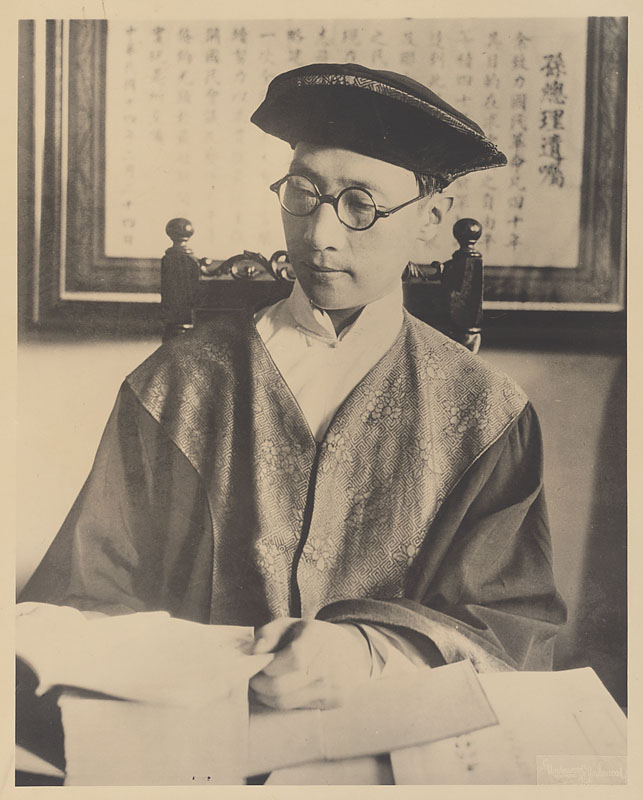 John C.H Wu as
a young judge in China
The beautiful thing about you is that your heart is as great as your mind. Thus in you, love and knowledge are united organically. Herein lies your profound significance for this great age of synthesis of East and West.
Shortly thereafter, in a letter dated November 28th, John writes, after having just read Merton’s book The New Man,
It is, he says, “a living synthesis of East and West…It seems to me that you read contemplatively. You are so deeply Christian that you cannot help touching the vital springs of other religions.”
That, I think, is an opinion of Merton from someone who actually knows something about what he is talking about. Both John and Dom Lou argue convincingly about how to spread the Good News to our brothers and sisters throughout Asia. Thankfully, it appears that the leadership of the Church has been listening, even if a few naysayers didn’t get the memo.

Forgive the length of this post folks, but there is more to share. Given what has been stated in the Guide to Catechists above, it should come as no surprise that the esteemed Servant of God, Archbishop Fulton J. Sheen, could say this:
Someday Buddha and Confucius may be to the Eastern Catholic theology what Plato and Aristotle were to St. Thomas and Augustine.
If that idea curdles your milk, I respectfully submit that you re-read the scriptures that preface the Guide for Catechists again:
“I have made myself all things to all in order to save some at any cost. I do it all for the sake of the gospel” (1Cor 9:22-23; cf. 2Cor 12:15).
“Woe to me if I do not preach the gospel” (1Cor 9:16)
“Other sheep I have that are not of this fold, and these too I must lead” (Jn 10:16); “go out to the whole world and preach the gospel to every creature” (Mk 16:15).
From posts I’ve shared with you in the past, you know that both John and Dom Lou grasped the idea that Sheen wrote of, and they not only grasped it, but they put it into action as soon as they became Catholics. Archbishop Sheen grasped it as well, which is why he would write in his autobiography Treasures in Clay,
Our missionaries, I felt, should start with what is good in the religions they find in their countries, as Our Lord started with a drink of cold water in converting a Samaritan, as Claudia began with a dream in understanding Christ far better than a rational husband, and as Paul began with an inscription to a pagan diety to convert two souls in Athens.
Sheen himself would actively help others to see the True Faith from the kernel of it contained in other beliefs. Here is another example from his autobiography:
During my teaching days at the university, I visited Madame Koo, the wife of the last ambassador from China to the United States before the Communist takeover. She told me she was not interested in Christianity because she considered that original sin was the most stupid doctrine she had ever heard of in her life. I asked her what religion she preferred. She told me she was a Buddhist. I then asked her to describe for me the eightfold path, which she did. When she had finished I said:
“If man is perfect, why do you think Buddha offered these ways of purification? Was it not because he saw that in human nature there were certain endemic evils, as well as emotions and instincts, which had to be controlled?”
Madame Koo saw the light and later on brought her Buddhism to perfection in Christianity.
He went on to say,
I have always contended in talking to missionaries that we are not so much to bring Christ to peoples as we are to bring Christ out of them…Christ is hidden in all world religions, though as yet His face is veiled as it was to Moses, who asked to see it.
I’ll wrap this post up with one of Archbishop Sheen’s videos that speaks of embracing all humanity to bring them the Truth.
Lord, I lack the master emotion of love. Help me to receive it and share the Good News to all.

Previous Post

August 27, 2011
Because Love Went to Madrid, And Its Cup Runneth Over
Next Post
August 28, 2011 Because Words Matter...
Browse Our Archives
Select a Category Blog News Conversion Story Culture Learning Living Nature Prayer Uncategorized Working
Select a Month June 2016 May 2016 August 2015 July 2015 June 2015 May 2015 April 2015 March 2015 February 2015 January 2015 December 2014 November 2014 October 2014 September 2014 August 2014 July 2014 June 2014 May 2014 April 2014 March 2014 February 2014 January 2014 December 2013 November 2013 October 2013 September 2013 August 2013 July 2013 June 2013 May 2013 April 2013 March 2013 February 2013 January 2013 December 2012 November 2012 October 2012 September 2012 August 2012 July 2012 June 2012 May 2012 April 2012 March 2012 February 2012 January 2012 December 2011 November 2011 October 2011 September 2011 August 2011 July 2011 June 2011 May 2011 April 2011 March 2011 February 2011 January 2011 December 2010 November 2010 October 2010 September 2010 August 2010 July 2010 June 2010 May 2010 April 2010 March 2010 February 2010 January 2010 December 2009 November 2009 October 2009 September 2009 August 2009
Follow Us!
TAKE THE
Religious Wisdom Quiz
True or False: Balaam's donkey spoke to him.
Select your answer to see how you score.
FALSE TRUE
Related posts from Why I Am Catholic

Belated Happy Birthday To Blaise Pascal, Unofficial Saint...

Because My Brother Imran Yousef Is An American...

Joe Six-Pack, USMC, With A Few Post-Terrorist Attack...

This Is Why God Invented YouTube...
TRENDING AT PATHEOS Catholic

Rejecting Doom: Christian Hope And Human Action
Christianity is a religion of hope. We are to have hope and...

It’s What Comes From Within Which Matters
One of the most difficult things for us to understand is why...

Why I Choose the Eucharist Over the Sermon
Choose the Eucharist, Not the Sermon What are we supposed to get...

5 Design Elements Found in Spiritually Rooted Homes
Putting Spirituality Into Home Decor Our homes are more than our living...

Credo: A Story of God Told with the...
About 10 years ago, I began to imagine a personal "Credo" that...

The Anatomy of Divine Revelation in Catholic Thought
The claim that God has made Himself known to human beings is...
Ad-Free & Subscriber Log-In Subscription Support
- About Us
- 2026 Calendar
- Videos
- Podcasts
- Library of World Religions
- Faith In Media Tracker
- Advertise With Us
- Write for Us
- Privacy Policy
- Terms of Service
- Do Not Sell My Data
- Contact Us
- Radiant Digital
- Manage Newsletter Subscriptions
- Unsubscribe From Notifications
- Sitemap
Copyright 2008-2026, Patheos. All rights reserved.
Subscription Support Ad-Free & Subscriber Log-In
Follow Patheos