
BuddhistCatholicContemplativeEvangelicalGeneral ChristianHinduJewishLatter-day SaintMuslimNew VisionsProgressive Christian
Beliefs
- Buddhist
- Catholic
- Contemplative
- Evangelical
- General Christian
- Hindu
- Jewish
- Latter-day Saint
- More Voices
- Muslim
- New Visions
- Pagan
- Progressive Christian
Topics
- Religion News
- Food and Religion
- Sports and Religion
- Religious Art
- Religious Music and Entertainment
- Religious Events
- History and Religion
- Style and Religion
- Politics and Religion
- Women in Religion
- Recreation Outdoors and Religion
- Business Finance and Religion
- Careers Workplace and Religion
- Education and Religion
- Family Parenting and Religion
- Health Fitness and Religion
- Home and Religion
- Relationships and Religion
- Technology and Religion
- Travel and Religion
Columnists
- Buddhist Columnists
- Business Finance and Religion Columnists
- Careers Workplace and Religion Columnists
- Catholic Columnists
- Contemplative Columnists
- Education and Religion Columnists
- Evangelists Columnists
- Family Parenting and Religion Columnists
- General Christian Columnists
- Health Fitness and Religion Columnists
- Hindu Columnists
- History and Religion Columnists
- Home and Religion Columnists
- Jewish Columnists
- More Voices Columnists
- Latter Day Columnists
- Muslim Columnists
- New Visions Columnists
- Nonreligious Columnists
- Pagan Columnists
- Politics and Religion Columnists
- Progressive Columnists
- Recreation Outdoors and Religion Columnists
- Relationships and Religion Columnists
- Religion News Columnists
- Religious Art Columnists
- Religious Events Columnists
- Religious Music and Entertainment Columnists
- Sports and Religion Columnists
- Style and Religion Columnists
- Technology and Religion Columnists
- Travel and Religion Columnists
- Women in Religion Columnists
Resource Library
- 2026 Calendar
- Library of World Religions
- The 100 Most Holy Places on Earth
- Patheos Answers
- Podcasts
- Videos
- Faith Leaders Database
- Anglican Episcopalian
- Bahai
- Baptist
- Buddhism
- Christianity
- Confucianism
- Eastern Orthodoxy
- Hinduism
- Holiness and Pentecostal
- ISKCON
- Islam
- Judaism
- Lutheran
- Methodist
- The Church of Jesus Christ of Latter-day Saints
- New Age
- Paganism
- Presbytarian and Reformed
- Protestantism
- Religion Behind the Scenes
- Roman Catholic
- Scientology
- Shia Islam
- Sikhism
- Sufism
- Sunni Islam
- Taoism
- Zen
- See all religions
Research Tools
 Ad-Free & Subscriber Log-In Subscription Support
Ad-Free & Subscriber Log-In Subscription Support
Follow Patheos 

- Trending:
- Forgiveness
- |
- Marriage
- |
- Consciousness
- |
- Death Penalty
- |
- Election
- |
- Halloween
 Why I Am Catholic
-
More
- Home
- For the Seed Planted by a Chinese Confucian Diplomat
For the Seed Planted by a Chinese Confucian Diplomat
Last updated on: January 24, 2017 at 6:26 pm by Frank Weathers
For the Seed Planted by a Chinese Confucian Diplomat 2017-01-24T18:26:26-05:00 Frank Weathers
Patheos Explore the world's faith through different perspectives on religion and spirituality! Patheos has the views of the prevalent religions and spiritualities of the world.
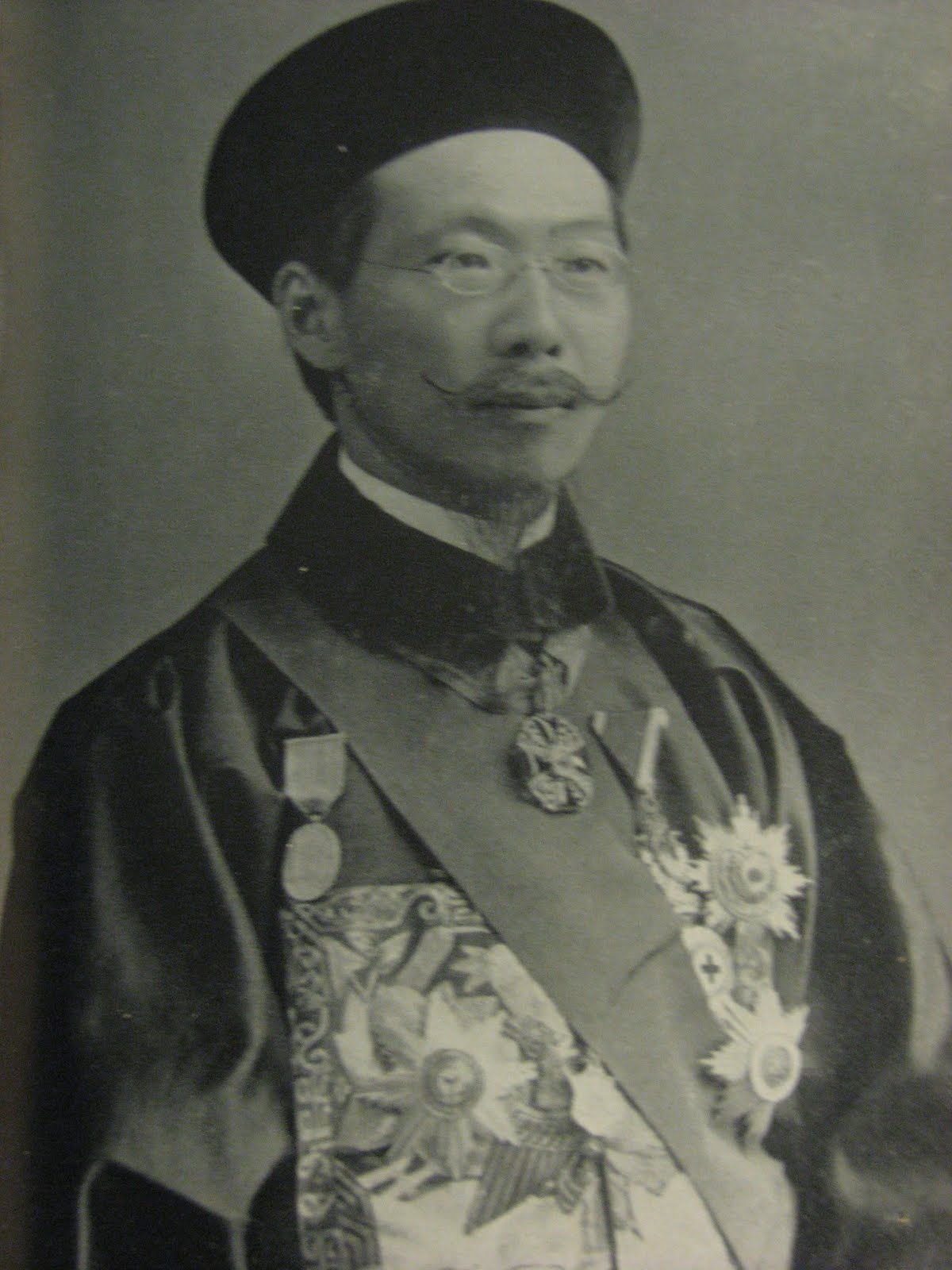
The Holy Father has asked us to pray for the Church in China today. News reports are saying that security is tight in Sheshan. Of course, we must not forget that Mainland China is still under the control of a form of government that is not altogether friendly to the Church. Militant xenophobia has run through China long before she fell to the Communists.
That’s why I feel compelled to share the following story from my dear, departed friend named Dom Lou Tseng-Tsiang. Doesn’t he look stunning in this photograph? That was taken in 1906 when he was a diplomat to the Hague. At that time, China was still ruled by the soon to be extinct Manchu Dynasty.
From an earlier post you may recall that Lou was briefly the Premier of China, after the revolution of Sun Yat-sen ushered in a republican form of government. Alas, that was not to last long as the forces of Mao Sedong would overthrow the democratic republic following on the heels of the end of World War II.
I don’t believe Dom Lou saw that one coming. Besides, he had retired from the Diplomatic Service in 1922 and settled in Europe to care for his wife who was ill. He never returned to his homeland. As I reported in another post, he became a Benedictine soon after her death in 1926.
The interesting twist in Lou’s conversion story, is that he was encouraged to become a Catholic, and a Benedictine to boot, by his mentor in the Diplomatic Service named M. Shu King-Shen. Lou was already a rarity in that he was born and raised as a Protestant Christian, see. King-Shen never got the chance to convert himself, as he was executed during the Boxer Rebellion when the anti-foreigner (hence, anti-Christian) xenophobia hit a high mark.
But I am overstepping myself and must let Dom Lou himself tell the rest of the tale,
from Ways of Confucius and of Christ.
Periods of decadence have a singular attraction for those who live in them. To embark upon their reform it is necessary to some extent to be ignorant of their manners. In China, I had known neither the world of officialdom nor society. M. Shu King-Shen gave me as a first rule that of not attaching myself to a declining regime; neither to enter into it nor to condemn it, but to confine myself to doing my duty and, while studying the most distinguished servants of the European countries, to make a personal program of life and action for myself.
****
 Dom Pierre-Célestin
My master prescribed that I should Europeanize myself for love of China. How would I have been able to follow these instructions if my countrymen had succeeded in keeping me in ignorance of foreign countries, or if foreign countries had led me to disparage my own country? In every period of transition the two opposing currents are very violent. To escape from them, one must be prepared to be judged unfavorably by both.
So one must learn to be alone. The Christian life, for it’s part, does not escape this rule. Our Lord Jesus Christ is so often all alone on His Cross.
M. Shu desired for China a complete rejuvenation, and he desired that in every sphere, the country should emerge from the condition of stagnation in which the best ancestral traditions, deformed and become sterile, were leading to a result diametrically opposed to the spirit which had given them birth and which had enabled them in the past to give us our finest epochs of richness and splendor.
He wanted a modernization which should cause the spirit of Yao, of Choen and of Yu, to live again in the world of today. He studied Europe, seeking to grasp the principle of its best institutions, the source of its progress, seeking to discover, in order to win them and to give them to China, the moral forces which assured the balance of European society, and to distinguish them sharply from the forces, from the passions and infatuations, which compromised that balance.
Christianity, the Church, and in particular the Catholic Church, imposed themselves on the respectful attention of M. Shu. He had been struck by the existence of a world-wide spiritual government, of which the history went back right to the Founder of the Christian Religion. So as to study this fact more closely, in the course of a journey which took him to Europe, he had stopped in Rome and had there spent the Christmas holidays.
I remember very clearly the first conversation in which he spoke to me of it, giving to the expression of his thought, as he often liked to do, the form of a fable. He had got me to call at his home, and he begun thus:
 M. Shu King-Shen
One day the Minister of Commerce in England noticed the arrival and entry into the country of a new commodity, previously unknown in Europe—tea; ten chests of tea, coming from China. The following year the number of cases increased tenfold. Two years later it rose to a thousand.
Surprised by the unexpected growth of this import, he called a tree-planter and bade him set out for China and there study the cultivation of tea, instructing him to choose some of the finest seeds and then to betake himself to Ceylon, in order there to introduce this crop, so that England might no longer need to purchase her tea in China.
M. Shu went on,
The strength of Europe is not to be found in her armaments; it is not to be found in her science; it is to be found in her religion. In the course of your diplomatic career you will have occasion to study the Christian religion. It comprehends various branches and societies.
Take the most ancient branch of that religion, that which goes back most nearly to its origins. Enter into it. Study its doctrine, practice its commandments, observe its government, closely follow all its works. And later on, when you have ended your career, perhaps you will have the opportunity to go still farther.
In this most ancient branch, choose the most ancient society. If you can do so, enter into it also. Make yourself a follower, and study the interior life which must be the secret of it. When you have understood and won the secret of that life, when you have grasped the heart of the strength of the religion of Christ, bring them and give them to China.
I hear him still. He continued,
 St. Ignatius Cathedral
Shanghai
You are from Shanghai. Have you seen the foundation at Zikawei?
I had to confess that I did not know it. The foundation at Zikiwei, as you will hardly be unaware, was a gift of the Minister of State Paul Siu, converted to the Catholic Faith by the Jesuit Father Matteo Ricci, in that 17th Century which might have marked the beginning of the evangelization and the modernization of China.
You know (Ed. This was all news to me!) also, alas, how the long quarrel over the rites, by its state of inept and sterile passions and arguments, destroyed the magnificent work undertaken with such vision by the missionaries of those days, the intellectual and moral work which have endowed the Catholic apostolate with a strength and with a vitality from which one would have been able to expect the complete regeneration of our society and country.
M. Shu said to me,
Study, then, what was done three centuries ago at Zikawei. And see what has come of it.
In those few words, he set before me the whole problem of the relations between China and Christianity, the whole of that missionary question which had to wait for the pontificates of Benedict XV, of Pius XI and of His Holiness Pius XII before its solution could begin.
If M. Shu were alive today he would be profoundly happy; he would see China, victorious over herself, treated by the Powers on a footing of equality; in his clarity of vision he would rejoice to see the Church, freed of her former shackles, coming into contact with our country in a new fashion, on the solid foundation of a direct understanding with the Chinese State, in an atmosphere of mutual respect and sympathy, of understanding, of independence, and of cooperation.
****
Not quite Dom Lou, but things could be worse. But things could be far, far better too, which is why we’ve been asked to pray today. Here is the prayer Pope Benedict XVI recommends to us,
Prayer for the Intercession of Our Lady of Sheshan:
Virgin Most Holy, Mother of the Incarnate Word and our Mother,venerated in the Shrine of Sheshan under the title “Help of Christians”, the entire Church in China looks to you with devout affection. We come before you today to implore your protection. Look upon the People of God and, with a mother’s care, guide them along the paths of truth and love, so that they may always be a leaven of harmonious coexistence among all citizens.
When you obediently said “yes” in the house of Nazareth, you allowed God’s eternal Son to take flesh in your virginal womb and thus to begin in history the work of our redemption. You willingly and generously cooperated in that work, allowing the sword of pain to pierce your soul, until the supreme hour of the Cross, when you kept watch on Calvary, standing beside your Son, who died that we might live.
From that moment, you became, in a new way, the Mother of all those who receive your Son Jesus in faith and choose to follow in his footsteps by taking up his Cross. Mother of hope, in the darkness of Holy Saturday you journeyed with unfailing trust towards the dawn of Easter. Grant that your children may discern at all times, even those that are darkest, the signs of God’s loving presence.
Our Lady of Sheshan, sustain all those in China,who, amid their daily trials, continue to believe, to hope, to love. May they never be afraid to speak of Jesus to the world, and of the world to Jesus. In the statue overlooking the Shrine you lift your Son on high, offering him to the world with open arms in a gesture of love. Help Catholics always to be credible witnesses to this love, ever clinging to the rock of Peter on which the Church is built.
Mother of China and all Asia, pray for us, now and for ever. Amen!
Update: Mark Shea on the diversity, and yet the sameness, of Mother Church. Dom Lou’s book is out of print. However, this is sort of the Readers Digest Condensed version of his book. And here is the post that opened my eyes to the fact the Christianity and China are compatible.


Previous Post

May 23, 2011
For "The Risk of Education"
Next Post
May 26, 2011 Summer Cometh...
Browse Our Archives
Select a Category Blog News Conversion Story Culture Learning Living Nature Prayer Uncategorized Working
Select a Month June 2016 May 2016 August 2015 July 2015 June 2015 May 2015 April 2015 March 2015 February 2015 January 2015 December 2014 November 2014 October 2014 September 2014 August 2014 July 2014 June 2014 May 2014 April 2014 March 2014 February 2014 January 2014 December 2013 November 2013 October 2013 September 2013 August 2013 July 2013 June 2013 May 2013 April 2013 March 2013 February 2013 January 2013 December 2012 November 2012 October 2012 September 2012 August 2012 July 2012 June 2012 May 2012 April 2012 March 2012 February 2012 January 2012 December 2011 November 2011 October 2011 September 2011 August 2011 July 2011 June 2011 May 2011 April 2011 March 2011 February 2011 January 2011 December 2010 November 2010 October 2010 September 2010 August 2010 July 2010 June 2010 May 2010 April 2010 March 2010 February 2010 January 2010 December 2009 November 2009 October 2009 September 2009 August 2009
Follow Us!
TAKE THE
Religious Wisdom Quiz
Which is considered the greatest commandment in Christianity?
Select your answer to see how you score.
Fast often Give money Go to church Love God
Related posts from Why I Am Catholic

Because My Brother Imran Yousef Is An American...

Joe Six-Pack, USMC, With A Few Post-Terrorist Attack...

This Is Why God Invented YouTube...
HHS Forced Sex Changes? There Ain't No Fait...
TRENDING AT PATHEOS Catholic

Rejecting Doom: Christian Hope And Human Action
Christianity is a religion of hope. We are to have hope and...

It’s What Comes From Within Which Matters
One of the most difficult things for us to understand is why...

Why I Choose the Eucharist Over the Sermon
Choose the Eucharist, Not the Sermon What are we supposed to get...

5 Design Elements Found in Spiritually Rooted Homes
Putting Spirituality Into Home Decor Our homes are more than our living...

Credo: A Story of God Told with the...
About 10 years ago, I began to imagine a personal "Credo" that...

The Anatomy of Divine Revelation in Catholic Thought
The claim that God has made Himself known to human beings is...
Ad-Free & Subscriber Log-In Subscription Support
- About Us
- 2026 Calendar
- Videos
- Podcasts
- Library of World Religions
- Faith In Media Tracker
- Advertise With Us
- Write for Us
- Privacy Policy
- Terms of Service
- Do Not Sell My Data
- Contact Us
- Radiant Digital
- Manage Newsletter Subscriptions
- Unsubscribe From Notifications
- Sitemap
Copyright 2008-2026, Patheos. All rights reserved.
Subscription Support Ad-Free & Subscriber Log-In
Follow Patheos