
BuddhistCatholicContemplativeEvangelicalGeneral ChristianHinduJewishLatter-day SaintMuslimNew VisionsProgressive Christian
Beliefs
- Buddhist
- Catholic
- Contemplative
- Evangelical
- General Christian
- Hindu
- Jewish
- Latter-day Saint
- More Voices
- Muslim
- New Visions
- Pagan
- Progressive Christian
Topics
- Religion News
- Food and Religion
- Sports and Religion
- Religious Art
- Religious Music and Entertainment
- Religious Events
- History and Religion
- Style and Religion
- Politics and Religion
- Women in Religion
- Recreation Outdoors and Religion
- Business Finance and Religion
- Careers Workplace and Religion
- Education and Religion
- Family Parenting and Religion
- Health Fitness and Religion
- Home and Religion
- Relationships and Religion
- Technology and Religion
- Travel and Religion
Columnists
- Buddhist Columnists
- Business Finance and Religion Columnists
- Careers Workplace and Religion Columnists
- Catholic Columnists
- Contemplative Columnists
- Education and Religion Columnists
- Evangelists Columnists
- Family Parenting and Religion Columnists
- General Christian Columnists
- Health Fitness and Religion Columnists
- Hindu Columnists
- History and Religion Columnists
- Home and Religion Columnists
- Jewish Columnists
- More Voices Columnists
- Latter Day Columnists
- Muslim Columnists
- New Visions Columnists
- Nonreligious Columnists
- Pagan Columnists
- Politics and Religion Columnists
- Progressive Columnists
- Recreation Outdoors and Religion Columnists
- Relationships and Religion Columnists
- Religion News Columnists
- Religious Art Columnists
- Religious Events Columnists
- Religious Music and Entertainment Columnists
- Sports and Religion Columnists
- Style and Religion Columnists
- Technology and Religion Columnists
- Travel and Religion Columnists
- Women in Religion Columnists
Resource Library
- 2026 Calendar
- Library of World Religions
- The 100 Most Holy Places on Earth
- Patheos Answers
- Podcasts
- Videos
- Faith Leaders Database
- Anglican Episcopalian
- Bahai
- Baptist
- Buddhism
- Christianity
- Confucianism
- Eastern Orthodoxy
- Hinduism
- Holiness and Pentecostal
- ISKCON
- Islam
- Judaism
- Lutheran
- Methodist
- The Church of Jesus Christ of Latter-day Saints
- New Age
- Paganism
- Presbytarian and Reformed
- Protestantism
- Religion Behind the Scenes
- Roman Catholic
- Scientology
- Shia Islam
- Sikhism
- Sufism
- Sunni Islam
- Taoism
- Zen
- See all religions
Research Tools
 Ad-Free & Subscriber Log-In Subscription Support
Ad-Free & Subscriber Log-In Subscription Support
Follow Patheos 

- Trending:
- Forgiveness
- |
- Marriage
- |
- Consciousness
- |
- Death Penalty
- |
- Election
- |
- Halloween
 Why I Am Catholic
-
More
- Home
- Pat McNamara on “Why I Am Catholic”
Pat McNamara on “Why I Am Catholic”
Last updated on: June 7, 2015 at 10:39 pm by Frank Weathers
Pat McNamara on “Why I Am Catholic” 2015-06-07T22:39:21-05:00 Frank Weathers
Patheos Explore the world's faith through different perspectives on religion and spirituality! Patheos has the views of the prevalent religions and spiritualities of the world.

One of the first blogs I ever read was McNamara’s Blog. I enjoy it because I enjoy history. And as a new Catholic, the amount of Church history I do know is tiny compared to what is available for me to learn. Pat McNamara, who also has a column over at Patheos, helps bring Church History to life for me.
This is the second time I have asked one of my blogging friends to write a post for me answering the phrase that headlines this space. Remember the first time? Each of us has a different reason, but as conversion is on-going (and not a “one and done event”) each one of us must confront the reason as we make progress along the path of our individual pilgrimages.
So Pat, if I asked you to answer “Why I Am Catholic,” what would you say?
Because of Church History, Not In Spite of It
by Pat McNamara
 Perugino’s The Delivery of the Keys
Today, the question is asked with greater frequency, in a variety of places: Why Stay Catholic? People are leaving the Church for various reasons: celibacy, lack of leadership roles for women, abuse scandals, issues relating to sex and sexuality, and a sense that the leadership is out of touch with the people. At some point or another, every Catholic has to ask themselves: Why am I Catholic?
For me personally, history has a lot to do it. Catholics are literally surrounded by it. In our churches, we worship amid statues, paintings, mosaics and stained glass windows that depict past people and events. We sing hymns written long ago, sometimes centuries. While there have been many changes in the post-Vatican II Church, there are more continuities than we credit it for.
I’ve never had a head for philosophy or theology, and apologetics aren’t among my gifts. But from early on, Church history has been in my blood. Years ago, I found a quote that has become my favorite, from an English Protestant historian named Thomas Babington Macaulay. I love to use it when teaching the subject:
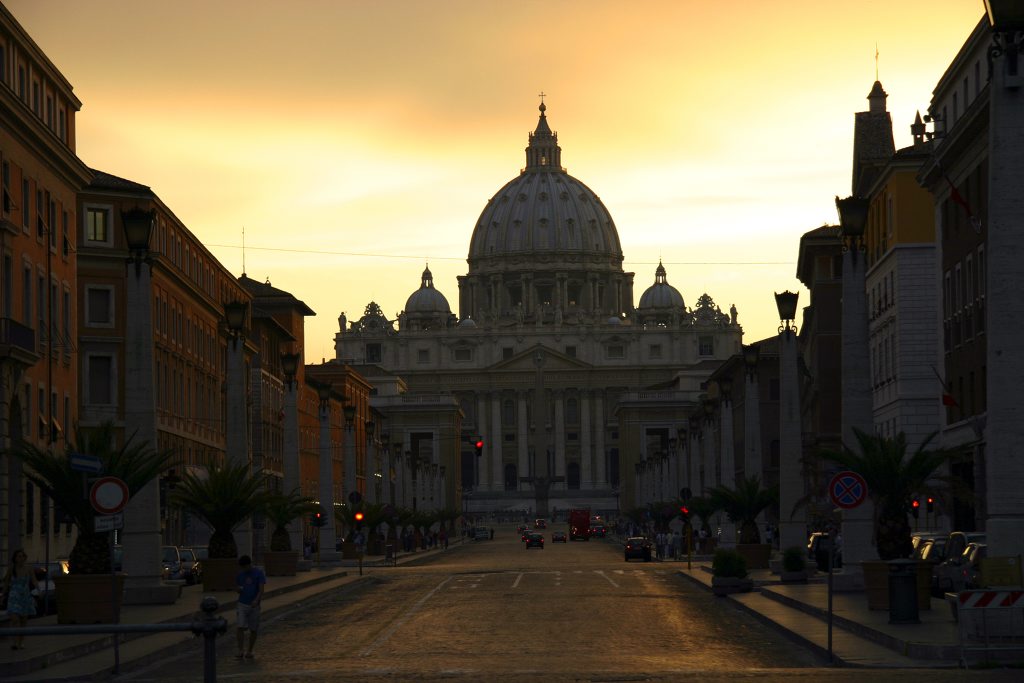 St. Peters Basilica, Rome
There is not and there never was on this earth, a work of human policy so well deserving of examination as the Roman Catholic Church… She saw the commencement of all the governments and of all the ecclesiastical establishments that now exist in the world; and we feel no assurance that she is not destined to see the end of them all. She was great and respected before the Saxon had set foot on Britain, before the Frank had passed the Rhine, when Grecian eloquence still flourished in Antioch, when idols were still worshipped in the temple of Mecca. And she may still exist in undiminished vigour when some traveler from New Zealand shall, in the midst of a vast solitude, take his stand on a broken arch of London Bridge to sketch the ruins of St. Paul’s.
As Macaulay says, there’s never been anything like it in world history. For better or for worse, you can’t talk about the last two millennia without referencing it.
For Catholics, Church history is the story of God’s People in a particular time and in a particular place. That is to say, the fallible People of God. Take the words of Jean Baptiste Lacordaire (1802-1865), the French Dominican priest who was probably the greatest Catholic preacher of his time:
 Notre Dame Cathedral, Paris
God has indeed conferred upon His Church the prerogative of infallibility, but to none of her members has He granted immunity from sin. Peter was a sinner and a renegade, and God has been at pains to have that fact recorded in the Gospels.
Right from the night of the Last Supper, there have been low points in Church history. Often cited are the Crusades, the Inquisition, and Pope Pius XII’s “silence” during the Holocaust. But let’s take the Renaissance Papacy, now the subject of an HBO minseries. Historian Eamon Duffy writes of it:
The Renaissance papacy evokes images of a Hollywood spectacular, all decadence and drag. Contemporaries viewed Renaissance Rome as we now view Nixon’s Washington, a city of expense-account whores and political graft, where everything and everyone had a price, where nothing and nobody could be trusted. The popes themselves seemed to set the tone.
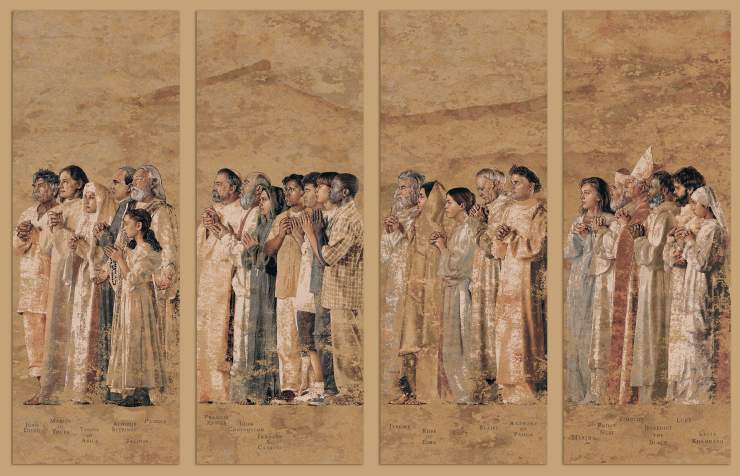 Our Lady of Angels, Los Angeles
Tapestries by John Nava
Yet despite scandal and schism, the next hundred years also saw some of history’s greatest saints: Ignatius of Loyola, Teresa of Avila, John of the Cross, Francis De Sales, and Vincent De Paul, to name just a few. Blessed John Henry Newman considered this “one of the great arguments for Christianity.”
So there are high points and low points in Church history, but Catholics don’t see it as a meaningless cycle as the ancients did. In his City of God, St. Augustine explained the Christian understanding of history as linear, with a starting and ending point. As a Church, we have our ups and downs. We fall along the way. But we get up and move on toward our ultimate goal together. People create scandals, but God sends graces, and the people who respond to it we call saints.
History shows us, then, that we need not despair. There is hope. Father James Kent Stone, a 19th century American priest, wrote, “Yes, there have been scandals… if we look for them. But there have been saints and martyrs… of whom the world knows nothing. And there are saints still.” And though we are all fallible, from top to bottom, Jesus promised to remain with us until the end of time.
As people of faith, therefore, we have an obligation not to be discouraged, but to keep hope. For help is always in sight, and God’s grace is waiting for us to to respond. So for those of us who are discouraged by the current state of the Church, fear not. As Father Stone noted, the saints aren’t coming. They’re already here!
That’s why I am Catholic, and proud of it.
 Inside St. Peters Basilica

Previous Post

April 27, 2011
Thanks to Easter and My Journey
Next Post
April 28, 2011 To Train My Family to Pray, And Lead Them By Example
Browse Our Archives
Select a Category Blog News Conversion Story Culture Learning Living Nature Prayer Uncategorized Working
Select a Month June 2016 May 2016 August 2015 July 2015 June 2015 May 2015 April 2015 March 2015 February 2015 January 2015 December 2014 November 2014 October 2014 September 2014 August 2014 July 2014 June 2014 May 2014 April 2014 March 2014 February 2014 January 2014 December 2013 November 2013 October 2013 September 2013 August 2013 July 2013 June 2013 May 2013 April 2013 March 2013 February 2013 January 2013 December 2012 November 2012 October 2012 September 2012 August 2012 July 2012 June 2012 May 2012 April 2012 March 2012 February 2012 January 2012 December 2011 November 2011 October 2011 September 2011 August 2011 July 2011 June 2011 May 2011 April 2011 March 2011 February 2011 January 2011 December 2010 November 2010 October 2010 September 2010 August 2010 July 2010 June 2010 May 2010 April 2010 March 2010 February 2010 January 2010 December 2009 November 2009 October 2009 September 2009 August 2009
Follow Us!
TAKE THE
Religious Wisdom Quiz
What food was eaten during the first Passover?
Select your answer to see how you score.
Fish and figs Unleavened bread, bitter herbs, and lamb Barley and honey Roasted quail and dates
Related posts from Why I Am Catholic

Belated Happy Birthday To Blaise Pascal, Unofficial Saint...

Because My Brother Imran Yousef Is An American...

Because of G.K. Chesterton (29 May, 1874 – 14 June, 1936)

Joe Six-Pack, USMC, With A Few Post-Terrorist Attack...
TRENDING AT PATHEOS Catholic

Rejecting Doom: Christian Hope And Human Action
Christianity is a religion of hope. We are to have hope and...

It’s What Comes From Within Which Matters
One of the most difficult things for us to understand is why...

Why I Choose the Eucharist Over the Sermon
Choose the Eucharist, Not the Sermon What are we supposed to get...

5 Design Elements Found in Spiritually Rooted Homes
Putting Spirituality Into Home Decor Our homes are more than our living...

Credo: A Story of God Told with the...
About 10 years ago, I began to imagine a personal "Credo" that...

The Anatomy of Divine Revelation in Catholic Thought
The claim that God has made Himself known to human beings is...
Ad-Free & Subscriber Log-In Subscription Support
- About Us
- 2026 Calendar
- Videos
- Podcasts
- Library of World Religions
- Faith In Media Tracker
- Advertise With Us
- Write for Us
- Privacy Policy
- Terms of Service
- Do Not Sell My Data
- Contact Us
- Radiant Digital
- Manage Newsletter Subscriptions
- Unsubscribe From Notifications
- Sitemap
Copyright 2008-2026, Patheos. All rights reserved.
Subscription Support Ad-Free & Subscriber Log-In
Follow Patheos