
BuddhistCatholicContemplativeEvangelicalGeneral ChristianHinduJewishLatter-day SaintMuslimNew VisionsProgressive Christian
Beliefs
- Buddhist
- Catholic
- Contemplative
- Evangelical
- General Christian
- Hindu
- Jewish
- Latter-day Saint
- More Voices
- Muslim
- New Visions
- Pagan
- Progressive Christian
Topics
- Religion News
- Food and Religion
- Sports and Religion
- Religious Art
- Religious Music and Entertainment
- Religious Events
- History and Religion
- Style and Religion
- Politics and Religion
- Women in Religion
- Recreation Outdoors and Religion
- Business Finance and Religion
- Careers Workplace and Religion
- Education and Religion
- Family Parenting and Religion
- Health Fitness and Religion
- Home and Religion
- Relationships and Religion
- Technology and Religion
- Travel and Religion
Columnists
- Buddhist Columnists
- Business Finance and Religion Columnists
- Careers Workplace and Religion Columnists
- Catholic Columnists
- Contemplative Columnists
- Education and Religion Columnists
- Evangelists Columnists
- Family Parenting and Religion Columnists
- General Christian Columnists
- Health Fitness and Religion Columnists
- Hindu Columnists
- History and Religion Columnists
- Home and Religion Columnists
- Jewish Columnists
- More Voices Columnists
- Latter Day Columnists
- Muslim Columnists
- New Visions Columnists
- Nonreligious Columnists
- Pagan Columnists
- Politics and Religion Columnists
- Progressive Columnists
- Recreation Outdoors and Religion Columnists
- Relationships and Religion Columnists
- Religion News Columnists
- Religious Art Columnists
- Religious Events Columnists
- Religious Music and Entertainment Columnists
- Sports and Religion Columnists
- Style and Religion Columnists
- Technology and Religion Columnists
- Travel and Religion Columnists
- Women in Religion Columnists
Resource Library
- 2026 Calendar
- Library of World Religions
- The 100 Most Holy Places on Earth
- Patheos Answers
- Podcasts
- Videos
- Faith Leaders Database
- Anglican Episcopalian
- Bahai
- Baptist
- Buddhism
- Christianity
- Confucianism
- Eastern Orthodoxy
- Hinduism
- Holiness and Pentecostal
- ISKCON
- Islam
- Judaism
- Lutheran
- Methodist
- The Church of Jesus Christ of Latter-day Saints
- New Age
- Paganism
- Presbytarian and Reformed
- Protestantism
- Religion Behind the Scenes
- Roman Catholic
- Scientology
- Shia Islam
- Sikhism
- Sufism
- Sunni Islam
- Taoism
- Zen
- See all religions
Research Tools
 Ad-Free & Subscriber Log-In Subscription Support
Ad-Free & Subscriber Log-In Subscription Support
Follow Patheos 

- Trending:
- Forgiveness
- |
- Marriage
- |
- Consciousness
- |
- Death Penalty
- |
- Election
- |
- Halloween
 Why I Am Catholic
-
More
- Home
- Because Yes, You Can Go Without Food For A Day (Or Two)
Because Yes, You Can Go Without Food For A Day (Or Two)
Last updated on: June 7, 2015 at 10:39 pm by Frank Weathers
Because Yes, You Can Go Without Food For A Day (Or Two) 2015-06-07T22:39:23-05:00 Frank Weathers
Patheos Explore the world's faith through different perspectives on religion and spirituality! Patheos has the views of the prevalent religions and spiritualities of the world.

The Season of Lent has begun and Catholics are required to fast today (Ash Wednesday) as well as on Good Friday. We are, however, allowed to break the Lenten fasts on Sundays throughout the season. And you don’t have to fast if you are ill, nursing, below 10 years old, etc.
So although 40 days of sacrifice seems like a lot, fasting from food for only two days is a walk in the park compared to what the saints listed below did. Because I found the following examples of saints who survived for long periods of time on the Eucharist…alone.
These accounts are from an old book published in 1894 called, A Dictionary of Miracles: Imitative, Realistic, and Dogmatic. Though not an exhaustive list (St. Catherine of Siena is missing, for example), it may help you put to bed the notion that you personally cannot fast for the required two days that we are obligated to adhere to for Lent, not to mention simply refraining from eating meat on Fridays.
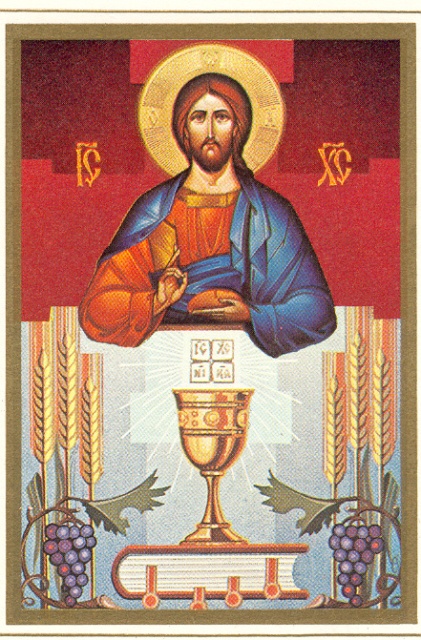
My Flesh is Meat indeed, and My Blood is Drink indeed.
John vi. 48-55: Jesus said, I am the bread of life. A man may eat thereof, and not die. I am the living bread; if any man eat of this bread, he shall live for ever; and the bread that I will give is My flesh. For My flesh is meat indeed, and My blood is drink indeed.
John vi. 35: Jesus said to the people, “I am the bread of life. He that cometh to Me shall never hunger; and he that believeth on Me shall never thirst.”
John iv. 13, 14. Jesus said unto the woman of Samaria, “Whosoever drinketh of the water of this well shall thirst again; but whosoever drinketh of the water that I shall give him shall never thirst.
And now for some miraculous examples:

St. Catherine Fieschi of Genoa supported by the Eucharist (a.d. 1447-1510). All through Advent and all through Lent, Catherine Fieschi took no food at all except that administered to her in the mass. In fact, for twenty-three years, from St. Martin’s Day (Nov. 11) to Christmas Day, and from Quinquagesima Sunday to Easter Day, she took no food except “this heavenly manna,” administered to her daily, and her only drink was a glass of water mixed with vinegar and salt.
If ever she attempted to swallow any other food or drink, her stomach rejected it. Sometimes she made great efforts to retain what she had thus swallowed, especially before her confessor, but in these cases her efforts were followed by alarming illness, almost to the verge of death.—Acta Sanctorum, Sept. 14.
St. Gerasimus, a recluse of Palestine, ate nothing but the bread given him in the Eucharist all Lent (a.d. 475). St. Gerasimus was noted for his extraordinary abstinence. He fasted always all Lent, taking no nourishment of any kind, except the eulogie or sacred bread administered to him in the Eucharist.—Lives of the Fathers of the Eastern Deserts.
Remember my friendly flying saint?
 St. Joseph of Cupertino
St. Joseph of Cupertino lived for five years on the Eucharist only (a.d. 1603-1663).
St. Joseph of Cupertino lived five years without eating, and fifteen years “without drinking. In these long abstinences, he was sustained by the eulogie, which was administered to him daily. It was often noticed that before the sacrament he looked pale and haggard, weary and spiritless; but when he left the altar he was brisk, animated, and full of vigour.
The body of Christ was food indeed, and the blood of Christ was drink indeed. On one occasion the superior insisted on his taking a little food; he took it in obedience to the superior, but the moment he swallowed it, his stomach rejected it again.—Dominic Bernini, Life of St. Joseph of Cupertino.
St. Nicholas de Flue for twenty years ate and drank nothing but the Eucharist (a.d. 1417-1487).
This must be given in the ipsissima verba of John de Muller himself, Protestant historian of the Swiss Confederation: “Nicolas de Flue, during the twenty years he lived [in Ranft], took no other food or drink other than the Holy Eucharist he received every month. This was done by the grace of Almighty God who created from nothing the heavens and the earth, and can keep them as he pleases. This miracle was examined during his life, and is proven “to posterity, by his contemporaries, and held undisputed”(1487).—John de Muller, Histoire de la Suisse, vol. v. p. 248.
Oswald Isner, cure at Kerns, writes in 1447: “When Father Nicholas began his life of total abstinence, and had reached the eleventh day, he sent for me and asked me privately if he should take food or continue to abstain. He wished to live wholly without food, that he might more sever himself from the world. I felt his members, and found only skin and bone; all the flesh was dried up entirely, the checks were hollow, and the lips wonderfully thin.
 St. Nicholas de Flue
I told him to persevere as long as he could without endangering life. For if God had sustained him for eleven days, He could sustain him eleven years. Nicholas followed my advice; and from that moment to the day of his death, a period of twenty and a half years, he took no sort of food, and drank nothing. As he was more familiar with me than with any other person, I often spoke to him on the subject. He told me he received the sacrament once a month, and felt that the body and blood of Christ communicated vital force which served him for meat and drink. Otherwise he could not sustain life without nourishment.
The magistrates, wishing to verify the fact, sent guards for an entire month to surround the retreat of the saint both night and day, to see that no one brought him food. The prince-bishop of Constance sent his suffragan, the bishop of Ascalom, with strict orders to unmask the imposture, if he could detect any. The suffragan took up his abode in a chapel adjoining the cell of Nicholas, And entering the cell, asked him, “What is the first duty of a Christian?”
“Obedience,” said Nicholas. “If obedience is the first duty of a Christian. I command you to eat these pieces of bread, and to drink this wine,” said the bishop. Nicholas besought the bishop not to insist on this order, but the bishop would not give way. Nicholas was obliged to obey; but the moment he swallowed a mouthful of bread, his agony was so great, that the bishop pressed him no longer, and said he only wished to prove whether Nicholas was possessed with a devil; but his obedience had shown him to be a child of grace.
The Archduke Sigismond of Austria sent the royal physician Burcard von Hornek. to examine into the case, and he remained in the cell several days and nights. The Emperor Fredrick III, sent delegations to search into it, but one and all confessed it was a real fact, wholly without delusion.’
Nicholas took part in the service of the parish church every Sunday, and in the great annual procession at Lucerne and he tried to be as little different from other men as possible.
St. Sabis and his Armenian disciples live on the Eucharist (a.d. 480-531).
St. Sabas and several Armenians retired to a desert, where they lived in what is called a laura—that is, a number of separate huts—but every Saturday and Sunday they met in a common oratory. All Lent they lived in the desert in absolute solitude till Palm Sunday, without seeing a soul, or taking any food except the Eucharist, which they received twice a week.—Father Giry, St. Sabast etc.
 “Meat indeed”
St. Silvinus, bishop of Regionnaire, lived for forty years on the Eucharist (a.d. 718).
St. Silvinus was noted for his austerities, and for forty years ate no bread except that which he received in the Eucharist. Sometimes he took a few herbs or a little fruit. He never slept in a bed, but always on the bare ground, wholly without covering, even in winter. He treated his body as a slave, surrounded it with bands of iron, macerated it with scourges, and carried enormous stones, which he deposited as a trophy before the doors of the basilica of St. Peter.
—Bollandus, Acta Sanctorum, Feb. 17, p. 23.
Grace of Valencia used to live all Lent on the Eucharist only (a.d. 1494-16U6).
For seven years Grace of Valencia drank nothing, not even one drop of water; this was before she entered the order of St. Francis of Paula; and for the last twenty-one years of her life, she abstained wholly from drink of any kind. She often went four or five days on “angels’ food;” that is, the eulogie, or sacred bread of the Eucharist.—K. P. d’Attichy, Jitstoire Generate de I’Ordre des Freres Mincurs,
Miscellaneous examples of saints going for long periods on the strength afforded by the Eucharist.
Father Sebastian of Perouse says, in his Life of Colomba of Riett, “The holy Eucharist was well-nigh her only food; but this sacred bread sustained her forces and her courage.”
Elizabeth of Waldsech, In Suabia (a.d. 138G-1420). Her biographer says that Elizabeth of Waldsech often lived a whole day on the bread she received in the Holy Sacrament.
John The Good Of Mantua (a.d. 1222). John the Good of Mantua fasted from Easter to Pentecost; the days prescribed by the Church before Easter and before Christmas; besides every Monday, Wednesday, and Friday throughout the year. On the first of these fasts, between Easter and Pentecost, he took no food except that supplied in the Holy Communion. On Ash Wednesday he took three ounces of bread, which lasted him for three days. On the Christmas fastdays, his daily allowance of food was three beans. His weekly fasts were restricted to bread and water. He never touched meat from year’s end to year’s end.—Histoire des Homines Illustres de tOrdre des Ermites de St. Augustin.
 St. Rita of Cascia
Marianne De Jesus(a.d. 1645). Marianne at first restricted her diet to bread, fruit, and vegetables; she then gave up the bread, and at last confined herself to the eulogie or sacred bread as her only food. “This,” says her biographer, “is by no means unusual in the lives of saints. Her drink was a glass of water at noon, but later in life she dropped this luxury, and suffered dreadful thirst. On one occasion a cup of water was brought her; she raised it to her feverish lips, and then suddenly put the cup down without touching a drop. She entreated to be allowed to serve the table at the daily meals, that she might mortify her flesh by seeing and handling food without touching a morsel.” — Las Betits Bollandistes, vol. vi. p. 232.
Rita of Cascia (a.d. 1456) took scarcely any nourishment, and the sisters of the convent always believed it was the Holy Eucharist which supplied material aliment to her.—Augustin Cavalucci, Life of the Beatified Rita de Cascia.
St. Manutius of Bayeux (a.d. 480). For forty-seven days before his death the only aliment taken by Manutiua of Bayeux was the Holy Eucharist. He died May 28, A.D. 480.—Propre de Bayeux.
St. Mary Frances of the Five Wounds (a.d. 1715-1791). This was the name taken by Anna Maria Rosa Nicoletta of Naples when she joined the Society of St. Francis d’Assisi. She was a great invalid, and lived for some considerable time on the eulogie or sacred bread alone. —R. P. Bernard Laviosa, Life of Mary Frances.
It’s not too late to skip your supper.
Update: Taylor Marshall has all the official rules on fasting and abstinence.
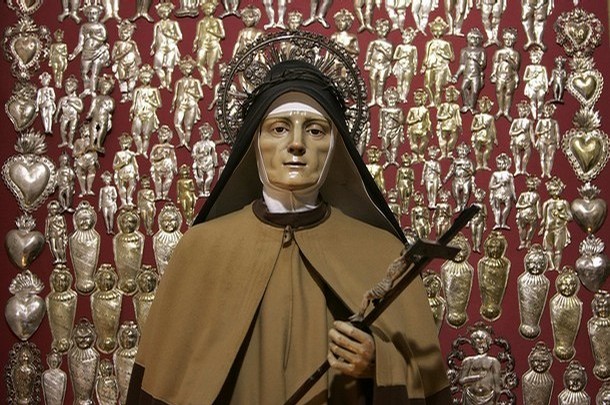 St. Mary Frances of
the Five Wounds

Previous Post

March 9, 2011
Dust in the Wind (A Few Words for Wednesday)
Next Post
March 9, 2011 Because God Offers "Re-do's"
Browse Our Archives
Select a Category Blog News Conversion Story Culture Learning Living Nature Prayer Uncategorized Working
Select a Month June 2016 May 2016 August 2015 July 2015 June 2015 May 2015 April 2015 March 2015 February 2015 January 2015 December 2014 November 2014 October 2014 September 2014 August 2014 July 2014 June 2014 May 2014 April 2014 March 2014 February 2014 January 2014 December 2013 November 2013 October 2013 September 2013 August 2013 July 2013 June 2013 May 2013 April 2013 March 2013 February 2013 January 2013 December 2012 November 2012 October 2012 September 2012 August 2012 July 2012 June 2012 May 2012 April 2012 March 2012 February 2012 January 2012 December 2011 November 2011 October 2011 September 2011 August 2011 July 2011 June 2011 May 2011 April 2011 March 2011 February 2011 January 2011 December 2010 November 2010 October 2010 September 2010 August 2010 July 2010 June 2010 May 2010 April 2010 March 2010 February 2010 January 2010 December 2009 November 2009 October 2009 September 2009 August 2009
Follow Us!
TAKE THE
Religious Wisdom Quiz
I am the resurrection and the life. Whoever believes in me will live, even though they do what?
Select your answer to see how you score.
Fall Sin Die Suffer
Related posts from Why I Am Catholic

Belated Happy Birthday To Blaise Pascal, Unofficial Saint...

Because My Brother Imran Yousef Is An American...

Joe Six-Pack, USMC, With A Few Post-Terrorist Attack...

This Is Why God Invented YouTube...
TRENDING AT PATHEOS Catholic

Rejecting Doom: Christian Hope And Human Action
Christianity is a religion of hope. We are to have hope and...

It’s What Comes From Within Which Matters
One of the most difficult things for us to understand is why...

Why I Choose the Eucharist Over the Sermon
Choose the Eucharist, Not the Sermon What are we supposed to get...

5 Design Elements Found in Spiritually Rooted Homes
Putting Spirituality Into Home Decor Our homes are more than our living...

Credo: A Story of God Told with the...
About 10 years ago, I began to imagine a personal "Credo" that...

The Anatomy of Divine Revelation in Catholic Thought
The claim that God has made Himself known to human beings is...
Ad-Free & Subscriber Log-In Subscription Support
- About Us
- 2026 Calendar
- Videos
- Podcasts
- Library of World Religions
- Faith In Media Tracker
- Advertise With Us
- Write for Us
- Privacy Policy
- Terms of Service
- Do Not Sell My Data
- Contact Us
- Radiant Digital
- Manage Newsletter Subscriptions
- Unsubscribe From Notifications
- Sitemap
Copyright 2008-2026, Patheos. All rights reserved.
Subscription Support Ad-Free & Subscriber Log-In
Follow Patheos