
BuddhistCatholicContemplativeEvangelicalGeneral ChristianHinduJewishLatter-day SaintMuslimNew VisionsProgressive Christian
Beliefs
- Buddhist
- Catholic
- Contemplative
- Evangelical
- General Christian
- Hindu
- Jewish
- Latter-day Saint
- More Voices
- Muslim
- New Visions
- Pagan
- Progressive Christian
Topics
- Religion News
- Food and Religion
- Sports and Religion
- Religious Art
- Religious Music and Entertainment
- Religious Events
- History and Religion
- Style and Religion
- Politics and Religion
- Women in Religion
- Recreation Outdoors and Religion
- Business Finance and Religion
- Careers Workplace and Religion
- Education and Religion
- Family Parenting and Religion
- Health Fitness and Religion
- Home and Religion
- Relationships and Religion
- Technology and Religion
- Travel and Religion
Columnists
- Buddhist Columnists
- Business Finance and Religion Columnists
- Careers Workplace and Religion Columnists
- Catholic Columnists
- Contemplative Columnists
- Education and Religion Columnists
- Evangelists Columnists
- Family Parenting and Religion Columnists
- General Christian Columnists
- Health Fitness and Religion Columnists
- Hindu Columnists
- History and Religion Columnists
- Home and Religion Columnists
- Jewish Columnists
- More Voices Columnists
- Latter Day Columnists
- Muslim Columnists
- New Visions Columnists
- Nonreligious Columnists
- Pagan Columnists
- Politics and Religion Columnists
- Progressive Columnists
- Recreation Outdoors and Religion Columnists
- Relationships and Religion Columnists
- Religion News Columnists
- Religious Art Columnists
- Religious Events Columnists
- Religious Music and Entertainment Columnists
- Sports and Religion Columnists
- Style and Religion Columnists
- Technology and Religion Columnists
- Travel and Religion Columnists
- Women in Religion Columnists
Resource Library
- 2026 Calendar
- Library of World Religions
- The 100 Most Holy Places on Earth
- Patheos Answers
- Podcasts
- Videos
- Faith Leaders Database
- Anglican Episcopalian
- Bahai
- Baptist
- Buddhism
- Christianity
- Confucianism
- Eastern Orthodoxy
- Hinduism
- Holiness and Pentecostal
- ISKCON
- Islam
- Judaism
- Lutheran
- Methodist
- The Church of Jesus Christ of Latter-day Saints
- New Age
- Paganism
- Presbytarian and Reformed
- Protestantism
- Religion Behind the Scenes
- Roman Catholic
- Scientology
- Shia Islam
- Sikhism
- Sufism
- Sunni Islam
- Taoism
- Zen
- See all religions
Research Tools
 Ad-Free & Subscriber Log-In Subscription Support
Ad-Free & Subscriber Log-In Subscription Support
Follow Patheos 

- Trending:
- Forgiveness
- |
- Marriage
- |
- Consciousness
- |
- Death Penalty
- |
- Election
- |
- Halloween
 Why I Am Catholic
-
More
- Home
- Because Napoleon Died a Catholic Death
Because Napoleon Died a Catholic Death
Last updated on: June 7, 2015 at 11:36 pm by Frank Weathers
Because Napoleon Died a Catholic Death 2015-06-07T23:36:13-05:00 Frank Weathers
Patheos Explore the world's faith through different perspectives on religion and spirituality! Patheos has the views of the prevalent religions and spiritualities of the world.

A few weeks back, my family and I hit the used book sale that is held annually to benefit our local public library. Going to this sale has been an annual event for us, ever since we moved to Tennessee six years ago. It is at that sale where I first picked up the collection of Harvard Classics, where I met Blaise Pascal and Thomas à Kempis.
Now that I’m a Catholic, I go to this sale on the lookout for books about the Faith, and works written by great Catholic authors.
I hit the jackpot this year, with a treasure trove of titles. Four Faultless Felons by G.K. Chesterton, for example. A paperback from 1956 called The Papal Encyclicals*, with writings from St. Peter all the way up to Pope Pius XII. More Chesterton with* Father Brown of the Church of Rome*, edited by John Peterson. I picked up 17 titles in all, including* The Waters of Siloe by Thomas Merton and The Peasant of Garonne by Jacques Maritain.
And the selection I am sharing with you today is from Hilaire Belloc’s biography of a famous French general and Emperor you may have heard of named Napoleon Bonaparte. Published in 1932, and weighing in at 379 pages, in a large hardback sporting “16 Illustrations and 22 Maps,” I’m looking forward to getting to know Napoleon better, through Hilaire Belloc’s pen.
A cursory glance of the volume landed me near the end of the book where the death of the exiled leader is imminent. Much as he did in The Great Heresies*, Belloc doesn’t bother with footnotes here. But from what he writes about how Napoleon died, I hope to meet him in heaven.*
Here is how Belloc tells the tale,
The Death of Napoleon
 In exile on St. Helena
It was nightfall on Sunday, April 29, 1821. Napoleon lay dying. The little iron camp-bed with the silver eagles on its four corners and its green curtains was placed in the middle of the low petty room, its head to the light between two windows, its foot towards the simple fireplace, on the mantlepiece of which, in front of a large square looking-glass, stood the bust of his little son.
Wretched as the room was, it was the best in the shanty of a house—a place that was soon to be turned into common stables and was most suitable perhaps for that. It had been worse, when first the Emperor and the few who followed him came into that exile. They had found shreds of the wall-paper turned moldy and rotten with moisture and the ragged carpet on the floor gnawed into holes by rats. So much had been set right; muslin had been stretched over the walls and fluted round, the ceiling white-washed, and the place reasonably clean.
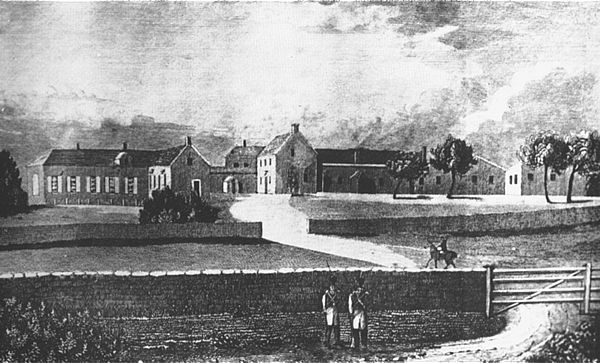 Napoleon’s Lodgings
It stood not far from the summit of a sort of very wide shallow cup sloping down easterly towards the sea from on of the ridges of that volcanic island (St. Helena in the South Atlantic), the floors of the long low place being somewhat less than 2000 feet above the sea, the noise of which could be heard coming up the funnel from the mouth of the depression below. And up that broad cup of the valley, and from the ocean below too, frequently blew the south-east gales—which the failing Emperor dreaded, finding that they suited him ill.
To the right end of the bed as he lay in such extremity he looked through an open door at the chapel which had been set up as best might be in the next room of the suite, the dining room. He gazed through to the wooden altar which the Chinese workmen (serfs of the East India Company) had set up; and his eyes could rest there on one of the last monuments of his name; the four golden letters “N” embroidered on either corner of the green velvet cloth which covered the two steps.
Through this door that morning he had heard the Sunday Mass which Bertrand’s young son had served. There also was the Tabernacle, rough, amateur, cardboard covered, but ornamented as best might be with gilt paper and the white of it gleaming against the red satin behind, while above stood a great Crucifix in ebony, too large it seemed for the altarpiece. Its great silver figure of Christ dominated the scene. He had given orders that when his last agony should be upon him, the Blessed Sacrament should be exposed and the Prayers of the Dead recited; also, said he, he desired to fulfill all the duties of the Catholic Faith.

Now as he had said these words, Antommarchi—the surgeon attendant upon him, who was an atheist in the spirit of his time,as also from the boast of science that he had, could not restrain a smile; whereat Napoleon, with some remnant of strength, flamed up at him and cried, “Be off! Stupidity fatigues me, but I can forgive shallow wits or even bad manners. I cannot forgive dullness of heart.”
It being not long after dark, Montholon had already taken up his watch at nine o’clock, which he changes alternately with the valet Marchand, and it ran till two o’clock in the morning. But on that day he had occasion to leave the Emperor alone, for this reason, that the priest Vignali was to attend. For Napoleon had said long before, when first he discovered what awaited him in his exile, “I must have a priest about me: I would not die like a dog.”
The Emperor had not feared death. He had seen it coming for now long past, ever since the beginning of the year. For when, on New Year’s Day, Marchand had pulled the curtains in the morning, Napoleon—who loved a joking converse with a familiar, and was devoted to those about him—had said, “Well, and what present have you for me this New Years?”
Marchand had answered, “Sire, the hope of seeing Your Majesty soon set to rights and leaving this air which does you only ill.”
But to such words Napoleon, no longer smiling, had gravely replied, “It will not last long, my son. My end is on me; I cannot carry on much more.”
Said Marchand, “As I see things it is not so.”
And then Napoleon had ended all this by the few words, “It shall be as God wills.”
As his illness had increased upon him he had known more and more that certainly it was death.
There came a time when he could no longer walk or ride out of doors, and when he attempted to do so turned faint. In March his blood had chilled and they needed to put warm clothes about his feet, and by the middle of the month he said to a doctor who begged him to take remedies prescribed, “Well, sir! I am at your orders! But do you not see that death will be to me a gift from Heaven? I do not dread it. I will do nothing to hasten it, but I would try no sortilege to make my life the longer.” And at another time he said, “Death has now been for some weeks beside me upon my pillow,” meaning that he had become familiar with that Visitor.
He had told them also, with more instinctive knowledge than their science possessed, that he was dying of what his father had died of; and so he was—with a cancer in the stomach which was certain soon to make an end; so that he could also say, when his English doctor asked him how he felt upon a certain day, “I shall soon give back to the earth the remnant of that life which it is of such import to the Kings to seize.”
He had asked, while still he could attend to reading, that they should read him Homer for a while; and that same day, Sunday the 29th, he had dictated, as he had dictated upon the day before, what he termed “A Reverie”—would that we possessed it! But now, when the night had come, greater things were at hand. The priest was with him alone.
Napoloeon Bonaparte confessed, and was absolved; his peace with the Faith was made; the Last Sacraments were administered—save for this, that he might not receive the Viaticum since he could retain no food. They therefore dared not give him the Eucharist. But he was at peace, while yet his reason remained to him.
It remained to him still for a brief four days. Upon the next day, the last of April, the Monday, his thoughts being still clear but his weakness very great and the sickness upon him very grievous, he kept his eyes still fixed upon the bust of his little son showing there against the glass at the foot of the bed upon the mantel. His sleep had left him, but he lingered on through May 2 and until the 3rd. Upon the 3rd, the last flicker of his great will being, as he thought, still at his service, he attempted to rise for a moment, but fell back. They gave him wine, and as he tasted it he murmured, “How good is wine!”
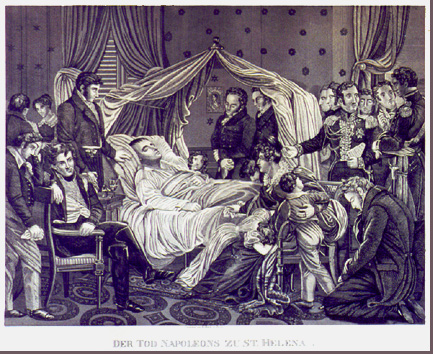 With that night of the 3rd, however, all around know that the end was upon him, and all watched. With the morning, before noon, his delirium began, in the frenzy of which at one moment he attempted to seize on Montholon at his side; and in that fever he muttered continually words the whispered confusion of which suggested now this, now that. It is said that the last of them which any mortal could distinguish were, “Army…army…” and “Head of the Army….” But there can be no certain record of such things.
All that day long, all the afternoon, right on through the night till four in the morning of the Saturday, the 5th, that final unconscious communion with the last flicker of this life continued. Drowning the slight murmurs of it, came violent rain for hours against the window panes at either side of the beds head, and mixed with that noise the saying of the Prayers before the Altar. Out of the sea a great wind arose and blew furiously up the valley, shaking the frail and miserable tenement with its gusts and rattling the casements and driving more furiously still the waters of the tempest against the glass.
But as the afternoon grew louder in the heavens without, the Emperor at last lay still, and even the faint whisperings from his lips were no longer heard; but they still moved imperceptibly in breathing. The household were assembled. It was near six in the evening. At nine minutes to the hour, the sunset gun was heard far off down the wind; and the rush of the tropical twilight fell under the hurrying clouds and that now lessening gale all those silent about him saw the change: the mouth half fell, the eyes opened; but they saw nothing of this world any more: Napoleon was dead.
They covered him with the cloak he had worn at Marengo, a Crucifix upon it, and by his side laid his sword.

You better believe that if I can say a prayer for the soul of Dracula, then I can certainly say one for Napoleon’s soul as well. And in the spirit of Lenten almsgiving, I’ll throw another one in for Hilaire Belloc’s soul for good measure too.
Update: Napoleon answers the question “Who is Jesus Christ?”

Previous Post

March 22, 2011
Because Jesus is the Unjust Steward
Next Post
March 23, 2011 For 10 Things To Do While Fr. Corapi is on Leave
Browse Our Archives
Select a Category Blog News Conversion Story Culture Learning Living Nature Prayer Uncategorized Working
Select a Month June 2016 May 2016 August 2015 July 2015 June 2015 May 2015 April 2015 March 2015 February 2015 January 2015 December 2014 November 2014 October 2014 September 2014 August 2014 July 2014 June 2014 May 2014 April 2014 March 2014 February 2014 January 2014 December 2013 November 2013 October 2013 September 2013 August 2013 July 2013 June 2013 May 2013 April 2013 March 2013 February 2013 January 2013 December 2012 November 2012 October 2012 September 2012 August 2012 July 2012 June 2012 May 2012 April 2012 March 2012 February 2012 January 2012 December 2011 November 2011 October 2011 September 2011 August 2011 July 2011 June 2011 May 2011 April 2011 March 2011 February 2011 January 2011 December 2010 November 2010 October 2010 September 2010 August 2010 July 2010 June 2010 May 2010 April 2010 March 2010 February 2010 January 2010 December 2009 November 2009 October 2009 September 2009 August 2009
Follow Us!
TAKE THE
Religious Wisdom Quiz
True or False: In Revelation, there are ten elders seated around God's throne.
Select your answer to see how you score.
FALSE TRUE
Related posts from Why I Am Catholic

Belated Happy Birthday To Blaise Pascal, Unofficial Saint...

Because My Brother Imran Yousef Is An American...

Joe Six-Pack, USMC, With A Few Post-Terrorist Attack...
HHS Forced Sex Changes? There Ain't No Fait...
TRENDING AT PATHEOS Catholic

Rejecting Doom: Christian Hope And Human Action
Christianity is a religion of hope. We are to have hope and...

It’s What Comes From Within Which Matters
One of the most difficult things for us to understand is why...

Why I Choose the Eucharist Over the Sermon
Choose the Eucharist, Not the Sermon What are we supposed to get...

5 Design Elements Found in Spiritually Rooted Homes
Putting Spirituality Into Home Decor Our homes are more than our living...

Credo: A Story of God Told with the...
About 10 years ago, I began to imagine a personal "Credo" that...

The Anatomy of Divine Revelation in Catholic Thought
The claim that God has made Himself known to human beings is...
Ad-Free & Subscriber Log-In Subscription Support
- About Us
- 2026 Calendar
- Videos
- Podcasts
- Library of World Religions
- Faith In Media Tracker
- Advertise With Us
- Write for Us
- Privacy Policy
- Terms of Service
- Do Not Sell My Data
- Contact Us
- Radiant Digital
- Manage Newsletter Subscriptions
- Unsubscribe From Notifications
- Sitemap
Copyright 2008-2026, Patheos. All rights reserved.
Subscription Support Ad-Free & Subscriber Log-In
Follow Patheos