
BuddhistCatholicContemplativeEvangelicalGeneral ChristianHinduJewishLatter-day SaintMuslimNew VisionsProgressive Christian
Beliefs
- Buddhist
- Catholic
- Contemplative
- Evangelical
- General Christian
- Hindu
- Jewish
- Latter-day Saint
- More Voices
- Muslim
- New Visions
- Pagan
- Progressive Christian
Topics
- Religion News
- Food and Religion
- Sports and Religion
- Religious Art
- Religious Music and Entertainment
- Religious Events
- History and Religion
- Style and Religion
- Politics and Religion
- Women in Religion
- Recreation Outdoors and Religion
- Business Finance and Religion
- Careers Workplace and Religion
- Education and Religion
- Family Parenting and Religion
- Health Fitness and Religion
- Home and Religion
- Relationships and Religion
- Technology and Religion
- Travel and Religion
Columnists
- Buddhist Columnists
- Business Finance and Religion Columnists
- Careers Workplace and Religion Columnists
- Catholic Columnists
- Contemplative Columnists
- Education and Religion Columnists
- Evangelists Columnists
- Family Parenting and Religion Columnists
- General Christian Columnists
- Health Fitness and Religion Columnists
- Hindu Columnists
- History and Religion Columnists
- Home and Religion Columnists
- Jewish Columnists
- More Voices Columnists
- Latter Day Columnists
- Muslim Columnists
- New Visions Columnists
- Nonreligious Columnists
- Pagan Columnists
- Politics and Religion Columnists
- Progressive Columnists
- Recreation Outdoors and Religion Columnists
- Relationships and Religion Columnists
- Religion News Columnists
- Religious Art Columnists
- Religious Events Columnists
- Religious Music and Entertainment Columnists
- Sports and Religion Columnists
- Style and Religion Columnists
- Technology and Religion Columnists
- Travel and Religion Columnists
- Women in Religion Columnists
Resource Library
- 2026 Calendar
- Library of World Religions
- The 100 Most Holy Places on Earth
- Patheos Answers
- Podcasts
- Videos
- Faith Leaders Database
- Anglican Episcopalian
- Bahai
- Baptist
- Buddhism
- Christianity
- Confucianism
- Eastern Orthodoxy
- Hinduism
- Holiness and Pentecostal
- ISKCON
- Islam
- Judaism
- Lutheran
- Methodist
- The Church of Jesus Christ of Latter-day Saints
- New Age
- Paganism
- Presbytarian and Reformed
- Protestantism
- Religion Behind the Scenes
- Roman Catholic
- Scientology
- Shia Islam
- Sikhism
- Sufism
- Sunni Islam
- Taoism
- Zen
- See all religions
Research Tools
 Ad-Free & Subscriber Log-In Subscription Support
Ad-Free & Subscriber Log-In Subscription Support
Follow Patheos 

- Trending:
- Forgiveness
- |
- Marriage
- |
- Consciousness
- |
- Death Penalty
- |
- Election
- |
- Halloween
 Why I Am Catholic
-
More
- Home
- A View from the Back Pew (A Book Review)
A View from the Back Pew (A Book Review)
Last updated on: January 24, 2017 at 6:28 pm by Frank Weathers
A View from the Back Pew (A Book Review) 2017-01-24T18:28:20-05:00 Frank Weathers
Patheos Explore the world's faith through different perspectives on religion and spirituality! Patheos has the views of the prevalent religions and spiritualities of the world.
—Feast of St. Louise de Marillac
As long-time readers of this blog know, we like books around here. It all started when Webster Bull kicked off the YIMC Book Club with 9 weeks of posts for the 9 chapters in G.K. Chesterton’s classic, Orthodoxy.
Then I followed up with 9 weeks of posts on Mere Christianity by C.S. Lewis, as well as a later series of weekly posts on Hilaire Belloc’s The Great Heresies. Those books were all worthy of selections by a blog that makes attempting to answer the statement Why I Am Catholic as it’s raison d’être.
Then a funny thing happened. I wrote a post on how I realized reading The Rule of St. Benedict was helping me be a better father. Next thing I know, Fr. Dwight Longenecker makes me an offer I couldn’t refuse by sending me a free copy of his book, Listen My Son: St. Benedict for Fathers in return for reviewing it in this space. Since the Rule itself is so good, I figured Fr. Dwight could only make it better. So I happily agreed.
Some time passed and Eric Sammons, who blogs at The Divine Life asked me to do the same thing for him, and on the same terms. One free book (Who Is Jesus Christ?) in return for a review. I was happy for the opportunity to read his book, having read of his progress on his blog. Did you see his interview with Fr. Groeschel? It’s “must-see TV.” By the way, Eric? Get a haircut!
Right about now, the opportunist (or the skeptic) in you is thinking “free book = great review with Frank Weathers over at YIMCatholic. Let’s send him something!”
Well that might not be a bad idea, as long as your work is faithful to the Magisterium. For the non-Catholics who may stumble upon this review today, that is a neat word that means “the teaching authority of the Church.” If you would like a more in-depth discussion of this authority, head on over to the Catholic Encyclopedia.

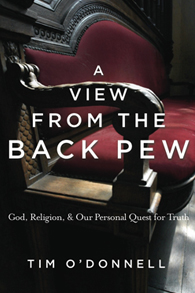
Anyway, the folks over at TLC Book Tours made me the same offer that Fr. Dwight and Eric Sammons made me. They sent me a free copy of A View from the Back Pew: God, Religion, & Our Personal Quest for Truth in return for a review.
For all of the books I mentioned above, this was more than a fair trade. That’s because I gained far more from reading all of those books than I paid for in the labor on writing the posts following their chapters, or on writing the reviews. Unfortunately, I can’t say that in the case this time around.
The author, Tim O’Donnell, according to the back cover of the copy I was sent,
takes us on a powerful search for balance—between faith and personal experience, between the roots of Christianity and later layers of doctrine, and between systems of belief and a direct connection to the spiritual presence we call God.
And so my labor began. The first 103 pages (out of a total of 280) drew me through Mr. O’Donnell’s experiences growing up in Catholic schools, where it seems he had more interest in being a cut-up and class appointed pain in the rear (we have that in common, at least) than in actually learning about the faith. There were also some sophomoric school hi-jinks shared, an episode of running away from home, and Tim’s year abroad to Rome while in college, all jammed into these first 100 pages.
Now, I’m not a product of Catholic schools, so his experience reads like another stereotype of mean nuns who wouldn’t answer all of his questions about the faith to his satisfaction. No big deal though, because when you become an adult, and start questioning your faith, you’ll be able to mine the vast resources available to you and answer these questions more to your satisfaction. Except that is not how it turns out for Mr. O’Donnell.
No. Instead, while in Rome, he has an experience that leads him to believe that organized religion is a waste of time. It doesn’t happen all at once, but that is where it eventually leads. After all, God is so much bigger than the Church. And though I agree with that statement, the fact that Jesus started the Church and entrusted St. Peter and his successors with spreading the Gospel and building His Church up is relegated to not much more than being “perhaps the most powerful and wealthy private institution the world has ever known.” Huh? Not much more than a country club for the elite? Sheesh!
On page 103 (Chapter 7) we learn of “the Deal.” This is where Mr. O’Donnell describes the sure knowledge that he will be taken care of by God, made wealthy by Him, in exchange for him bringing the knowledge he has discovered about the true nature of God to the good folks like us. It goes something like this: “I will make you rich, while you’re young, so you can retire early and spread this good news.” Neat, huh? Sometimes while laboring through this book, I wasn’t sure if I wasn’t reading something written by the self-help guru Anthony Robbins.
To be charitable, Mr. O’Donnell has hit upon the importance of people needing to ask questions about their faith. But unfortunately, it doesn’t appear to me that he went very much farther than his own opinion to find many of the answers. By page 113 of the book, I knew where this was heading. Throughout the book, the author makes a few references to the Catechism, and to a few passages from the Gospels. But not many. And not near enough to buttress his arguments.
Besides, by page 129 he is already “questioning” how the Trinity can be true. The Holy Spirit? Redundant. Later he questions why certain books were left out of the New Testament, like the Gnostic gospels that he quotes liberally later. The Kingdom of Heaven? Mr. O’Donnell has his own idea about that. The Our Father? Mr. O’Donnell show us the way we should really pray that prayer. And then the usual bromides about how the Church won’t let women be priests, and how badly the Church treats women, how celibacy is a pretty bad idea, the difficulty in believing Mary was a virgin, or stayed a virgin, etc. It’s pretty much the run-of-the mill list of “silly Catholic stuff” you’ve already read elsewhere. As for the Church being the “bulwark of Truth?” Fegettaboutit!
It took me but a short while to realize that I was reading the work of someone who, sadly, had dropped deeply into the pit of self-made ideas that are best described by one strong word: heresy. At this point, I was just glad I had read Belloc’s The Great Heresies before being asked to review this book. Because although Mr. O’Donnell states that he “did not become a modern-day Gnostic, or anything like that,” I can only say that it appears to me that he is exactly that. Read about the Albigensian Attack and you will understand what I encountered in Mr. O’Donnell’s book.
And so ends my first book review in which I state flatly that this book should be avoided. And that isn’t because Mr. O’Donnell questioned doctrines and found them wanting. It’s because he questioned the doctrines and then failed to find the answers explaining them. As I was reading this book I kept thinking, where are the Church Fathers? Where are the writings of the Doctors of the Church? Wither the Saints? When he states that women are second-class citizens in the Catholic Church I wonder, where is St. Catherine of Siena, or St. Teresa of Avila, and The Little Flower?
One of Mr. O’Donnell’s main arguments against the Church here is that she just doesn’t change, or evolve. Which is ridiculous on it’s face because of course she does! That is why Catholicism can’t be “taken up in a tea cup,” as the saint who wrote at length about her development stated so wisely.
The sad fact about this book is that by looking only inward, Mr. O’Donnell has missed so very much. The good news is, he still has a chance to find the rest of the forest if he applies himself to the task. My hope for him is that he climbs down from his own tree to do just that.

Previous Post

March 12, 2011
Because There Is Good News
Next Post
March 15, 2011 For All the Saints: Louise de Marillac
Browse Our Archives
Select a Category Blog News Conversion Story Culture Learning Living Nature Prayer Uncategorized Working
Select a Month June 2016 May 2016 August 2015 July 2015 June 2015 May 2015 April 2015 March 2015 February 2015 January 2015 December 2014 November 2014 October 2014 September 2014 August 2014 July 2014 June 2014 May 2014 April 2014 March 2014 February 2014 January 2014 December 2013 November 2013 October 2013 September 2013 August 2013 July 2013 June 2013 May 2013 April 2013 March 2013 February 2013 January 2013 December 2012 November 2012 October 2012 September 2012 August 2012 July 2012 June 2012 May 2012 April 2012 March 2012 February 2012 January 2012 December 2011 November 2011 October 2011 September 2011 August 2011 July 2011 June 2011 May 2011 April 2011 March 2011 February 2011 January 2011 December 2010 November 2010 October 2010 September 2010 August 2010 July 2010 June 2010 May 2010 April 2010 March 2010 February 2010 January 2010 December 2009 November 2009 October 2009 September 2009 August 2009
Follow Us!
TAKE THE
Religious Wisdom Quiz
Who was the youngest son of Jacob?
Select your answer to see how you score.
Joseph Levi Dan Benjamin
Related posts from Why I Am Catholic

Because My Brother Imran Yousef Is An American...
HHS Forced Sex Changes? There Ain't No Fait...
Apparently, There USED to be Secrets of Fatima
BREAKING: SCOTUS Decides Not To Decide On The...
TRENDING AT PATHEOS Catholic

Rejecting Doom: Christian Hope And Human Action
Christianity is a religion of hope. We are to have hope and...

It’s What Comes From Within Which Matters
One of the most difficult things for us to understand is why...

Why I Choose the Eucharist Over the Sermon
Choose the Eucharist, Not the Sermon What are we supposed to get...

5 Design Elements Found in Spiritually Rooted Homes
Putting Spirituality Into Home Decor Our homes are more than our living...

Credo: A Story of God Told with the...
About 10 years ago, I began to imagine a personal "Credo" that...

The Anatomy of Divine Revelation in Catholic Thought
The claim that God has made Himself known to human beings is...
Ad-Free & Subscriber Log-In Subscription Support
- About Us
- 2026 Calendar
- Videos
- Podcasts
- Library of World Religions
- Faith In Media Tracker
- Advertise With Us
- Write for Us
- Privacy Policy
- Terms of Service
- Do Not Sell My Data
- Contact Us
- Radiant Digital
- Manage Newsletter Subscriptions
- Unsubscribe From Notifications
- Sitemap
Copyright 2008-2026, Patheos. All rights reserved.
Subscription Support Ad-Free & Subscriber Log-In
Follow Patheos