
BuddhistCatholicContemplativeEvangelicalGeneral ChristianHinduJewishLatter-day SaintMuslimNew VisionsProgressive Christian
Beliefs
- Buddhist
- Catholic
- Contemplative
- Evangelical
- General Christian
- Hindu
- Jewish
- Latter-day Saint
- More Voices
- Muslim
- New Visions
- Pagan
- Progressive Christian
Topics
- Religion News
- Food and Religion
- Sports and Religion
- Religious Art
- Religious Music and Entertainment
- Religious Events
- History and Religion
- Style and Religion
- Politics and Religion
- Women in Religion
- Recreation Outdoors and Religion
- Business Finance and Religion
- Careers Workplace and Religion
- Education and Religion
- Family Parenting and Religion
- Health Fitness and Religion
- Home and Religion
- Relationships and Religion
- Technology and Religion
- Travel and Religion
Columnists
- Buddhist Columnists
- Business Finance and Religion Columnists
- Careers Workplace and Religion Columnists
- Catholic Columnists
- Contemplative Columnists
- Education and Religion Columnists
- Evangelists Columnists
- Family Parenting and Religion Columnists
- General Christian Columnists
- Health Fitness and Religion Columnists
- Hindu Columnists
- History and Religion Columnists
- Home and Religion Columnists
- Jewish Columnists
- More Voices Columnists
- Latter Day Columnists
- Muslim Columnists
- New Visions Columnists
- Nonreligious Columnists
- Pagan Columnists
- Politics and Religion Columnists
- Progressive Columnists
- Recreation Outdoors and Religion Columnists
- Relationships and Religion Columnists
- Religion News Columnists
- Religious Art Columnists
- Religious Events Columnists
- Religious Music and Entertainment Columnists
- Sports and Religion Columnists
- Style and Religion Columnists
- Technology and Religion Columnists
- Travel and Religion Columnists
- Women in Religion Columnists
Resource Library
- 2026 Calendar
- Library of World Religions
- The 100 Most Holy Places on Earth
- Patheos Answers
- Podcasts
- Videos
- Faith Leaders Database
- Anglican Episcopalian
- Bahai
- Baptist
- Buddhism
- Christianity
- Confucianism
- Eastern Orthodoxy
- Hinduism
- Holiness and Pentecostal
- ISKCON
- Islam
- Judaism
- Lutheran
- Methodist
- The Church of Jesus Christ of Latter-day Saints
- New Age
- Paganism
- Presbytarian and Reformed
- Protestantism
- Religion Behind the Scenes
- Roman Catholic
- Scientology
- Shia Islam
- Sikhism
- Sufism
- Sunni Islam
- Taoism
- Zen
- See all religions
Research Tools
 Ad-Free & Subscriber Log-In Subscription Support
Ad-Free & Subscriber Log-In Subscription Support
Follow Patheos 

- Trending:
- Forgiveness
- |
- Marriage
- |
- Consciousness
- |
- Death Penalty
- |
- Election
- |
- Halloween
 Why I Am Catholic
-
More
- Home
- For All the Sacramentals, The Vestments (Part II)
For All the Sacramentals, The Vestments (Part II)
Last updated on: June 7, 2015 at 10:39 pm by Frank Weathers
For All the Sacramentals, The Vestments (Part II) 2015-06-07T22:39:00-05:00 Frank Weathers
Patheos Explore the world's faith through different perspectives on religion and spirituality! Patheos has the views of the prevalent religions and spiritualities of the world.

Prior to finding Fr. Sullivan’s book The Visible Church, there is no way that I would have learned about the priestly vestments that will be discussed below. So again, for the clergy in the audience, this is nothing new.
But for the rest of us, unless you are a player of the Facebook game called Priestville (I kid you not!), you’ve probably never heard of most of this stuff. As for me, I don’t have time for fun and games like that.
Some of the articles described below are vestments, and therefore they are sacramentals, and some aren’t. Perhaps the ones that aren’t are optional? I really have no idea. But I do like the symbolism of some of these articles.
There is a lot of gear here, but luckily there is no quiz at the end. So relax and let’s have a look,
Vestments—II
A Priest’s Vestments. The vestments worn by a priest at Mass are the amice, the alb, the cincture, the maniple, the stole and the chasuble. At certain other services he uses the cope, the humeral veil and the surplice.
The cassock, or “soutane,” the black gown worn by a priest, is not a vestment. It is the priest’s ordinary garb, and in Catholic countries is worn on the street as well as indoors. The Roman collar worn by the clergy (usually with a “rabbi” or stock attached) is not a vestment. The cap worn by priests, known by the Italian name of biretta, is also not a vestment. Its upper surface is square, with three wings—one at the front, another at the rear, and a third at the right side. This peculiar form comes from the fact that the biretta was originally a soft flatcrowned cap; the removal of this from the head caused it to be compressed into folds, especially on the right side, because the right hand is generally used for that purpose; and after a time these folds were sewn together, forming wings—with none on the left side, except in the case of the cap of a Doctor of Sacred Theology, whose dignity is indicated by a fourth wing.
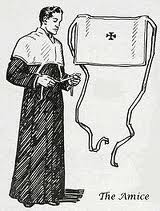
The Amice. This is an oblong piece of white linen, with strings or ribbons by which it is fastened around the shoulders. The name comes from the Latin “amictus,” a wrapper. This vestment has been in use since about the year 800. Formerly it was worn covering the head, and certain religious orders still use it in this way until the beginning of the Mass. It symbolizes a helmet, protecting the priest against the assaults of Satan.
The Alb. This is a long linen gown, extending from the neck to the feet. The lower part is often made of lace. It is a survival of the old Roman dress called the toga. The name is derived from the Latin “alba,” white, and the color, of course, denotes purity.
The Cincture or Girdle. This is a doubled cord which binds the alb closely to the body.
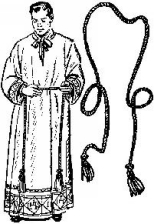 Alb & Cincture
Its name, in Latin, is “cingulum,” a girdle. It may be of the same color as the vestments, but among us it is usually white. It is made of braided linen or of wool, with tassels, and symbolizes continence.
The following vestments vary in color from day to day, according to the object for which the Mass is offered or the festival on which it is said.
The Maniple. This is a small vestment of peculiar shape, worn on the left forearm.
It was originally a handkerchief. The name comes from the Latin “manipulum,” meaning something carried in the hand, a small bundle, a handkerchief, a sheaf of grain; and therefore this vestment is considered symbolical of good works. It is the special badge of the order of subdeaconship.
 Stoles
The Stole. This is a long narrow vestment worn around the neck, and ends hanging down in front. At Mass, the ends of a priest’s stole are crossed, and fastened thus by the cincture. At other services the ends are not crossed. A “preaching stole” is often ornamented with tasseled cords connecting the ends. A deacon at a Solemn Mass wears a stole diagonally, from his left shoulder to his right side. The stole came into use as a vestment about the fourth century, and was originally a robe or cloak, which is the meaning of its Latin name “stola.” It was probably adapted from the court uniform of Roman, judges, and hence signifies authority. It is also a symbol of immortality and of the yoke of obedience.
 The Chasuble. This is a large vestment worn on the shoulders and hanging down in front and behind. The rear portion is often ornamented with a large cross. The name comes from the late Latin “casula,” a little house. It was originally a large mantle or cloak with an opening for the head in the centre, and had to be raised at the sides to allow the hands to be extended beyond it. The assistants at the Mass helped the priest by holding it up, and a trace of this practice still remains at Solemn Masses, where the deacon and subdeacon hold the edges of the priest’s chasuble, and at ordinary Masses, chasuble, where the acolyte raises it slightly at the Elevation. It symbolizes protection, preservation from evil—a spiritual suit of armor.
Next time, the Vestments-Part III

Previous Post

February 21, 2011
To Remember to be Childlike (An Artful Reminder)
Next Post
February 24, 2011 For My Classmate in the Back Row
Browse Our Archives
Select a Category Blog News Conversion Story Culture Learning Living Nature Prayer Uncategorized Working
Select a Month June 2016 May 2016 August 2015 July 2015 June 2015 May 2015 April 2015 March 2015 February 2015 January 2015 December 2014 November 2014 October 2014 September 2014 August 2014 July 2014 June 2014 May 2014 April 2014 March 2014 February 2014 January 2014 December 2013 November 2013 October 2013 September 2013 August 2013 July 2013 June 2013 May 2013 April 2013 March 2013 February 2013 January 2013 December 2012 November 2012 October 2012 September 2012 August 2012 July 2012 June 2012 May 2012 April 2012 March 2012 February 2012 January 2012 December 2011 November 2011 October 2011 September 2011 August 2011 July 2011 June 2011 May 2011 April 2011 March 2011 February 2011 January 2011 December 2010 November 2010 October 2010 September 2010 August 2010 July 2010 June 2010 May 2010 April 2010 March 2010 February 2010 January 2010 December 2009 November 2009 October 2009 September 2009 August 2009
Follow Us!
TAKE THE
Religious Wisdom Quiz
What Christian group is known for wearing black hats and beards?
Select your answer to see how you score.
Orthodox Jews Amish Mennonites Quakers
Related posts from Why I Am Catholic

Belated Happy Birthday To Blaise Pascal, Unofficial Saint...

Because My Brother Imran Yousef Is An American...

Because of G.K. Chesterton (29 May, 1874 – 14 June, 1936)

Joe Six-Pack, USMC, With A Few Post-Terrorist Attack...
TRENDING AT PATHEOS Catholic

Rejecting Doom: Christian Hope And Human Action
Christianity is a religion of hope. We are to have hope and...

It’s What Comes From Within Which Matters
One of the most difficult things for us to understand is why...

Why I Choose the Eucharist Over the Sermon
Choose the Eucharist, Not the Sermon What are we supposed to get...

5 Design Elements Found in Spiritually Rooted Homes
Putting Spirituality Into Home Decor Our homes are more than our living...

Credo: A Story of God Told with the...
About 10 years ago, I began to imagine a personal "Credo" that...

The Anatomy of Divine Revelation in Catholic Thought
The claim that God has made Himself known to human beings is...
Ad-Free & Subscriber Log-In Subscription Support
- About Us
- 2026 Calendar
- Videos
- Podcasts
- Library of World Religions
- Faith In Media Tracker
- Advertise With Us
- Write for Us
- Privacy Policy
- Terms of Service
- Do Not Sell My Data
- Contact Us
- Radiant Digital
- Manage Newsletter Subscriptions
- Unsubscribe From Notifications
- Sitemap
Copyright 2008-2026, Patheos. All rights reserved.
Subscription Support Ad-Free & Subscriber Log-In
Follow Patheos