
BuddhistCatholicContemplativeEvangelicalGeneral ChristianHinduJewishLatter-day SaintMuslimNew VisionsProgressive Christian
Beliefs
- Buddhist
- Catholic
- Contemplative
- Evangelical
- General Christian
- Hindu
- Jewish
- Latter-day Saint
- More Voices
- Muslim
- New Visions
- Pagan
- Progressive Christian
Topics
- Religion News
- Food and Religion
- Sports and Religion
- Religious Art
- Religious Music and Entertainment
- Religious Events
- History and Religion
- Style and Religion
- Politics and Religion
- Women in Religion
- Recreation Outdoors and Religion
- Business Finance and Religion
- Careers Workplace and Religion
- Education and Religion
- Family Parenting and Religion
- Health Fitness and Religion
- Home and Religion
- Relationships and Religion
- Technology and Religion
- Travel and Religion
Columnists
- Buddhist Columnists
- Business Finance and Religion Columnists
- Careers Workplace and Religion Columnists
- Catholic Columnists
- Contemplative Columnists
- Education and Religion Columnists
- Evangelists Columnists
- Family Parenting and Religion Columnists
- General Christian Columnists
- Health Fitness and Religion Columnists
- Hindu Columnists
- History and Religion Columnists
- Home and Religion Columnists
- Jewish Columnists
- More Voices Columnists
- Latter Day Columnists
- Muslim Columnists
- New Visions Columnists
- Nonreligious Columnists
- Pagan Columnists
- Politics and Religion Columnists
- Progressive Columnists
- Recreation Outdoors and Religion Columnists
- Relationships and Religion Columnists
- Religion News Columnists
- Religious Art Columnists
- Religious Events Columnists
- Religious Music and Entertainment Columnists
- Sports and Religion Columnists
- Style and Religion Columnists
- Technology and Religion Columnists
- Travel and Religion Columnists
- Women in Religion Columnists
Resource Library
- 2026 Calendar
- Library of World Religions
- The 100 Most Holy Places on Earth
- Patheos Answers
- Podcasts
- Videos
- Faith Leaders Database
- Anglican Episcopalian
- Bahai
- Baptist
- Buddhism
- Christianity
- Confucianism
- Eastern Orthodoxy
- Hinduism
- Holiness and Pentecostal
- ISKCON
- Islam
- Judaism
- Lutheran
- Methodist
- The Church of Jesus Christ of Latter-day Saints
- New Age
- Paganism
- Presbytarian and Reformed
- Protestantism
- Religion Behind the Scenes
- Roman Catholic
- Scientology
- Shia Islam
- Sikhism
- Sufism
- Sunni Islam
- Taoism
- Zen
- See all religions
Research Tools
 Ad-Free & Subscriber Log-In Subscription Support
Ad-Free & Subscriber Log-In Subscription Support
Follow Patheos 

- Trending:
- Forgiveness
- |
- Marriage
- |
- Consciousness
- |
- Death Penalty
- |
- Election
- |
- Halloween
 Why I Am Catholic
-
More
- Home
- For All the Sacramentals, The Vestments (Part I)
For All the Sacramentals, The Vestments (Part I)
Last updated on: June 7, 2015 at 10:39 pm by Frank Weathers
For All the Sacramentals, The Vestments (Part I) 2015-06-07T22:39:01-05:00 Frank Weathers
Patheos Explore the world's faith through different perspectives on religion and spirituality! Patheos has the views of the prevalent religions and spiritualities of the world.

Today, the series on Sacramentals continues with the vestments worn by the clergy. As a rookie Catholic, I understood some of the significance of the vestments, the colors, etc. But if I had to take a quiz and answer the question, “True or False: Are vestments a sacramental?,” my answer would have been a guess, and I would have gotten this one wrong.
Now if the quiz would have been about Marine Corps uniforms, from Dress Blues, to Service (Greens), and Utilities (what you may know as “cammies”) etc., I would have passed with flying colors.
Speaking of colors, that is what Fr. John F. Sullivan’s first lesson on vestments is about. What do they mean? Ponder no more, as Fr. John will make it clear. After this lesson, you will be ready for the quiz.
Vestments—1
Vestments are garments worn by the ministers of religion while performing their sacred duties. They are sacramentals, being blessed by the Church to increase devotion in those who see them and those who use them.
The word “vestment” is from the Latin vestimentum, signifying simply clothing. In every religion the priest has had a distinctive dress; just as others who hold positions of dignity or of authority wear a uniform or badge, so does the minister of God.
Among the Jews every detail of the vestments used in the worship of God was provided for by divine command. In the Catholic Church these details have always been prescribed by church law, and many changes have been made at different times in the number and form of the priestly vestments. During the first four centuries there were no special vestments; the clergy wore their ordinary garb, flowing robes and long cloaks, at the Church’s services; but gradually these were altered and ornamented until they became vestments as we have them now.
The Colors of Vestments
The Church ordinarily uses five colors, and each has its meaning. The Mass is offered for many purposes and in honor of many classes of saints; and each of these is symbolized by the color of the vestments worn during the Holy Sacrifice.
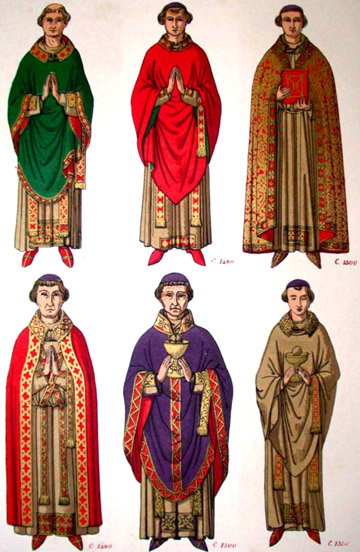
White vestments denote purity, innocence and glory. They are worn on the feast of the Holy Trinity and on festivals of our Lord, of the Blessed Virgin, of Angels and of all Saints who were not martyrs.
Red is the color of fire and of blood. Vestments of that color are used in Masses of the Holy Ghost, such as on Pentecost, to remind us of the tongues of fire which descended upon the Apostles; on the feasts of the Holy Cross of our Lord, and on the festivals of all Saints who shed their blood for their faith.
Purple, or violet, is expressive of penance. It is used during Lent and Advent (except on saints’ days), and on the sorrowful feast of the Holy Innocents.
Black is the color of mourning. It is worn at all Masses of Requiem, and on Good Friday.
Green denotes the growth and increase of our holy Church, and is also a symbol of hope.
It is used on all days during the year that are not saints’ days, except in Lent and Advent.
Gold vestments may be used as a substitute for white, red or green—not for purple or black.
Rose-colored vestments, when obtainable, may be used at the Solemn Mass on the third Sunday of Advent (Gaudete Sunday), and the fourth Sunday of Lent (Laetare Sunday), because these Sundays are somewhat joyful in the midst of penitential seasons, and the rose-color is less penitential than the purple.
Next time, the “Priestly Vestments.”

Previous Post

February 21, 2011
Artist's That Begin With an "S" & More (Music for Mondays)
Next Post
February 21, 2011 To Remember to be Childlike (An Artful Reminder)
Browse Our Archives
Select a Category Blog News Conversion Story Culture Learning Living Nature Prayer Uncategorized Working
Select a Month June 2016 May 2016 August 2015 July 2015 June 2015 May 2015 April 2015 March 2015 February 2015 January 2015 December 2014 November 2014 October 2014 September 2014 August 2014 July 2014 June 2014 May 2014 April 2014 March 2014 February 2014 January 2014 December 2013 November 2013 October 2013 September 2013 August 2013 July 2013 June 2013 May 2013 April 2013 March 2013 February 2013 January 2013 December 2012 November 2012 October 2012 September 2012 August 2012 July 2012 June 2012 May 2012 April 2012 March 2012 February 2012 January 2012 December 2011 November 2011 October 2011 September 2011 August 2011 July 2011 June 2011 May 2011 April 2011 March 2011 February 2011 January 2011 December 2010 November 2010 October 2010 September 2010 August 2010 July 2010 June 2010 May 2010 April 2010 March 2010 February 2010 January 2010 December 2009 November 2009 October 2009 September 2009 August 2009
Follow Us!
TAKE THE
Religious Wisdom Quiz
True or False: Solomon asked God for wisdom rather than wealth or long life.
Select your answer to see how you score.
FALSE TRUE
Related posts from Why I Am Catholic

Belated Happy Birthday To Blaise Pascal, Unofficial Saint...

Because My Brother Imran Yousef Is An American...

Because of G.K. Chesterton (29 May, 1874 – 14 June, 1936)

Joe Six-Pack, USMC, With A Few Post-Terrorist Attack...
TRENDING AT PATHEOS Catholic

Rejecting Doom: Christian Hope And Human Action
Christianity is a religion of hope. We are to have hope and...

It’s What Comes From Within Which Matters
One of the most difficult things for us to understand is why...

Why I Choose the Eucharist Over the Sermon
Choose the Eucharist, Not the Sermon What are we supposed to get...

5 Design Elements Found in Spiritually Rooted Homes
Putting Spirituality Into Home Decor Our homes are more than our living...

Credo: A Story of God Told with the...
About 10 years ago, I began to imagine a personal "Credo" that...

The Anatomy of Divine Revelation in Catholic Thought
The claim that God has made Himself known to human beings is...
Ad-Free & Subscriber Log-In Subscription Support
- About Us
- 2026 Calendar
- Videos
- Podcasts
- Library of World Religions
- Faith In Media Tracker
- Advertise With Us
- Write for Us
- Privacy Policy
- Terms of Service
- Do Not Sell My Data
- Contact Us
- Radiant Digital
- Manage Newsletter Subscriptions
- Unsubscribe From Notifications
- Sitemap
Copyright 2008-2026, Patheos. All rights reserved.
Subscription Support Ad-Free & Subscriber Log-In
Follow Patheos