
BuddhistCatholicContemplativeEvangelicalGeneral ChristianHinduJewishLatter-day SaintMuslimNew VisionsProgressive Christian
Beliefs
- Buddhist
- Catholic
- Contemplative
- Evangelical
- General Christian
- Hindu
- Jewish
- Latter-day Saint
- More Voices
- Muslim
- New Visions
- Pagan
- Progressive Christian
Topics
- Religion News
- Food and Religion
- Sports and Religion
- Religious Art
- Religious Music and Entertainment
- Religious Events
- History and Religion
- Style and Religion
- Politics and Religion
- Women in Religion
- Recreation Outdoors and Religion
- Business Finance and Religion
- Careers Workplace and Religion
- Education and Religion
- Family Parenting and Religion
- Health Fitness and Religion
- Home and Religion
- Relationships and Religion
- Technology and Religion
- Travel and Religion
Columnists
- Buddhist Columnists
- Business Finance and Religion Columnists
- Careers Workplace and Religion Columnists
- Catholic Columnists
- Contemplative Columnists
- Education and Religion Columnists
- Evangelists Columnists
- Family Parenting and Religion Columnists
- General Christian Columnists
- Health Fitness and Religion Columnists
- Hindu Columnists
- History and Religion Columnists
- Home and Religion Columnists
- Jewish Columnists
- More Voices Columnists
- Latter Day Columnists
- Muslim Columnists
- New Visions Columnists
- Nonreligious Columnists
- Pagan Columnists
- Politics and Religion Columnists
- Progressive Columnists
- Recreation Outdoors and Religion Columnists
- Relationships and Religion Columnists
- Religion News Columnists
- Religious Art Columnists
- Religious Events Columnists
- Religious Music and Entertainment Columnists
- Sports and Religion Columnists
- Style and Religion Columnists
- Technology and Religion Columnists
- Travel and Religion Columnists
- Women in Religion Columnists
Resource Library
- 2026 Calendar
- Library of World Religions
- The 100 Most Holy Places on Earth
- Patheos Answers
- Podcasts
- Videos
- Faith Leaders Database
- Anglican Episcopalian
- Bahai
- Baptist
- Buddhism
- Christianity
- Confucianism
- Eastern Orthodoxy
- Hinduism
- Holiness and Pentecostal
- ISKCON
- Islam
- Judaism
- Lutheran
- Methodist
- The Church of Jesus Christ of Latter-day Saints
- New Age
- Paganism
- Presbytarian and Reformed
- Protestantism
- Religion Behind the Scenes
- Roman Catholic
- Scientology
- Shia Islam
- Sikhism
- Sufism
- Sunni Islam
- Taoism
- Zen
- See all religions
Research Tools
 Ad-Free & Subscriber Log-In Subscription Support
Ad-Free & Subscriber Log-In Subscription Support
Follow Patheos 

- Trending:
- Forgiveness
- |
- Marriage
- |
- Consciousness
- |
- Death Penalty
- |
- Election
- |
- Halloween
 Why I Am Catholic
-
More
- Home
- Because the Church is Paradoxically Consistent
Because the Church is Paradoxically Consistent
Last updated on: June 7, 2015 at 10:39 pm by Frank Weathers
Because the Church is Paradoxically Consistent 2015-06-07T22:39:01-05:00 Frank Weathers
Patheos Explore the world's faith through different perspectives on religion and spirituality! Patheos has the views of the prevalent religions and spiritualities of the world.

—Feast of St. Macarius the Great
The other day I wrote about the dictionary meanings for the word “catholic.” I have more thoughts on the matter, but that post was running long. Having already imposed a 3500 word(!) post on you right after the New Year, constant reading of marathon length missives might tucker you out, make you cross-eyed, and compel you never to return to this space. So consider this post as part II in a series of indeterminate length on the meanings of that word.
Though this Marine is no expert on word etymology, today I ask you to consider the meanings of the word “catholic” again, but this time applying them to an organism.
A human being for instance, or perhaps I should say to the ideal of what it means to be fully a human being. I wrote that this is one of my goals while slogging through what remains of the pilgrimage that is my time here on earth.
I happen to agree with the following thoughts I ran across recently on the Catholic Church,
Church and Bible are not to be judged only by what they say, but rather by what, for society and the individual, they have actually achieved; and what has acted for so many ages as a key to so complex a lock as human nature has its testimony in itself.
These words were written back in 1906 by an obscure convert to Catholicism named W.J. Williams. The bold highlights are mine. As my eyes ran across these words, my memory bank lit up remembering similar thoughts written, and more fully elaborated on, by someone who is anything but obscure. G.K. Chesterton in Orthodoxy, which was published in 1909 (long before he was received into the Church) writes the following on page 152,

The complication of our modern world proves the truth of the creed more perfectly than any of the plain problems of the ages of faith. It was in Notting Hill and Battersea that I began to see that Christianity was true. This is why the faith has that elaboration of doctrines and details which so much distresses those who admire Christianity without believing in it. When once one believes in a creed, one is proud of its complexity, as scientists are proud of the complexity of science. It shows how rich it is in discoveries. If it is right at all, it is a compliment to say that it’s elaborately right. A stick might fit a hole or a stone a hollow by accident. But a key and a lock are both complex. And if a key fits a lock, you know it is the right key.
Chesterton then takes the reader through the full development of this idea between pages 148 and 187, in the sixth chapter which he calls The Paradoxes of Christianity. If you haven’t read Chesterton before, head over to my favorite electronic bookshelf and read this for yourself. Then read our discussion notes on this chapter too.
Perhaps you are perfect, but if you are like me, it’s more likely that you simply judge others by their actions while judging yourself by your intentions. I’m getting better at stopping myself from following that pharisaical path into the pit of unhappiness and oblivion. It must have something to do with how I’m spending my time lately.

Someone shared their opinion on the post on Dracula that I was being inconsistent in my approach in how I considered Vlad, his life, his acts, and his death. To which I say, welcome to the paradox of lived Christianity. I have often quoted Qohelth, the Teacher, from my favorite Old Testament book in this space. As the writer of the Letter to the Hebrews said of the words of the Psalmist, The Holy Spirit says,
All things have their season, and in their times all things pass under heaven.
A time to be born and a time to die. A time to plant, and a time to pluck up that which is planted. A time to kill, and a time to heal. A time to destroy, and a time to build. A time to weep, and a time to laugh. A time to mourn, and a time to dance. A time to scatter stones, and a time to gather. A time to embrace, and a time to be far from embraces. A time to get, and a time to lose. A time to keep, and a time to cast away. A time to rend, and a time to sew. A time to keep silence, and a time to speak. A time of love, and a time of hatred. A time of war, and a time of peace.
What hath man more of his labor? I have seen the trouble, which God hath given the sons of men to be exercised in it. He hath made all things good in their time, and hath delivered the world to their consideration, so that man cannot find out the work which God hath made from the beginning to the end.
Are not these seasons also shared by our human natures in our own life cycle? I can only speak of my personal recognition of my own paradoxical nature, so perhaps you do not see this. Perhaps you are more consistent than I am, but I know that I am consistently paradoxical. But the Church sees this as her thoughts have developed over these past 2000 years of her existence. And again, this viewpoint is not that of one solitary person, but of this earthly house of the world-society of souls, as my new friend Algar Thorold describes the Church, shepherded by the Vicar of Christ for the benefit of all mankind.
Consider the paradoxical nature of the Church herself as a living organism that is growing up in Her mission, and maturing in it as well. This is better explained by Blessed John Henry Newman in his Essay on Development than I ever could. But in essence Newman argues that the Church too has grown and matured through a life cycle of change. And still she develops, guided by the Holy Spirit.
Take a look at this long paragraph Newman writes at the conclusion of section 1 of the first chapter of his Essay on Development,
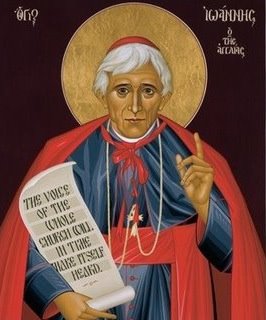
But whatever be the risk of corruption from intercourse with the world around, such a risk must be encountered if a great idea is duly to be understood, and much more if it is to be fully exhibited. It is elicited and expanded by trial, and battles into perfection and supremacy. Nor does it escape the collision of opinion even in its earlier years, nor does it remain truer to itself, and with a better claim to be considered one and the same, though externally protected from vicissitude and change. It is indeed sometimes said that the stream is clearest near the spring. Whatever use may fairly be made of this image, it does not apply to the history of a philosophy or belief, which on the contrary is more equable, and purer, and stronger, when its bed has become deep, and broad, and full. It necessarily rises out of an existing state of things, and for a time savours of the soil. Its vital element needs disengaging from what is foreign and temporary, and is employed in efforts after freedom which become more vigorous and hopeful as its years increase. Its beginnings are no measure of its capabilities, nor of its scope.
We’re half-way through the paragraph now but I wanted to alert you that the bold highlights above are mine. The words “deep”, “broad,” and “full” are, to me anyway, synonyms for the word “catholic” too, both in regards to human beings as well as to the institution of the Church. Or maybe you buy into the modern social science idea that man can only be understood as little self-serving widgets directed by their own self-interest like the economists would have you believe. That is the way that governments treat us too. I used to think that way as well, until I met the saints. Their lives are lived for others, at the expense of themselves. This is true humanism. Now back to the beata’s thoughts. He was talking about scope,
At first no one knows what it is, or what it is worth. It remains perhaps for a time quiescent; it tries, as it were, its limbs, and proves the ground under it, and feels its way. From time to time it makes essays which fail, and are in consequence abandoned. It seems in suspense which way to go; it wavers, and at length strikes out in one definite direction. In time it enters upon strange territory; points of controversy alter their bearing; parties rise and around it; dangers and hopes appear in new relations; and old principles reappear under new forms. It changes with them in order to remain the same. In a higher world it is otherwise, but here below to live is to change, and to be perfect is to have changed often.
That was me with the bold again (and a link, actually). Recently I’ve had discussions with those who say “I can’t follow the Church because back during the Thirty Years War she advocated the killing of Protestant’s etc. etc.” To which I say, that was then and this is now,

Religious freedom expresses what is unique about the human person, for it allows us to direct our personal and social life to God, in whose light the identity, meaning and purpose of the person are fully understood. To deny or arbitrarily restrict this freedom is to foster a reductive vision of the human person; to eclipse the public role of religion is to create a society which is unjust, inasmuch as it fails to take account of the true nature of the human person; it is to stifle the growth of the authentic and lasting peace of the whole human family.
For this reason, I implore all men and women of good will to renew their commitment to building a world where all are free to profess their religion or faith, and to express their love of God with all their heart, with all their soul and with all their mind (cf. Mt 22:37). This is the sentiment which inspires and directs this “Message for the XLIV World Day of Peace, devoted to the theme: Religious Freedom, the Path to Peace.”
Yes, the Vicar of Christ just said those words recently. Read it all at the not-so-top-secret Vatican website. Again, this is a true form of humanism, the Christian form, because Christ, the Eternal Word is the origin of humanism. God became a human, and the Good News, which has existed from the start, only obscured, arrived in the flesh. The world hasn’t been the same since. But the Word is eternal and as this past weeks reading from the Letter to the Hebrews notes, our ancestors saw the words, but didn’t get the message.
For in fact we have received the Good News just as our ancestors did. But the word that they heard did not profit them, for they were not united in faith with those who listened.
If you are still stuck in the times of the Middle Ages, the Inquisition, the Thirty Years War, etc. etc., are you being profited? Are you even fulfilling the pledge that we pray in the prayer that the Word taught us?
And forgive us our trespasses as we forgive those who trespass against us.
Instead, you may be falling into that logic trap that our human ancestors fell into before the Incarnation as well. Bear with me here.
Because to me, judging the Church only on her failures, while forgetting her successes is like judging the Marine Corps only on her failures while forgetting her prowess in actually fighting battles and winning wars. Stay stuck on the Ribbon Creek incident (where several Marine Recruits died of drowning by the actions of a sadistic drill instructor), for example, while forgetting all of the Marine Corps’ success on the battle field, like the fighting withdrawal from the Chosin Reservior to Hungnam during the Korean War, and you may understand what I mean.
Those young men who died at Ribbon Creek can never be forgotten, nor can we bring them back to life and restore them to their families. But as a result of that tragedy, the Marine Corps changed the way recruits were handled, and she continues to develop the way recruits are trained to this day. Critics of the Church today who say that she is incapable of allowing freedom of thinking which helps her to develop makes me wonder if they have really considered what she has accomplished in spite of her growing pains. As W.J. Williams writes,
The Church, then, does not regard herself as perfect, but as having found the only possible way in which to make a great religious experiment, to organize and objectify the religious idea; to create and to continue an organism in which the religious process may be carried on. She does not say that she has accomplished her purpose in a manner the most perfect that could be conceived—far from it, she does but say, that she has done what she could; but she adds that if she has failed in her purpose it is not easy to see whom else she should regard as having succeeded, nor is it easy to find in the world an organism which has united experiment, consistency and advance in the religious idea, in an equal degree with herself.
So the critics that keep pounding the table that the Catholic Church never changes, is anathema to change, is the killer of all freedom, both actual and intellectual, are, in my humble and unimportant opinion, missing the boat. Perhaps they can’t see the forest for the trees.
Because the Church is paradoxically consistent and consistently paradoxical.

Previous Post

January 14, 2011
Thanks to the New York Encounter, Probably
Next Post
January 15, 2011 For Thoughts On Freedom Like These By Fulton Sheen
Browse Our Archives
Select a Category Blog News Conversion Story Culture Learning Living Nature Prayer Uncategorized Working
Select a Month June 2016 May 2016 August 2015 July 2015 June 2015 May 2015 April 2015 March 2015 February 2015 January 2015 December 2014 November 2014 October 2014 September 2014 August 2014 July 2014 June 2014 May 2014 April 2014 March 2014 February 2014 January 2014 December 2013 November 2013 October 2013 September 2013 August 2013 July 2013 June 2013 May 2013 April 2013 March 2013 February 2013 January 2013 December 2012 November 2012 October 2012 September 2012 August 2012 July 2012 June 2012 May 2012 April 2012 March 2012 February 2012 January 2012 December 2011 November 2011 October 2011 September 2011 August 2011 July 2011 June 2011 May 2011 April 2011 March 2011 February 2011 January 2011 December 2010 November 2010 October 2010 September 2010 August 2010 July 2010 June 2010 May 2010 April 2010 March 2010 February 2010 January 2010 December 2009 November 2009 October 2009 September 2009 August 2009
Follow Us!
TAKE THE
Religious Wisdom Quiz
Who dreamed about the sun, moon, and stars bowing to him?
Select your answer to see how you score.
Elijah Daniel Joseph Adam
Related posts from Why I Am Catholic

Belated Happy Birthday To Blaise Pascal, Unofficial Saint...

Because My Brother Imran Yousef Is An American...

Joe Six-Pack, USMC, With A Few Post-Terrorist Attack...

This Is Why God Invented YouTube...
TRENDING AT PATHEOS Catholic

Rejecting Doom: Christian Hope And Human Action
Christianity is a religion of hope. We are to have hope and...

It’s What Comes From Within Which Matters
One of the most difficult things for us to understand is why...

Why I Choose the Eucharist Over the Sermon
Choose the Eucharist, Not the Sermon What are we supposed to get...

5 Design Elements Found in Spiritually Rooted Homes
Putting Spirituality Into Home Decor Our homes are more than our living...

Credo: A Story of God Told with the...
About 10 years ago, I began to imagine a personal "Credo" that...

The Anatomy of Divine Revelation in Catholic Thought
The claim that God has made Himself known to human beings is...
Ad-Free & Subscriber Log-In Subscription Support
- About Us
- 2026 Calendar
- Videos
- Podcasts
- Library of World Religions
- Faith In Media Tracker
- Advertise With Us
- Write for Us
- Privacy Policy
- Terms of Service
- Do Not Sell My Data
- Contact Us
- Radiant Digital
- Manage Newsletter Subscriptions
- Unsubscribe From Notifications
- Sitemap
Copyright 2008-2026, Patheos. All rights reserved.
Subscription Support Ad-Free & Subscriber Log-In
Follow Patheos