
BuddhistCatholicContemplativeEvangelicalGeneral ChristianHinduJewishLatter-day SaintMuslimNew VisionsProgressive Christian
Beliefs
- Buddhist
- Catholic
- Contemplative
- Evangelical
- General Christian
- Hindu
- Jewish
- Latter-day Saint
- More Voices
- Muslim
- New Visions
- Pagan
- Progressive Christian
Topics
- Religion News
- Food and Religion
- Sports and Religion
- Religious Art
- Religious Music and Entertainment
- Religious Events
- History and Religion
- Style and Religion
- Politics and Religion
- Women in Religion
- Recreation Outdoors and Religion
- Business Finance and Religion
- Careers Workplace and Religion
- Education and Religion
- Family Parenting and Religion
- Health Fitness and Religion
- Home and Religion
- Relationships and Religion
- Technology and Religion
- Travel and Religion
Columnists
- Buddhist Columnists
- Business Finance and Religion Columnists
- Careers Workplace and Religion Columnists
- Catholic Columnists
- Contemplative Columnists
- Education and Religion Columnists
- Evangelists Columnists
- Family Parenting and Religion Columnists
- General Christian Columnists
- Health Fitness and Religion Columnists
- Hindu Columnists
- History and Religion Columnists
- Home and Religion Columnists
- Jewish Columnists
- More Voices Columnists
- Latter Day Columnists
- Muslim Columnists
- New Visions Columnists
- Nonreligious Columnists
- Pagan Columnists
- Politics and Religion Columnists
- Progressive Columnists
- Recreation Outdoors and Religion Columnists
- Relationships and Religion Columnists
- Religion News Columnists
- Religious Art Columnists
- Religious Events Columnists
- Religious Music and Entertainment Columnists
- Sports and Religion Columnists
- Style and Religion Columnists
- Technology and Religion Columnists
- Travel and Religion Columnists
- Women in Religion Columnists
Resource Library
- 2026 Calendar
- Library of World Religions
- The 100 Most Holy Places on Earth
- Patheos Answers
- Podcasts
- Videos
- Faith Leaders Database
- Anglican Episcopalian
- Bahai
- Baptist
- Buddhism
- Christianity
- Confucianism
- Eastern Orthodoxy
- Hinduism
- Holiness and Pentecostal
- ISKCON
- Islam
- Judaism
- Lutheran
- Methodist
- The Church of Jesus Christ of Latter-day Saints
- New Age
- Paganism
- Presbytarian and Reformed
- Protestantism
- Religion Behind the Scenes
- Roman Catholic
- Scientology
- Shia Islam
- Sikhism
- Sufism
- Sunni Islam
- Taoism
- Zen
- See all religions
Research Tools
 Ad-Free & Subscriber Log-In Subscription Support
Ad-Free & Subscriber Log-In Subscription Support
Follow Patheos 

- Trending:
- Forgiveness
- |
- Marriage
- |
- Consciousness
- |
- Death Penalty
- |
- Election
- |
- Halloween
 Why I Am Catholic
-
More
- Home
- For Dom Lou’s Thoughts on The Effects of Secularization in China
For Dom Lou’s Thoughts on The Effects of Secularization in China
Last updated on: January 27, 2015 at 1:33 pm by Frank Weathers
For Dom Lou’s Thoughts on The Effects of Secularization in China 2015-01-27T13:33:11-05:00 Frank Weathers
Patheos Explore the world's faith through different perspectives on religion and spirituality! Patheos has the views of the prevalent religions and spiritualities of the world.

*—*Feast of St. Vincent de Paul
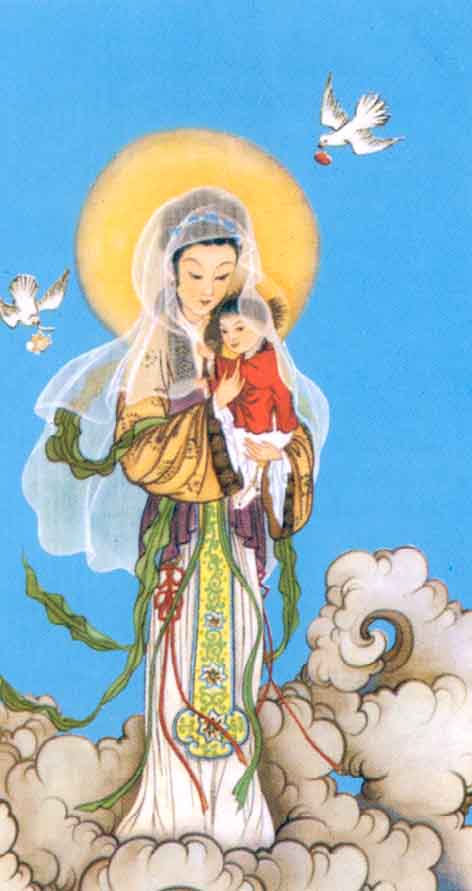
I just finished reading Lou Tseng-Tsiang’s Ways of Confucius and of Christ
This new, new thing, is really nothing more than “been there, done that.” Would it come as a shock to you to learn that the best laid plans of purifying Chinese culture of its religious roots simply opened the door to a foreign religion coming in to fill the void? Cultural relativism, and the dictatorship thereof, is something that Dom Lou explains happened in China long, long ago.
Keep in mind that these words were published in 1948, before China fell to the Communists. So Dom Lou doesn’t see Mao Zedong’s Cultural Revolution coming, with it’s brutal attempt to further cleanse China of it’s religious tendencies (The Four Old’s) once again.
Santayana’s famous quote of “Those who cannot remember the past are condemned to repeat it” isn’t quite right here, if only because ignorance of Chinese history on my part precludes my ability to have any memory of it. But Dom Lou remembers, and these thoughts on the Chinese experience with it’s own “dictatorship of relativism” thousands of years ago is very enlightening indeed.
Here is what he has to say on the matter:
The Chinese political tradition, of which Confucius collected the documents, is the fruit of more than four thousand years of existence. It is eminently realist. It extols the just mean. The just mean is not a condition of mediocrity, but a condition of equilibrium. Equilibrium is the very condition of all progress and all ascent.
There is much wisdom in not being surprised that the circle of terrestrial happiness is never a perfect circle, that it is necessary to endure in order to grow, and, in working to bring about greater justice, to bear one’s own lot of moral fortitude. This wisdom contains a great wealth of joys and happiness.
It forgets the sufferings of yesterday in order to rejoice in the pleasures of today, modest as they may be; avoiding bitterness, it sweetens sorrows; in time of trial it values the least drops of joy. It is modest in its desires; this modesty permits it to receive with gratitude every grace and every gift of Heaven, every proof of neighborly sympathy.
Human equilibrium is an interior state of moral stability, the state of clear and tranquil conscience, animated by a profound submission to the Creator, by an unwearying generosity towards one’s neighbor, and by a strength which nothing can bend.
This equilibrium is the first virtue necessary in a statesman. It enables him to distinguish at a glance the artificial from the natural, the true from the false. Without this judgment, how would he be capable of governing men? This interior equilibrium enables him to comprehend the Natural Law, which is the first principle of all social life and the foundation of public happiness.
The earliest political philosophy of the Chinese people took its aspirations from these very simple aphorisms. It took as its basis the existence of the Creator of the Universe, the Most High God, Altissimus, Chang Ti. It took for its guiding principle, and strove to take for its model, the providential government of creation.
It means, then, in principle, banishing from one’s self all servility towards any man whatsoever. It requires a man, as his first duty, to obey God and to do what is in him to render to the Creator a worship that may not be too unworthy.
Starting from there, it declares, not without pride, that the sovereign authority of God is the sole source whence is derived, at an infinite distance, the authority of the Head of State. The head of the State is simply the Mandatory of Heaven. His mandate, of which all our political tradition underlines the fragility, imposes on him, as his first duty, “to love Heaven”(Mencius, Book I, chapter II, iii), in the name of which he is “the shepherd of the people”(Shu Ching: Book of History).
His obligations are heavy and unceasing. To meet them, he will choose for himself, “just and religious Ministers.” He will consider them “as the members of his own body, which will lead to Ministers to regard the Prince as their heart and as their bowels.” If the Prince deviates from the truth, the Ministers will know how to correct him; they will refuse to tolerate the Prince ever usurping “the place of Heaven” (Li Chi: Book of Rites). Thus “the Sovereign is, as it were, the heart of the people, and the people, as it were, the body of the Sovereign…When the body is wounded or suffering, the heart is so also.”
The religious basis of political power has been the corrective principle for all the abuses to which, one after another, through the weakness of human nature and through its corruption, the successive dynasties which ruled the Chinese people allowed themselves to succumb. In consequence of our classical books, our political tradition never ceases to tell the Emperor that “no one, in the whole world, is noble by birth.”
This mentality provoked many political revolutions. But it banished for all time, from the Chinese heart, the myth of an imperial divinity; of an Emperor or a dynasty which could pretend to substitute itself for Heaven.
Applications of this principle of the Natural Law were constant. They made a discipline for many circles at the Court and in the high mandarinate.
Under the influence of those governing circles, there went on from century to century a progressive endeavor to detach the religious basis from politics and morality. To that end, it was necessary to secularize the meaning of religious terms in our classical books; or rather, to “atheize” them. This was a slow task; it was pursued for more than a thousand years. Our national treasure was thereby changed and profoundly impoverished.
In depriving the Chinese people of the religious content of their ancestral heritage, political rulers blindly opened the frontiers to foreign importation. Buddism came into China. It was presented as a religion of monastic form. Thanks to this monastic constitution, which responds to one of the most profound aspirations of the Chinese soul, it overran the whole of China, winning the Court and the people, erecting its temples by the tens of thousands in all the towns and in all the villages, multiplying its monasteries in all the most beautiful places; giving spiritual sustenance to a number of souls, but scarcely coming to offer a spiritual framework for society, a sustenance for public life. Far from that!
It encumbered the minds of its adherents with a mixture of superstitions, which have kept at an altogether too low level, the excellent minds of so many Chinese women and so many children. The faith which our people have combined with those superstitions is easily explained, for Buddist literature contains very pure and very great pages, in which the human heart and the human mind, escape from their miseries and insufficiencies, groping, and indeed, making mistakes, often very grave mistakes, to seek out the beauty and the goodness of God.
The field of religion is very delicate ground. Religious truth is a deliverance. On the other hand, errors, omissions, and confusions do very far-reaching damage, because religious reality is of a spiritual order and embraces the whole of life.
When I insist on the greatness and the purity of the fundamental principles of religion, of which Confucianism contains the treasure, no one will charge me with imagining or saying that any religion whatsoever overcomes the various temptations which, by a permissive disposition of God, make a moral trial of every human life. God reserves the final judgment to Himself alone.
But every true religious idea is a great insight. It offers an incalculable moral assistance, which enables a man to do what is good easily, to avoid what is evil with more care, and the better to correct his shortcomings.
Confucius vigorously declines to create a system. He presents himself as being simply a righteous man who, in the deep disorder of his times (the sixth century B.C. was in China a century of corruption, when regicides and parricides were frequent), turns back to primitive institutions and asks for their restoration.
The restorer of moral and political integrity was in all things a poor pilgrim, endlessly journeying, from kingdom to kingdom, in search of a sovereign who would agree to take up the principles of the Natural Law again, so as to bring back public well-being and to give back a happy life to the people.
These efforts were vain. The enlightenment of his teaching was reserved for posterity. Today, after twenty-six centuries, it enlightens us still.
The most illustrious of his disciples, who lived two centuries after him, Mencius, set down in terms as lofty as those of Confucius himself, the teachings of the Master. The century of Mencius was not very much better than that of Confucius. “At present,” writes Mencius, “in the whole of the Empire, there is no shepherd of men who does not love to send men to their deaths.” Those shepherds were, then, “totalitarians.”
And he continues: “If there should be found the Head of State who does not love to send men to their deaths, the peoples of the world would lift up their heads, aspiring to enjoy his rule. They would run to him as water, which of its own accord, flows towards the valleys. Who could withstand such a torrent?”
The cry of Mencius is universal.

Previous Post

September 26, 2010
Because I Was a Stow-Away
Next Post
September 27, 2010 Four for the Day (Music for Mondays)
Browse Our Archives
Select a Category Blog News Conversion Story Culture Learning Living Nature Prayer Uncategorized Working
Select a Month June 2016 May 2016 August 2015 July 2015 June 2015 May 2015 April 2015 March 2015 February 2015 January 2015 December 2014 November 2014 October 2014 September 2014 August 2014 July 2014 June 2014 May 2014 April 2014 March 2014 February 2014 January 2014 December 2013 November 2013 October 2013 September 2013 August 2013 July 2013 June 2013 May 2013 April 2013 March 2013 February 2013 January 2013 December 2012 November 2012 October 2012 September 2012 August 2012 July 2012 June 2012 May 2012 April 2012 March 2012 February 2012 January 2012 December 2011 November 2011 October 2011 September 2011 August 2011 July 2011 June 2011 May 2011 April 2011 March 2011 February 2011 January 2011 December 2010 November 2010 October 2010 September 2010 August 2010 July 2010 June 2010 May 2010 April 2010 March 2010 February 2010 January 2010 December 2009 November 2009 October 2009 September 2009 August 2009
Follow Us!
TAKE THE
Religious Wisdom Quiz
In Hebrews, what did Moses consider more valuable than the treasures of Egypt?
Select your answer to see how you score.
The promised land Disgrace for the sake of Christ God's covenant Eternal life
Related posts from Why I Am Catholic

Because My Brother Imran Yousef Is An American...

HHS Forced Sex Changes? There Ain't No Fait...

Apparently, There USED to be Secrets of Fatima
President Obama Embraces the Fait Accompli He Wasn’t...
TRENDING AT PATHEOS Catholic

Creation, Preservation, and Teleology in Catholic Theology
As I write this, it is very early Monday morning. Like millions...

The Parable Of The Sower And The Word...
One of Christ’s most famous parables is that of the sower who...

Rejecting Doom: Christian Hope And Human Action
Christianity is a religion of hope. We are to have hope and...

Why I Choose the Eucharist Over the Sermon
Choose the Eucharist, Not the Sermon What are we supposed to get...

5 Design Elements Found in Spiritually Rooted Homes
Putting Spirituality Into Home Decor Our homes are more than our living...

Credo: A Story of God Told with the...
About 10 years ago, I began to imagine a personal "Credo" that...
Ad-Free & Subscriber Log-In Subscription Support
- About Us
- 2026 Calendar
- Videos
- Podcasts
- Library of World Religions
- Faith In Media Tracker
- Advertise With Us
- Write for Us
- Privacy Policy
- Terms of Service
- Do Not Sell My Data
- Contact Us
- Radiant Digital
- Manage Newsletter Subscriptions
- Unsubscribe From Notifications
- Sitemap
Copyright 2008-2026, Patheos. All rights reserved.
Subscription Support Ad-Free & Subscriber Log-In
Follow Patheos