
BuddhistCatholicContemplativeEvangelicalGeneral ChristianHinduJewishLatter-day SaintMuslimNew VisionsProgressive Christian
Beliefs
- Buddhist
- Catholic
- Contemplative
- Evangelical
- General Christian
- Hindu
- Jewish
- Latter-day Saint
- More Voices
- Muslim
- New Visions
- Pagan
- Progressive Christian
Topics
- Religion News
- Food and Religion
- Sports and Religion
- Religious Art
- Religious Music and Entertainment
- Religious Events
- History and Religion
- Style and Religion
- Politics and Religion
- Women in Religion
- Recreation Outdoors and Religion
- Business Finance and Religion
- Careers Workplace and Religion
- Education and Religion
- Family Parenting and Religion
- Health Fitness and Religion
- Home and Religion
- Relationships and Religion
- Technology and Religion
- Travel and Religion
Columnists
- Buddhist Columnists
- Business Finance and Religion Columnists
- Careers Workplace and Religion Columnists
- Catholic Columnists
- Contemplative Columnists
- Education and Religion Columnists
- Evangelists Columnists
- Family Parenting and Religion Columnists
- General Christian Columnists
- Health Fitness and Religion Columnists
- Hindu Columnists
- History and Religion Columnists
- Home and Religion Columnists
- Jewish Columnists
- More Voices Columnists
- Latter Day Columnists
- Muslim Columnists
- New Visions Columnists
- Nonreligious Columnists
- Pagan Columnists
- Politics and Religion Columnists
- Progressive Columnists
- Recreation Outdoors and Religion Columnists
- Relationships and Religion Columnists
- Religion News Columnists
- Religious Art Columnists
- Religious Events Columnists
- Religious Music and Entertainment Columnists
- Sports and Religion Columnists
- Style and Religion Columnists
- Technology and Religion Columnists
- Travel and Religion Columnists
- Women in Religion Columnists
Resource Library
- 2026 Calendar
- Library of World Religions
- The 100 Most Holy Places on Earth
- Patheos Answers
- Podcasts
- Videos
- Faith Leaders Database
- Anglican Episcopalian
- Bahai
- Baptist
- Buddhism
- Christianity
- Confucianism
- Eastern Orthodoxy
- Hinduism
- Holiness and Pentecostal
- ISKCON
- Islam
- Judaism
- Lutheran
- Methodist
- The Church of Jesus Christ of Latter-day Saints
- New Age
- Paganism
- Presbytarian and Reformed
- Protestantism
- Religion Behind the Scenes
- Roman Catholic
- Scientology
- Shia Islam
- Sikhism
- Sufism
- Sunni Islam
- Taoism
- Zen
- See all religions
Research Tools
 Ad-Free & Subscriber Log-In Subscription Support
Ad-Free & Subscriber Log-In Subscription Support
Follow Patheos 

- Trending:
- Forgiveness
- |
- Marriage
- |
- Consciousness
- |
- Death Penalty
- |
- Election
- |
- Halloween
 Why I Am Catholic
-
More
- Home
- Because of Thoughts Like These by Blaise Pascal
Because of Thoughts Like These by Blaise Pascal
Last updated on: June 7, 2015 at 11:36 pm by Frank Weathers
Because of Thoughts Like These by Blaise Pascal 2015-06-07T23:36:17-05:00 Frank Weathers
Patheos Explore the world's faith through different perspectives on religion and spirituality! Patheos has the views of the prevalent religions and spiritualities of the world.
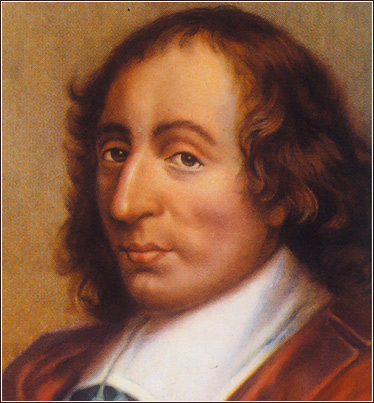
—Feast of Our Lady of Walsingham
About a month ago, Webster wrote a post about awaking from a long, bad, dream. Blaise Pascal woke me up from a long slumber. His was a shrill alarm too, much like the one on the clock by my nightstand right now. But unlike that one, Blaise’s alarm didn’t have a snooze button. That’s because I had been snoozing for most of my adult life.
Before I bumped into Blaise, I had been sleeping in my shoes, so to speak. My conscience tried to arose my soul from its slumber from time to time, but mainly my ego just kept hitting the snooze button, ten minutes at a time.
The ironic thing is that when I started reading Blaise, I did so with the intent to find evidence of the errors of Catholicism. That lasted for maybe 20 pages. This mathematical genius, who died at 39 years of age in 1662, had deep knowledge of scriptures as well as deep insights into the human condition. And yet, he could explain his thoughts simply and lucidly. In other words, he could tell it like it is.
The selection below is from Chapter XXI of his Thoughts On Religion. It is a long chapter, and the selection below is only the last quarter of it. But it should suffice to show you the decibel level of Blaise’s klaxon. Like my friend John C.H.Wu reported in his life story in Beyond East and West, up until this time I had thought that I was a clever man. After reading this, being by the grace of God in the right frame of mind, I realized that I had been merely sleep walking.
Blaise wrote this in the mid 1600’s, and yet it seemed as fresh as this mornings cup of coffee. And it had the same stimulative effect.
The Strange Contrarieties Discoverable in Human Nature, with regard to Truth and Happiness, and Many Other Things.
Isn’t this lead-in to the chapter provocative? Contrarieties. Now if that isn’t a word for Anu Garg, there aren’t any.
The civil war between reason and passion has occasioned two opposite projects, for the restoration of peace to mankind: The one, of those who were for renouncing their passions, and becoming gods; the other, of those who were for renouncing their reason, and becoming beasts. But neither the one nor the other could take effect. Reason still remains, to accuse the baseness and injustice of the passions, and to disturb the repose of those who abandon themselves to their dominion: And the passions live, even in the hearts of those, who talk the most of their extirpation.
“Reason still remains, to accuse the baseness and injustice of the passions…” And Blaise is saying that this is the role fulfilled by Mother Church, as you will see shortly. That turns the world’s perception of the Church upside down, doesn’t it? Faith and reason are not only compatible, but they have a home. But what of standing on our own two feet?
This is the just account of what man can do, in respect to truth and happiness. We have an idea of truth, not to be effaced by all the wiles of the sceptic; we have an incapacity of argument, not to be rectified by all the power of the dogmatist. We wish for truth, and find nothing in ourselves but uncertainty. We seek after happiness, and find nothing but misery. We must needs desire both truth and happiness, yet we are incapable of both. This desire seems to have been left in us, partly as a punishment, and partly to remind us whence we are fallen.
For a brief period of time, I was a stock-broker. Blaise just described 95 percent of my clients. Which should come as no surprise, given the raw humanity of the markets in motion. Manic-depressive swings up and down, ad infinitum; a game that virtually no one has a definitive lock on. Which, again can be seen in war, politics, sports, etc., etc. So Blaise counters with these thoughts:
** If man was not made for God, why can he enjoy no happiness but in God? If man was made for God, why is he so opposed to God?*
* Man is at a loss where to fix himself. He is unquestionably out of his way, and feels within himself the remains of a happy state which he cannot retrieve. He searches in every direction, with solicitude, but without success, encompassed with impenetrable darkness!
By the time I read this, I had come to realize this was true. The world had been grappling with this since the beginning of time, as Blaise explains with elegant simplicity here,
Hence arose the contest amongst the philosophers: some of whom endeavored to exalt man, by displaying his greatness; others to abase him, by representing his misery. And what seems more strange, is, that each party borrowed the arguments of the other, to establish their own opinion.
For the misery of man may be inferred from his greatness, and his greatness from his misery. Thus the one sect demonstrated his misery the more satisfactorily, in that they inferred it from his greatness; and the other the more clearly proved his greatness, because they deduced it from his misery. Whatever was offered by the one, to establish his greatness, served only to evince his misery, as alleged by the other; it being more miserable to have fallen from the greater height.
And the converse is equally true. So that in this endless circle of dispute, each helped to advance his adversary’s cause; for it is certain that the more men are enlightened, the more they will discover of human misery and human greatness. In a word, man knows himself to be miserable. He is, therefore miserable, because he knows himself to be so. But he is also eminently great, because he knows himself to be miserable.
What a chimera then is man! What a novelty! What a chaos! What a subject of contradiction! A judge of all things, and yet a worm of the earth; the depositary of the truth, and yet a medley of uncertainties; the glory and the scandal of the universe. If he exalt himself, I humble him; if he humble himself, I exalt him; and press him with his own inconsistencies, till he comprehends himself to be an incomprehensible monster.
Not a pretty picture, that. The preceding chapter had ended with the following thoughts,
Without Jesus Christ man is, of necessity, in vice and misery: With Jesus Christ man is released from vice and misery. In him is all our happiness, our virtue, our life, our light, our hope : Out of him there is naught but vice, misery, darkness, and despair; and we can discover naught but obscurity and confusion, whether in the divine nature, or in our own.
I couldn’t have agreed more, because deep down in my soul, I knew this to be true. And in the 28th chapter, Blaise told me emphatically where I needed to go in order to come into the light,
It is the Church, together with Jesus Christ, to whom She is inseparably united, which obtains the conversion of all those who are in error. And it is these converts, who subsequently aid their Mother, to whom they owe their deliverance.
The body can no more live without the head, than the head without the body. He that separates from the one, or the other, is no longer of the body, nor a member of Jesus Christ. All virtues, all mortification, all good works, and even martyrdom itself, are of no worth out of the Church, and out of communion with the head of the Church.
Because Blaise knew what Our Lord meant we He said,
And behold I am with you all days, even to the consummation of the world.

Previous Post

September 22, 2010
"Sensitiveness" A Poem By Blessed John Henry Newman
Next Post
September 26, 2010 Because I Was a Stow-Away
Browse Our Archives
Select a Category Blog News Conversion Story Culture Learning Living Nature Prayer Uncategorized Working
Select a Month June 2016 May 2016 August 2015 July 2015 June 2015 May 2015 April 2015 March 2015 February 2015 January 2015 December 2014 November 2014 October 2014 September 2014 August 2014 July 2014 June 2014 May 2014 April 2014 March 2014 February 2014 January 2014 December 2013 November 2013 October 2013 September 2013 August 2013 July 2013 June 2013 May 2013 April 2013 March 2013 February 2013 January 2013 December 2012 November 2012 October 2012 September 2012 August 2012 July 2012 June 2012 May 2012 April 2012 March 2012 February 2012 January 2012 December 2011 November 2011 October 2011 September 2011 August 2011 July 2011 June 2011 May 2011 April 2011 March 2011 February 2011 January 2011 December 2010 November 2010 October 2010 September 2010 August 2010 July 2010 June 2010 May 2010 April 2010 March 2010 February 2010 January 2010 December 2009 November 2009 October 2009 September 2009 August 2009
Follow Us!
TAKE THE
Religious Wisdom Quiz
Which Christian movement is called "Holiness" and focuses on personal sanctification?
Select your answer to see how you score.
Eastern Orthodox Pentecostal Wesleyan/Methodist Anglican
Related posts from Why I Am Catholic

Belated Happy Birthday To Blaise Pascal, Unofficial Saint...

Because My Brother Imran Yousef Is An American...

This Is Why God Invented YouTube...

HHS Forced Sex Changes? There Ain't No Fait...
TRENDING AT PATHEOS Catholic

Rejecting Doom: Christian Hope And Human Action
Christianity is a religion of hope. We are to have hope and...

It’s What Comes From Within Which Matters
One of the most difficult things for us to understand is why...

Why I Choose the Eucharist Over the Sermon
Choose the Eucharist, Not the Sermon What are we supposed to get...

5 Design Elements Found in Spiritually Rooted Homes
Putting Spirituality Into Home Decor Our homes are more than our living...

Credo: A Story of God Told with the...
About 10 years ago, I began to imagine a personal "Credo" that...

The Anatomy of Divine Revelation in Catholic Thought
The claim that God has made Himself known to human beings is...
Ad-Free & Subscriber Log-In Subscription Support
- About Us
- 2026 Calendar
- Videos
- Podcasts
- Library of World Religions
- Faith In Media Tracker
- Advertise With Us
- Write for Us
- Privacy Policy
- Terms of Service
- Do Not Sell My Data
- Contact Us
- Radiant Digital
- Manage Newsletter Subscriptions
- Unsubscribe From Notifications
- Sitemap
Copyright 2008-2026, Patheos. All rights reserved.
Subscription Support Ad-Free & Subscriber Log-In
Follow Patheos