
BuddhistCatholicContemplativeEvangelicalGeneral ChristianHinduJewishLatter-day SaintMuslimNew VisionsProgressive Christian
Beliefs
- Buddhist
- Catholic
- Contemplative
- Evangelical
- General Christian
- Hindu
- Jewish
- Latter-day Saint
- More Voices
- Muslim
- New Visions
- Pagan
- Progressive Christian
Topics
- Religion News
- Food and Religion
- Sports and Religion
- Religious Art
- Religious Music and Entertainment
- Religious Events
- History and Religion
- Style and Religion
- Politics and Religion
- Women in Religion
- Recreation Outdoors and Religion
- Business Finance and Religion
- Careers Workplace and Religion
- Education and Religion
- Family Parenting and Religion
- Health Fitness and Religion
- Home and Religion
- Relationships and Religion
- Technology and Religion
- Travel and Religion
Columnists
- Buddhist Columnists
- Business Finance and Religion Columnists
- Careers Workplace and Religion Columnists
- Catholic Columnists
- Contemplative Columnists
- Education and Religion Columnists
- Evangelists Columnists
- Family Parenting and Religion Columnists
- General Christian Columnists
- Health Fitness and Religion Columnists
- Hindu Columnists
- History and Religion Columnists
- Home and Religion Columnists
- Jewish Columnists
- More Voices Columnists
- Latter Day Columnists
- Muslim Columnists
- New Visions Columnists
- Nonreligious Columnists
- Pagan Columnists
- Politics and Religion Columnists
- Progressive Columnists
- Recreation Outdoors and Religion Columnists
- Relationships and Religion Columnists
- Religion News Columnists
- Religious Art Columnists
- Religious Events Columnists
- Religious Music and Entertainment Columnists
- Sports and Religion Columnists
- Style and Religion Columnists
- Technology and Religion Columnists
- Travel and Religion Columnists
- Women in Religion Columnists
Resource Library
- 2026 Calendar
- Library of World Religions
- The 100 Most Holy Places on Earth
- Patheos Answers
- Podcasts
- Videos
- Faith Leaders Database
- Anglican Episcopalian
- Bahai
- Baptist
- Buddhism
- Christianity
- Confucianism
- Eastern Orthodoxy
- Hinduism
- Holiness and Pentecostal
- ISKCON
- Islam
- Judaism
- Lutheran
- Methodist
- The Church of Jesus Christ of Latter-day Saints
- New Age
- Paganism
- Presbytarian and Reformed
- Protestantism
- Religion Behind the Scenes
- Roman Catholic
- Scientology
- Shia Islam
- Sikhism
- Sufism
- Sunni Islam
- Taoism
- Zen
- See all religions
Research Tools
 Ad-Free & Subscriber Log-In Subscription Support
Ad-Free & Subscriber Log-In Subscription Support
Follow Patheos 

- Trending:
- Forgiveness
- |
- Marriage
- |
- Consciousness
- |
- Death Penalty
- |
- Election
- |
- Halloween
 Why I Am Catholic
-
More
- Home
- To Suffer with the Church, with Christ
To Suffer with the Church, with Christ
Last updated on: January 24, 2017 at 7:04 pm by Webster Bull
To Suffer with the Church, with Christ 2017-01-24T19:04:34-05:00 Webster Bull
Patheos Explore the world's faith through different perspectives on religion and spirituality! Patheos has the views of the prevalent religions and spiritualities of the world.
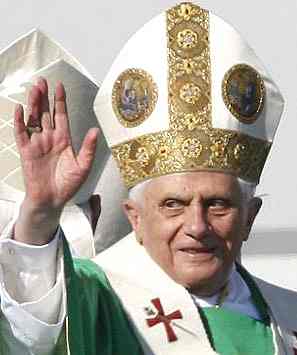 I used to think how lucky I was not to have been a Catholic early in this decade, as the abuse scandal was first coming to light in Boston. Only now, it’s worse, and I realize how shallow that so-called luck of mine is. Now, the daily, weekly drip, drip, drip of revelations—two months ago Ireland, last month Germany, yesterday Norway—is just exactly torture. And my Pope, about whom I have written so often with admiration, is right under the drain spout. What to do?
My first inclination is to go on the defensive. As a personal witness to abuse in non-clerical situations (secular day school, prep school, ashram), I know that this is not alone a “Catholic problem.” I watched “The Daily Show” with mounting outrage a couple of weeks back as host Jon Stewart guffawed through a seven-minute segment called HOLY SH*T about—guess what. I said to myself that when Stewart runs seven minutes on abuse in the Jewish community (his culture) I’ll watch the show again. It would not be politically correct to poke such “fun” at Jewish or Muslim communities, but the Catholic Church? The Catholic Church has a bullseye painted on her forehead.
But that defensive response misses the point. And there are other ways to get lost on this issue, like leaving the Church altogether, the Protestant response. Or to leave one’s body, the Buddhist response. My dear friend Robbie shared with me a video on brain scientist Jill Bolte Taylor who is famous for describing a stroke—her own—from the inside out. You can check it out here.
http://video.ted.com/assets/player/swf/EmbedPlayer.swf
If you don’t have time for this video, let me summarize: Taylor explains the basic differences between the left and right brain and then concludes that if only we could see the world from the timeless peace of the right brain all the time we would never experience distress, we would never suffer. It is a Buddhist view, and one that I imagine Robbie, as peaceable a person as I know, endorses.
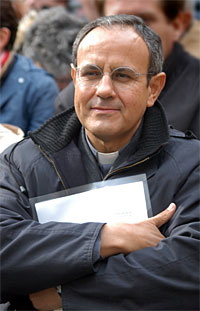
But what is a Catholic to do, and now? Part of an answer can be found at the US web site for Communion and Liberation (CL). At the head of the CL web page you can find a link to a letter written to the Italian newspaper La Repubblica by Fr. Julián Carrón, president of the Fraternity of Communion and Liberation (pictured here). In the letter Carrón begins by openly acknowledging the horror of the situation:
 The request to assume responsibility, the acknowledgment of the evil committed, the reprimand for the mistakes made in the handling of the affair – all of this seems to us to be totally inadequate as we face this sea of evil. Nothing seems to be enough. And so we can understand the frustrated reactions that have been coming forth at this time.
Then Carrón poses a question:
“Quid animo satis?” What can satisfy our thirst for justice? . . . In other words, cannot the whole force of human will succeed in bringing about the justice that we so long for?
This is the question I and probably you are grappling with. What response will have any value at all? How can this wrong be righted? How can our desire for goodness and justice and truth be satisfied? Carrón writes that Pope Benedict has given us an answer, if we have ears to hear it:
To begin with, [Benedict XVI] admitted without hesitation the gravity of the evil committed by priests and religious, urged them to accept their responsibility for it, and condemned the way certain bishops in their fear of scandal have handled the affair, expressing his deep dismay over what had happened and taking steps to ensure that it not happen again. But then, he expressed his full awareness that this is not enough to respond to the demand that there be justice for the harm inflicted: “I know that nothing can undo the wrong you have endured. Your trust has been betrayed and your dignity has been violated.” Likewise, even if the perpetrators serve their sentences, repent, and do penance, it will never be enough to repair the damage they did to the victims and to themselves.
Benedict XVI’s recognition of the true nature of our need, of our struggle, is the only way to save our full demand for justice; it is the only way to take it seriously, to take it fully into consideration. “The demand for justice is a need that is proper to man, proper to a person. Without the possibility of something beyond, of an answer that lies beyond the existential modalities that we can experience, justice is impossible… If the hypothesis of a ‘beyond’ were eliminated, that demand would be unnaturally suffocated” (Father Giussani). So how did the Pope save this demand?
(I’m glad you asked, Father Carrón. You were starting to lose me there.)
By calling on the only one who can save it, someone who makes the beyond present in the here and now, namely, Christ, the Mystery made flesh. “Jesus Christ … was Himself a victim of injustice and sin. Like you, He still bears the wounds of His own unjust suffering. He understands the depths of your pain and its enduring effect upon your lives and your relationships, including your relationship with the Church.” Calling on Christ is not a way to seek a hiding place to run off to in the face of the demand for justice: it is the only way to bring justice about. The Pope calls upon Christ, and steers clear of a truly dangerous shoal, that of distancing Christ from the Church, as if the Church were too full of filth to be able to bear Him. The Protestant temptation is always lurking. It would have been very easy to give in to, but at too high a price – that of losing Christ. Because, as the Pope recalls, “it is in the communion of the Church that we encounter the person of Jesus Christ.”
I read this letter last night and went to bed thinking about it and woke up to the Office of Readings. Does it happen to you, as it happens to me, that when you’re thinking about a question, answers appear all around?
This week’s readings from the first letter of Peter, prescribed for the Octave of Easter, enjoin us to suffer with Christ. Yesterday, household slaves were urged to “obey your masters with all deference, not only the good and reasonable ones but even those who are harsh.” Today, married women are instructed to obey their husbands and we are all reminded, “Even if you should have to suffer for justice’s sake, happy will you be.” Today’s second reading, from the Jerusalem Catecheses, reminds us that baptism is not some Buddhist rite of cleansing the mind and soul:

Our baptism is not like the baptism of John, which conferred only the forgiveness of sins. We know perfectly well that baptism, besides washing away our sins and bringing us the gift of the Holy Spirit, is a symbol of the sufferings of Christ. This is why Paul exclaims: “Do you not know that when we were baptized into Christ Jesus we were, by that very action, sharing in his death? By baptism we went with him into the tomb.”
I would have been lucky to be a Catholic in 2002, and I am lucky to be a Catholic today, especially today—lucky to be asked to embrace the Church now, when it is most wounded. The Church is the bleeding body of Christ. It is my Pope who said it: we encounter the person of Jesus Christ in our wounded Church, and nowhere better.

Previous Post

April 8, 2010
Because Worshiping God is Important, Even If It Takes an Electronic Sign
Next Post
April 10, 2010 Because of Ferrell, My Guardian Angel
Browse Our Archives
Select a Category Blog News Conversion Story Culture Learning Living Nature Prayer Uncategorized Working
Select a Month June 2016 May 2016 August 2015 July 2015 June 2015 May 2015 April 2015 March 2015 February 2015 January 2015 December 2014 November 2014 October 2014 September 2014 August 2014 July 2014 June 2014 May 2014 April 2014 March 2014 February 2014 January 2014 December 2013 November 2013 October 2013 September 2013 August 2013 July 2013 June 2013 May 2013 April 2013 March 2013 February 2013 January 2013 December 2012 November 2012 October 2012 September 2012 August 2012 July 2012 June 2012 May 2012 April 2012 March 2012 February 2012 January 2012 December 2011 November 2011 October 2011 September 2011 August 2011 July 2011 June 2011 May 2011 April 2011 March 2011 February 2011 January 2011 December 2010 November 2010 October 2010 September 2010 August 2010 July 2010 June 2010 May 2010 April 2010 March 2010 February 2010 January 2010 December 2009 November 2009 October 2009 September 2009 August 2009
Follow Us!
TAKE THE
Religious Wisdom Quiz
Which was the day that God ended His creation and rested?
Select your answer to see how you score.
He never rested On the 6th day On the 7th day On the 5th day
Related posts from Why I Am Catholic

Belated Happy Birthday To Blaise Pascal, Unofficial Saint...

Because My Brother Imran Yousef Is An American...

Because of G.K. Chesterton (29 May, 1874 – 14 June, 1936)

Joe Six-Pack, USMC, With A Few Post-Terrorist Attack...
TRENDING AT PATHEOS Catholic

Rejecting Doom: Christian Hope And Human Action
Christianity is a religion of hope. We are to have hope and...

It’s What Comes From Within Which Matters
One of the most difficult things for us to understand is why...

Why I Choose the Eucharist Over the Sermon
Choose the Eucharist, Not the Sermon What are we supposed to get...

5 Design Elements Found in Spiritually Rooted Homes
Putting Spirituality Into Home Decor Our homes are more than our living...

Credo: A Story of God Told with the...
About 10 years ago, I began to imagine a personal "Credo" that...

The Anatomy of Divine Revelation in Catholic Thought
The claim that God has made Himself known to human beings is...
Ad-Free & Subscriber Log-In Subscription Support
- About Us
- 2026 Calendar
- Videos
- Podcasts
- Library of World Religions
- Faith In Media Tracker
- Advertise With Us
- Write for Us
- Privacy Policy
- Terms of Service
- Do Not Sell My Data
- Contact Us
- Radiant Digital
- Manage Newsletter Subscriptions
- Unsubscribe From Notifications
- Sitemap
Copyright 2008-2026, Patheos. All rights reserved.
Subscription Support Ad-Free & Subscriber Log-In
Follow Patheos