
BuddhistCatholicContemplativeEvangelicalGeneral ChristianHinduJewishLatter-day SaintMuslimNew VisionsProgressive Christian
Beliefs
- Buddhist
- Catholic
- Contemplative
- Evangelical
- General Christian
- Hindu
- Jewish
- Latter-day Saint
- More Voices
- Muslim
- New Visions
- Pagan
- Progressive Christian
Topics
- Religion News
- Food and Religion
- Sports and Religion
- Religious Art
- Religious Music and Entertainment
- Religious Events
- History and Religion
- Style and Religion
- Politics and Religion
- Women in Religion
- Recreation Outdoors and Religion
- Business Finance and Religion
- Careers Workplace and Religion
- Education and Religion
- Family Parenting and Religion
- Health Fitness and Religion
- Home and Religion
- Relationships and Religion
- Technology and Religion
- Travel and Religion
Columnists
- Buddhist Columnists
- Business Finance and Religion Columnists
- Careers Workplace and Religion Columnists
- Catholic Columnists
- Contemplative Columnists
- Education and Religion Columnists
- Evangelists Columnists
- Family Parenting and Religion Columnists
- General Christian Columnists
- Health Fitness and Religion Columnists
- Hindu Columnists
- History and Religion Columnists
- Home and Religion Columnists
- Jewish Columnists
- More Voices Columnists
- Latter Day Columnists
- Muslim Columnists
- New Visions Columnists
- Nonreligious Columnists
- Pagan Columnists
- Politics and Religion Columnists
- Progressive Columnists
- Recreation Outdoors and Religion Columnists
- Relationships and Religion Columnists
- Religion News Columnists
- Religious Art Columnists
- Religious Events Columnists
- Religious Music and Entertainment Columnists
- Sports and Religion Columnists
- Style and Religion Columnists
- Technology and Religion Columnists
- Travel and Religion Columnists
- Women in Religion Columnists
Resource Library
- 2026 Calendar
- Library of World Religions
- The 100 Most Holy Places on Earth
- Patheos Answers
- Podcasts
- Videos
- Faith Leaders Database
- Anglican Episcopalian
- Bahai
- Baptist
- Buddhism
- Christianity
- Confucianism
- Eastern Orthodoxy
- Hinduism
- Holiness and Pentecostal
- ISKCON
- Islam
- Judaism
- Lutheran
- Methodist
- The Church of Jesus Christ of Latter-day Saints
- New Age
- Paganism
- Presbytarian and Reformed
- Protestantism
- Religion Behind the Scenes
- Roman Catholic
- Scientology
- Shia Islam
- Sikhism
- Sufism
- Sunni Islam
- Taoism
- Zen
- See all religions
Research Tools
 Ad-Free & Subscriber Log-In Subscription Support
Ad-Free & Subscriber Log-In Subscription Support
Follow Patheos 

- Trending:
- Forgiveness
- |
- Marriage
- |
- Consciousness
- |
- Death Penalty
- |
- Election
- |
- Halloween
 Why I Am Catholic
-
More
- Home
- For Practical Advice Like This from Benedict Baur
For Practical Advice Like This from Benedict Baur
Last updated on: January 24, 2017 at 7:04 pm by Allison Salerno
For Practical Advice Like This from Benedict Baur 2017-01-24T19:04:11-05:00 Allison Salerno
Patheos Explore the world's faith through different perspectives on religion and spirituality! Patheos has the views of the prevalent religions and spiritualities of the world.
 Webster was kind enough earlier this year to send me a gem of a book about developing one’s interior spiritual life. This is one of those books, like St. Teresa of Avila’s The Interior Castle, that is so deep, so lovely and so helpful that one certainly cannot read it in one sitting, or even a chapter at a time. In fact, I have been reading it sentence by sentence, pausing to take notes and meditate on how the book’s message speaks to my own circuitous pilgrim path.
The title of this book, “Frequent Confession” by the late German abbot Benedict Baur O.S.B., was about as appealing to me as would be a book titled “Monthly Weigh-ins” that focuses on improving one’s physical health. That is because Baur’s book, first published in 1922, is not so much about encouraging Catholics to make frequent use of the Sacrament of Penance, which it does, but rather about cultivating an understanding of one’s exterior and interior faults daily so as to grow spiritually. Thus, frequent confession becomes a kind of weigh-in for our souls.
Thanks to poor faith formation as a child and my own spiritual immaturity, my understanding of the Sacrament of Penance has been shallow. I knew one is supposed to go to Confession at least once a year and always after one has committed a mortal sin, including deliberately missing Sunday Mass. So my habit has been to go at least once a year, and when I am aware of a mortal sin. Then before I head into the confessional I will do a quick examination of conscience, which helps me to confess a few venial sins for good measure. Until I started reading Baur’s book, sadly enough, I never connected my earnest freelance efforts to grow as a Christian throughout the year with this sacrament. This book is a useful guide.
Baur, for example, recommends that we examine our conscience every evening. He suggests we take a look at our “thought, feelings, words and deeds.” This is not an obsessive-compulsive exercise in scrupulosity; rather, Baur says: “When this examination of conscience is made regularly it is not very difficult; a person knows his customary failings, and so he discovers without much trouble whatever faults he has committed during the day.” It’s pretty humbling.
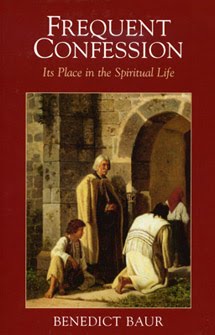
Another point Baur makes early on in the book is that we can confess sins more than once. I never had considered this; I had felt an overwhelming sense of relief that some of the more embarrassing sins of my youth had been confessed and that was that. Baur is helping me to see the links in my journey, the way my path sometimes winds back upon itself. In other words, perhaps as a youth I had the tendency to sin in a certain way. While I have confessed those particular sins, and no longer sin in that way, the underlying character fault that caused those sins has remained and perhaps found expression in different ways of sinning.
Baur follows this insight with a discussion of exterior and interior faults. Exterior faults are those “by which those around us are annoyed or irritated.” I am finding those are easy to tackle, or at least to identify. For example, I have a tendency to gossip. When I fall into that bad habit or feel as if I am about to, it is relatively easy to realize and then I quite literally hold my tongue.
What is much more difficult to face and diminish are my interior faults: “our own faults of character, the weak points in our makeup.” These are the brutes I’m now confronting. It’s painful and cathartic and perhaps the subject of another post at another time. I am so grateful to have this monk, Benedict Baur, as my companion through rough terrain.
For now, dear readers, I’d like to ask you: what role does confession play in the cultivation of your own interior life?

Previous Post

April 18, 2010
Because of Bishops Like This II (A Letter to Parishioners)
Next Post
April 19, 2010 Gettin’ Twangy, Sister (Music for Mondays)
Browse Our Archives
Select a Category Blog News Conversion Story Culture Learning Living Nature Prayer Uncategorized Working
Select a Month June 2016 May 2016 August 2015 July 2015 June 2015 May 2015 April 2015 March 2015 February 2015 January 2015 December 2014 November 2014 October 2014 September 2014 August 2014 July 2014 June 2014 May 2014 April 2014 March 2014 February 2014 January 2014 December 2013 November 2013 October 2013 September 2013 August 2013 July 2013 June 2013 May 2013 April 2013 March 2013 February 2013 January 2013 December 2012 November 2012 October 2012 September 2012 August 2012 July 2012 June 2012 May 2012 April 2012 March 2012 February 2012 January 2012 December 2011 November 2011 October 2011 September 2011 August 2011 July 2011 June 2011 May 2011 April 2011 March 2011 February 2011 January 2011 December 2010 November 2010 October 2010 September 2010 August 2010 July 2010 June 2010 May 2010 April 2010 March 2010 February 2010 January 2010 December 2009 November 2009 October 2009 September 2009 August 2009
Follow Us!
TAKE THE
Religious Wisdom Quiz
Which Old Testament prophet's book has the most chapters?
Select your answer to see how you score.
Ezekiel Jeremiah Daniel Isaiah
Related posts from Why I Am Catholic

Belated Happy Birthday To Blaise Pascal, Unofficial Saint...

Because My Brother Imran Yousef Is An American...

Because of G.K. Chesterton (29 May, 1874 – 14 June, 1936)

Joe Six-Pack, USMC, With A Few Post-Terrorist Attack...
TRENDING AT PATHEOS Catholic

Creation, Preservation, and Teleology in Catholic Theology
As I write this, it is very early Monday morning. Like millions...

The Parable Of The Sower And The Word...
One of Christ’s most famous parables is that of the sower who...

Rejecting Doom: Christian Hope And Human Action
Christianity is a religion of hope. We are to have hope and...

Why I Choose the Eucharist Over the Sermon
Choose the Eucharist, Not the Sermon What are we supposed to get...

5 Design Elements Found in Spiritually Rooted Homes
Putting Spirituality Into Home Decor Our homes are more than our living...

Credo: A Story of God Told with the...
About 10 years ago, I began to imagine a personal "Credo" that...
Ad-Free & Subscriber Log-In Subscription Support
- About Us
- 2026 Calendar
- Videos
- Podcasts
- Library of World Religions
- Faith In Media Tracker
- Advertise With Us
- Write for Us
- Privacy Policy
- Terms of Service
- Do Not Sell My Data
- Contact Us
- Radiant Digital
- Manage Newsletter Subscriptions
- Unsubscribe From Notifications
- Sitemap
Copyright 2008-2026, Patheos. All rights reserved.
Subscription Support Ad-Free & Subscriber Log-In
Follow Patheos