
BuddhistCatholicContemplativeEvangelicalGeneral ChristianHinduJewishLatter-day SaintMuslimNew VisionsProgressive Christian
Beliefs
- Buddhist
- Catholic
- Contemplative
- Evangelical
- General Christian
- Hindu
- Jewish
- Latter-day Saint
- More Voices
- Muslim
- New Visions
- Pagan
- Progressive Christian
Topics
- Religion News
- Food and Religion
- Sports and Religion
- Religious Art
- Religious Music and Entertainment
- Religious Events
- History and Religion
- Style and Religion
- Politics and Religion
- Women in Religion
- Recreation Outdoors and Religion
- Business Finance and Religion
- Careers Workplace and Religion
- Education and Religion
- Family Parenting and Religion
- Health Fitness and Religion
- Home and Religion
- Relationships and Religion
- Technology and Religion
- Travel and Religion
Columnists
- Buddhist Columnists
- Business Finance and Religion Columnists
- Careers Workplace and Religion Columnists
- Catholic Columnists
- Contemplative Columnists
- Education and Religion Columnists
- Evangelists Columnists
- Family Parenting and Religion Columnists
- General Christian Columnists
- Health Fitness and Religion Columnists
- Hindu Columnists
- History and Religion Columnists
- Home and Religion Columnists
- Jewish Columnists
- More Voices Columnists
- Latter Day Columnists
- Muslim Columnists
- New Visions Columnists
- Nonreligious Columnists
- Pagan Columnists
- Politics and Religion Columnists
- Progressive Columnists
- Recreation Outdoors and Religion Columnists
- Relationships and Religion Columnists
- Religion News Columnists
- Religious Art Columnists
- Religious Events Columnists
- Religious Music and Entertainment Columnists
- Sports and Religion Columnists
- Style and Religion Columnists
- Technology and Religion Columnists
- Travel and Religion Columnists
- Women in Religion Columnists
Resource Library
- 2026 Calendar
- Library of World Religions
- The 100 Most Holy Places on Earth
- Patheos Answers
- Podcasts
- Videos
- Faith Leaders Database
- Anglican Episcopalian
- Bahai
- Baptist
- Buddhism
- Christianity
- Confucianism
- Eastern Orthodoxy
- Hinduism
- Holiness and Pentecostal
- ISKCON
- Islam
- Judaism
- Lutheran
- Methodist
- The Church of Jesus Christ of Latter-day Saints
- New Age
- Paganism
- Presbytarian and Reformed
- Protestantism
- Religion Behind the Scenes
- Roman Catholic
- Scientology
- Shia Islam
- Sikhism
- Sufism
- Sunni Islam
- Taoism
- Zen
- See all religions
Research Tools
 Ad-Free & Subscriber Log-In Subscription Support
Ad-Free & Subscriber Log-In Subscription Support
Follow Patheos 

- Trending:
- Forgiveness
- |
- Marriage
- |
- Consciousness
- |
- Death Penalty
- |
- Election
- |
- Halloween
 Why I Am Catholic
-
More
- Home
- Because of Blaise Pascal’s Letter upon the Death of his Father
Because of Blaise Pascal’s Letter upon the Death of his Father
Last updated on: June 7, 2015 at 10:39 pm by Frank Weathers
Because of Blaise Pascal’s Letter upon the Death of his Father 2015-06-07T22:39:31-05:00 Frank Weathers
Patheos Explore the world's faith through different perspectives on religion and spirituality! Patheos has the views of the prevalent religions and spiritualities of the world.
Webster has been serving at funerals lately, one in early December and one just a few days ago. And in a prediction that is all too likely to come to fruition, he believes he will attend the funeral of at least one dear friend this year. Reading these posts, I reflect on the fragility of human life and the sudden impact on our loved ones lives when we depart this mortal coil.
A sudden death, an accidental death, the unexpected death is always a shocker. Others are blessed with an illness—or maybe it’s not a blessing, to see the train enter the station that will inevitably bear them away. There is pain, and suffering in the long drawn-out route to eternity.
The fact that our own death is inevitable is why I don’t spend much mental horsepower worrying about the Apocalypse. Fifteen seconds from now is more likely to be the end times for me, and that is likely true for you too. By preparing for the near term, and I argue, the more likely event, I’ll be prepared, like a good Boy Scout, if I am blessed to witness the Second Coming.
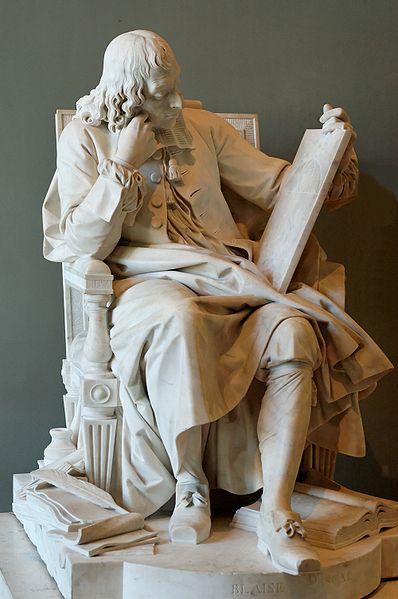
As I have come to find out through reading about their lives, many of the saints recommend that you ponder your personal end times often. Though not an official saint, my buddy Blaise Pascal (pictured here, sitting in the Louvre in Paris) did his share of pondering death. Perhaps he’s proofreading the letter he wrote to his sister upon the death of his father. I’m not sure how she took it, but it provided me much comfort and became another reason why I am Catholic.
After his introduction expressing remorse at this news he writes that,
In the midst of grief . . . we should seek consolation in our ills, not in ourselves, not in men, not in anything that is created; but in God. And the reason is, that all creatures are not the first cause of the accidents that we call evils; but that the providence of God being the only and veritable cause, the arbiter and the sovereign of them, it is indubitable that we must resort directly to the source, and go back to the origin to find a solid alleviation.
And now, get ready for the longest, most cogent and understandable sentence regarding death that any mathematician has ever written in the history of mankind (I can’t verify this but sheeeesh!).
If we follow this precept, and if we regard this event, not as an effect of chance, not as a fatal necessity of nature, not as the play of the elements and parts of which man is composed (for God has not abandoned his elect to caprice and chance) but as a result indispensable, inevitable, just, holy, useful to the good of the Church, and to the exaltation of the name and greatness of God, of a decree of his providence conceived from all eternity to be executed in the plenitude of its time in such a year, such a day, such an hour, such a place, such a manner; and, in short, that all that has happened has been from all time foreknown and foreordained of God; if, I say, through a transport of grace, we regard this accident, not in itself and apart from God, but apart from itself and in the inmost part of the will of God, in the justice of his decree, in the order of his providence, which is the true cause of it, without which it would not have happened, and in the manner in which it happened, through which alone it has happened; we shall adore in humble silence the impenetrable loftiness of his secrets, we shall venerate the sanctity of his decrees, we shall bless the acts of his providence, and, uniting our will to that of God himself, we shall wish with him the thing that he has willed in us and for us for all eternity.
Sure, Blaise could have used an editor. But this was a letter to his sister written while he was grieving. And—if you could have edited that sentence, what would you have removed? Uh, huh—absolutely nothing! It is a great summation of the fact that God’s will is being done whether we see it that way or not.
Blaise continues to console his sister masterfully, paragraph after paragraph. He mentions that it is certain that neither the philosophies of Socrates nor Seneca can provide any solace to the question of our mortality. And that is because they believed that it was merely natural that all men die.
But Blaise, being a good Catholic Christian sees death in an entirely different light. He acknowledges this as follows,
Let us consider death in the truth which the Holy Spirit has taught us. We have this admirable advantage, of knowing that death is really and actually a penalty of sin imposed on man in order to expiate his crime, necessary to man to purge him from sin; that it is the only one that can deliver the soul from the concupiscence of the members, without which saints come not into the world. We know that life, and the life of Christians is a continual sacrifice that can only be completed at death. . . . We know that what has been accomplished in Jesus Christ should be accomplished also in all his members.
In other words, unlike Enoch or Elijah, we aren’t going to get off the planet alive. And you can’t get to heaven unless you die. You can’t get there without going here, that is, through death. Blaise then proceeds to preach a heck of a good sermon on the example that Jesus set for us all. We have to be like Him, and He died, was buried and then rose again in fulfillment of the scripture. Our Lord showed us the way that we too must go.
But Blaise is quick to mention that death apart from Jesus Christ is . . .
horrible, detestable, the horror of nature. But in Jesus Christ, it is altogether different; it is benignant, holy, the joy of the faithful. Everything is sweet in Jesus Christ, even unto death.
Half way through the letter Blaise writes the following exhortation:
Let us then no longer look upon death as the heathen, but like Christians, that is, with hope, as St. Paul commands since this is the especial privilege of Christians. Let us no longer regard a corpse as putrid carrion because deceitful nature figures it thus; but as the inviolable and eternal temple of the Holy Spirit, as faith teaches. For we know that sainted bodies are inhabited by the Holy Spirit until the resurrection which will be caused by virtue of this spirit which dwells in them for this effect. . . . Let us no longer regard a man as having ceased to live although nature suggests it, but as beginning to live as truth assures. Let us no longer regard his soul as perished and reduced to nothingness, but as quickened and united to the sovereign life; and let us thus correct, by attention to these truths, the sentiments of error so deeply imprinted in ourselves and those emotions of honor so natural to mankind.
I don’t know how this could be explained any better. Blaise’s letter in its entirety can be read here.

Previous Post

January 7, 2010
Because of the Liturgy
Next Post
January 9, 2010 Comments of the Week
Browse Our Archives
Select a Category Blog News Conversion Story Culture Learning Living Nature Prayer Uncategorized Working
Select a Month June 2016 May 2016 August 2015 July 2015 June 2015 May 2015 April 2015 March 2015 February 2015 January 2015 December 2014 November 2014 October 2014 September 2014 August 2014 July 2014 June 2014 May 2014 April 2014 March 2014 February 2014 January 2014 December 2013 November 2013 October 2013 September 2013 August 2013 July 2013 June 2013 May 2013 April 2013 March 2013 February 2013 January 2013 December 2012 November 2012 October 2012 September 2012 August 2012 July 2012 June 2012 May 2012 April 2012 March 2012 February 2012 January 2012 December 2011 November 2011 October 2011 September 2011 August 2011 July 2011 June 2011 May 2011 April 2011 March 2011 February 2011 January 2011 December 2010 November 2010 October 2010 September 2010 August 2010 July 2010 June 2010 May 2010 April 2010 March 2010 February 2010 January 2010 December 2009 November 2009 October 2009 September 2009 August 2009
Follow Us!
TAKE THE
Religious Wisdom Quiz
What does the word "apostle" mean?
Select your answer to see how you score.
One who is sent Leader Counselor Teacher
Related posts from Why I Am Catholic

Belated Happy Birthday To Blaise Pascal, Unofficial Saint...

Because My Brother Imran Yousef Is An American...

Joe Six-Pack, USMC, With A Few Post-Terrorist Attack...

This Is Why God Invented YouTube...
TRENDING AT PATHEOS Catholic

Creation, Preservation, and Teleology in Catholic Theology
As I write this, it is very early Monday morning. Like millions...

The Parable Of The Sower And The Word...
One of Christ’s most famous parables is that of the sower who...

Rejecting Doom: Christian Hope And Human Action
Christianity is a religion of hope. We are to have hope and...

Why I Choose the Eucharist Over the Sermon
Choose the Eucharist, Not the Sermon What are we supposed to get...

5 Design Elements Found in Spiritually Rooted Homes
Putting Spirituality Into Home Decor Our homes are more than our living...

Credo: A Story of God Told with the...
About 10 years ago, I began to imagine a personal "Credo" that...
Ad-Free & Subscriber Log-In Subscription Support
- About Us
- 2026 Calendar
- Videos
- Podcasts
- Library of World Religions
- Faith In Media Tracker
- Advertise With Us
- Write for Us
- Privacy Policy
- Terms of Service
- Do Not Sell My Data
- Contact Us
- Radiant Digital
- Manage Newsletter Subscriptions
- Unsubscribe From Notifications
- Sitemap
Copyright 2008-2026, Patheos. All rights reserved.
Subscription Support Ad-Free & Subscriber Log-In
Follow Patheos