
BuddhistCatholicContemplativeEvangelicalGeneral ChristianHinduJewishLatter-day SaintMuslimNew VisionsProgressive Christian
Beliefs
- Buddhist
- Catholic
- Contemplative
- Evangelical
- General Christian
- Hindu
- Jewish
- Latter-day Saint
- More Voices
- Muslim
- New Visions
- Pagan
- Progressive Christian
Topics
- Religion News
- Food and Religion
- Sports and Religion
- Religious Art
- Religious Music and Entertainment
- Religious Events
- History and Religion
- Style and Religion
- Politics and Religion
- Women in Religion
- Recreation Outdoors and Religion
- Business Finance and Religion
- Careers Workplace and Religion
- Education and Religion
- Family Parenting and Religion
- Health Fitness and Religion
- Home and Religion
- Relationships and Religion
- Technology and Religion
- Travel and Religion
Columnists
- Buddhist Columnists
- Business Finance and Religion Columnists
- Careers Workplace and Religion Columnists
- Catholic Columnists
- Contemplative Columnists
- Education and Religion Columnists
- Evangelists Columnists
- Family Parenting and Religion Columnists
- General Christian Columnists
- Health Fitness and Religion Columnists
- Hindu Columnists
- History and Religion Columnists
- Home and Religion Columnists
- Jewish Columnists
- More Voices Columnists
- Latter Day Columnists
- Muslim Columnists
- New Visions Columnists
- Nonreligious Columnists
- Pagan Columnists
- Politics and Religion Columnists
- Progressive Columnists
- Recreation Outdoors and Religion Columnists
- Relationships and Religion Columnists
- Religion News Columnists
- Religious Art Columnists
- Religious Events Columnists
- Religious Music and Entertainment Columnists
- Sports and Religion Columnists
- Style and Religion Columnists
- Technology and Religion Columnists
- Travel and Religion Columnists
- Women in Religion Columnists
Resource Library
- 2026 Calendar
- Library of World Religions
- The 100 Most Holy Places on Earth
- Patheos Answers
- Podcasts
- Videos
- Faith Leaders Database
- Anglican Episcopalian
- Bahai
- Baptist
- Buddhism
- Christianity
- Confucianism
- Eastern Orthodoxy
- Hinduism
- Holiness and Pentecostal
- ISKCON
- Islam
- Judaism
- Lutheran
- Methodist
- The Church of Jesus Christ of Latter-day Saints
- New Age
- Paganism
- Presbytarian and Reformed
- Protestantism
- Religion Behind the Scenes
- Roman Catholic
- Scientology
- Shia Islam
- Sikhism
- Sufism
- Sunni Islam
- Taoism
- Zen
- See all religions
Research Tools
 Ad-Free & Subscriber Log-In Subscription Support
Ad-Free & Subscriber Log-In Subscription Support
Follow Patheos 

- Trending:
- Forgiveness
- |
- Marriage
- |
- Consciousness
- |
- Death Penalty
- |
- Election
- |
- Halloween
 Wrestling with God
- Home
- New Visions
- I Kill Plants. Do You?
I Kill Plants. Do You?
Last updated on: June 20, 2016 at 9:46 am by Barbara Falconer Newhall
I Kill Plants. Do You? 2016-06-20T09:46:15-08:00 Barbara Falconer Newhall
Patheos Explore the world's faith through different perspectives on religion and spirituality! Patheos has the views of the prevalent religions and spiritualities of the world.
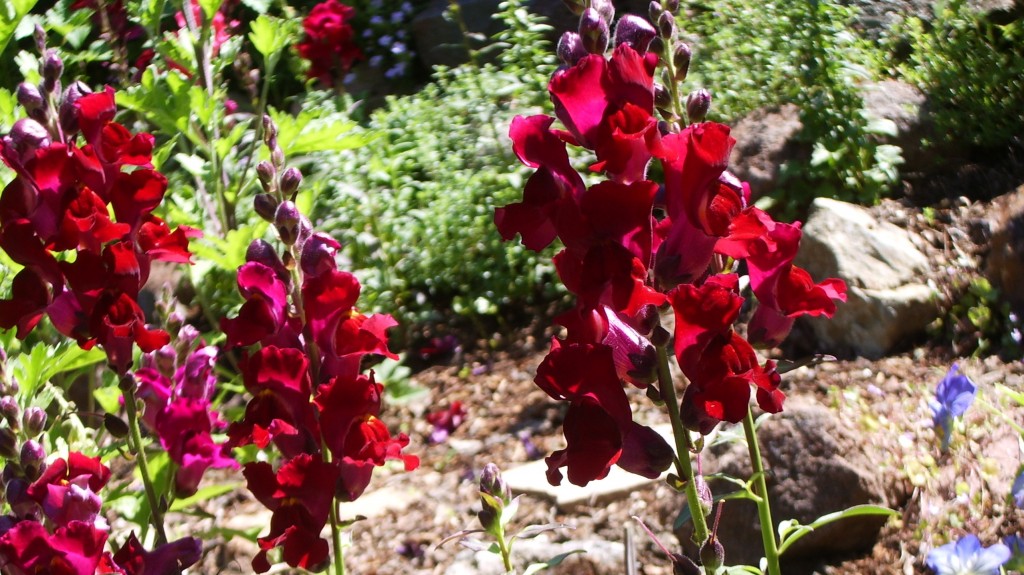
Is it OK to kill plants if they are as overbearing as these red snaps? Photo by Barbara Newhall
By Barbara Falconer Newhall
Is it OK to kill plants just because they are ugly? The snapdragons sprouting up in my front yard a few summers ago were innocent. They were doing what snapdragons do: send down roots, suck up water, push out blossoms. But they were ugly, really ugly — a screaming red-maroon color that outshouted the pastel pinks, lavenders and yellows that I’d planted in my rock garden.
If I ripped those snaps out of the ground in full bloom would that make me an assassin? Would I be committing — what? — floricide? They were ugly, but clearly they were living, striving things. Beings of some kind. But their color, somewhere between scarlet and maroon, was getting on my nerves. I don’t like scarlet. I like maroon even less.
At the nursery, when I first spotted the six-packs of baby snapdragons, I saw only creamy buds. As they grew, however, the blossoms turned maroon and started taking over my garden, leaving the lavender and the bacopa to go unnoticed.
My mother had shelves of potted plants growing with fervor out on the patio of her assisted living apartment at the time. One plant, a philodendron, was not doing so well. It had only a few leaves, most of them dead or yellow.
“Do I throw it out?” she asked. “It doesn’t look very good.”
I thought of my snapdragons. And my mother, for that matter. She didn’t look very good.
I thought too of the cypress tree growing in our back yard. When Peter was little, we found out he was allergic to cypress. “Hmm,” I said to the pediatrician. “We have a cypress tree growing in our back yard a few feet from the house and Peter’s bedroom.”
“Cut it down,” the doctor said.
Jon and I conferred. Our cypress was massive — five stories tall — and older than both of us put together. It was a magnificent tree, timeless, a steady presence at our house. Its branches had grown over and around our deck, so that you could go out there at any time, day or night, stand inside that tree and forget where you were in time and space.
No way were Jon and I going to get rid of that cypress tree. Peter would have to take antihistamines. Or grow out of his allergies. Or we’d move to another house.
Peter outgrew the allergies. We didn’t move. Today, the cypress tree, as stately and self-sufficient as ever, lives on.
But the awful snapdragons? The scraggly, deadish philodendron on my mother’s patio? I put them out of my misery. I killed them.
If you enjoyed this post, you might like “The Hagia Sophia: Face to Face With Islam.” Also, “When a Young Mother Dies.”

Next Post

June 14, 2016 Religious Pluralism at the Hagia Sophia -- Where Christianity and Islam Meet
Browse Our Archives
Select a Category Uncategorized
Select a Month January 2017 December 2016 November 2016 September 2016 July 2016 June 2016 May 2016 April 2016 March 2016 February 2016 January 2016 December 2015 November 2015 October 2015 September 2015 August 2015 July 2015 June 2015 May 2015 April 2015 March 2015 February 2015 January 2015 December 2014
Follow Us!
TAKE THE
Religious Wisdom Quiz
Who is credited with writing much of Proverbs?
Select your answer to see how you score.
Solomon Agur David Hezekiah
Related posts from Wrestling with God

How George Leonard Showed Me the Tao

Do Plants Have a Will to Live? These...
Floricide at My House -- I Offed Those...
TRENDING AT PATHEOS New Visions

Did Prayer Cure His Cancer? Or Was It...
At 4 AM one morning, Joshua W. Brown’s wife awoke to a...

8 Ways a Near-Death Experience Rewires the Soul
Does Consciousness Survive Physical Death? After 50 Years of Research, Dr. Raymond...

Holy Longing: What Our Restlessness Is Telling Us
“One can find so many pains when the rain is falling.” -John...

What this is NOT about. This blog is definitely not about...

Who said the Israelites were God’s chosen? That’s right, they did. Who...

The Spirit World Is the Real World: God...
A Monk’s Wisdom on Body and Spirit I sit with Brother Martin...
view all New Visions blogs
Ad-Free & Subscriber Log-In Subscription Support
- About Us
- 2026 Calendar
- Videos
- Podcasts
- Library of World Religions
- Faith In Media Tracker
- Advertise With Us
- Write for Us
- Privacy Policy
- Terms of Service
- Do Not Sell My Data
- Contact Us
- Radiant Digital
- Manage Newsletter Subscriptions
- Unsubscribe From Notifications
- Sitemap
Copyright 2008-2026, Patheos. All rights reserved.
Subscription Support Ad-Free & Subscriber Log-In
Follow Patheos