
BuddhistCatholicContemplativeEvangelicalGeneral ChristianHinduJewishLatter-day SaintMuslimNew VisionsProgressive Christian
Beliefs
- Buddhist
- Catholic
- Contemplative
- Evangelical
- General Christian
- Hindu
- Jewish
- Latter-day Saint
- More Voices
- Muslim
- New Visions
- Pagan
- Progressive Christian
Topics
- Religion News
- Food and Religion
- Sports and Religion
- Religious Art
- Religious Music and Entertainment
- Religious Events
- History and Religion
- Style and Religion
- Politics and Religion
- Women in Religion
- Recreation Outdoors and Religion
- Business Finance and Religion
- Careers Workplace and Religion
- Education and Religion
- Family Parenting and Religion
- Health Fitness and Religion
- Home and Religion
- Relationships and Religion
- Technology and Religion
- Travel and Religion
Columnists
- Buddhist Columnists
- Business Finance and Religion Columnists
- Careers Workplace and Religion Columnists
- Catholic Columnists
- Contemplative Columnists
- Education and Religion Columnists
- Evangelists Columnists
- Family Parenting and Religion Columnists
- General Christian Columnists
- Health Fitness and Religion Columnists
- Hindu Columnists
- History and Religion Columnists
- Home and Religion Columnists
- Jewish Columnists
- More Voices Columnists
- Latter Day Columnists
- Muslim Columnists
- New Visions Columnists
- Nonreligious Columnists
- Pagan Columnists
- Politics and Religion Columnists
- Progressive Columnists
- Recreation Outdoors and Religion Columnists
- Relationships and Religion Columnists
- Religion News Columnists
- Religious Art Columnists
- Religious Events Columnists
- Religious Music and Entertainment Columnists
- Sports and Religion Columnists
- Style and Religion Columnists
- Technology and Religion Columnists
- Travel and Religion Columnists
- Women in Religion Columnists
Resource Library
- 2026 Calendar
- Library of World Religions
- The 100 Most Holy Places on Earth
- Patheos Answers
- Podcasts
- Videos
- Faith Leaders Database
- Anglican Episcopalian
- Bahai
- Baptist
- Buddhism
- Christianity
- Confucianism
- Eastern Orthodoxy
- Hinduism
- Holiness and Pentecostal
- ISKCON
- Islam
- Judaism
- Lutheran
- Methodist
- The Church of Jesus Christ of Latter-day Saints
- New Age
- Paganism
- Presbytarian and Reformed
- Protestantism
- Religion Behind the Scenes
- Roman Catholic
- Scientology
- Shia Islam
- Sikhism
- Sufism
- Sunni Islam
- Taoism
- Zen
- See all religions
Research Tools
 Ad-Free & Subscriber Log-In Subscription Support
Ad-Free & Subscriber Log-In Subscription Support
Follow Patheos 

- Trending:
- Forgiveness
- |
- Marriage
- |
- Consciousness
- |
- Death Penalty
- |
- Election
- |
- Halloween
 Wrestling with God
- Home
- New Visions
- “Go Set a Watchman” Meets Mother Emanuel
“Go Set a Watchman” Meets Mother Emanuel
Last updated on: July 15, 2015 at 12:02 am by Barbara Falconer Newhall
“Go Set a Watchman” Meets Mother Emanuel 2015-07-14T22:11:06-08:00 Barbara Falconer Newhall
Patheos Explore the world's faith through different perspectives on religion and spirituality! Patheos has the views of the prevalent religions and spiritualities of the world.
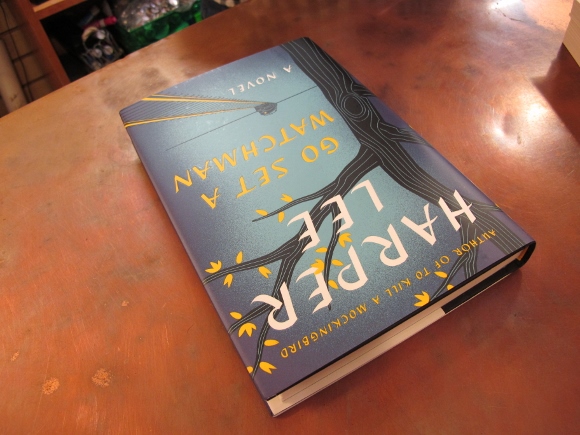
At the bookstore: my brand-new copy of “Watchman,” as yet unopened. Barbara Newhall photo
By Barbara Falconer Newhall
I haven’t cracked open my copy of Go Set a Watchman. But that doesn’t keep me from having opinions about it.
For months now, I’ve been looking forward to taking a look at the long-lost book that was the original version of Harper Lee’s famous, much-loved, much-read best-seller, To Kill a Mockingbird.
I wasn’t planning to rush out to buy it. Maybe I’d wait to get it at the library. But sooner or later I’d get my hands on a copy and study it for what it could tell me about this famous writer’s creative process.
I was wondering, what made Harper Lee put aside this original manuscript and rewrite it as To Kill a Mockingbird? Was the writing inferior in the original version? Was the plot not working? Did the characters not come alive? I assumed that the problem with Go Set a Watchman was a craft problem.
Turns out, if reviewers like Michiko Kakutani of the New York Times are correct, the problem with Go Set a Watchman was not a craft problem. It was a theme problem — a theme problem embodied in the character of Atticus Finch.
In Mockingbird, Finch is the heroic, sensitive, forward-looking attorney, adored by his young children, who comes to the defense of a black man standing trial for rape.

A sign outside A Great Good Place for Books bookstore in Oakland, California, advertises the first day of sales of “Go Set a Watchman.” Photo by Barbara Newhall
In Watchman, Atticus is a southern bigot who lets loose with hate speech. When his daughter, the grown-up Scout, comes home from New York, she is distressed to learn that her beloved father has attended a Klan meeting.
Kakutani asks: “How did a distressing narrative filled with characters spouting hate speech . . . mutate into a redemptive novel associated with the civil rights movement, hailed, in the words of the former civil rights activist and congressman Andrew Young, for giving us ‘a sense of emerging humanism and decency’”?
I ask: Why was a bigot transformed into a larger-than-life hero? Why did Watchman become an – idealized? – story about an idealistic man?
Maybe because a good, well written story with a heavy shot of idealism is what was needed in civil rights era 1960.
According to Times writer Jonathan Mahler, that idealistic story is the one that Harper Lee elected to tell under the guidance – influence? — of her motherly, strong-willed editor, Tay Hohoff.
But now maybe we – by we I mean the American zeitgeist – maybe we are ready for a different story.
I’m thinking about the families and church friends of the nine parishioners murdered at the Emanuel African Methodist Episcopal Church, aka Mother Emanuel, in South Carolina last month.
Miraculously, they found themselves capable of forgiving their loved ones’ murderer. Their open-heartedness set off a chain reaction of open-heartedness around the country – leading to President Obama’s June 26 eulogy at Emanuel AME and the South Carolina legislature’s decision to take down the Confederate battle flag.
It’s not 1960 anymore. It’s 2015. The events in South Carolina point out that perhaps we are ready to feel a heavy shot of compassion for the pain and fear that the “bigots” in our midst are feeling.
Kakutani puts it this way: “‘Mockingbird’ suggested that we should have compassion for outsiders like Boo and Tom Robinson, while ‘Watchman’ asks us to have understanding for a bigot named Atticus.”

Copies of “Go Set a Watchman” were stacked high at A Great Good Place for Books. Photo by Barbara Newhall
But wait, I’m not done here. I’ve got one more preconceived idea – question – about Watchman to put out there: Under a different editor, with different proclivities, might Watchman have become a different story entirely, maybe an even better one?
In the process of cleaning up the Atticus character and making him presentable – and, yes, inspiring — to high school English classes everywhere, wasn’t another, equally poignant (but possibly more nuanced) story lost: The painful story of a young woman who goes home to her beloved father to find he has feet of clay?
Let’s see what happens when I actually read the book. No doubt some more opinions will rear their feisty heads.
A version of this post appeared originally on BarbaraFalconerNewhall.com, where Barbara writes about the view from the second half of life. If you enjoyed this post, you might like “Do Books Have Rights? This One Didn’t. I Threw It in the Trash.” Learn more about her new book from Patheos Press at WrestlingWithGodBook.com.
Previous Post
July 14, 2015
A Persistent Seeker Takes on the Hard Questions
Next Post
July 21, 2015 Religion in America? There's a Whole Lot of Wrestling Going On
Browse Our Archives
Select a Category Uncategorized
Select a Month January 2017 December 2016 November 2016 September 2016 July 2016 June 2016 May 2016 April 2016 March 2016 February 2016 January 2016 December 2015 November 2015 October 2015 September 2015 August 2015 July 2015 June 2015 May 2015 April 2015 March 2015 February 2015 January 2015 December 2014
Follow Us!
TAKE THE
Religious Wisdom Quiz
What did Isaiah see in his vision in Isaiah 6?
Select your answer to see how you score.
The Lord seated on His throne A chariot of fire A burning bush A ladder to heaven
Related posts from Wrestling with God

Last-Minute Gifts for the Worried Progressives on Your...

Evidence of God's Existence -- From a Scientist

Huston Smith -- A Spiritual Companion to Millions

Am I Trump's Idea of a Pathetic Loser?
TRENDING AT PATHEOS New Visions

Did Prayer Cure His Cancer? Or Was It...
At 4 AM one morning, Joshua W. Brown’s wife awoke to a...

8 Ways a Near-Death Experience Rewires the Soul
Does Consciousness Survive Physical Death? After 50 Years of Research, Dr. Raymond...

Holy Longing: What Our Restlessness Is Telling Us
“One can find so many pains when the rain is falling.” -John...

What this is NOT about. This blog is definitely not about...

Who said the Israelites were God’s chosen? That’s right, they did. Who...

The Spirit World Is the Real World: God...
A Monk’s Wisdom on Body and Spirit I sit with Brother Martin...
view all New Visions blogs
Ad-Free & Subscriber Log-In Subscription Support
- About Us
- 2026 Calendar
- Videos
- Podcasts
- Library of World Religions
- Faith In Media Tracker
- Advertise With Us
- Write for Us
- Privacy Policy
- Terms of Service
- Do Not Sell My Data
- Contact Us
- Radiant Digital
- Manage Newsletter Subscriptions
- Unsubscribe From Notifications
- Sitemap
Copyright 2008-2026, Patheos. All rights reserved.
Subscription Support Ad-Free & Subscriber Log-In
Follow Patheos