
BuddhistCatholicContemplativeEvangelicalGeneral ChristianHinduJewishLatter-day SaintMuslimNew VisionsProgressive Christian
Beliefs
- Buddhist
- Catholic
- Contemplative
- Evangelical
- General Christian
- Hindu
- Jewish
- Latter-day Saint
- More Voices
- Muslim
- New Visions
- Pagan
- Progressive Christian
Topics
- Religion News
- Food and Religion
- Sports and Religion
- Religious Art
- Religious Music and Entertainment
- Religious Events
- History and Religion
- Style and Religion
- Politics and Religion
- Women in Religion
- Recreation Outdoors and Religion
- Business Finance and Religion
- Careers Workplace and Religion
- Education and Religion
- Family Parenting and Religion
- Health Fitness and Religion
- Home and Religion
- Relationships and Religion
- Technology and Religion
- Travel and Religion
Columnists
- Buddhist Columnists
- Business Finance and Religion Columnists
- Careers Workplace and Religion Columnists
- Catholic Columnists
- Contemplative Columnists
- Education and Religion Columnists
- Evangelists Columnists
- Family Parenting and Religion Columnists
- General Christian Columnists
- Health Fitness and Religion Columnists
- Hindu Columnists
- History and Religion Columnists
- Home and Religion Columnists
- Jewish Columnists
- More Voices Columnists
- Latter Day Columnists
- Muslim Columnists
- New Visions Columnists
- Nonreligious Columnists
- Pagan Columnists
- Politics and Religion Columnists
- Progressive Columnists
- Recreation Outdoors and Religion Columnists
- Relationships and Religion Columnists
- Religion News Columnists
- Religious Art Columnists
- Religious Events Columnists
- Religious Music and Entertainment Columnists
- Sports and Religion Columnists
- Style and Religion Columnists
- Technology and Religion Columnists
- Travel and Religion Columnists
- Women in Religion Columnists
Resource Library
- 2026 Calendar
- Library of World Religions
- The 100 Most Holy Places on Earth
- Patheos Answers
- Podcasts
- Videos
- Faith Leaders Database
- Anglican Episcopalian
- Bahai
- Baptist
- Buddhism
- Christianity
- Confucianism
- Eastern Orthodoxy
- Hinduism
- Holiness and Pentecostal
- ISKCON
- Islam
- Judaism
- Lutheran
- Methodist
- The Church of Jesus Christ of Latter-day Saints
- New Age
- Paganism
- Presbytarian and Reformed
- Protestantism
- Religion Behind the Scenes
- Roman Catholic
- Scientology
- Shia Islam
- Sikhism
- Sufism
- Sunni Islam
- Taoism
- Zen
- See all religions
Research Tools
 Ad-Free & Subscriber Log-In Subscription Support
Ad-Free & Subscriber Log-In Subscription Support
Follow Patheos 

- Trending:
- Forgiveness
- |
- Marriage
- |
- Consciousness
- |
- Death Penalty
- |
- Election
- |
- Halloween
 Work Cited
- Home
- Careers, Workplace and Religion
- I’ve Never Pretended I’m Not Religious
I’ve Never Pretended I’m Not Religious
Last updated on: February 10, 2016 at 11:41 am by Jennifer Woodruff Tait
I’ve Never Pretended I’m Not Religious 2016-02-10T11:41:46-05:00 Jennifer Woodruff Tait
Patheos Explore the world's faith through different perspectives on religion and spirituality! Patheos has the views of the prevalent religions and spiritualities of the world.
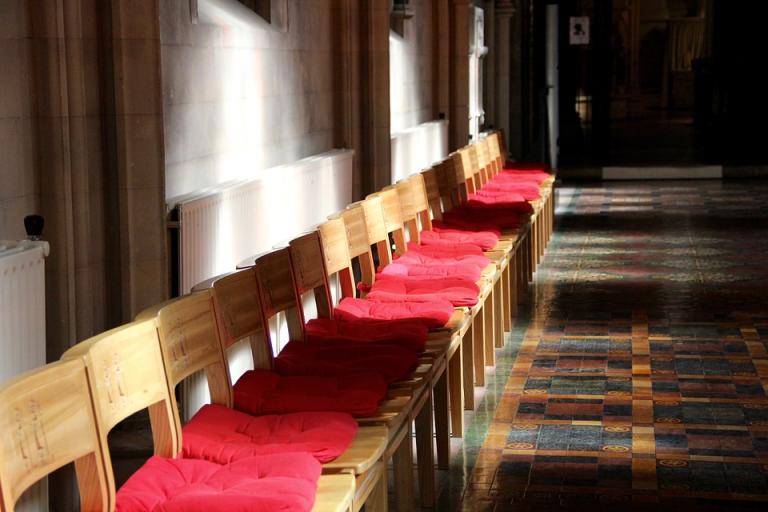
This is a participation in the Patheos Book Club on David Dark’s Life’s Too Short to Pretend You’re Not Religious.
When I was a kid, I was always the odd one out whenever rebellion was contemplated. From the 1970s (my natal decade) I took away in full measure the messages of Marlo Thomas’ “Free to be You and Me” about gender and racial equality, but I missed the whole hippie ethos that accompanied them.
My teenage years were spent in the decidedly Establishment 1980s, but I was “establishment” even for the 1980s. I  decided when I was 16 that I wanted to be an ordained United Methodist minister like my father and grandfather. I got the denomination wrong (I’m being ordained a priest in the Episcopal Church on April 1 of this year…no, this is not an April Fools!) but one could hardly come up with a less rebellious goal.
That whole drifting-away-from-the-church-in-your-20s-until-you-have-kids thing? Never happened. That whole I’m-spiritual-but-not-religious approach? Not here. Unless illness and occasionally travel have prevented me, I’ve been in Sunday morning worship–in a mainline, denominational church, no less–pretty much every Sunday of my entire life. As the daughter of a United Methodist denominational executive I learned fairly early on that churches on the local and global level were imperfect and corrupt and that religious meetings look a lot more like the making of sausage than the descent of the Holy Spirit. But it never once produced in me a desire to spend my Sunday mornings conversing with God on the golf course. My DNA, amid a world and a generation of do-it-yourself and follow-your-bliss, appears to be irredeemably tied to liturgy, sacrament, institution, and painful bureaucratic process.
All of which explains why I jumped at the chance to read David Dark’s book. Finally, somebody else was going to say the things I had thought my whole life! And Dark does, as a matter of fact, say many of those things. I was not quite prepared for the style in which he said them: it sounded like he had swallowed all of pop culture whole and regurgitated it in one endless, breathless spiral (maybe I even started humming “Windmills of Your Mind” at some point).
But I fully stand behind his basic message: all of life is in fact religious, and when we fail to recognize the power we give secular liturgies and loyalties (as trivial as the Super Bowl or as serious as racism) we also fail to recognize the power that the Christian liturgy and loyalty has to combat their darkness. (One great moment in the book is when he asks his students to write about their weird religious backgrounds and, when they claim they don’t have any such things, says, “Well, most of you were probably raised capitalist.”)
Religion is not something that can be written off as an irrational motivator and set aside so that we can have discussions based on all the other motivators of human behavior that are supposedly more rational. All of life is motivated by what we believe. The sooner we recognize that, the sooner we can place our beliefs in things that make for life and light: the sooner we can submit to both the discipline and the healing that come from community and tradition…from community lived in obedience to tradition, in fact. (I’m an Anglican. You knew I was going to say that.)
And I realized as I read on that the frenetic, pop-culture-name-checking writing style was an attempt to get that across to a modern generation which, through no fault of their own, was cut loose by parents and teachers and other adults of my generation from any kind of mooring in community and tradition. We served them up youth group as pizza and basketball instead of youth group as initiation into an alternative community. Now, it takes Doctor Who and Saturday Night Live and Scooby Doo to build the bridge back, because sometimes those “relevant” places are preaching more truth than the church, in its desire to be “relevant,” has allowed itself to preach.
Early on in the book Dark tells the story of a (to me) horrifying Saturday Night Live skit where Will Ferrell (long before Anchorman) stars as the host of a morning show called Wake Up and Smile, a show whose 20th-anniversary celebration goes horribly wrong when the teleprompters fail and the on-screen personalities literally have no words, retreating into an almost animal state where they barricade themselves against imagined dangers with the furniture and at one point even perform a beheading.
Of all the stories in the book, that’s the one I can’t shake. If we cut ourselves too far off from the wisdom of the past, we will lose the words when our cultural teleprompters fail, and eventually we will lose touch with the Word. The saving grace, however, is that the Word has promised not to lose touch with us. My hope is that Dark’s book will help a lot of people find the words again and find the Word again. Or find that the Word is already trying to find them.
Stay in touch! Like Patheos Faith and Work on Facebook:
Life's Too Short to Pretend You're Not Religious
Previous Post

February 2, 2016
Helping College Students Find Meaning
Next Post

February 12, 2016 What are you up to and what are you into?
Browse Our Archives
Select a Category Book Reviews Curriculum Reviews Discipleship Information Interviews Movie Reviews New Book Resource Lists Theology of Work Uncategorized Videos
Select a Month March 2016 February 2016 January 2016 December 2015 November 2015 October 2015 September 2015 August 2015 July 2015 June 2015 May 2015 April 2015 March 2015 February 2015 January 2015 December 2014
Follow Us!
TAKE THE
Religious Wisdom Quiz
Who said, "It is finished"?
Select your answer to see how you score.
Peter John Paul Jesus
Related posts from Work Cited


"My passions feel at odds with each other":...

A big deal for the Kingdom of God:...

What are you up to and what are...
TRENDING AT PATHEOS Careers, Workplace and Religion

St. Francis by Bill Droel Pope Leo XIV declares 2026 as “Year...

Catholics are schooled in the faith by memorizing dogmatic points and lots...

The Good News of Our Human Limitations -...
After another day of trying to meet deadlines and working on projects,...

Quiet Holy Attentiveness (podcast) with Sarah Clarkson
We know that quiet is an essential aspect of the spiritual life,...

Every Vocation Everywhere All At Once
What is a vocation? How does it endure through the years? Can...

I promise this is not going to become a Taylor Swift Studies...
view all Careers, Workplace and Religion blogs
Ad-Free & Subscriber Log-In Subscription Support
- About Us
- 2026 Calendar
- Videos
- Podcasts
- Library of World Religions
- Faith In Media Tracker
- Advertise With Us
- Write for Us
- Privacy Policy
- Terms of Service
- Do Not Sell My Data
- Contact Us
- Radiant Digital
- Manage Newsletter Subscriptions
- Unsubscribe From Notifications
- Sitemap
Copyright 2008-2026, Patheos. All rights reserved.
Subscription Support Ad-Free & Subscriber Log-In
Follow Patheos