
BuddhistCatholicContemplativeEvangelicalGeneral ChristianHinduJewishLatter-day SaintMuslimNew VisionsProgressive Christian
Beliefs
- Buddhist
- Catholic
- Contemplative
- Evangelical
- General Christian
- Hindu
- Jewish
- Latter-day Saint
- More Voices
- Muslim
- New Visions
- Pagan
- Progressive Christian
Topics
- Religion News
- Food and Religion
- Sports and Religion
- Religious Art
- Religious Music and Entertainment
- Religious Events
- History and Religion
- Style and Religion
- Politics and Religion
- Women in Religion
- Recreation Outdoors and Religion
- Business Finance and Religion
- Careers Workplace and Religion
- Education and Religion
- Family Parenting and Religion
- Health Fitness and Religion
- Home and Religion
- Relationships and Religion
- Technology and Religion
- Travel and Religion
Columnists
- Buddhist Columnists
- Business Finance and Religion Columnists
- Careers Workplace and Religion Columnists
- Catholic Columnists
- Contemplative Columnists
- Education and Religion Columnists
- Evangelists Columnists
- Family Parenting and Religion Columnists
- General Christian Columnists
- Health Fitness and Religion Columnists
- Hindu Columnists
- History and Religion Columnists
- Home and Religion Columnists
- Jewish Columnists
- More Voices Columnists
- Latter Day Columnists
- Muslim Columnists
- New Visions Columnists
- Nonreligious Columnists
- Pagan Columnists
- Politics and Religion Columnists
- Progressive Columnists
- Recreation Outdoors and Religion Columnists
- Relationships and Religion Columnists
- Religion News Columnists
- Religious Art Columnists
- Religious Events Columnists
- Religious Music and Entertainment Columnists
- Sports and Religion Columnists
- Style and Religion Columnists
- Technology and Religion Columnists
- Travel and Religion Columnists
- Women in Religion Columnists
Resource Library
- 2026 Calendar
- Library of World Religions
- The 100 Most Holy Places on Earth
- Patheos Answers
- Podcasts
- Videos
- Faith Leaders Database
- Anglican Episcopalian
- Bahai
- Baptist
- Buddhism
- Christianity
- Confucianism
- Eastern Orthodoxy
- Hinduism
- Holiness and Pentecostal
- ISKCON
- Islam
- Judaism
- Lutheran
- Methodist
- The Church of Jesus Christ of Latter-day Saints
- New Age
- Paganism
- Presbytarian and Reformed
- Protestantism
- Religion Behind the Scenes
- Roman Catholic
- Scientology
- Shia Islam
- Sikhism
- Sufism
- Sunni Islam
- Taoism
- Zen
- See all religions
Research Tools
 Ad-Free & Subscriber Log-In Subscription Support
Ad-Free & Subscriber Log-In Subscription Support
Follow Patheos 

- Trending:
- Forgiveness
- |
- Marriage
- |
- Consciousness
- |
- Death Penalty
- |
- Election
- |
- Halloween
 Work Cited
- Home
- Careers, Workplace and Religion
- The Business of Faith: An Interview with Al Erisman
The Business of Faith: An Interview with Al Erisman
Last updated on: September 10, 2015 at 2:08 pm by Guest Contributor
The Business of Faith: An Interview with Al Erisman 2015-09-10T14:08:17-05:00 Guest Contributor
Patheos Explore the world's faith through different perspectives on religion and spirituality! Patheos has the views of the prevalent religions and spiritualities of the world.

By Romal Tune, reprinted with permission. This interview originally appeared at the Huffington Post*.*
For much of my career I’ve worked in the faith community but lately I’ve been asked by a few companies to conduct workshops on professional and personal development. I found it a little challenging to make the transition. During that time I met Michael Erisman, a VP of Human Resources . One of the things Michael and I discussed, and what prompted our relationship, was that he saw the similarity between what I was doing with the gang culture and in leading in the church, as needed and relevant in the business setting. The core issues of relationship, purpose, belonging and leadership are the same whenever people are involved. He provided some context on how to translate the key points of my work with terminology and events common to business settings. During one of our conversations Michael offered to introduce me to his dad Al and sent me a copy of his new book The Accidental Executive: Lessons on Business, Faith and Calling from the Life of Joseph. The book was extremely insightfully and I couldn’t wait to talk to Al about the intersection of faith and business. It was an eye opening conversation that I had to share with others. Al agreed to be interviewed.
Here’s a snapshot of Al’s career followed by his answers to my questions.
Albert M. (Al) Erisman is the Executive in Residence and the past Director for the Center for Integrity in Business in the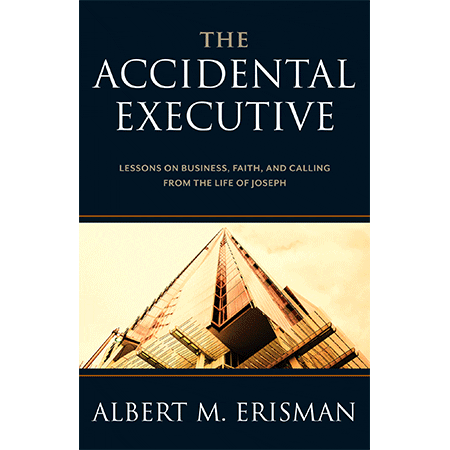 School of Business and Economics at Seattle Pacific University. He teaches business ethics and business and technology both at the undergraduate and the graduate level. He is also executive editor of Ethix magazine, which he co-founded with a colleague in 1998. In this capacity he has interviewed business leaders from around the world on issues of ethics, values, and purpose. In April 2001, Dr. Erisman completed a 32 year career at The Boeing Company where, for the last 10 years, he was director of R&D for computing and mathematics.
RT: Al, I pulled this quote from your book. “For people in the workplace, there is a great deal to learn from Joseph in the book of Genesis. He spent time both at the top and at the bottom-as a leader and as a slave in Egypt. In this new book about faith and work, author Albert M. Erisman shares lessons learned from the frontlines of business, government, and education, and how they connect to Joseph’s life. Through the author’s own work experiences and interviews with business leaders across the world, you’ll learn that Joseph dealt with issues that are still common in the business world today. Studying his life can offer guidance and encouragement in any workplace.” What compelled you to write The Accidental Executive?
AE: There are two dominant things that led me to write this. First, almost 30 years ago while at Boeing, a challenging year caused me to consider how Joseph dealt with the difficulties of his workplace while he was in slavery and in prison. The story helped me through that period, but it also focused my attention on the story of a career. Second, I have been engaged over the past eight years with an international team writing a commentary on the Bible and what it has to say about our daily work (www.theologyofwork.org). This work gave a framework for me to see the Scripture in a new way.
RT: Who is your intended audience?
AE: When I started, I was thinking about people in a leadership position, since Joseph ended up as the CEO of the Egyptian International Food Company. But as I got into it, I realized that his first 13 years in the workplace, he worked from the bottom of the corporate ladder as a slave and in prison. I thought of my many students who start out doing what might seem like menial jobs, and what they could also learn from Joseph. Also, I started by thinking of people of faith who are familiar with the biblical story, but later realized that there is common wisdom found in this account. Dealing with office politics, acting professionally, executing a strategy, and dealing with success are just a few of these. So my hope is that anyone in the workplace can make connections with this book. Early responses from people who do not identify with the faith community indicate this to be the case.
RT: What do you want readers to take away from The Accidental Executive?
AE: It starts with purpose. Joseph saw purpose, even a call from God, on the “ordinary” work he did. But it extends to how the work is done, navigating through the long and challenging tasks each of us face in our workplaces. The big project Joseph took on lasted 14 years. It is important to plan well, but it is also important to carry out the work when things get difficult and the glamour is gone. Joseph had to work through all of these things.
RT: Based on the overview of your book it sounds like you believe that there are things business professionals can learn from Biblical leaders on business success. Is that an accurate assessment? Do you also think that there are principles that Christians can learn from the business leaders?
AE: I absolutely believe there are biblical lessons people can learn that apply to 21st century business. But as you say, Christians can learn from business leaders as well. I tried to make this point when examining how Joseph handled particular situations. I linked what Joseph did with the way 21st century business leaders do similar things. Over the past 15 years I have had the opportunity to interview prominent business leaders across the world. People like Alan Mulally (Ford), Jim Sinegal (Costco), Fu Hua Hsieh (Singapore Exchange), Bonnie Wurzbacher (Coca Cola) and so many others show up in the book as illustrations for the business principles discussed.
RT: In some circles there seem to be misconceptions about the role of faith in doing business and similarly, in the faith community I sometimes find that people don’t like to talk about business and specifically money. What are your thoughts in these issues?
AE: Some people reduce the connection between faith and business to acting ethically or sharing their faith. But it goes much deeper than this. What we do, why we do it, and how we do it are all matters that need to be informed by our faith. Jesus said as much about money and property as he did about the afterlife. Faith is about a new way of seeing all of life, not just a compartment of life. That said, I believe business is about a great deal more than making money, and reducing business to money is a problem. Business is about creating great products and services that make a difference in society. It is usually easy to tell the difference between people trying to make as much money as they can, and people with a passion for the products and services they produce.
(Stay tuned for the second part of the interview tomorrow!)
Image: Pixabay.
Next Post

September 11, 2015 The Business of Faith: Part 2 of an interview with Al Erisman
Browse Our Archives
Select a Category Book Reviews Curriculum Reviews Discipleship Information Interviews Movie Reviews New Book Resource Lists Theology of Work Uncategorized Videos
Select a Month March 2016 February 2016 January 2016 December 2015 November 2015 October 2015 September 2015 August 2015 July 2015 June 2015 May 2015 April 2015 March 2015 February 2015 January 2015 December 2014
Follow Us!
TAKE THE
Religious Wisdom Quiz
Which prophet had a vision of God standing beside a destroyed altar?
Select your answer to see how you score.
Joel Micah Amos Ezekiel
Related posts from Work Cited

Why you should read 50 books this year...


Top Books of 2015 from The Gospel Coalition

33 business books every professional should read before...
TRENDING AT PATHEOS Careers, Workplace and Religion

St. Francis by Bill Droel Pope Leo XIV declares 2026 as “Year...

Catholics are schooled in the faith by memorizing dogmatic points and lots...

The Good News of Our Human Limitations -...
After another day of trying to meet deadlines and working on projects,...

Quiet Holy Attentiveness (podcast) with Sarah Clarkson
We know that quiet is an essential aspect of the spiritual life,...

Every Vocation Everywhere All At Once
What is a vocation? How does it endure through the years? Can...

I promise this is not going to become a Taylor Swift Studies...
view all Careers, Workplace and Religion blogs
Ad-Free & Subscriber Log-In Subscription Support
- About Us
- 2026 Calendar
- Videos
- Podcasts
- Library of World Religions
- Faith In Media Tracker
- Advertise With Us
- Write for Us
- Privacy Policy
- Terms of Service
- Do Not Sell My Data
- Contact Us
- Radiant Digital
- Manage Newsletter Subscriptions
- Unsubscribe From Notifications
- Sitemap
Copyright 2008-2026, Patheos. All rights reserved.
Subscription Support Ad-Free & Subscriber Log-In
Follow Patheos