
BuddhistCatholicContemplativeEvangelicalGeneral ChristianHinduJewishLatter-day SaintMuslimNew VisionsProgressive Christian
Beliefs
- Buddhist
- Catholic
- Contemplative
- Evangelical
- General Christian
- Hindu
- Jewish
- Latter-day Saint
- More Voices
- Muslim
- New Visions
- Pagan
- Progressive Christian
Topics
- Religion News
- Food and Religion
- Sports and Religion
- Religious Art
- Religious Music and Entertainment
- Religious Events
- History and Religion
- Style and Religion
- Politics and Religion
- Women in Religion
- Recreation Outdoors and Religion
- Business Finance and Religion
- Careers Workplace and Religion
- Education and Religion
- Family Parenting and Religion
- Health Fitness and Religion
- Home and Religion
- Relationships and Religion
- Technology and Religion
- Travel and Religion
Columnists
- Buddhist Columnists
- Business Finance and Religion Columnists
- Careers Workplace and Religion Columnists
- Catholic Columnists
- Contemplative Columnists
- Education and Religion Columnists
- Evangelists Columnists
- Family Parenting and Religion Columnists
- General Christian Columnists
- Health Fitness and Religion Columnists
- Hindu Columnists
- History and Religion Columnists
- Home and Religion Columnists
- Jewish Columnists
- More Voices Columnists
- Latter Day Columnists
- Muslim Columnists
- New Visions Columnists
- Nonreligious Columnists
- Pagan Columnists
- Politics and Religion Columnists
- Progressive Columnists
- Recreation Outdoors and Religion Columnists
- Relationships and Religion Columnists
- Religion News Columnists
- Religious Art Columnists
- Religious Events Columnists
- Religious Music and Entertainment Columnists
- Sports and Religion Columnists
- Style and Religion Columnists
- Technology and Religion Columnists
- Travel and Religion Columnists
- Women in Religion Columnists
Resource Library
- 2026 Calendar
- Library of World Religions
- The 100 Most Holy Places on Earth
- Patheos Answers
- Podcasts
- Videos
- Faith Leaders Database
- Anglican Episcopalian
- Bahai
- Baptist
- Buddhism
- Christianity
- Confucianism
- Eastern Orthodoxy
- Hinduism
- Holiness and Pentecostal
- ISKCON
- Islam
- Judaism
- Lutheran
- Methodist
- The Church of Jesus Christ of Latter-day Saints
- New Age
- Paganism
- Presbytarian and Reformed
- Protestantism
- Religion Behind the Scenes
- Roman Catholic
- Scientology
- Shia Islam
- Sikhism
- Sufism
- Sunni Islam
- Taoism
- Zen
- See all religions
Research Tools
 Ad-Free & Subscriber Log-In Subscription Support
Ad-Free & Subscriber Log-In Subscription Support
Follow Patheos 

- Trending:
- Forgiveness
- |
- Marriage
- |
- Consciousness
- |
- Death Penalty
- |
- Election
- |
- Halloween
 Work Cited
- Home
- Careers, Workplace and Religion
- Best Books for Business: I Beg to Differ by Tim Muehlhoff
Best Books for Business: I Beg to Differ by Tim Muehlhoff
Last updated on: July 16, 2015 at 5:21 pm by The High Calling
Best Books for Business: I Beg to Differ by Tim Muehlhoff 2015-07-14T18:52:14-05:00 The High Calling
Patheos Explore the world's faith through different perspectives on religion and spirituality! Patheos has the views of the prevalent religions and spiritualities of the world.
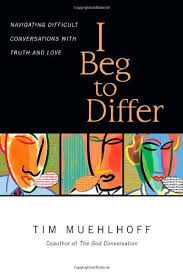 By Christine A. Scheller; part of a series at TheHighCalling.org called “Best Books for Business.” Stay tuned for more!
Many years ago, I heard the theory of entropy applied to relationships. Their quality has a tendency to decline over time, this person said. Without effort, couples (and coworkers) may find themselves wondering how they ever got along. The idea stuck and inspired me to tend my marriage well, because I wanted it to not only last, but to always be a source of joy and mutual satisfaction.
In I Beg to Differ: Navigating Difficult Conversations With Truth and Love, Biola University communications professor Tim Muehlhoff offers strong ballast for resisting relational decline.
I began reading the book in search of tips for my work helping to facilitate dialogue between scientists and religious leaders. I quickly discovered, however, that it is chock-full of good advice for marriage and career.
My husband and I have always had good communication, in part because of our mutual love and shared values, and in part because we’ve never let disagreements simmer for too long. There’s been a lot of good will built up between us over nearly 30 years together.
The last several years have depleted some of that good will as health, vocational, and financial challenges, along with grief over our son’s death have taken a toll and changed us both in ways we couldn’t have anticipated.
We sometimes find ourselves talking past each other, making uncharacteristic assumptions about the other person’s thoughts or motives, and generally misunderstanding each other. We’ve turned into squabblers, I’m afraid.
As I’ve absorbed principles from I Beg to Differ, I’ve found myself stepping back and reflecting on the words that come out of my mouth, sometimes before I speak them and sometimes before a conversation careens too far off course.
“The first step in crafting a difficult conversation is to reclaim a healthy respect for the power of words,” Muehlfoff writes. “As soon as two people start to talk, a communication climate is formed that is just as real as the weather outside your door—and just as impossible to ignore. A key step to improving communication and reducing conflict is to understand the overall climate of the relationship in which the communication takes place.”
This climate is a product of how each of us was raised and of our shared relational history. It is “the overarching sense of value and satisfaction individuals feel as they interact with each other and go about daily activities.”
When I communicate annoyance and impatience with my husband because of his physical limitations, it creates an emotionally unsafe environment for him. When he communicates insecurity about the changes he sees in me, it creates a climate of fear in which a healthy relationship cannot flourish.
“We impart life by reminding those with whom we struggle of unchanging truths—I am committed to you as a spouse, you are my daughter, we are both committed to this organization—as we seek to resolve differences and obey biblical commands to pursue peace,” Muehlhoff says.
Trust is foundational to good communication.
“To notice and engage another person as a unique and irreplaceable individual is a deeply encouraging form of interaction,” Muehlhoff writes. “Conversely, if we regularly feel that our perspective is not being acknowledged in a relationship, the climate will quickly deteriorate.”
What about areas of sincere disagreement? “Most conflict begins with a latency period in which tensions exist but go unexpressed,” Muehlhoff says. The result can be a verbal explosion in which every perceived offense, no matter how old, gets dragged up.
“Before every conversation, we must manage and recognize our emotions, knowing that they will to some degree be transferred to the other person,” he says. This is important because our conflict resolution strategies usually get abandoned once the temperature of the conversation begins to rise.
Muehlhoff suggests having specific goals for difficult conversations:
- Topic goals: “What do we want?”
- Process goals: “How will the conversation be structured?”
- Identity or face-saving goals: “Who am I in this interaction?”
- Relational goals: “Who are we to each other?”
- The nonnegotiable, biblically mandated goal of gentleness.
We should also keep four questions in mind:
- What does the other person believe?
- Why do they believe it?
- Where do we agree?
- Finally, and perhaps most importantly, “With this person, at this time, under these circumstances, what is the next thing I should say?”
There are some dos and don’ts, including:
- Do resist the urge to persuade or correct early in the conversation.
- Listen to understand, not as manipulative strategy.
One danger in this approach is in never getting around to the underlying issues.
“Over time we become experts at finding areas of agreement or common ground while skillfully avoiding areas of contention … We are hesitant to jeopardize the positive climate by challenging others,” Muehlhoff says.
“It is a mistake to consistently avoid hard issues. Honesty communicates trust … If the time never seems right to address honest disagreements, then we have fallen into this common mistake,” he writes.
At the other end of the spectrum, “If every conversation we have with others is about the issues that divide us, the intensity will hurt the communication climate.” We need to make time and space for honest disagreement, but also for ordinary interactions and plain old fun.
For my husband and me, this usually means dinner and a short walk or a bike ride. Sometimes there is squabbling. I’m always glad when there’s not. I can write about our communication challenges because I’m confident we’ll work through them, just as we have worked through every other challenge we’ve faced. We’re both committed to the relationship and are operating in good faith.
This isn’t true of all relationships, especially not professional ones.
“Attempting to find common ground with others is a two-way proposition and, unfortunately, we can be rebuffed,” Muehlhoff rightly notes.
When we are, there’s no reason we can’t continue operating with these principles in mind. We have the power to influence the communication climates in our homes and workplaces, no matter how others choose to act.
 Christine A. Scheller is a widely published, award-winning journalist and essayist. She helps facilitate dialogue between scientific and religious communities.
Previous Post

July 13, 2015
10 Recent Books About Faith and the Arts
Next Post

July 24, 2015 Good Work: The Gift of Work by Bill Heatley
Browse Our Archives
Select a Category Book Reviews Curriculum Reviews Discipleship Information Interviews Movie Reviews New Book Resource Lists Theology of Work Uncategorized Videos
Select a Month March 2016 February 2016 January 2016 December 2015 November 2015 October 2015 September 2015 August 2015 July 2015 June 2015 May 2015 April 2015 March 2015 February 2015 January 2015 December 2014
Follow Us!
TAKE THE
Religious Wisdom Quiz
Which book of the Bible contains the Ten Plagues of Egypt?
Select your answer to see how you score.
Leviticus Genesis Deuteronomy Exodus
Related posts from Work Cited


"My passions feel at odds with each other":...

A big deal for the Kingdom of God:...

What are you up to and what are...
TRENDING AT PATHEOS Careers, Workplace and Religion

St. Francis by Bill Droel Pope Leo XIV declares 2026 as “Year...

Catholics are schooled in the faith by memorizing dogmatic points and lots...

The Good News of Our Human Limitations -...
After another day of trying to meet deadlines and working on projects,...

Quiet Holy Attentiveness (podcast) with Sarah Clarkson
We know that quiet is an essential aspect of the spiritual life,...

Every Vocation Everywhere All At Once
What is a vocation? How does it endure through the years? Can...

I promise this is not going to become a Taylor Swift Studies...
view all Careers, Workplace and Religion blogs
Ad-Free & Subscriber Log-In Subscription Support
- About Us
- 2026 Calendar
- Videos
- Podcasts
- Library of World Religions
- Faith In Media Tracker
- Advertise With Us
- Write for Us
- Privacy Policy
- Terms of Service
- Do Not Sell My Data
- Contact Us
- Radiant Digital
- Manage Newsletter Subscriptions
- Unsubscribe From Notifications
- Sitemap
Copyright 2008-2026, Patheos. All rights reserved.
Subscription Support Ad-Free & Subscriber Log-In
Follow Patheos