
BuddhistCatholicContemplativeEvangelicalGeneral ChristianHinduJewishLatter-day SaintMuslimNew VisionsProgressive Christian
Beliefs
- Buddhist
- Catholic
- Contemplative
- Evangelical
- General Christian
- Hindu
- Jewish
- Latter-day Saint
- More Voices
- Muslim
- New Visions
- Pagan
- Progressive Christian
Topics
- Religion News
- Food and Religion
- Sports and Religion
- Religious Art
- Religious Music and Entertainment
- Religious Events
- History and Religion
- Style and Religion
- Politics and Religion
- Women in Religion
- Recreation Outdoors and Religion
- Business Finance and Religion
- Careers Workplace and Religion
- Education and Religion
- Family Parenting and Religion
- Health Fitness and Religion
- Home and Religion
- Relationships and Religion
- Technology and Religion
- Travel and Religion
Columnists
- Buddhist Columnists
- Business Finance and Religion Columnists
- Careers Workplace and Religion Columnists
- Catholic Columnists
- Contemplative Columnists
- Education and Religion Columnists
- Evangelists Columnists
- Family Parenting and Religion Columnists
- General Christian Columnists
- Health Fitness and Religion Columnists
- Hindu Columnists
- History and Religion Columnists
- Home and Religion Columnists
- Jewish Columnists
- More Voices Columnists
- Latter Day Columnists
- Muslim Columnists
- New Visions Columnists
- Nonreligious Columnists
- Pagan Columnists
- Politics and Religion Columnists
- Progressive Columnists
- Recreation Outdoors and Religion Columnists
- Relationships and Religion Columnists
- Religion News Columnists
- Religious Art Columnists
- Religious Events Columnists
- Religious Music and Entertainment Columnists
- Sports and Religion Columnists
- Style and Religion Columnists
- Technology and Religion Columnists
- Travel and Religion Columnists
- Women in Religion Columnists
Resource Library
- 2026 Calendar
- Library of World Religions
- The 100 Most Holy Places on Earth
- Patheos Answers
- Podcasts
- Videos
- Faith Leaders Database
- Anglican Episcopalian
- Bahai
- Baptist
- Buddhism
- Christianity
- Confucianism
- Eastern Orthodoxy
- Hinduism
- Holiness and Pentecostal
- ISKCON
- Islam
- Judaism
- Lutheran
- Methodist
- The Church of Jesus Christ of Latter-day Saints
- New Age
- Paganism
- Presbytarian and Reformed
- Protestantism
- Religion Behind the Scenes
- Roman Catholic
- Scientology
- Shia Islam
- Sikhism
- Sufism
- Sunni Islam
- Taoism
- Zen
- See all religions
Research Tools
 Ad-Free & Subscriber Log-In Subscription Support
Ad-Free & Subscriber Log-In Subscription Support
Follow Patheos 

- Trending:
- Forgiveness
- |
- Marriage
- |
- Consciousness
- |
- Death Penalty
- |
- Election
- |
- Halloween
 Work Cited
- Home
- Careers, Workplace and Religion
- At work as it is in heaven? How to develop a liberating view of work
At work as it is in heaven? How to develop a liberating view of work
Last updated on: May 20, 2015 at 8:30 am by The High Calling
At work as it is in heaven? How to develop a liberating view of work 2015-05-19T08:39:44-05:00 The High Calling
Patheos Explore the world's faith through different perspectives on religion and spirituality! Patheos has the views of the prevalent religions and spiritualities of the world.
This interview originally appeared at The High Calling.
J.B. Wood, aka Shrinking Camel, aka the Work Editor for The High Calling, has collected his best columns (actually, all of his columns are best columns) in At Work As It Is in Heaven: 25 Ways to Re-imagine the Spiritual Purpose of Your Work, published as an e-book by Patheos Press. He’s a corporate executive and his writing has been featured at The Conference Board Review, Christianity Today’s 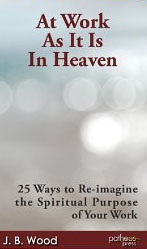 faithintheworkplace.com and Men of Integrity, and the Chicago Sun-Times (all previously under the pen name of “Bradley J. Moore”).
I first met Jim online, in articles he was writing for a faith and business website. I followed him to his blog, and then on to The High Calling. Recently I had the opportunity to talk with him about the book, where it came from, and this whole concept of finding the spiritual purpose in our daily work.
I’ve been seeing a few books on faith in the workplace, but not one quite like this — written from the perspective of someone “on the inside,” someone who works in corporate America and understands the pressures and realities of organizational work. What prompted you to write the book?
Several years ago, I was searching for material to help me as I struggled to integrate my career with a quest for greater spiritual purpose. The available “faith in the workplace” content was mostly disappointing, to say the least. It all seemed idealized, over-spiritualized, and over-sanitized. As a manager, there was nothing I could relate to that acknowledged some pretty basic career concerns, like ambition, competition, making money and establishing a career identity. All of these are real-life variables that get mixed into our adult working lives, yet it was like Christian “experts” were afraid to mention them for fear of coming off as unspiritual or something.
Since I couldn’t find anything, I started writing it myself. I covered every topic and issue I could think of as it related to the question of spiritual purpose in work and business. Writing was also a form of spiritual/career therapy, you might say. It actually helped me to resolve much of what I was struggling with. Before long I had dozens of essays and stories written and felt that surely I cannot be the only person who struggled with these issues. Perhaps this content could help others in similar life predicaments. We culled 25 of these essays for this project.
By the way, I did end up finding some fine resources in my discovery of The High Calling. And many great books on the subject have been written in the past few years.
Why is it that many Christians feel at sea in the workplace, and default to doing “what everyone else does”?
When we are at work, we are being paid to do a job, with usually a great deal of expectations for delivering results. We are also in a pool of various people and bosses and a corporate culture, and we have to navigate all of this while drawing upon our experience and skills. It’s not hard to see why survival can overwhelm any sense of spiritual purpose.
In the Introduction, you describe a program at church when people were asked what the purpose of work was. And the answer — the real answer — was a surprise. What was that, and why the discomfort?
The “real” answer is that the purpose of work is to glorify God. (Duh). The surprise came in the form of embarrassment, not just for me, but for my fellow church-members. How could we as Christians, many of us Christians from our earliest memories, not know deep in our hearts that the purpose of our work is to glorify God? We didn’t have a clue. It was pathetic.
And to think we devote such enormous energy and time during our adult years on this very thing – to develop a fulfilling career, to discover what we’re good at, how to earn a living, how to express our strengths and gifts. Yet, unless we are discussing “ministry,” there is a gaping disconnect among the majority of Christians in terms of considering how their work might make God happy.
Once I really grasped this concept, that my work could glorify God, it changed everything. I started sinking into my work and career as an inherent part of my spiritual journey, where God was going to teach me, use me, build his kingdom through me. Not through a “ministry” version of my work, mind you, but through my real, actual work itself. This was quite liberating. And exhilarating.
You speak of “compartmentalization” — how we wall our faith from our work as separate entities. Why do we do that, and what is the cost — the personal cost and the cost to the organization?
We do it because of this gaping disconnect that has emerged in the 20th-century White Evangelical Suburban culture that says God only wants us to be missionaries and ministers, and anything else is second-hand throw-away junk. That’s why we compartmentalize. Our work has never been really legitimized by the church. The personal cost is a schizo struggle, where we either feel guilty about building a career, or we feel like we are never truly pleasing God with the work we are doing, always sniffing around for something else to fulfill “God’s will for my life.”
The cost to the organization? Well, that is a profound question and is worthy of another book altogether.
Post by Glynn Young. Click here to continue reading the second half of the interview at Glynn’s blog, Faith, Fiction, Friends.
Next Post

May 23, 2015 Faithfully juggling flaming chain saws: 2 books on work-life balance
Browse Our Archives
Select a Category Book Reviews Curriculum Reviews Discipleship Information Interviews Movie Reviews New Book Resource Lists Theology of Work Uncategorized Videos
Select a Month March 2016 February 2016 January 2016 December 2015 November 2015 October 2015 September 2015 August 2015 July 2015 June 2015 May 2015 April 2015 March 2015 February 2015 January 2015 December 2014
Follow Us!
TAKE THE
Religious Wisdom Quiz
Who wrote the words on the tables of stone for the 10 Commandments?
Select your answer to see how you score.
God Moses Abraham Jesus
Related posts from Work Cited

"My passions feel at odds with each other":...

A big deal for the Kingdom of God:...

What are you up to and what are...

20 Great Books on Prayer (even the Washington...
TRENDING AT PATHEOS Careers, Workplace and Religion

St. Francis by Bill Droel Pope Leo XIV declares 2026 as “Year...

Catholics are schooled in the faith by memorizing dogmatic points and lots...

The Good News of Our Human Limitations -...
After another day of trying to meet deadlines and working on projects,...

Quiet Holy Attentiveness (podcast) with Sarah Clarkson
We know that quiet is an essential aspect of the spiritual life,...

Every Vocation Everywhere All At Once
What is a vocation? How does it endure through the years? Can...

I promise this is not going to become a Taylor Swift Studies...
view all Careers, Workplace and Religion blogs
Ad-Free & Subscriber Log-In Subscription Support
- About Us
- 2026 Calendar
- Videos
- Podcasts
- Library of World Religions
- Faith In Media Tracker
- Advertise With Us
- Write for Us
- Privacy Policy
- Terms of Service
- Do Not Sell My Data
- Contact Us
- Radiant Digital
- Manage Newsletter Subscriptions
- Unsubscribe From Notifications
- Sitemap
Copyright 2008-2026, Patheos. All rights reserved.
Subscription Support Ad-Free & Subscriber Log-In
Follow Patheos