
BuddhistCatholicContemplativeEvangelicalGeneral ChristianHinduJewishLatter-day SaintMuslimNew VisionsProgressive Christian
Beliefs
- Buddhist
- Catholic
- Contemplative
- Evangelical
- General Christian
- Hindu
- Jewish
- Latter-day Saint
- More Voices
- Muslim
- New Visions
- Pagan
- Progressive Christian
Topics
- Religion News
- Food and Religion
- Sports and Religion
- Religious Art
- Religious Music and Entertainment
- Religious Events
- History and Religion
- Style and Religion
- Politics and Religion
- Women in Religion
- Recreation Outdoors and Religion
- Business Finance and Religion
- Careers Workplace and Religion
- Education and Religion
- Family Parenting and Religion
- Health Fitness and Religion
- Home and Religion
- Relationships and Religion
- Technology and Religion
- Travel and Religion
Columnists
- Buddhist Columnists
- Business Finance and Religion Columnists
- Careers Workplace and Religion Columnists
- Catholic Columnists
- Contemplative Columnists
- Education and Religion Columnists
- Evangelists Columnists
- Family Parenting and Religion Columnists
- General Christian Columnists
- Health Fitness and Religion Columnists
- Hindu Columnists
- History and Religion Columnists
- Home and Religion Columnists
- Jewish Columnists
- More Voices Columnists
- Latter Day Columnists
- Muslim Columnists
- New Visions Columnists
- Nonreligious Columnists
- Pagan Columnists
- Politics and Religion Columnists
- Progressive Columnists
- Recreation Outdoors and Religion Columnists
- Relationships and Religion Columnists
- Religion News Columnists
- Religious Art Columnists
- Religious Events Columnists
- Religious Music and Entertainment Columnists
- Sports and Religion Columnists
- Style and Religion Columnists
- Technology and Religion Columnists
- Travel and Religion Columnists
- Women in Religion Columnists
Resource Library
- 2026 Calendar
- Library of World Religions
- The 100 Most Holy Places on Earth
- Patheos Answers
- Podcasts
- Videos
- Faith Leaders Database
- Anglican Episcopalian
- Bahai
- Baptist
- Buddhism
- Christianity
- Confucianism
- Eastern Orthodoxy
- Hinduism
- Holiness and Pentecostal
- ISKCON
- Islam
- Judaism
- Lutheran
- Methodist
- The Church of Jesus Christ of Latter-day Saints
- New Age
- Paganism
- Presbytarian and Reformed
- Protestantism
- Religion Behind the Scenes
- Roman Catholic
- Scientology
- Shia Islam
- Sikhism
- Sufism
- Sunni Islam
- Taoism
- Zen
- See all religions
Research Tools
 Ad-Free & Subscriber Log-In Subscription Support
Ad-Free & Subscriber Log-In Subscription Support
Follow Patheos 

- Trending:
- Forgiveness
- |
- Marriage
- |
- Consciousness
- |
- Death Penalty
- |
- Election
- |
- Halloween
 Work Cited
- Home
- Careers, Workplace and Religion
- 4 points on faith and work from Timothy Keller’s Every Good Endeavor
4 points on faith and work from Timothy Keller’s Every Good Endeavor
Last updated on: April 28, 2015 at 10:10 am by Guest Contributor
4 points on faith and work from Timothy Keller’s Every Good Endeavor 2015-04-27T16:50:41-05:00 Guest Contributor
Patheos Explore the world's faith through different perspectives on religion and spirituality! Patheos has the views of the prevalent religions and spiritualities of the world.
By Matt Perman
I’m going through Keller’s Every Good Endeavor again and taking some notes. Here are four central points from my 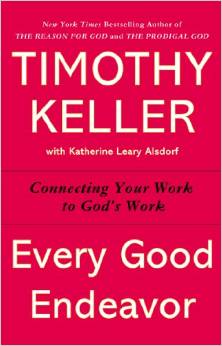 overall summary of the book (quotes are, interestingly, from the dust jacket — which for most books does a great job of highlighting the core points):
- A Christian view of work is “that we work to serve others, not ourselves.”
- We can indeed have “a thriving professional and balanced personal life.” This is a Christian goal, not just a worldly goal (though, due to suffering and the priorities of the gospel, sometimes it is not possible for some seasons – and that does not mean we are sinning or disobedient).
- Excellence, integrity, discipline, creativity, and passion in the workplace all matter and are to be done as acts of worship — not just self interest.
- We are able to — and called to — serve God through the secular arena as well as the ministry arena.
Why are these points so important, and why have I focused in on these? Here’s why.
Point four addresses the dichotomy between “sacred and secular” that robs work of meaning for so many people. It is life giving and liberating to realize that Christ can be served through the so-called secular tasks of reconciling bank statements or taking out the trash just as much as in ministry work.
Points two and three address issues which I find Christians sometimes disputing due to a some incorrect views of the fall, human nature, and God’s expectations of us. Because of the fact that we live in a fallen world, some Christians fall into the notion that we are to work only for a paycheck. Sometimes it is reasoned that life is so hard that the most you can expect out of your job is to provide for your financial needs. To seek meaning in work is just not possible or, at best, a nice bonus only available to a select fortunate few.
But that view treats us as merely economic beings. It is an overly reductionistic view of people. Since we are social, intellectual, and spiritual as well as economic, work needs to tap into those capacities as well. This is part of how God has designed work. The fact that the fall really screwed things up does not deny or remove this reality. It simply means that in each of these realms we will have hardship as well as success — not that we should reduce work to merely the economic dimension.
I would submit that one reason life does feel so hard sometimes, in fact, is because of employers who try to treat people as merely economic beings. If employers did a better job of managing to the whole person, quality of life for everyone would go up.
More could be said here, but the statement affirming the possibility of “a thriving professional life” affirms this reality (as does the rest of the book) that it is indeed possible to thrive in our work beyond just the economic side of things, and that it is good and right to seek this as Christians. So also creativity, passion, and excellence in our work are right, and in fact part of how we find meaning and purpose in our work, when done for the glory of God, because these things especially tap into our social, intellectual, and spiritual dimensions.
Finally, point one is the foundation of any truly Christian view of work. In the world, work is often viewed as something we do ultimately for ourselves. This often results in work that may benefit the company (in the short-term), but doesn’t really give the customer what they actually need (and want).
Of course, self-interest is not wrong in itself. But a Christian view of work is that we work for more than ourselves and even more than our families. We work for the good of everyone (cf. Jeremiah 29:7, which applies to us as Christians because we are in exile, 1 Peter 1:17) — especially the good of the customers our organization services.
This means that it is not enough to simply work in order to make the sale or get the paycheck. We have to work in such a way that people will truly be benefited. If doing our work in a certain way will earn the money, but not truly benefit the other person (perhaps by cutting corners on quality), we are not doing our work in a Christian way. Christians in the workplace should seek profit, but they should also seek more than profit.
If more people worked this way, the entire world would be a better place. And, perhaps, if we worked this way from distinctly Christian motives and were tactful and winsome about our faith, more people would ask us for the reason for the hope that is in us (1 Peter 3:15), and the gospel would spread more fully throughout our vocations (that’s the meaning of a close reading of Matthew 5:16 and Ephesians 5:8-17; for more on this in the Ephesians passage, see Peter T O’Brien’s commentary).
Reprinted from Matt Perman’s blog What’s Best Next. Check out many other wonderful resources at his blog!
Previous Post

April 24, 2015
Work is no vacation, right?
Next Post
May 1, 2015 12 books to help us become grown-up Christians
Browse Our Archives
Select a Category Book Reviews Curriculum Reviews Discipleship Information Interviews Movie Reviews New Book Resource Lists Theology of Work Uncategorized Videos
Select a Month March 2016 February 2016 January 2016 December 2015 November 2015 October 2015 September 2015 August 2015 July 2015 June 2015 May 2015 April 2015 March 2015 February 2015 January 2015 December 2014
Follow Us!
TAKE THE
Religious Wisdom Quiz
How many days did God take to create the world?
Select your answer to see how you score.
Ten Five Seven Six
Related posts from Work Cited


"My passions feel at odds with each other":...

A big deal for the Kingdom of God:...

What are you up to and what are...
TRENDING AT PATHEOS Careers, Workplace and Religion

St. Francis by Bill Droel Pope Leo XIV declares 2026 as “Year...

Catholics are schooled in the faith by memorizing dogmatic points and lots...

The Good News of Our Human Limitations -...
After another day of trying to meet deadlines and working on projects,...

Quiet Holy Attentiveness (podcast) with Sarah Clarkson
We know that quiet is an essential aspect of the spiritual life,...

Every Vocation Everywhere All At Once
What is a vocation? How does it endure through the years? Can...

I promise this is not going to become a Taylor Swift Studies...
view all Careers, Workplace and Religion blogs
Ad-Free & Subscriber Log-In Subscription Support
- About Us
- 2026 Calendar
- Videos
- Podcasts
- Library of World Religions
- Faith In Media Tracker
- Advertise With Us
- Write for Us
- Privacy Policy
- Terms of Service
- Do Not Sell My Data
- Contact Us
- Radiant Digital
- Manage Newsletter Subscriptions
- Unsubscribe From Notifications
- Sitemap
Copyright 2008-2026, Patheos. All rights reserved.
Subscription Support Ad-Free & Subscriber Log-In
Follow Patheos