
BuddhistCatholicContemplativeEvangelicalGeneral ChristianHinduJewishLatter-day SaintMuslimNew VisionsProgressive Christian
Beliefs
- Buddhist
- Catholic
- Contemplative
- Evangelical
- General Christian
- Hindu
- Jewish
- Latter-day Saint
- More Voices
- Muslim
- New Visions
- Pagan
- Progressive Christian
Topics
- Religion News
- Food and Religion
- Sports and Religion
- Religious Art
- Religious Music and Entertainment
- Religious Events
- History and Religion
- Style and Religion
- Politics and Religion
- Women in Religion
- Recreation Outdoors and Religion
- Business Finance and Religion
- Careers Workplace and Religion
- Education and Religion
- Family Parenting and Religion
- Health Fitness and Religion
- Home and Religion
- Relationships and Religion
- Technology and Religion
- Travel and Religion
Columnists
- Buddhist Columnists
- Business Finance and Religion Columnists
- Careers Workplace and Religion Columnists
- Catholic Columnists
- Contemplative Columnists
- Education and Religion Columnists
- Evangelists Columnists
- Family Parenting and Religion Columnists
- General Christian Columnists
- Health Fitness and Religion Columnists
- Hindu Columnists
- History and Religion Columnists
- Home and Religion Columnists
- Jewish Columnists
- More Voices Columnists
- Latter Day Columnists
- Muslim Columnists
- New Visions Columnists
- Nonreligious Columnists
- Pagan Columnists
- Politics and Religion Columnists
- Progressive Columnists
- Recreation Outdoors and Religion Columnists
- Relationships and Religion Columnists
- Religion News Columnists
- Religious Art Columnists
- Religious Events Columnists
- Religious Music and Entertainment Columnists
- Sports and Religion Columnists
- Style and Religion Columnists
- Technology and Religion Columnists
- Travel and Religion Columnists
- Women in Religion Columnists
Resource Library
- 2026 Calendar
- Library of World Religions
- The 100 Most Holy Places on Earth
- Patheos Answers
- Podcasts
- Videos
- Faith Leaders Database
- Anglican Episcopalian
- Bahai
- Baptist
- Buddhism
- Christianity
- Confucianism
- Eastern Orthodoxy
- Hinduism
- Holiness and Pentecostal
- ISKCON
- Islam
- Judaism
- Lutheran
- Methodist
- The Church of Jesus Christ of Latter-day Saints
- New Age
- Paganism
- Presbytarian and Reformed
- Protestantism
- Religion Behind the Scenes
- Roman Catholic
- Scientology
- Shia Islam
- Sikhism
- Sufism
- Sunni Islam
- Taoism
- Zen
- See all religions
Research Tools
 Ad-Free & Subscriber Log-In Subscription Support
Ad-Free & Subscriber Log-In Subscription Support
Follow Patheos 

- Trending:
- Forgiveness
- |
- Marriage
- |
- Consciousness
- |
- Death Penalty
- |
- Election
- |
- Halloween

- Home
- Pagan
- Foundations of Modern Witchcraft: Hermetic Philosophy
Foundations of Modern Witchcraft: Hermetic Philosophy
Last updated on: January 24, 2020 at 1:43 pm by Heron Michelle
Foundations of Modern Witchcraft: Hermetic Philosophy 2020-01-24T13:43:17-04:00 Heron Michelle
Patheos Explore the world's faith through different perspectives on religion and spirituality! Patheos has the views of the prevalent religions and spiritualities of the world.
Hermetic Philosophy forms the warp strings upon which the tapestry of Modern Witchcraft are woven; it is impossible to extract those threads without our entire magickal paradigm unraveling. Hermetic philosophy is a perennial wisdom, which describes the metaphysical mechanics of our divine cosmos.
- Does your witchcraft employ Astrology? Tarot? Qabala?
- Do you sense the spirits of crystals and plants? Use sympathetic magick?
- Do you use the alchemy of Essential Oils or Tinctures for healing?
- Do you use the “secret” of visualizations, affirmations, and “positive thinking” to achieve your goals?
- Do you work with the elements of Earth, Air, Fire and Water, and their elemental beings?
- These are all derived from the study of Hermetic Philosophy!
It all goes back to Hermes Trismegistus. Hermes “Thrice Greatest” is thought to have either been the Egyptian God Thoth himself, or an ancient sage and priest chosen by Thoth to receive a vision of the creation of the cosmos and then teach them to others. More on that (Here) These ideas, which originated in Egypt and Persia, grew into the applied spiritual sciences of Alchemy, Qabala, and Theurgy, which informed the occultism of the western world.

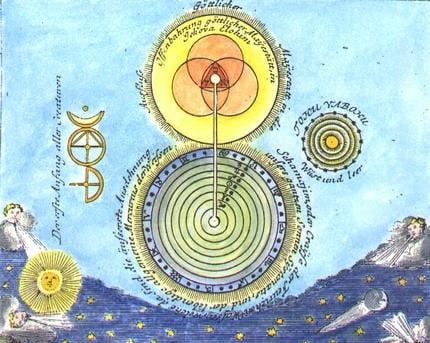
Unknown artist; uploaded, retouched and colored by Hugo Heikenwaelder, Austria; edited by Jaybear; [CC BY-SA (https://creativecommons.org/licenses/by-sa/4.0)]
In this Foundations of Modern Witchcraft series articles, I’ve shared what I learned on my quest to discover the answers to the question Who is Hermes Trismegistus? In this second article, I’ll discuss what Hermetic Philosophy teaches in a nutshell. In forthcoming articles, we’ll take a closer look at the cosmological story given to Hermes, then discover how these Egyptian philosophies found their way into British Wicca. Then we’ll take a side-road that diverged in 1908 America, and figure out where the “Seven Hermetic Principles” actually came from and what they teach us. We’ll conclude with a look at why Hermeticism is important to Modern Witchcraft today.
What does Hermetic Philosophy teach?
To recap: The teachings attributed to Hermes Trismegistus, which were written down during the late-classical period in Alexandria, Egypt, and survived the burning of the library there, are now gathered together as the Corpus Hermeticum. You may have heard of the Divine Pymander, The Book of Thoth, and the Emerald Tablet as coming from Hermes. Hundreds of other works have been attributed to his name throughout the centuries which fall into two categories: the Philosophical Hermetica, and Technical Hermetica, which came later. For this article, I’ll focus on what is included within the Corpus Hermeticum, the body of writings which founded the natural religious philosophy known as Hermetics.
The 18 tractates of Hermes’ teachings begin with the Pymander, a cosmological story, and are followed by dialogues with three students, Ammon, Asclepius and Tat. In those dialogues, Hermes discusses his vision and gnosis of the mechanics of the Divine Cosmos as governed by the seven wandering stars/gods/planets, and the means by which others may attain similar gnosis and a reunion with “god” throughout a process of reincarnation.
Hermeticism in Context
Within Hermetic philosophy, this concept which is so often referred to simply as “God” is entirely different from how that word is used by the Abrahamic religions [18]. Too often in this over-culture, “God” is used as a generic shorthand for their culturally specific deity, YVHV (Yahweh) and the mythologies attributed him. The discourse on “God” within Hermeticism began within a different culture, originating with an entirely different god (Tehuti, or Thoth). Despite the later inter-mingling of philosophies between Judaeo-Christian and Hermetic practitioners throughout the ages, there remains a stark contrast between the paradigm of Hermes Trismegistus and the paradigm of the Judaeo-Christian sacred texts.
Mind you, Hermetics developed simultaneously to Judaism (founded 2000-1700 BCE) and Christianity (founded 30 CE), and predates Islam (founded 610 CE). It is thought that the figure and legend of Hermes Trismegistus emerged in Egypt during the time of Pharoah Amun, which is 2100’s BCE, prior to Moses. All these philosophies grew up in parallel in the same region of the ancient, classical world. Later, they developed clandestinely while nested within those cultures, so their influences do co-mingle, and even merge in some places. However, the Hermetic concept of “god” is a pagan one, recognizing a multi-layered divinity within nature, which is radically inclusive of all cultural god-forms and -isms. So when reading the Hermetic texts, westerners should throw out all the biases to the word “god” we may have grown up with, and meet these translations with fresh neo-pagan eyes.
Public Domain
Tenets of Hermetic Philosophy in a Nutshell
The texts of Hermes Trismegistus were written in Greek, by Egyptians trained in the Greek philosophical schools. The Greek word used for this largest concept of divinity, The Source, or The ALL, is Nous. I’ve read several versions, and seen ‘Nous’ translated as the Divine Mind, Supreme Mind, Glory of the Sovereign Mind, and Highest Intelligence. In the next installment of this series, we’ll dive into the cosmology known as the Divine Pymander. First, let’s hit the bullet points of modern Hermetic teachings. I’ve pulled inspiration for these points from my own readings of the Corpus Hermeticum and various synopses, and the website for the Hermetic Fellowship [18.]
Poetic: Hermeticism is a poetic paradigm, not a literal or aesthetic one.
Divine Mind: The original Divine Source (Nous) is Mental in nature. Everything within the cosmos is a thought, a dream, an emanation within the Divine Mind.
Speech: The greatest gifts bestowed upon humanity are Speech and Divine Thought. The cosmos was created by Divine Mind speaking the Word (reason) into existence. All beings who think, and who have the powers of speech, are co-creators within the Divine Mind. Hence, magick spells.
Panentheism: The Divine is both immanent within nature and transcendent. This -ism contains polytheism, as it recognizes a multiplicity of divine emanations with all cultural faces and names of the gods. However, it is also considered by some to be ultimately monotheistic; Hermeticism views the Universe is multiform and diverse, yet unified within One Source.
Immortality: Divine Mind remains inherently within all of creation, therefore everything and everyone in the cosmos is the body of “god” and has an immortal spirit. Everything and everyone has both an individual consciousness, as well as being part of the collective consciousness of Divine Mind. This includes the realms of plant, stone and bone. Everything has a spark of divine consciousness which is immortal. The science of Alchemy based in this truth resulted in the extraction of the essential oils and tinctures from plants…to refine their “spirit” for use in medicine and magick.
Reincarnation: Change is a universal constant, but nothing ever perishes or is destroyed. Both life and death are merely perceptions, trading forms within Divine Mind. The ultimate goal of Hermetic practice is to eventually evolve beyond the need for body, and cease the cycles of reincarnation, to remain within Divine Mind. To do so we need only remember that we are also Divine beings, shifting our perceptions. This evolution is generally believed to take many, many lifetimes.
Benevolence: The Essence of the Divine Mind is made up of Supreme Good, bliss, beauty and wisdom, and thus the universe also has a basically benevolent nature, and all beings within it.
Gender Inclusive: The Divine Source is specifically stated as containing all genders, division into biological sexes being the last result of material creation solely for the purpose of procreation. The cosmological poetry establishes a range of gender in balance, with all matter containing a unique blending of feminine and masculine divinity.
Three-World Model: Hermes presented a “Three World Model” of the Cosmos: These are the Mental Plane, the Spiritual Plane, and the Physical Plane. The cosmos is manifold, composed of multiple layers within these three worlds: our elements of earth, air, fire and water of the physical world, our minds and thoughts of the mental plane, and our soul, spirit, emotions of the spiritual plane. Humans can access the non-physical realms through technique and aspiration; using methods from theurgy, meditation, ritual, and other religious and magickal practices.
As above, so below: All things in the material Universe, including ourselves, have a dual nature which is both spiritual and material. Because of the mirrored interconnection between ‘above’ and ‘below,’ what happens on a spiritual level has consequences in the material. Conversely, what happens in the material can have consequences in the spiritual. They remain in equilibrium.
Unity: There is unity within the Cosmos, with sympathy and interconnection between all things, both physical and spiritual. It is all alive within the Divine Mind. Separateness is the illusion created by the material world. But we may discover and utilize the occult unity behind the apparent diversity of the material world. Hermetic Qabalah is one model, which forms the foundation of Tarot symbolism.
Syncretism: Modern Hermeticism is eclectic and syncretic, drawing from the ancient pagan mystery religions, Qabalah, Alchemy, Rosicrucian and Gnostic traditions, and other types of esoteric Christianity, Theurgy, Wicca and Neo-Paganism, the Grail Quest, etc. Spiritual paradox is considered a Mystery to be understood, not denied.
Orthopraxy: Hermeticism encourages spiritual curiosity through diverse study of texts, and learning from wise teachers, but is ultimately about the praxis of genuine, personal Spiritual engagement. “Belief” is not the point, Hermeticism encourages participation in ritual, meditation, religious devotions of one’s choice, and the practice of magick, so that we experience Divinity first hand.
Free-Will: If humans are to attain this reunification, we must aspire to that divinity; we must apply the fires of our Free Will intentionally; spiritual growth cannot be achieved without making an effort, and engaging in spiritual practices.

Wikimedia Commons: The scheme of the division of spheres. · The empyrean (fiery) heaven, dwelling of God and of all the selected · 10 Tenth heaven, first cause · 9 Ninth heaven, crystalline · 8 Eighth heaven of the firmament · 7 Heaven of Saturn · 6 Jupiter · 5 Mars · 4 Sun · 3 Venus · 2 Mercury · 1 Moon
Natural Religion: Hermeticism seeks Divinity by connecting through the cycles of Nature. Nature is the great “Revealer of Mysteries.” Nature is the vessel of Divine Love, the source of Divine Power, and evolves through the curiosity of the Divine Mind. Humans are entrusted to care for that vessel as priests and priestesses of Nature. We do so by celebrating the rhythms of the sun through our yearly seasons, the monthly tides of the Moon. We attune to these cycles according to the movements of the Planets within the mechanism of our solar system, in relation to our place within our galaxy, and the cosmos beyond. Within the mysteries of birth, death, and rebirth on all levels of reality, we unveil Divinity. [17]
Destiny: All within the manifest world is governed by the Divine Order ruled by the seven classical planets. In the ancient world, those were considered to be the gods for which they are named. These gods/stars/planets reveal the mechanics of destiny which governs all manifest beings. As Divinity descends through the 7 celestial spheres to become material, their destiny and personality are determined by that celestial mechanism, like being cast through a mold into a particular form of being. This model establishes the science of Astrology, which organizes the systems of Qabala, Tarot and sympathetic correspondences in magickal practices.
Salvation: There is no hint of a “savior” within Hermetics. We must save ourselves from the challenges of incarnation, and the dictates of our destiny, by continually learning and improving ourselves. The mercies that are granted through Reason will be our salvation from the rigors of physical existance. Those mercies are: knowledge of the Divine Mind, joy, self-control, stead-fastness, justice, generosity, truth, supreme good, life and light. [11]
Challenges: The pitfalls that will impede our reunification with Divine Mind are our “tormentors” that arise from a lack of Reason. They are listed as: ignorance, sorrow, intemperance, lust, injustice, greed, deceit, envy, treachery, anger, recklessness and malice. [12]
Balance: Creating equilibrium between all polarities is pivotal to spiritual work; Balance and integration are the keys to growth, not denial. We must integrate both light and shadow, for example. Instead of rejecting the material (any aspect of polarity) to achieve a spiritual re-connection, the goal of Hermetics is to embrace the material in healthy balance within our many aspects of self: physical, mental, emotional, will, and spiritual.
The Great Work of humankind is a spiritual journey of evolution toward a reunification with the Divine Source. We were sent to the physical realm to learn and grow through diverse manifestation, so that when we return to our Spiritual Source, we add a complex wisdom of what it means to exist. This process of intentionally evolving in awareness of our manifest divinity, toward eventual reunification of all human-kind, is called The Great Work.
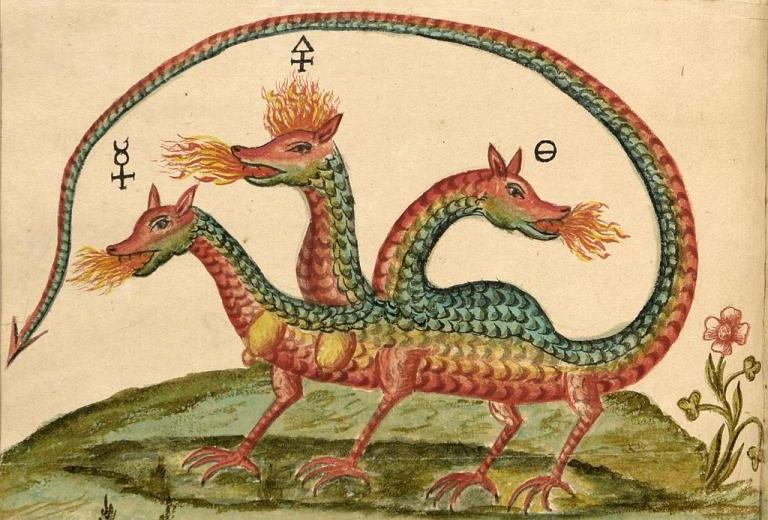
https://commons.wikimedia.org/wiki/File:ClavisArtis.Ms-2-27.Hortis.V3.034.jpg

The Moral of the Story
When I read the Corpus Hermeticum, I see clearly the foundations for a nature-based spirituality which exalts wisdom through our divine unity, power, and personal sovereignty. It offers a structure through which we may strive to improve ourselves without shame, or fear of cosmic retribution extorting us to be decent humans. I see radical inclusivity and a call to balance and equality, harmony and enjoyment of all beings within our interconnected world – all people, all animals, our environments, and all the various plants and minerals within it. Hermeticism provides the mechanics of that Divine Cosmos which reveals magick to not only be possible, but also ubiquitous, self-evident, and the birthright of every sentient being.
Hermetic philosophies shine clearly throughout all the books on Wicca and Witchcraft that I’ve read over the years, even if they didn’t announce their sources. Basically, the tenets of Hermeticism, and the syncretic blending of ancient pagan religion and science from Egypt, Greece, Rome, Persia and the Middle-East are as much the cultural heritage of Wicca and Witchcraft, as those found in the indigenous paganism of Western Europe. By understanding where our ideas come from, we can deepen and authenticate our “Modern” Witchcraft even further, while tearing down walls that attempt to divide us, and turn us against each other. We are all ONE.
Continue on to the next installment in this series on Hermetic foundations of Modern Witchcraft, we’ll explore the cosmological story found in the Pymander, which is the first book of the Corpus Hermeticum. Spoiler alert: thar be dragons!
~Heron
References for this series
[1] The Kybalion 100th Anniversary Ed. Introduced and Edited by Philip Deslippe
[2] Barlett, Robert Allen. Real Alchemy. Page 12-13
[3] Ebeling, Florian. The Secret History of Hermes Trismegistus: Hermeticism from Ancient to Modern Times. Ithaca and London, Cornell University Press, 2007. Page 3.
[4] Scott, Sir Walter. Hermetica: The ancient Greek and Latin Writings Which Contain Religious or Philosophic Teachings ascribed to Hermes Trismegistus, Edited with English Translation and Notes. Boston: Shambala Press, 1993. page 3
[5] Scott, Sir Walter. Hermetica. page 4
[6] Hall, Manly P. The Secret Teachings of all Ages. XXXVII-XL
[7] Scott, Sir Walter. Hermetica. Page 6.
[8] Ebeling, Florian. The Secret History of Hermes Trismegistus. Page 9
[9] This is also how we came to have the First Harry Potter novel, thank you JK Rowling for having studied the classics.
[10] Hall, Manly P. The Secret Teachings of All Ages, XXXVII-XL
[11] Corpus Hermeticum Book 13:8.
[12] Corpus Hermeticum Book 13:7
[13]The Way of Hermes. Corpus Hermeticum, Book 1:4 Page 17
[14] The Way of Hermes. Corpus Hermeticum, Book 1:11 Page 19
[15]The Way of Hermes. Corpus Hermeticum, Book 1:14 Page 20
[16]The Way of Hermes. Corpus Hermeticum, Book 1:16
[17] Hermetic Fellowship Website: http://www.hermeticfellowship.org, M. Isidora Forrest & Adam P. Forrest. 1998 Accessed Jan 12, 2020.
[18] For ease of communication, I use the term “Abrahamic” to refer to the family of middle-eastern monotheistic orthodoxies which are founded upon the history and paradigm begun by their common patriarch, Abraham, and focused on his patron deity, YVHV. Today they are known as Judaism, Christianity, and Islam (among many other iterations).

About Heron Michelle
Heron Michelle is a witch, high priestess, mom, artist and shopkeeper living in Greenville, North Carolina. Connect with her on Facebook: Witch on Fire, and follow her on Twitter @HeronMichelle13. You can read more about the author here.
Previous Post

January 2, 2020
2020 has 13 Full Moons but None are "Blue"
Next Post
January 22, 2020 Foundations of Modern Witchcraft: Hermetic Cosmology
Browse Our Archives
Select a Category Arts, Crafts & Cooking Business Cermony and Liturgy Columns Comedy Community Death Elemental Witchcraft Health and Wellness Holidays Interfaith Life Love, Sex & Relationships Magic or Magick Nature Politics Prayers, Poems, Blessings & Stories Recipes Rites of Passage Ritual and Practice Science and Research Shopkeeper Saga Technology Theology, Ethics, Philosophy Uncategorized Witch on Fire
Select a Month October 2026 September 2026 July 2026 June 2026 May 2026 March 2026 February 2026 January 2026 November 2025 September 2025 August 2025 May 2025 November 2024 September 2024 August 2024 March 2024 February 2024 December 2023 September 2023 August 2023 May 2023 February 2023 October 2022 September 2022 August 2022 April 2022 March 2022 December 2021 November 2021 September 2021 August 2021 July 2021 May 2021 April 2021 March 2021 February 2021 December 2020 October 2020 September 2020 August 2020 July 2020 May 2020 April 2020 March 2020 February 2020 January 2020 December 2019 November 2019 October 2019 September 2019 August 2019 July 2019 June 2019 May 2019 April 2019 March 2019 February 2019 January 2019 December 2018 November 2018 October 2018 September 2018 August 2018 July 2018 June 2018 May 2018 April 2018 March 2018 February 2018 January 2018 December 2017 November 2017 October 2017 September 2017 August 2017 July 2017 June 2017 May 2017 April 2017 March 2017 February 2017 January 2017 December 2016 November 2016 October 2016 September 2016 August 2016 July 2016 June 2016 May 2016 April 2016 March 2016 February 2016 January 2016 December 2015 November 2015 October 2015 August 2015 July 2015
Follow Us!
TAKE THE
Religious Wisdom Quiz
What Jewish festival celebrates deliverance from Egypt?
Select your answer to see how you score.
Passover Tabernacles Purim Pentecost
Related posts from Witch on Fire
Medusa Magick for Sexual Sovereignty
A Witch Honors Dolly Parton among the Mighty...
2027 Witch's Wheel of the Year Calendar
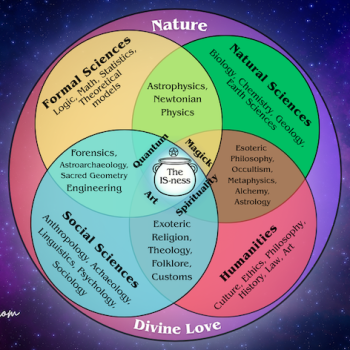
Restoring the Watershed of Divine Love
TRENDING AT PATHEOS Pagan

In "Irreplaceable," our book on vocation and technology, Trevor Sutton and I...

I was strolling through the top floor of the brand new Parthenon...

What Does Gêvâh Mean For Kimberley Guifoyle &...
This week, a lot of the news is focused on Kimberly Guilfoyle....

INNER CIRCLE: Profound Mystery (Of Christ In All...
Ephesians 5:31-32 “For this reason, a man will leave his father and...

Do Not Rejoice When Your Enemy Falls: The...
Turning an execution into a public spectacle is a disturbing expression of...

'The Chosen' S6 Trailer: The Passion Gets Very...
Not many watching 'The Chosen' worry about spoilers, but just because they...
view all Pagan blogs
Ad-Free & Subscriber Log-In Subscription Support
- About Us
- 2026 Calendar
- Videos
- Podcasts
- Library of World Religions
- Faith In Media Tracker
- Advertise With Us
- Write for Us
- Privacy Policy
- Terms of Service
- Do Not Sell My Data
- Contact Us
- Radiant Digital
- Manage Newsletter Subscriptions
- Unsubscribe From Notifications
- Sitemap
Copyright 2008-2026, Patheos. All rights reserved.
Subscription Support Ad-Free & Subscriber Log-In
Follow Patheos