
BuddhistCatholicContemplativeEvangelicalGeneral ChristianHinduJewishLatter-day SaintMuslimNew VisionsProgressive Christian
Beliefs
- Buddhist
- Catholic
- Contemplative
- Evangelical
- General Christian
- Hindu
- Jewish
- Latter-day Saint
- More Voices
- Muslim
- New Visions
- Pagan
- Progressive Christian
Topics
- Religion News
- Food and Religion
- Sports and Religion
- Religious Art
- Religious Music and Entertainment
- Religious Events
- History and Religion
- Style and Religion
- Politics and Religion
- Women in Religion
- Recreation Outdoors and Religion
- Business Finance and Religion
- Careers Workplace and Religion
- Education and Religion
- Family Parenting and Religion
- Health Fitness and Religion
- Home and Religion
- Relationships and Religion
- Technology and Religion
- Travel and Religion
Columnists
- Buddhist Columnists
- Business Finance and Religion Columnists
- Careers Workplace and Religion Columnists
- Catholic Columnists
- Contemplative Columnists
- Education and Religion Columnists
- Evangelists Columnists
- Family Parenting and Religion Columnists
- General Christian Columnists
- Health Fitness and Religion Columnists
- Hindu Columnists
- History and Religion Columnists
- Home and Religion Columnists
- Jewish Columnists
- More Voices Columnists
- Latter Day Columnists
- Muslim Columnists
- New Visions Columnists
- Nonreligious Columnists
- Pagan Columnists
- Politics and Religion Columnists
- Progressive Columnists
- Recreation Outdoors and Religion Columnists
- Relationships and Religion Columnists
- Religion News Columnists
- Religious Art Columnists
- Religious Events Columnists
- Religious Music and Entertainment Columnists
- Sports and Religion Columnists
- Style and Religion Columnists
- Technology and Religion Columnists
- Travel and Religion Columnists
- Women in Religion Columnists
Resource Library
- 2026 Calendar
- Library of World Religions
- The 100 Most Holy Places on Earth
- Patheos Answers
- Podcasts
- Videos
- Faith Leaders Database
- Anglican Episcopalian
- Bahai
- Baptist
- Buddhism
- Christianity
- Confucianism
- Eastern Orthodoxy
- Hinduism
- Holiness and Pentecostal
- ISKCON
- Islam
- Judaism
- Lutheran
- Methodist
- The Church of Jesus Christ of Latter-day Saints
- New Age
- Paganism
- Presbytarian and Reformed
- Protestantism
- Religion Behind the Scenes
- Roman Catholic
- Scientology
- Shia Islam
- Sikhism
- Sufism
- Sunni Islam
- Taoism
- Zen
- See all religions
Research Tools
 Ad-Free & Subscriber Log-In Subscription Support
Ad-Free & Subscriber Log-In Subscription Support
Follow Patheos 

- Trending:
- Forgiveness
- |
- Marriage
- |
- Consciousness
- |
- Death Penalty
- |
- Election
- |
- Halloween

- Home
- Pagan
- Foundations of Modern Witchcraft: Hermes Trismegistus
Foundations of Modern Witchcraft: Hermes Trismegistus
Last updated on: July 11, 2022 at 3:30 pm by Heron Michelle
Foundations of Modern Witchcraft: Hermes Trismegistus 2022-07-11T15:30:24-04:00 Heron Michelle
Patheos Explore the world's faith through different perspectives on religion and spirituality! Patheos has the views of the prevalent religions and spiritualities of the world.
Among witches, the name Hermes Trismegistus should be equally recognizable to us as the names of Jesus, Moses, Buddha, or Muhammad. In our modern texts, this name is often cited as the source of the “Hermetic Principles,” but rarely with adequate historical context, and so these origins remain significantly misunderstood.
In these Foundations of Modern Witchcraft articles, I will share what I learned on my quest to discover the answers to the following questions: Who is this fellow Hermes Trismegistus? What does Hermetic Philosophy teach? How does that cosmology include both the Goddess and the God? Where do the “Seven Hermetic Principles” actually come from? How did this Egyptian philosophy find its way into British Wicca? and why is that important to Modern Witchcraft today?
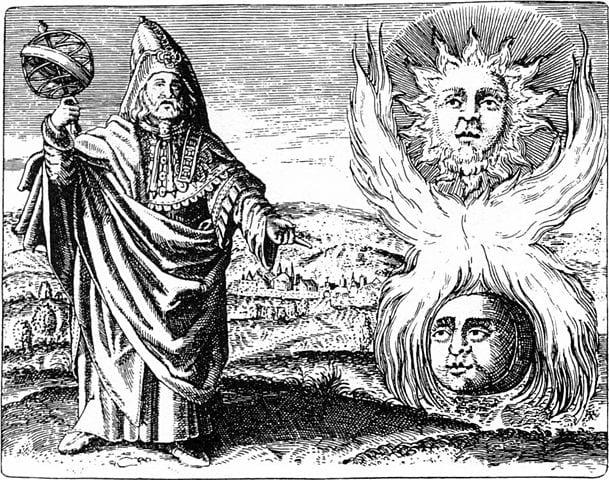
Hermes Trismegistus from Public Domain, Wikimedia Commons. D. Stolcius von Stolcenbeerg: Viridarium chymicum, 1624
Who is this fellow Hermes Mercurius Trismegistus?
Surprise, surprise! Like many of the world’s legendary religious figures, Hermes Mercurius Trismegistus likely never physically existed.[3] This is the Greek name for the Egyptian whom legends claim was either the god Thoth himself, or merely an ancient sage who received a vision from the Ibis-headed God of knowledge, magic and writing. This name translates as “thrice-greatest Hermes.” Thrice Great was a common Egyptian epithet for Thoth at the time. Philosophers in Alexandria, being both Egyptian by heritage, and educated in Greek philosophy, conflated Thoth with the Greek God Hermes, or by his Roman name, Mercury.
Hermes Trismegistus is credited as the source of a collection of 18 texts, or tractates, which together make up a body of work known as the Corpus Hermeticum. These are the foundational teachings of a philosophy known as Hermeticism. To put this in context to the over-culture, this “book” is not unlike the ancient scriptures of the Torah, Bible, or Koran, and are of a relatively similar age.
Who this figure truly was, may never be known. What seems clear is that the writings ascribed to Hermes emerged from many individual teachers in Roman-ruled Alexandria Egypt during the first few centuries of the common era. Here, philosophers instructed in natural Greek Philosophies such as Platonism and Stoicism sought to dismiss the old dogmatic and orthodox interpretations of Greece, and seek “god” through their own philosophic religion. The short story is that Hermeticism is an example of a syncretic, second-generation pagan religion. An apt comparison is to the way that Buddhism diverges from a basis in Hindu polytheism, in the same way that Hermeticism diverges from a basis in the classical Hellenic/Egyptian polytheism. In both examples, the focus shifts to the philosophy and practices of personal improvement, rather than the worship and religiosity of a particular deity; both revere the human teacher of that Gnosis of “God”, without defaulting to a worship of that teacher.
In the introduction of his translation entitled Hermetica, Sir Walter Scott suggests that during the first three centuries CE in Alexandria, the writers of the tractates would have described Hermes Trismegistus as “…a man like you and me – a man who lived in Egypt…during the time of King Ammon. But he was a man who attained gnosis (that is to say knowledge of God, but a kind of “knowledge” that involved union with God); and he was the first and greatest teacher of gnosis. He died…and after death he became a god – just as you and I also, if we attain to gnosis, will become gods after our deaths.”[7]
In The Secret History of Hermes Trismegistus, Florian Ebeling described the many philosophical influences of Hermeticism as such:
“Both the figure and writings of Hermes Trismegistus were the product of the syncretic, Hellenistic philosophy of nature, which itself was a conglomeration of Aristotelian, Platonic, Stoic, and Pythagorean doctrines, interspersed with motifs from Egyptian mythology, and theme of Jewish and Iranian origin.”[8]
Who actually wrote the Corpus Hermeticum?
All the tractates within the Corpus Hermeticum by various writers simply chose to credit Hermes Trismegistus as the author of their own writings, to lend credibility and prestige that they would have never received under their own names. This was a common practice during that time. Scott does suggest in his introduction to Hermetica, that is was likely that the original authors did not intend to deceive, because everyone in their circle understood this common practice. However, after those writings left their inner circles, and time wore on, this truth was lost.
The individual Egyptian teachers in Alexandria taught orally to a few students at a time, who may eventually write down the gist of the talks, which would be passed around among similar groups. The tractates of the Corpus Hermeticum were written by many different pupils, studying with many different teachers of the time. So why are they all written as if from the point of view of Hermes Trismegistus? Why not use their own names? Sir Walter Scott answers this question in Hermetica:
“It is true that there was at the same time a strong tendency to syncretism; that is to say, men of different philosophic schools were very ready to borrow thoughts from one another; but that, the most part, meant little more than that a man acknowledged the authority of two or more masters instead of one, and made some attempt to blend or reconciled the teachings of those masters. The names of the great thinkers of earlier times – Plato, Pythagoras, and others – were held in almost superstitious veneration…it hardly occurred to people that anyone could possibly hit on a truth by thinking for himself.” [4]
So their adherents kept seeking earlier sources from where the Masters must have received their wisdom. To the philosophers in Egypt influenced by Greek Culture, their preferred assumption of that source was the mythological figure of Hermes Trismegistus. Scott goes on to say, “It had long been accepted as a known historical fact that both Plato and Pythagorus studied in Egypt. So they assumed they must have studied in the schools of Egyptian Priests.”[5] No one knew for sure what was taught in those mystery schools, except that they were said to have ancient texts written by the God Thoth.
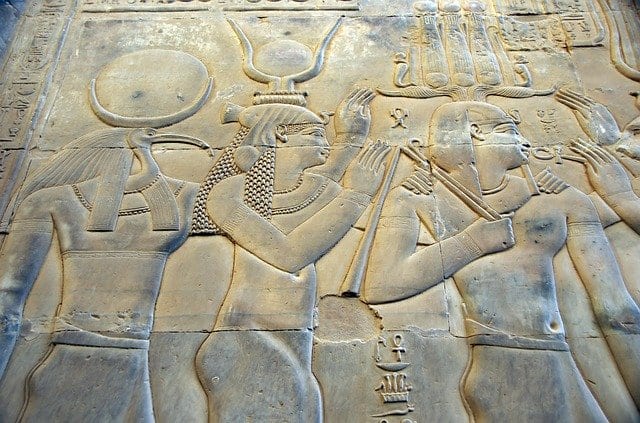
Image by Albert Dezetter from Pixabay
Origins and Development of Hermetic Philosophy
Hermetic Philosophy began developing when Alexander the Great invaded Egypt in 332 BCE, bringing Greek culture and religion with him. He built the name-sake city of Alexandria, where the great library stood. Here the Greek philosophical schools mingled with the robust Egyptian culture and created a renowned center of learning. Here, intellectuals from all over the ancient world came together in debate.
After Rome conquered Egypt in 30 BCE, Hermetic philosophy developed in Alexandria over the first three centuries of the common era. This coincides with the introduction and development of early Christianity. At first, Roman rulers were tolerant of a pluralistic society. Unfortunately, the brutal spread of Christianity eventually led to clashes with pagans; “pagans” being the latin word used to refer to everyone still practicing their indigenous, or Non-Abrahamic religions. The intolerance of those early Christians in Alexandria resulted in terrible violence and a partial burning of the Alexandrian library.
The Roman Empire officially Christianized in 325 CE, and the rest of the Library of Alexandria was burned to the ground. Many books attributed to Hermes Trismegistus are known to have been destroyed in that fire. By then, heresy against the Christian doctrine meant a death sentence. You could convert or die, so many of the Hermetic Philosophers chose instead to migrate east into pre-Islamic Persia (modern-day Iran and Iraq) where they guardedly continued their studies.
Hermetic Alchemy Emerges
These foundational philosophies were furthered within the influences of the Arab world. Here the occult arts and sciences of Astrology, Alchemy, Qabala/Kabbalah, Tarot and Ceremonial Magick all evolved into being over the centuries. Interestingly, the word “alchemy” was formed due to the Greek word for Egypt being Khem, or Khemet, which meant “The Black Land.” This described the dark, fertile soil left by the flooding of the Nile. Knowledge of the Egyptian sciences were called Khemia, or The Black Art, by the Greeks. After the Egyptian Hermeticists migrated into Persia, the Arabic prefix Al- (the) was added in front of Khemia. In this case, the word Al-khemia came to be roughly translated as “The Black Arts of Egypt.” Later the spelling shifted to what we know now as Alchemy.[2]
There are hints that a few early Hermeticists and alchemists may have traveled into Europe prior to the fall of Rome, in 476 CE. Unfortunately, after the Dark Ages of Christianity descended in Europe, any scientific pursuits there came to an abrupt halt for several centuries. It wouldn’t be until around 800 CE that alchemy would return to western Europe with the entry of Islamic populations.
Later, thanks to the D’Medici family in 15th Century Italy, the Hermetic Texts re-emerged and were translated into Latin, making them widely available and very popular. Though, at the time, the origins of the text were largely misunderstood to have been somehow related to Moses, and thus of Hebrew origin; this turned out to be absolutely wrong. However, for a time the study of Hermetic Alchemy became more socially acceptable by Christian scholars such as Sir Isaac Newton. We’ll discuss that further history in a forthcoming article.

Joseph Wright Alchemist – Public Domain Wikimedia Commons
The Moral of the Story
By now, the person-hood of Hermes Trismegistus is largely unimportant. Unlike our literalist neighbors in the Judeo-Christian over-culture, occultist do not need the originator of our Hermetic philosophies to have been a literal, living, divinely-chosen person. Nor do we necessarily need for these notions to have been from the specific Egyptian God, Thoth. Yet, understanding how and where these notions originated is absolutely necessary to keep us from falling into the pitfalls of empty religiosity and veneration of a “man” or a “god,” rather than the relevant ideas we may pluck from their stories and put to benefit in our modern lives.
A primary teaching of Hermetics is that we are all incarnations of the Divine Mind, and therefore have a divine nature; we only need to remember our divinity, and apply reason, so that we may grow in wisdom and evolve in our power. If this is true, then every person along the chain that developed Hermetics… everyone who contemplated, challenged, tested, and wrote down their insights to be shared with others… from the mists of pre-historic guesses that the ancients conveniently named “Hermes Trismegistus,” to the robustly codified philosophies that continue to be useful today… each voice made a divine contribution.
It doesn’t really matter which nation these mages came from, which gods they venerated, or what they called their personal religion. What does matter is that they’ve hailed from all over classical civilization, and syncretized their cultural contributions, and therefore this heritage may be enjoyed by everyone. Hermetics informs our collective magickal culture.
The Is-ness of the Divine Cosmos wants to be understood; it burbles up through the dreams and intuitions of evolved minds everywhere. Labels and “religion” matter not. Witches can proudly continue those contributions within our own Great Work of Magick, and with our own preferred metaphors, tools and rituals. We can further refine the application of this philosophy into a healthy magickal and spiritual practice for our modern world.
Continue reading the next article in this series exploring Hermetic Philosophy, the history of how they found their way from ancient Egypt into modern occultism, and the relevance to Modern Witchcraft practices today!
References for this Series:
[1] The Kybalion 100th Anniversary Ed. Introduced and Edited by Philip Deslippe
[2] Barlett, Robert Allen. Real Alchemy. Page 12-13
[3] Ebeling, Florian. The Secret History of Hermes Trismegistus: Hermeticism from Ancient to Modern Times. Ithaca and London, Cornell University Press, 2007. Page 3.
[4] Scott, Sir Walter. Hermetica: The ancient Greek and Latin Writings Which Contain Religious or Philosophic Teachings ascribed to Hermes Trismegistus, Edited with English Translation and Notes. Boston: Shambala Press, 1993. page 3
[5] Scott, Sir Walter. Hermetica. page 4
[6] Hall, Manly P. The Secret Teachings of all Ages. XXXVII-XL
[7] Scott, Sir Walter. Hermetica. Page 6.
[8] Ebeling, Florian. The Secret History of Hermes Trismegistus. Page 9
[9] This is also how we came to have the First Harry Potter novel, thank you JK Rowling for having studied the classics.
[10] Hall, Manly P. The Secret Teachings of All Ages, XXXVII-XL
[11] Corpus Hermeticum Book 13:8.
[12] Corpus Hermeticum Book 13:7

About Heron Michelle
Heron Michelle is a witch, high priestess, mom, artist and shopkeeper living in Greenville, North Carolina. Connect with her on Facebook: Witch on Fire, and follow her on Twitter @HeronMichelle13. You can read more about the author here.

Next Post

January 2, 2020 2020 has 13 Full Moons but None are "Blue"
Browse Our Archives
Select a Category Arts, Crafts & Cooking Business Cermony and Liturgy Columns Comedy Community Death Elemental Witchcraft Health and Wellness Holidays Interfaith Life Love, Sex & Relationships Magic or Magick Nature Politics Prayers, Poems, Blessings & Stories Recipes Rites of Passage Ritual and Practice Science and Research Shopkeeper Saga Technology Theology, Ethics, Philosophy Uncategorized Witch on Fire
Select a Month October 2026 September 2026 July 2026 June 2026 May 2026 March 2026 February 2026 January 2026 November 2025 September 2025 August 2025 May 2025 November 2024 September 2024 August 2024 March 2024 February 2024 December 2023 September 2023 August 2023 May 2023 February 2023 October 2022 September 2022 August 2022 April 2022 March 2022 December 2021 November 2021 September 2021 August 2021 July 2021 May 2021 April 2021 March 2021 February 2021 December 2020 October 2020 September 2020 August 2020 July 2020 May 2020 April 2020 March 2020 February 2020 January 2020 December 2019 November 2019 October 2019 September 2019 August 2019 July 2019 June 2019 May 2019 April 2019 March 2019 February 2019 January 2019 December 2018 November 2018 October 2018 September 2018 August 2018 July 2018 June 2018 May 2018 April 2018 March 2018 February 2018 January 2018 December 2017 November 2017 October 2017 September 2017 August 2017 July 2017 June 2017 May 2017 April 2017 March 2017 February 2017 January 2017 December 2016 November 2016 October 2016 September 2016 August 2016 July 2016 June 2016 May 2016 April 2016 March 2016 February 2016 January 2016 December 2015 November 2015 October 2015 August 2015 July 2015
Follow Us!
TAKE THE
Religious Wisdom Quiz
Who said, "He who is without sin among you, let him throw the first stone"?
Select your answer to see how you score.
Paul Peter Jesus James
Related posts from Witch on Fire
Medusa Magick for Sexual Sovereignty

A Witch Honors Dolly Parton among the Mighty...
2027 Witch's Wheel of the Year Calendar
Restoring the Watershed of Divine Love
TRENDING AT PATHEOS Pagan

The Sermon on the Mount, Part I: Matthew...
The Sermon on the Mount, Part I (Matthew 4:12-5:12) St. Matthew moves...

What's up from Crossway: Reviewing some of their latest A few weeks...

Janie Learns the Way of the Cross: A...
Teaching children about Jesus' Passion can be challenging. Many parents and educators...

Looking For Good Catholic Writing - October 2026
He alone extends the heavens, and he walks upon the waves of...

In "Irreplaceable," our book on vocation and technology, Trevor Sutton and I...

I was strolling through the top floor of the brand new Parthenon...
view all Pagan blogs
Ad-Free & Subscriber Log-In Subscription Support
- About Us
- 2026 Calendar
- Videos
- Podcasts
- Library of World Religions
- Faith In Media Tracker
- Advertise With Us
- Write for Us
- Privacy Policy
- Terms of Service
- Do Not Sell My Data
- Contact Us
- Radiant Digital
- Manage Newsletter Subscriptions
- Unsubscribe From Notifications
- Sitemap
Copyright 2008-2026, Patheos. All rights reserved.
Subscription Support Ad-Free & Subscriber Log-In
Follow Patheos