
BuddhistCatholicContemplativeEvangelicalGeneral ChristianHinduJewishLatter-day SaintMuslimNew VisionsProgressive Christian
Beliefs
- Buddhist
- Catholic
- Contemplative
- Evangelical
- General Christian
- Hindu
- Jewish
- Latter-day Saint
- More Voices
- Muslim
- New Visions
- Pagan
- Progressive Christian
Topics
- Religion News
- Food and Religion
- Sports and Religion
- Religious Art
- Religious Music and Entertainment
- Religious Events
- History and Religion
- Style and Religion
- Politics and Religion
- Women in Religion
- Recreation Outdoors and Religion
- Business Finance and Religion
- Careers Workplace and Religion
- Education and Religion
- Family Parenting and Religion
- Health Fitness and Religion
- Home and Religion
- Relationships and Religion
- Technology and Religion
- Travel and Religion
Columnists
- Buddhist Columnists
- Business Finance and Religion Columnists
- Careers Workplace and Religion Columnists
- Catholic Columnists
- Contemplative Columnists
- Education and Religion Columnists
- Evangelists Columnists
- Family Parenting and Religion Columnists
- General Christian Columnists
- Health Fitness and Religion Columnists
- Hindu Columnists
- History and Religion Columnists
- Home and Religion Columnists
- Jewish Columnists
- More Voices Columnists
- Latter Day Columnists
- Muslim Columnists
- New Visions Columnists
- Nonreligious Columnists
- Pagan Columnists
- Politics and Religion Columnists
- Progressive Columnists
- Recreation Outdoors and Religion Columnists
- Relationships and Religion Columnists
- Religion News Columnists
- Religious Art Columnists
- Religious Events Columnists
- Religious Music and Entertainment Columnists
- Sports and Religion Columnists
- Style and Religion Columnists
- Technology and Religion Columnists
- Travel and Religion Columnists
- Women in Religion Columnists
Resource Library
- 2026 Calendar
- Library of World Religions
- The 100 Most Holy Places on Earth
- Patheos Answers
- Podcasts
- Videos
- Faith Leaders Database
- Anglican Episcopalian
- Bahai
- Baptist
- Buddhism
- Christianity
- Confucianism
- Eastern Orthodoxy
- Hinduism
- Holiness and Pentecostal
- ISKCON
- Islam
- Judaism
- Lutheran
- Methodist
- The Church of Jesus Christ of Latter-day Saints
- New Age
- Paganism
- Presbytarian and Reformed
- Protestantism
- Religion Behind the Scenes
- Roman Catholic
- Scientology
- Shia Islam
- Sikhism
- Sufism
- Sunni Islam
- Taoism
- Zen
- See all religions
Research Tools
 Ad-Free & Subscriber Log-In Subscription Support
Ad-Free & Subscriber Log-In Subscription Support
Follow Patheos 

- Trending:
- Forgiveness
- |
- Marriage
- |
- Consciousness
- |
- Death Penalty
- |
- Election
- |
- Halloween
 Wild Garden
- Home
- Pagan
- Bringing Home the Parliament
Bringing Home the Parliament
Last updated on: November 3, 2015 at 6:03 pm by Holli Emore
Bringing Home the Parliament 2015-11-03T18:03:21-04:00 Holli Emore
Patheos Explore the world's faith through different perspectives on religion and spirituality! Patheos has the views of the prevalent religions and spiritualities of the world.
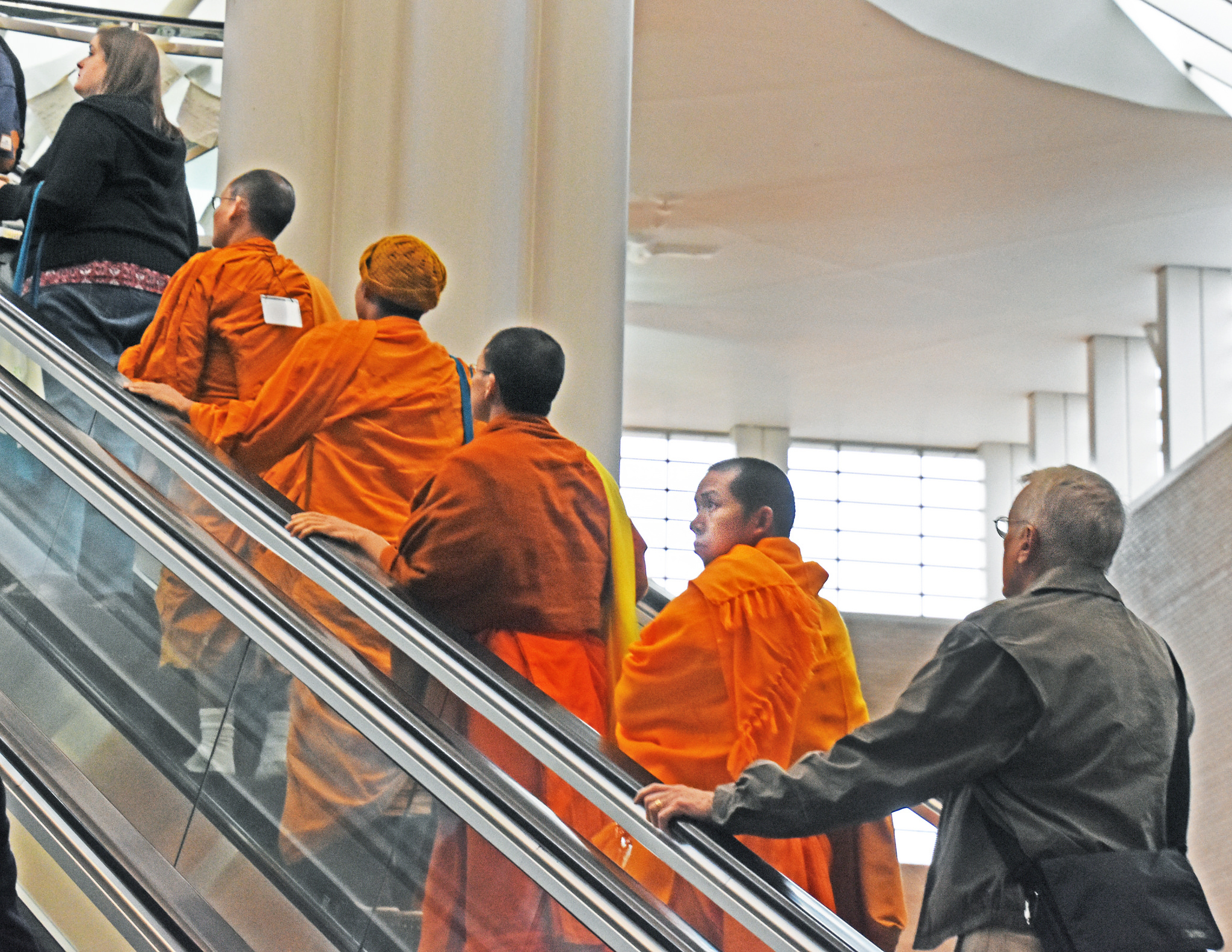
photo courtesy of Greg Harder
Many have written about their profound experiences attending the 2015 Parliament of the World’s Religions. For me, it was a dream of many years come true. But in this column I want to pass on notes and ideas which I recorded that week. So please excuse the abbreviated and prosaic format; today I simply want to share.
“Kill Them (Qu’Ran), Do Not Spare Them (Torah), and Cast Them Into Everlasting Fire (New Testament): Context of Difficult Religious Texts
The one big speaker I wanted to hear at the Parliament was Karen Armstrong, who did not disappoint. She was joined on the panel by Jonathan Brown, a Georgetown University Islamic scholar, and Rabbi Lynn Gottlieb. Please note that I understand this is a sensitive topic. Please don’t kill the messenger if comments shared below upset you.
Brown says that, historically, expansive jihad is a community obligation, but defensive jihad is an individual obligation. The position of the Quran on warfare is not the same as classical jihad. The Quran says permission to fight is given to those who have been wronged. Only a few centuries after the Prophet, imams agreed that expansive jihad was no longer appropriate. Today’s Muslim scholars take the position that defense is okay, offense is not. Regarding what are often called the “sword verses” (9:1-29), abrogation (or annulment or repeat) is the approach of scholars, who also note that the rules in the Qu’ran began with a local context. He says that we can ignore the “texts of terror” or we can struggle with their meaning. Every generation is equidistant from god and must each engage in their own way.
Gottlieb says rabbis to to the Israeli Defense Force are advising soldiers, kill anything that moves. But rabbis over time moved away from the violence of the Torah. Jews are not yet healed from the Holocaust. “Choose life that you and your children might live.” It is forbidden for us to execute, from a rabbinic tradition. The real causes of violence are militarism, racism, etc. We must address these first. American has guilt for the results of our colonialism so now we go to war again and again with no result. We cannot protect ourselves without learning the tactics of nonviolent resistance.
Armstrong says if we don’t learn how to be a community the world will cease to be a viable place to live. People today are reading scripture with a literalness unprecedented in history. Don’t make religion the scapegoat for the secular sins of the 20th century. Scripture is not a text, it’s an activity. Until the Protestant Reformation no one read scriptures literally. Our scriptures are violent because we are violent. Compassion should make us look out at the world and feel profoundly uncomfortable. All of our states are founded by and maintained by violence. This reinforces a sense of meaninglessness and futility. She calls on us to do the exegetical work with scriptures that will give us a peaceful, viable and sustainable world.
Compassion and Law Enforcement: Click to read my separate column on this panel discussion.
 Inland Valley Interfaith Network:
There are a number of interfaith groups which are part of this network, which includes United Religions Initiative founder and president Bishop William Swing. Members of each shared some of the things they have done over the years, including:
Unity in Diversity World Council candlelighting – a representative of each faith gives a very short reading from her/his tradition and lights a small candle, placing it around a larger unity candle.
Interfaith Walk Bead Exchange – Participants are given a small bag of beads, all one color. Each color represents a faith. During an activity, such as moving from one conversation to another, participants exchange a bead with each person. At the end, everyone creates a necklace or bracelet with the beads now in their bag, which should be many colors.
Souljourns – think of it as a gallery walk or pub crawl, except it’s to various places of worship.
Fraternity chapel time – I heard mention of interfaith representatives being the guest worship leader at local fraternities.
Rabbi Rachel Mikva at Closing Plenary: You are the seeds of goodness. Plant yourselves and you will all be able to harvest the fruits of goodness. Here is a link to her talk.
Shaykh Omar Suleiman at Closing Plenary: The most dangerous person in the world is the one who has nothing to lose The same link will take you to his talk, too.
A great many of the Parliament programs were recorded and may be watched here.
Heard on the plane to Salt Lake City, which was filled with Parliament-goers:
This [interfaith] is what I will do for the rest of my life.
Organizational change: what is it we want to continue to do if we change?
A technique to use in a group which wants to learn how better to engage in dialog. When someone speaks they must start by reflecting a bit of what the previous person said.
About a failed meeting: “We’ve got to stop meeting like this.” What have others done to recover when at an impasse or meltdown? Start out learning how dialog works.
A good meetup discussion topic – “What are you afraid of?”
People need the chance to tell their stories before they can turn to a collaborative process.
 Heard around the Parliament:
The past has a vote, not a veto. The importance of ritual for making meaning. Rituals are doors. Make ritual about what’s really true.
Not women knocking on doors but women opening new doors. Our moral and ethical codes are a means to an end, not the end itself.
We can never forget the tie that people have to the religion in which they were brought up.
There must be a willingness to risk and to experience discomfort.
The internet is making new forms of hate speech. Facebook e.g. may only take action when online spills over into real world harassment. What to do? Let companies know their profits will suffer. There are benefits to acting as a group. Get behind a hashtag. The difference between BLM (Black Lives Matter) and ALM (All Lives Matter) is inclusivity vs. generalization. All agree that all lives matter, but to say black lives matter is a call to action.
Everyone has within them what is needed to promote peace.
And heard in my own mind:
What will IPSC be able to say we did to make things better post-Mother Emanuel?
What about an ad campaign of slogans that promote interfaith ideas? Perhaps even place paid ads in state media?
How to make people feel engaged rather than that they are being attacked or drawn into controversy? We create safe boundaries by establishing respectful dialogue.
Inland Valley Interfaith Network
Previous Post

November 3, 2015
Compassion and Law Enforcement
Next Post
November 14, 2015 Blood Feud
Browse Our Archives
Select a Category Aline O'Brien posts Byron Ballard posts Carol Kirk posts David Dashifen Kees posts Drea Parker posts Holli Emore posts Jess Matz posts Molly Khan posts Uncategorized Xander Folmer posts
Select a Month November 2015 September 2015 July 2015 June 2015 May 2015 April 2015 March 2015 February 2015 January 2015 December 2014 November 2014 October 2014 September 2014 August 2014 July 2014 June 2014 May 2014 April 2014 March 2014 February 2014 January 2014 December 2013 November 2013 October 2013 September 2013 August 2013 July 2013 June 2013
Follow Us!
TAKE THE
Religious Wisdom Quiz
Who repeatedly sent soldiers to capture Elijah, only to see fire consume them?
Select your answer to see how you score.
King Ahab King Amaziah King Ahaziah King Asa
Related posts from Wild Garden


Compassion and Law Enforcement

Deborah Ann Light: A Life Well Lived
TRENDING AT PATHEOS Pagan

I was recently chatting with someone on Instagram. She asked me what...

While there are many people who share their results, the end of...

On July 23, I saw Christopher Nolan's The Odyssey which is Homer’s...

As I write this two big events have just finished up. One...

Restoring the Watershed of Divine Love
Perhaps cooperation is not something we manufacture through legislation, ideology, or moral...

Many UUs don’t pray because of bad experiences in a previous religion,...
view all Pagan blogs
Ad-Free & Subscriber Log-In Subscription Support
- About Us
- 2026 Calendar
- Videos
- Podcasts
- Library of World Religions
- Faith In Media Tracker
- Advertise With Us
- Write for Us
- Privacy Policy
- Terms of Service
- Do Not Sell My Data
- Contact Us
- Radiant Digital
- Manage Newsletter Subscriptions
- Unsubscribe From Notifications
- Sitemap
Copyright 2008-2026, Patheos. All rights reserved.
Subscription Support Ad-Free & Subscriber Log-In
Follow Patheos