
BuddhistCatholicContemplativeEvangelicalGeneral ChristianHinduJewishLatter-day SaintMuslimNew VisionsProgressive Christian
Beliefs
- Buddhist
- Catholic
- Contemplative
- Evangelical
- General Christian
- Hindu
- Jewish
- Latter-day Saint
- More Voices
- Muslim
- New Visions
- Pagan
- Progressive Christian
Topics
- Religion News
- Food and Religion
- Sports and Religion
- Religious Art
- Religious Music and Entertainment
- Religious Events
- History and Religion
- Style and Religion
- Politics and Religion
- Women in Religion
- Recreation Outdoors and Religion
- Business Finance and Religion
- Careers Workplace and Religion
- Education and Religion
- Family Parenting and Religion
- Health Fitness and Religion
- Home and Religion
- Relationships and Religion
- Technology and Religion
- Travel and Religion
Columnists
- Buddhist Columnists
- Business Finance and Religion Columnists
- Careers Workplace and Religion Columnists
- Catholic Columnists
- Contemplative Columnists
- Education and Religion Columnists
- Evangelists Columnists
- Family Parenting and Religion Columnists
- General Christian Columnists
- Health Fitness and Religion Columnists
- Hindu Columnists
- History and Religion Columnists
- Home and Religion Columnists
- Jewish Columnists
- More Voices Columnists
- Latter Day Columnists
- Muslim Columnists
- New Visions Columnists
- Nonreligious Columnists
- Pagan Columnists
- Politics and Religion Columnists
- Progressive Columnists
- Recreation Outdoors and Religion Columnists
- Relationships and Religion Columnists
- Religion News Columnists
- Religious Art Columnists
- Religious Events Columnists
- Religious Music and Entertainment Columnists
- Sports and Religion Columnists
- Style and Religion Columnists
- Technology and Religion Columnists
- Travel and Religion Columnists
- Women in Religion Columnists
Resource Library
- 2026 Calendar
- Library of World Religions
- The 100 Most Holy Places on Earth
- Patheos Answers
- Podcasts
- Videos
- Faith Leaders Database
- Anglican Episcopalian
- Bahai
- Baptist
- Buddhism
- Christianity
- Confucianism
- Eastern Orthodoxy
- Hinduism
- Holiness and Pentecostal
- ISKCON
- Islam
- Judaism
- Lutheran
- Methodist
- The Church of Jesus Christ of Latter-day Saints
- New Age
- Paganism
- Presbytarian and Reformed
- Protestantism
- Religion Behind the Scenes
- Roman Catholic
- Scientology
- Shia Islam
- Sikhism
- Sufism
- Sunni Islam
- Taoism
- Zen
- See all religions
Research Tools
 Ad-Free & Subscriber Log-In Subscription Support
Ad-Free & Subscriber Log-In Subscription Support
Follow Patheos 

- Trending:
- Forgiveness
- |
- Marriage
- |
- Consciousness
- |
- Death Penalty
- |
- Election
- |
- Halloween
 Wild Garden
- Home
- Pagan
- Interfaith as a Pagan: Assumptions
Interfaith as a Pagan: Assumptions
Last updated on: March 24, 2015 at 10:23 pm by David Dashifen Kees
Interfaith as a Pagan: Assumptions 2015-03-24T22:23:05-04:00 David Dashifen Kees
Patheos Explore the world's faith through different perspectives on religion and spirituality! Patheos has the views of the prevalent religions and spiritualities of the world.
After a brief hiatus, we return this week to my series discussing interfaith activities as a Pagan. If you’ve missed the earlier articles, part one was an introduction to the topic while in the second part I discussed how organizers often frame an event within a monotheist default and how this can become an opportunity for those that don’t fit the mold. Today, I want to discuss the most common assumptions I face when I engage those unfamiliar with Paganism.

We all make assumptions. It’s impossible not to. Especially when we’re faced with an unfamiliar situation, the only thing we have to work with might be our preconceived notions about how it may be resolved. What’s key in these moments is to understand that our assumptions are flawed; they cannot be universal, i.e. they do not apply to everything or everyone that we find surprising. Despite the fact that we all know this, our assumptions–our stereotypes–persist.
One of the primary reasons that I became involved in interfaith work was to help others examine their assumptions with respect to Paganism. And, especially when I started attending events ten to fifteen years ago, people were largely surprised to learn that Paganism even existed. They were even more surprised to learn that a middle-class American Caucasian cisgender male (i.e. me) could be a Pagan and a polytheist.
To most Americans, Paganism is something that other people do, and by “other people” most Americans mean “people who don’t look like me.” When one of us stands up in a room to introduce ourselves in a way that puts us in opposition to the assumptions others have made, it forces them to perform the sort of re-examination that I always hope I’m able to facilitate.
And, these assumptions are, perhaps, the easiest ones to work on: simply by being present we help to do so. At a workshop at Hartford Seminary, I spent a week with people of many other faiths learning about religious leadership in diverse settings. Twice that week people specifically told me that I had helped expand their horizons with respect to the religious diversity present. One was a Christian religious leader but, more interesting to me, was a Hindu woman who was surprised to meet an American polytheist. In both cases, my attendance was all that was necessary to prompt some deeper thinking about the preconceived notions that we had all probably brought with us to that event.

A harder one to work on is the assumption that humankind has progressed from animism to polytheism onto henotheism before (finally) reaching monotheism. Granted, some would argue that the progression continues passed monotheism (and theism in general) and ends with atheism, but regardless of where it “ends,” this progression feels true; it’s certainly true in other facets of our lives. For example, version one of a software program is typically made obsolete by version two. But, it’s incorrect (and inappropriate) to assume that polytheism was made similarly unnecessary by more recent (Western) theological developments or that our Pagan traditions were trampled by the inevitably marching vanguard of progress.
I was asked once why I practiced a “dead religion.” I was stunned for a moment. How could this person think my religion was “dead” if I was right in front of him claiming to practicing it? I could have accepted an understanding of the relative rarity of our traditions as compared to other religions — that’s easily recognizable as fact. But, he was convinced that to practice a tradition inspired by the cultures of the ancient world was both somewhat ludicrous and, in his mind, regressive.
Typically, it’s not too difficult to convince other interfaith activists that to be different is not the same as to be wrong. It is sometimes harder to convince them that to practice a tradition they consider to be primitive is a worthy pursuit.
Part of that difficulty stems from how deeply embedded the assumption of progress is in our culture. In fact, it’s so deeply embedded that it’s hard not to describe Western civilization without resorting to a chain of events that appears to progress from the primitive to the modern. Consider the steam engine giving way to coal and then internal combustion. And, now, we find that gasoline powered vehicles are beginning to yield to hybrid and fully electric engines.
And, at one time, this was the height of our artistic endeavors:
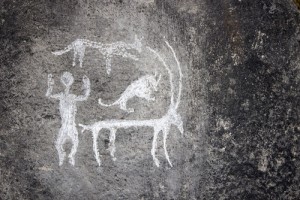
Now we use technology beyond the wildest dreams of our earliest ancestors to create works of such color and complexity that it’s hard to conceive of how the capabilities of the modern world haven’t made obsolescent the actions of the past.
And yet, we consider the cave art at Lascaux, France to be a cultural treasure of great value to all humankind.
When approached by those who have trouble seeing the value of our traditions, sometimes it only takes an example of something in a different context that we continue to treasure to help them see that their assumptions of worth are not as universally applicable as they might have thought. Use my cave art example above, or remind them that it was the Christian monks who recorded the histories of Celtic cultures (biased though these histories may be) regardless of the fact that the Celtic peoples believed vastly differently and, in the point of view of the monks, more primitively. And, there are many examples of things that we can produce (or reproduce) in the modern age that are considered to be of lesser worth than the same or similar objects made with care by hand in the past; the entire antiquing economy relies on such valuations!
In the end, sometimes you won’t be able to get through to people. They’ll find you quaint or simply decide that you’re wrong headedly backward thinking in some of your decisions. But, with luck, those people will be few and far between. In two weeks, I’ll be sharing a few of my thoughts about how I deal with the sometimes unquenchable curiosity that I’ve encountered in others when they have so many questions about Paganism that I’ve been in danger of derailing an otherwise on-topic conversation. Until then, I hope you enjoy other articles here at the Wild Garden, and don’t forget to visit the rest of the Patheos Pagan content.
Images courtesy of shutterstock.com.
Previous Post

March 20, 2015
Twixt the Darkness and the Light
Next Post

March 30, 2015 This is Real Interfaith
Browse Our Archives
Select a Category Aline O'Brien posts Byron Ballard posts Carol Kirk posts David Dashifen Kees posts Drea Parker posts Holli Emore posts Jess Matz posts Molly Khan posts Uncategorized Xander Folmer posts
Select a Month November 2015 September 2015 July 2015 June 2015 May 2015 April 2015 March 2015 February 2015 January 2015 December 2014 November 2014 October 2014 September 2014 August 2014 July 2014 June 2014 May 2014 April 2014 March 2014 February 2014 January 2014 December 2013 November 2013 October 2013 September 2013 August 2013 July 2013 June 2013
Follow Us!
TAKE THE
Religious Wisdom Quiz
What does Paul tell Timothy to guard in 1 Timothy?
Select your answer to see how you score.
The gospel The church His heart What has been entrusted to his care
Related posts from Wild Garden



Deborah Ann Light: A Life Well Lived
TRENDING AT PATHEOS Pagan

I was recently chatting with someone on Instagram. She asked me what...

While there are many people who share their results, the end of...

On July 23, I saw Christopher Nolan's The Odyssey which is Homer’s...

As I write this two big events have just finished up. One...

Restoring the Watershed of Divine Love
Perhaps cooperation is not something we manufacture through legislation, ideology, or moral...

Many UUs don’t pray because of bad experiences in a previous religion,...
view all Pagan blogs
Ad-Free & Subscriber Log-In Subscription Support
- About Us
- 2026 Calendar
- Videos
- Podcasts
- Library of World Religions
- Faith In Media Tracker
- Advertise With Us
- Write for Us
- Privacy Policy
- Terms of Service
- Do Not Sell My Data
- Contact Us
- Radiant Digital
- Manage Newsletter Subscriptions
- Unsubscribe From Notifications
- Sitemap
Copyright 2008-2026, Patheos. All rights reserved.
Subscription Support Ad-Free & Subscriber Log-In
Follow Patheos