
BuddhistCatholicContemplativeEvangelicalGeneral ChristianHinduJewishLatter-day SaintMuslimNew VisionsProgressive Christian
Beliefs
- Buddhist
- Catholic
- Contemplative
- Evangelical
- General Christian
- Hindu
- Jewish
- Latter-day Saint
- More Voices
- Muslim
- New Visions
- Pagan
- Progressive Christian
Topics
- Religion News
- Food and Religion
- Sports and Religion
- Religious Art
- Religious Music and Entertainment
- Religious Events
- History and Religion
- Style and Religion
- Politics and Religion
- Women in Religion
- Recreation Outdoors and Religion
- Business Finance and Religion
- Careers Workplace and Religion
- Education and Religion
- Family Parenting and Religion
- Health Fitness and Religion
- Home and Religion
- Relationships and Religion
- Technology and Religion
- Travel and Religion
Columnists
- Buddhist Columnists
- Business Finance and Religion Columnists
- Careers Workplace and Religion Columnists
- Catholic Columnists
- Contemplative Columnists
- Education and Religion Columnists
- Evangelists Columnists
- Family Parenting and Religion Columnists
- General Christian Columnists
- Health Fitness and Religion Columnists
- Hindu Columnists
- History and Religion Columnists
- Home and Religion Columnists
- Jewish Columnists
- More Voices Columnists
- Latter Day Columnists
- Muslim Columnists
- New Visions Columnists
- Nonreligious Columnists
- Pagan Columnists
- Politics and Religion Columnists
- Progressive Columnists
- Recreation Outdoors and Religion Columnists
- Relationships and Religion Columnists
- Religion News Columnists
- Religious Art Columnists
- Religious Events Columnists
- Religious Music and Entertainment Columnists
- Sports and Religion Columnists
- Style and Religion Columnists
- Technology and Religion Columnists
- Travel and Religion Columnists
- Women in Religion Columnists
Resource Library
- 2026 Calendar
- Library of World Religions
- The 100 Most Holy Places on Earth
- Patheos Answers
- Podcasts
- Videos
- Faith Leaders Database
- Anglican Episcopalian
- Bahai
- Baptist
- Buddhism
- Christianity
- Confucianism
- Eastern Orthodoxy
- Hinduism
- Holiness and Pentecostal
- ISKCON
- Islam
- Judaism
- Lutheran
- Methodist
- The Church of Jesus Christ of Latter-day Saints
- New Age
- Paganism
- Presbytarian and Reformed
- Protestantism
- Religion Behind the Scenes
- Roman Catholic
- Scientology
- Shia Islam
- Sikhism
- Sufism
- Sunni Islam
- Taoism
- Zen
- See all religions
Research Tools
 Ad-Free & Subscriber Log-In Subscription Support
Ad-Free & Subscriber Log-In Subscription Support
Follow Patheos 

- Trending:
- Forgiveness
- |
- Marriage
- |
- Consciousness
- |
- Death Penalty
- |
- Election
- |
- Halloween
 Wild Garden
- Home
- Pagan
- Travelling Together
Travelling Together
Last updated on: January 15, 2014 at 9:41 am by David Dashifen Kees
Travelling Together 2014-01-15T09:41:38-04:00 David Dashifen Kees
Patheos Explore the world's faith through different perspectives on religion and spirituality! Patheos has the views of the prevalent religions and spiritualities of the world.
This past weekend, the Wild Hunt ran a column entitled Institutions vs. Counterculture in Modern Paganism. I highly recommend reading it, it’s both thoughtful and thought provoking. But, in summary, it explores the tension in our community between the wild and the mystical and the more staid and sedate. Some in the comments, myself included, proposed possible resolutions or middle grounds. John Becket, another author here on the Patheos Pagan Channel, shared some of his thoughts in his essay, Visions of a Pagan Future, where he touches on some additional points that weren’t quite discussed in the Wild Hunt column.
I would like to touch on something else, but the above-linked pages give you the background for today’s topic. I desire institutions. Like John said, I’m not really much of a radical, or at least I don’t think of myself as one. And, I tend to be more administratively minded than mystical so perhaps my personality lends itself well to institutional thinking. Regardless, I think that for our community to grow into something that can last over time, we’re going to need the stability and the centralizing influence that only institutions can bring.
But, I also know that the wild and the mystical are necessary parts of our Pagan equation. We won’t be fully balanced without those elements. So the question that Jason at the Wild Hunt posed remains: if we are to grow institutional foci, how can we also maintain the counter cultural influences that are so important to so many of us? Perhaps there’s another question: is it even possible to do so?
I have no answer to that one, so I’d prefer to assume the answer is yes (because doing the opposite is to choose stagnation) until proven otherwise. Therefore, we’re back trying to figure out “how” to move forward. And that’s where I think we have a leg up on other community organizational efforts: there’s a lot of other people out there who’ve been doing this sort of thing for quite some time, and rather successfully to boot. Even better, some of them are doing so right now!

By Berdea (Own work) [CC-BY-SA-3.0],
via Wikimedia Commons

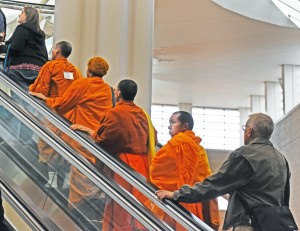
Here’s the thing: we don’t have to do this alone. The Hindu community, for example, represents another group with diverse, pluralistic theological ideas that has been building a community with shared ties despite internal inconsistencies. My own experiences with Judaism and Buddhism lead me to think that there are things we could learn from these communities to help enhance our own, too.
I’m not necessarily talking theological growth. I think that’s for us to handle. But there are techniques of community organization and building that other communities–communities of faith or otherwise–have tried and tested and we can learn from their mistakes and from their successes. From Jews we can learn about how to create and nurture a family or personal practice while also becoming a part of larger community, for example. I still remember my mother leading my family in prayer when Sabbath services began in our home on Friday night before we ever visited the synagogue on Saturday morning.
I mentioned non-faith communities above and there are interesting things going on in the wider atheist and humanist communities. To summarize, there’s a movement towards so-called “atheist churches” which has begun to gain momentum under the name The Sunday Assembly. Starting in London (if I understand correctly) and growing quickly to include over thirty assemblies throughout the UK, USA, and Australia, these “atheist mega-churches” have been popping up in many major cities. Perhaps, it was inevitable that those within the atheist community who disagreed with the direction and choices made by those driving the Sunday Assemblies broke with that organization to form one called the Godless Revival. Patheos Atheist author, Hermant Mehta, shared a vital point of view over at the Friendly Atheist that is, I think, particularly important for us to keep in mind: there were likely very few people interested in both of these organizations.
In other words: there wasn’t necessarily a break between these groups because they weren’t necessarily tightly bound in the first place. Like Witches and Heathens or Kemetics and Qadishuma, there are certainly similarities between the Sunday Assembly and the Godless Revival, but they have different ideas, different goals. And, as Mr. Mehta also points out: there’s a lot of people in the atheist community that likely care about neither of them and are happy doing their own thing.
For all of our differences, atheists and Pagans have a lot in common. Consider this quote and tell me you couldn’t probably substitute “Pagans” for “atheists” within:
For most atheists, the response has been a collective, “meh.” Organized-anything doesn’t sound very appealing to a lot of us, but for those who might like that sort of thing, these groups are helpful.
And that, in the end, is the point. There are going to be Pagans, like myself, who are like that subset of the atheist community. We’re interested in “that sort of thing.” And, those institutions provide, I think, a gateway to the large mysteries within any community as well as the multi-generational security that John Beckett touches on in his essay (linked above).
We’re a plural community, and that means probably having to deal with the tension between institutional forces and grassroots efforts for some time to come. My hope is that we find a way to have both so that our smaller, wilder groups can orbit the institutions comfortably and they will exert their own influence within that relationship. Finding that balance is key, but we’re not the only community dealing with these questions.
Maybe it’s time we started talking with others who share similar goals, even if they’re grounded in different theologies (or the lack thereof).
Previous Post

January 6, 2014
Interfaith in Prison
Next Post
January 16, 2014 Separation of religion and medicine?
Browse Our Archives
Select a Category Aline O'Brien posts Byron Ballard posts Carol Kirk posts David Dashifen Kees posts Drea Parker posts Holli Emore posts Jess Matz posts Molly Khan posts Uncategorized Xander Folmer posts
Select a Month November 2015 September 2015 July 2015 June 2015 May 2015 April 2015 March 2015 February 2015 January 2015 December 2014 November 2014 October 2014 September 2014 August 2014 July 2014 June 2014 May 2014 April 2014 March 2014 February 2014 January 2014 December 2013 November 2013 October 2013 September 2013 August 2013 July 2013 June 2013
Follow Us!
TAKE THE
Religious Wisdom Quiz
Who was Ahab's wicked wife, notorious for her cruelty?
Select your answer to see how you score.
Jezebel Michal Athaliah Abigail
Related posts from Wild Garden


Compassion and Law Enforcement

TRENDING AT PATHEOS Pagan

I was recently chatting with someone on Instagram. She asked me what...

While there are many people who share their results, the end of...

On July 23, I saw Christopher Nolan's The Odyssey which is Homer’s...

As I write this two big events have just finished up. One...

Restoring the Watershed of Divine Love
Perhaps cooperation is not something we manufacture through legislation, ideology, or moral...

Many UUs don’t pray because of bad experiences in a previous religion,...
view all Pagan blogs
Ad-Free & Subscriber Log-In Subscription Support
- About Us
- 2026 Calendar
- Videos
- Podcasts
- Library of World Religions
- Faith In Media Tracker
- Advertise With Us
- Write for Us
- Privacy Policy
- Terms of Service
- Do Not Sell My Data
- Contact Us
- Radiant Digital
- Manage Newsletter Subscriptions
- Unsubscribe From Notifications
- Sitemap
Copyright 2008-2026, Patheos. All rights reserved.
Subscription Support Ad-Free & Subscriber Log-In
Follow Patheos