
BuddhistCatholicContemplativeEvangelicalGeneral ChristianHinduJewishLatter-day SaintMuslimNew VisionsProgressive Christian
Beliefs
- Buddhist
- Catholic
- Contemplative
- Evangelical
- General Christian
- Hindu
- Jewish
- Latter-day Saint
- More Voices
- Muslim
- New Visions
- Pagan
- Progressive Christian
Topics
- Religion News
- Food and Religion
- Sports and Religion
- Religious Art
- Religious Music and Entertainment
- Religious Events
- History and Religion
- Style and Religion
- Politics and Religion
- Women in Religion
- Recreation Outdoors and Religion
- Business Finance and Religion
- Careers Workplace and Religion
- Education and Religion
- Family Parenting and Religion
- Health Fitness and Religion
- Home and Religion
- Relationships and Religion
- Technology and Religion
- Travel and Religion
Columnists
- Buddhist Columnists
- Business Finance and Religion Columnists
- Careers Workplace and Religion Columnists
- Catholic Columnists
- Contemplative Columnists
- Education and Religion Columnists
- Evangelists Columnists
- Family Parenting and Religion Columnists
- General Christian Columnists
- Health Fitness and Religion Columnists
- Hindu Columnists
- History and Religion Columnists
- Home and Religion Columnists
- Jewish Columnists
- More Voices Columnists
- Latter Day Columnists
- Muslim Columnists
- New Visions Columnists
- Nonreligious Columnists
- Pagan Columnists
- Politics and Religion Columnists
- Progressive Columnists
- Recreation Outdoors and Religion Columnists
- Relationships and Religion Columnists
- Religion News Columnists
- Religious Art Columnists
- Religious Events Columnists
- Religious Music and Entertainment Columnists
- Sports and Religion Columnists
- Style and Religion Columnists
- Technology and Religion Columnists
- Travel and Religion Columnists
- Women in Religion Columnists
Resource Library
- 2026 Calendar
- Library of World Religions
- The 100 Most Holy Places on Earth
- Patheos Answers
- Podcasts
- Videos
- Faith Leaders Database
- Anglican Episcopalian
- Bahai
- Baptist
- Buddhism
- Christianity
- Confucianism
- Eastern Orthodoxy
- Hinduism
- Holiness and Pentecostal
- ISKCON
- Islam
- Judaism
- Lutheran
- Methodist
- The Church of Jesus Christ of Latter-day Saints
- New Age
- Paganism
- Presbytarian and Reformed
- Protestantism
- Religion Behind the Scenes
- Roman Catholic
- Scientology
- Shia Islam
- Sikhism
- Sufism
- Sunni Islam
- Taoism
- Zen
- See all religions
Research Tools
 Ad-Free & Subscriber Log-In Subscription Support
Ad-Free & Subscriber Log-In Subscription Support
Follow Patheos 

- Trending:
- Forgiveness
- |
- Marriage
- |
- Consciousness
- |
- Death Penalty
- |
- Election
- |
- Halloween
 Wild Garden
- Home
- Pagan
- The Global Public Square
The Global Public Square
Last updated on: August 27, 2013 at 11:00 am by David Dashifen Kees
The Global Public Square 2013-08-26T21:44:52-04:00 David Dashifen Kees
Patheos Explore the world's faith through different perspectives on religion and spirituality! Patheos has the views of the prevalent religions and spiritualities of the world.
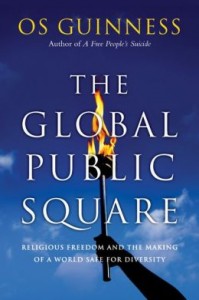
The Global Public Square: Religious Freedom and the Making of a World Safe for Diversity (paperback, kindle) is a book that starts and ends on high notes, but there are some dissonant chords in the middle. When I first heard that this book was going to be available as an option within our book club here at Patheos, I wondered how an idea that seems so obvious to me could necessitate 212 pages to cover. And, unfortunately, after reading the book, I think the answer is: it doesn’t.
The book deals with what the author, Os Guinness, terms soul freedom which is often expanded throughout the book as the freedom of thought, conscience, religion, and belief. In its longer form, it’s a powerful set of freedoms and it’s important that Guinness separates these four concepts because, in so doing, he’s included atheists, spiritual seekers, and philosophers alongside theists and other believers. In fact, he makes this point clearly throughout the book.
But, I remain confused as to whether or not Guinness offers us a clear understanding of his message. On the one hand, the author states (rightly, I think) on page seventy that “[soul] freedom is absolute at the point of belief, but qualified at the point of behavior, because behavior touches other people and other things” but within ten pages he’s criticizing the Affordable Care Act’s mandate that employers or insurance companies must cover contraceptives. How is this not a qualification on behavior? The ACA doesn’t outlaw anti-contraceptive belief, it simply makes clear that one cannot impose that belief on others. Even more confusing, at the end of the book, he writes:
Western conservatives and Western liberals have the right to believe what they each believe and disbelieve what they each disbelieve, but Western societies are free to challenge and outlaw the policies of one or the other so that society either favors or forbids such contested practices as abortion and same-sex marriage.
Is this an overly confusing way of restating his point regarding the qualification of behaviors? And, this is not the only time in which he brings up GLBT rights and other aspects of the sexual revolution, usually with a negative connotation. His overt denigration of our culture wars stands at odds with what seem to be his own shots fired within them. I suspect that the author’s own bias (he introduces his faith, Christianity, in the beginning of the text) is apparent at such times.
To be fair, Guinness doesn’t focus only on America. In fact, he touches on us probably less than he does on other countries. He digs deeply into various practices of the governments of the United Kingdom, France, the Netherlands, Saudi Arabia, Pakistan, India, and China throughout the text and uses the thinking of philosophers, religious and otherwise, to make his points.
Unfortunately, these explorations take up the majority of the book. After 179 pages, and a mere thirty-two pages from the end of the book, Guinness gets around to discussing his idea of the civil public square in chapter eight. He describes such a thing as one:
[…] in which citizens of all faiths and none are free to enter and engage public life on the basis of their faith […] forged through an agreed political framework of rights, responsibilities and respect, within which each faith is free to be faithful to its own beliefs and yet responsible to know how to deal respectfully and civilly with the vital differences of other beliefs.
He also touches on the relative benefits of persuasion against the costs of coercion and it is here where we can begin to understand Guinness’s opposition to the actions of the aforementioned governments: laws necessarily coerce behavior from those who oppose them. However, I don’t think that he makes a convincing argument that the civil public square could overcome deeply held and opposing beliefs to reach some sort of consensus regarding behavior. But, I wonder: if he had spent more than twelve pages attempting to do so, would he have been more successful?
The civil public square is a truly fascinating glimmer of an idea hidden by the glare produced by the exploration of problems throughout the world that create the need for it. I enjoyed the book overall, and I think those who find the idea of the civil public square to be as interesting as I do will find value in working their way through it. But, for every person that makes it to the good parts, I suspect that many will become tired of the hashed and rehashed examples throughout.
Next time, I hope to share my progress in setting up a Pagan chapter for the Foundation for Religious Diplomacy, an organization that I think is trying to implement some of what Guinness describes in his text. See you in two weeks!
Previous Post

August 22, 2013
What I Meant to Say Was...I'm Not Interested
Next Post

August 29, 2013 The Linguists' Principle of Charity
Browse Our Archives
Select a Category Aline O'Brien posts Byron Ballard posts Carol Kirk posts David Dashifen Kees posts Drea Parker posts Holli Emore posts Jess Matz posts Molly Khan posts Uncategorized Xander Folmer posts
Select a Month November 2015 September 2015 July 2015 June 2015 May 2015 April 2015 March 2015 February 2015 January 2015 December 2014 November 2014 October 2014 September 2014 August 2014 July 2014 June 2014 May 2014 April 2014 March 2014 February 2014 January 2014 December 2013 November 2013 October 2013 September 2013 August 2013 July 2013 June 2013
Follow Us!
TAKE THE
Religious Wisdom Quiz
True or False: Peter preached the first sermon after Pentecost, leading to 3,000 conversions.
Select your answer to see how you score.
TRUE FALSE
Related posts from Wild Garden



Deborah Ann Light: A Life Well Lived
TRENDING AT PATHEOS Pagan

I was recently chatting with someone on Instagram. She asked me what...

While there are many people who share their results, the end of...

On July 23, I saw Christopher Nolan's The Odyssey which is Homer’s...

As I write this two big events have just finished up. One...

Restoring the Watershed of Divine Love
Perhaps cooperation is not something we manufacture through legislation, ideology, or moral...

Many UUs don’t pray because of bad experiences in a previous religion,...
view all Pagan blogs
Ad-Free & Subscriber Log-In Subscription Support
- About Us
- 2026 Calendar
- Videos
- Podcasts
- Library of World Religions
- Faith In Media Tracker
- Advertise With Us
- Write for Us
- Privacy Policy
- Terms of Service
- Do Not Sell My Data
- Contact Us
- Radiant Digital
- Manage Newsletter Subscriptions
- Unsubscribe From Notifications
- Sitemap
Copyright 2008-2026, Patheos. All rights reserved.
Subscription Support Ad-Free & Subscriber Log-In
Follow Patheos