
BuddhistCatholicContemplativeEvangelicalGeneral ChristianHinduJewishLatter-day SaintMuslimNew VisionsProgressive Christian
Beliefs
- Buddhist
- Catholic
- Contemplative
- Evangelical
- General Christian
- Hindu
- Jewish
- Latter-day Saint
- More Voices
- Muslim
- New Visions
- Pagan
- Progressive Christian
Topics
- Religion News
- Food and Religion
- Sports and Religion
- Religious Art
- Religious Music and Entertainment
- Religious Events
- History and Religion
- Style and Religion
- Politics and Religion
- Women in Religion
- Recreation Outdoors and Religion
- Business Finance and Religion
- Careers Workplace and Religion
- Education and Religion
- Family Parenting and Religion
- Health Fitness and Religion
- Home and Religion
- Relationships and Religion
- Technology and Religion
- Travel and Religion
Columnists
- Buddhist Columnists
- Business Finance and Religion Columnists
- Careers Workplace and Religion Columnists
- Catholic Columnists
- Contemplative Columnists
- Education and Religion Columnists
- Evangelists Columnists
- Family Parenting and Religion Columnists
- General Christian Columnists
- Health Fitness and Religion Columnists
- Hindu Columnists
- History and Religion Columnists
- Home and Religion Columnists
- Jewish Columnists
- More Voices Columnists
- Latter Day Columnists
- Muslim Columnists
- New Visions Columnists
- Nonreligious Columnists
- Pagan Columnists
- Politics and Religion Columnists
- Progressive Columnists
- Recreation Outdoors and Religion Columnists
- Relationships and Religion Columnists
- Religion News Columnists
- Religious Art Columnists
- Religious Events Columnists
- Religious Music and Entertainment Columnists
- Sports and Religion Columnists
- Style and Religion Columnists
- Technology and Religion Columnists
- Travel and Religion Columnists
- Women in Religion Columnists
Resource Library
- 2026 Calendar
- Library of World Religions
- The 100 Most Holy Places on Earth
- Patheos Answers
- Podcasts
- Videos
- Faith Leaders Database
- Anglican Episcopalian
- Bahai
- Baptist
- Buddhism
- Christianity
- Confucianism
- Eastern Orthodoxy
- Hinduism
- Holiness and Pentecostal
- ISKCON
- Islam
- Judaism
- Lutheran
- Methodist
- The Church of Jesus Christ of Latter-day Saints
- New Age
- Paganism
- Presbytarian and Reformed
- Protestantism
- Religion Behind the Scenes
- Roman Catholic
- Scientology
- Shia Islam
- Sikhism
- Sufism
- Sunni Islam
- Taoism
- Zen
- See all religions
Research Tools
 Ad-Free & Subscriber Log-In Subscription Support
Ad-Free & Subscriber Log-In Subscription Support
Follow Patheos 

- Trending:
- Forgiveness
- |
- Marriage
- |
- Consciousness
- |
- Death Penalty
- |
- Election
- |
- Halloween
 Wild Garden
- Home
- Pagan
- Religious Leadership Diversity Workshop at Hartford Seminary: a Review
Religious Leadership Diversity Workshop at Hartford Seminary: a Review
Last updated on: June 25, 2013 at 8:37 pm by David Dashifen Kees
Religious Leadership Diversity Workshop at Hartford Seminary: a Review 2013-06-25T20:37:37-04:00 David Dashifen Kees
Patheos Explore the world's faith through different perspectives on religion and spirituality! Patheos has the views of the prevalent religions and spiritualities of the world.
As I mentioned briefly in my prior post, I spent the week of June 8 through June 14 at Hartford Seminary attending the Religious Leadership Diversity Workshop. The workshop has been running for a few years, and the seminary works to bring together people of various faiths to try and create an experience for attendees that both allows for the sharing of personal stories and points of view and helps to educate them on various faiths and faith practices as well as multifaith chaplaincy, conflict resolution, and religious leadership.
In short: it was a moving and intellectually thrilling experience.

Word cloud from the RLDW 2012 by Dr. Lucinda Mosher, facilitator of the workshop. Used with permission.
For a week, I worked with Christians, Jews, Hindus, a Muslim (from Singapore), a Jain, a Buddhist, and a variety of people who defied simple classification under a label. Even better, introducing myself as a Witch and a Pagan may have raised a few eyebrows, but it didn’t result in a feeling of being ostracized or excluded from the experience in anyway. In fact, if anything, being upfront about my own personal story opened the door for a variety of learning experiences both for myself and for others as we spoke throughout the week.
Organized around lectures, the workshop had two primary “tracks.” The first was to share information about specific faiths and practices and the second was to dig into questions of leadership in a multifaith situation. Because of the time constraints, we didn’t have any formal presentation relating to Judaism, Christianity, and Islam–all of which I personally wish we had the chance to touch on–with the exception of a presentation by the Church of Jesus Christ of Latter Day Saints. Instead, we had presentations that focused on Dharmic religions including Sikhism, Buddhism, Hinduism, and Jainism. And, I was also able to present about Paganism to the group formally as well as during informal conversations. Finally, we also spent a day visiting a local Sikh Gurdwara, a Hindu Mandir, and a Buddhist temple to witness and experience a bit of those three faiths in practice.
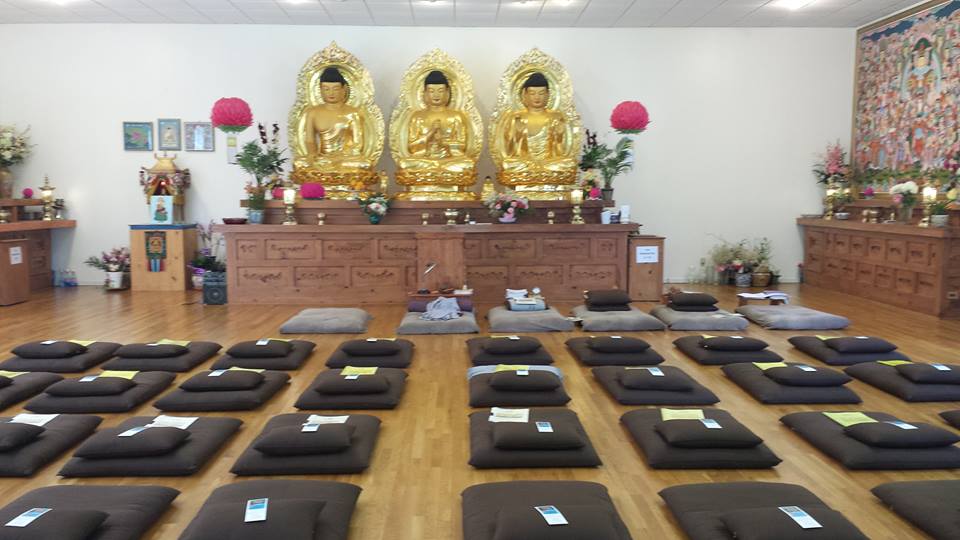
Dae Yen Sa Buddhist Temple in New Hartford, CT. Photo taken with permission by a workshop participant and shared with the rest of us.
The presentations relating to leadership were at least as interesting and potentially more valuable than the informational presentations. It cannot be stressed enough that the ability to hear about and learn from people practicing a specific faith or philosophy is a fantastic way to learn more about it, but there’s a lot of opportunity to do so. It’s harder to get a group of various religious leaders in the same room and discuss techniques for working together in situations more delicate that service projects or other more common interfaith situations.
Instead, we looked at situations where people of different faiths and philosophies were thrust together in ways that you may not expect. For example, we studied the case of a Baptist hospital chaplain who helped a Jewish family as a member of their family lay dying before them. Upon entering the room, we learned it was clear to the chaplain that he was working outside his own faith when he saw the men in the room wearing yarmulkes, the traditional Jewish skullcaps. When he asked if the family would prefer that he help them find a Rabbi to hold space with them, the family declined, indicating that his God was their God and that he should stay. Granted, not all Jews (and not all Baptists) would agree with that statement, but in that time–in that place–the differences of belief and practice between the family and the chaplain faded away when faced with the human need to grieve with family and, for some, with spiritual guidance.
If there was one thing that became more and more clear to me throughout my time at this workshop, it’s that there is nothing more dangerous than generalizations. Not only is there great differences between faiths and philosophies, there is diversity within those faith groups as well. Just as we in the Pagan community sometimes struggle to relate to and understand the members of our complex and growing family, every other faith does as well. And, what we often think of as a homogeneous philosophy guiding other faith communities is as heterogeneous as ours. Case and point, I was stunned when our Buddhist colleague presented on the diversity of her faith in American sharing with us over 20 different “streams” (her term) of Buddhism that can be found in our midst.
Additionally, something else was, once more, driven home for me: learning about and experiencing the faiths of others doesn’t cause one’s own faith to become more shallow. Perhaps counter-intuitively, doing so causes it to deepen and become stronger. As my colleagues asked me questions and I was forced to explain my own way of thinking and share with them, as best as any individual can, concepts relating to Paganism, it forced me to focus on what it is that I do believe. They challenged me to share with them my faith and, in so doing, they also challenged me to re-examine my choices and to re-affirm them not just internally but publicly.
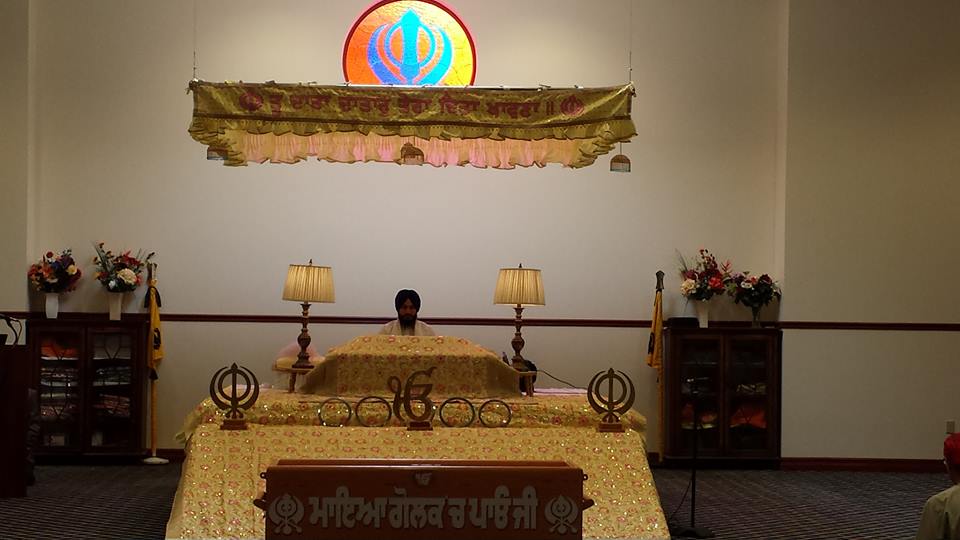
The takhat within Gurdwara Nanak Darbar in Southington, CT and an attending priest. Photo taken with permission by a workshop participant and shared with the rest of us.
On our final day, we were asked to share a blessing from our own tradition if we were moved to do so. I decided to take a prayer from my Jewish heritage, the Shehecheyanu, and rewrite it based on the morning devotional of the Solitary Druid Fellowship. It was well received and offered next to the singing of one of the psalms, the sharing of Hindu prayers in spoken in Sanskrit, the offering of gifts in the Native American style, and–very special to myself–the Shehecheyanu in Hebrew.
But perhaps most amazing was the prayer offered by a Catholic priest, a Pauline. He stepped forward with his iPhone in hand and explained that he was there to offer an embodied prayer. Hitting play, a men’s choir singing a psalm accompanied by a guitar sounded in the room. The priest stood, took a deep breath, and began to perform yoga before us juxtaposing his movements in time with the singing of a Christian hymn.
In many ways this represented, to me, a perfect synthesis of what it means to understand each other: we can grow within our own faiths by encountering those of others’.
And, in so doing, everyone is made stronger.
Previous Post
June 23, 2013
And All God's Children Said "Waheguru"
Next Post
June 25, 2013 MountainTop I
Browse Our Archives
Select a Category Aline O'Brien posts Byron Ballard posts Carol Kirk posts David Dashifen Kees posts Drea Parker posts Holli Emore posts Jess Matz posts Molly Khan posts Uncategorized Xander Folmer posts
Select a Month November 2015 September 2015 July 2015 June 2015 May 2015 April 2015 March 2015 February 2015 January 2015 December 2014 November 2014 October 2014 September 2014 August 2014 July 2014 June 2014 May 2014 April 2014 March 2014 February 2014 January 2014 December 2013 November 2013 October 2013 September 2013 August 2013 July 2013 June 2013
Follow Us!
TAKE THE
Religious Wisdom Quiz
What animal did Samson kill with his bare hands?
Select your answer to see how you score.
Lion Wolf Bear Leopard
Related posts from Wild Garden

Deborah Ann Light: A Life Well Lived
TRENDING AT PATHEOS Pagan

When we talk about Greek religion, we often begin with the dodekatheion—the...

I was recently chatting with someone on Instagram. She asked me what...

While there are many people who share their results, the end of...

On July 23, I saw Christopher Nolan's The Odyssey which is Homer’s...

As I write this two big events have just finished up. One...

Restoring the Watershed of Divine Love
Perhaps cooperation is not something we manufacture through legislation, ideology, or moral...
view all Pagan blogs
Ad-Free & Subscriber Log-In Subscription Support
- About Us
- 2026 Calendar
- Videos
- Podcasts
- Library of World Religions
- Faith In Media Tracker
- Advertise With Us
- Write for Us
- Privacy Policy
- Terms of Service
- Do Not Sell My Data
- Contact Us
- Radiant Digital
- Manage Newsletter Subscriptions
- Unsubscribe From Notifications
- Sitemap
Copyright 2008-2026, Patheos. All rights reserved.
Subscription Support Ad-Free & Subscriber Log-In
Follow Patheos