
BuddhistCatholicContemplativeEvangelicalGeneral ChristianHinduJewishLatter-day SaintMuslimNew VisionsProgressive Christian
Beliefs
- Buddhist
- Catholic
- Contemplative
- Evangelical
- General Christian
- Hindu
- Jewish
- Latter-day Saint
- More Voices
- Muslim
- New Visions
- Pagan
- Progressive Christian
Topics
- Religion News
- Food and Religion
- Sports and Religion
- Religious Art
- Religious Music and Entertainment
- Religious Events
- History and Religion
- Style and Religion
- Politics and Religion
- Women in Religion
- Recreation Outdoors and Religion
- Business Finance and Religion
- Careers Workplace and Religion
- Education and Religion
- Family Parenting and Religion
- Health Fitness and Religion
- Home and Religion
- Relationships and Religion
- Technology and Religion
- Travel and Religion
Columnists
- Buddhist Columnists
- Business Finance and Religion Columnists
- Careers Workplace and Religion Columnists
- Catholic Columnists
- Contemplative Columnists
- Education and Religion Columnists
- Evangelists Columnists
- Family Parenting and Religion Columnists
- General Christian Columnists
- Health Fitness and Religion Columnists
- Hindu Columnists
- History and Religion Columnists
- Home and Religion Columnists
- Jewish Columnists
- More Voices Columnists
- Latter Day Columnists
- Muslim Columnists
- New Visions Columnists
- Nonreligious Columnists
- Pagan Columnists
- Politics and Religion Columnists
- Progressive Columnists
- Recreation Outdoors and Religion Columnists
- Relationships and Religion Columnists
- Religion News Columnists
- Religious Art Columnists
- Religious Events Columnists
- Religious Music and Entertainment Columnists
- Sports and Religion Columnists
- Style and Religion Columnists
- Technology and Religion Columnists
- Travel and Religion Columnists
- Women in Religion Columnists
Resource Library
- 2026 Calendar
- Library of World Religions
- The 100 Most Holy Places on Earth
- Patheos Answers
- Podcasts
- Videos
- Faith Leaders Database
- Anglican Episcopalian
- Bahai
- Baptist
- Buddhism
- Christianity
- Confucianism
- Eastern Orthodoxy
- Hinduism
- Holiness and Pentecostal
- ISKCON
- Islam
- Judaism
- Lutheran
- Methodist
- The Church of Jesus Christ of Latter-day Saints
- New Age
- Paganism
- Presbytarian and Reformed
- Protestantism
- Religion Behind the Scenes
- Roman Catholic
- Scientology
- Shia Islam
- Sikhism
- Sufism
- Sunni Islam
- Taoism
- Zen
- See all religions
Research Tools
 Ad-Free & Subscriber Log-In Subscription Support
Ad-Free & Subscriber Log-In Subscription Support
Follow Patheos 

- Trending:
- Forgiveness
- |
- Marriage
- |
- Consciousness
- |
- Death Penalty
- |
- Election
- |
- Halloween
 Wild Fox Zen
- Home
- Buddhist
- Four Little Fishies in the Big Zen Sea and How They Do Study
Four Little Fishies in the Big Zen Sea and How They Do Study
Last updated on: May 17, 2023 at 1:25 pm by Dosho Port
Four Little Fishies in the Big Zen Sea and How They Do Study 2023-05-17T13:25:26-06:00 Dosho Port
Patheos Explore the world's faith through different perspectives on religion and spirituality! Patheos has the views of the prevalent religions and spiritualities of the world.
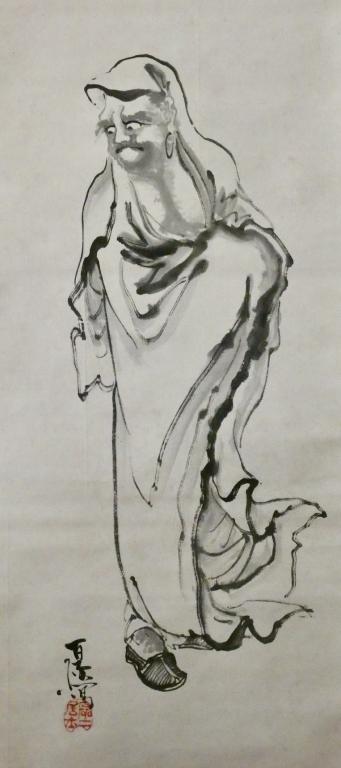
Bodhidharma as Kannon by Nantenbō Rōshi
Overview
This post is the second in a series of three on study practice in Zen. The first post, The Vital Importance of Studying Buddhadharma: Why and How, was the why and how – like the title says. In the third post, “Stinking Skin Bags, Blind Donkeys, Parrots and Studying the Buddhadharma,” I’ll offer some of what the great teachers in our tradition had to say about dharma study, especially Dōgen Zenji and Hakuin Zenji.
In this post, I really come out as a crabby old person and fulminate about the sad state of affairs in contemporary Zen. Again. This time, I’ll identify some of the study fish in the Zen sea and rant on about “them.” By “sea” here I’m referring mostly to the Zen social media whirl where the fact that most participants are short on actual Zen training seems to have no impact on their being long on opinions and advice for the training of others.
The essential problem, as I see it, is that in our time too few people have done the deep work necessary to thoroughly realize and fully actualize the buddhadharma in Zen tradition such that the authentic, intimate truth might be transmitted to the helpless ones in the next generations. Unfortunately, that doesn’t stop people from cosplaying in Zen robes and off-gassing about what they zealously cling to as Zen, much of which is just a regurgitation of the dharma-dogma of the Post-Meiji Soto Orthodoxy (PMSO)™. Click here for more about this.
But due to my wholehearted love for this tradition, a Way that I’ve given my life to (with no regrets), I’m called to do something about it, at least to call it out. Granted, I lack virtue and depth and am a work in progress. At the same time, I’m getting old and think that it is important that these things be said. Given that lost time does not come again, I transgress knowingly. So although my capacity is limited, the situation for Zen today is so dire, that I’ll cast decorum and good sense aside, and do my best here. My capacity for decorum, after all, was spent a long time ago, and as for good sense, well…. And, yes, I’m a little old guy on the shore of Lake Superior, whispering into the wind.
Consider all that your trigger warning.
I’m aware, of course, that it has long seemed that authentic Zen was at the very verge of extinction, some of which is the “old people yelling at kids on their lawn” phenomena. The Rinzai master, Nantenbō Rōshi (1839-1925), for example, was so concerned about the Rinzai Zen of his time, that in 1893, about a century after the death of Hakuin Zenji’s major disciples, that at an assembly of rōshis at Myōshinji, he “…boldly proposed a ruling that would have compelled all recognized rōshi to undertake an examination ascertaining the level of their realization.” (1)
Perhaps it is needless to add that his proposal was not adopted. As a result, Nantenbō Rōshi shifted his teaching to focus on householders and established a monastery in Tokyo that was open to all. He even worked with a so-called radical feminist and outcast, Hiratsuka Raicho, guiding her to kenshō.
For a bit of his spirit, see his “Bodhidharma as Kannon” at the top of this page.
Also see “Muso Soseki’s Admonitions” below for another example of the old teacher’s criticism of Zen in their day.
On the other hand, just because old people have long had concerns that the buddhadharma was on the verge of extinction doesn’t mean that it isn’t now. Keep that in mind. In addition, with the world coming apart at the seams, there really is no time for the frivolous indulgences I identify in this post. It is of utmost importance that we take up our practice as a life-death matter – because it is. Blink and it’s gone.
Click here to support my Zen teaching practice at Patreon of which translations and writings like this are one facet. You will also find an advertisement free version of this post there too.
Dreg Slurbers
The first type of currently common fish in the Zen sea are those who have read a lot on their own and have stuffed their heads with factoids devoid of dharma context, especially regarding the purpose of dharma practice – liberating self and other – and instead spend their time slurping dregs. They study apart from a training relationship with a Zen teacher and community, so their study isn’t a practice at all, and more often seems to be about satisfying an intellectual curiosity which simply isn’t connected within lived relationships. Thus, their study has no transformative function.
Many of these bottom feeders seem to have done the minimum amount of reading necessary so they sound smart to the uninformed. They have read widely (fast and furiously), but have not engaged in in-depth study of the sutras, Dōgen’s Shōbōgenzō, or Torei’s Inexhaustible Lamp, for example, within the synergistic dynamics of zazen and engagement, instead regard the teachings of the buddhas and ancestors with the same covertly dismissive attitude that they approach a post on social media – as something that might might gobble up so as to support their identity-center posturing. They then spew nonsense while masquerading as experts, misleading those new to Zen, and dampening the curiosity of those who might be capable of doing the deeper work. Sad!
Even if one can credential themselves with decades of Zen practice with many big name teachers, if one hasn’t broken through the barriers of the ancestors, then perhaps that might be one’s focus rather than hours a day on Facebook.
Scum Suckers
Another type of common Zen fish has studied very little buddhadharma, but that doesn’t stop them from simply duct-taping a zazen practice (often puffley referred to as “shikantaza”) onto their present world view – usually a Western, progressive, post-modern, materialist, “my way” view.
This type of fish naively assumes that one can pull a practice out of context and then get the same result as did those who wear through zafus within a training container. Nonsense!
In addition, they seem completely unaware that the buddhadharma is intended to be disorienting medicine and that the course of treatment is only fully effective when taken in full. They reject that which isn’t comfortable and nibble at the edges of truth. They might insist that they’re nibbling on whale shit, but whale shit is still shit.
Further, this type tends to assume that due to their Western modernity, they know better than the buddhas and ancestors. They then blithely pick and choose what works for them and what doesn’t without doing the deep work that would allow for such discernment. Paradoxically, it is this very “picking and choosing,” this type’s true religion, which is the very thing that blocks the blooming power of the buddhadharma.
This type tends to rudely dismiss the bone-breaking training of our ancestors in the buddhadharma, many of whom risked their lives so that we might have access to this incredible teaching, practice, and realization. Many of these scum suckers inhabit the pseudo-Zen “just-sitting” zone of social media, many never having set foot in a true place of Zen training, let alone have they studied wholeheartedly with a Zen teacher. After all, why bother? “It’s all good, dude.”
If they do have some background in training, it is often inflated for public consumption, and the Zen Centers they frequent tend to be merely coffee cliques. Posers!
As Koun Ejō Zenji put it: “Taking words at surface value, they never even imagine investigating the real meaning of the ancestors. Although they might dress up as seasoned veterans of practice, they do not understand advanced practice and so do not understand that the luminosity of this whole body is the luminosity of the Total Field, pervading the skies and covering the ground. Fools who cling to obvious forms, they are almost beneath contempt.” (2)
Definitely another crabby old man excreting billows of bile – don’t say I didn’t warn you!
Both dreg slurpers and scum suckers appear to be entrenched in a sweet delusion of “I’ve-already-got-it Zen” or “There’s nothing-to-get Zen,” oblivious to the truth that the dharma knows no such bounds.
Fishy Scholars
The third type of fish is more complicated. And they aren’t on social media much. Here I’m thinking of the study and writing that Buddhist scholars do. Their work can be valuable to those aspiring to practice awakening. However, what they do and how they do it (as a scholarly endeavor) isn’t the same as dharma study within a training relationship as I unpack in The Vital Importance of Studying Buddhadharma: Why and How.
Recently, I heard someone say that Buddhist scholars should share the dharma seat at Zen centers. Although I greatly value the contributions of scholars, I think it’s a mistake to conflate what’s learned through scholarly endeavors with what’s learned through studying under the guidance of a teacher, through absorption, and awakening.
The good news is that there is a fourth type of fish, thank the Buddha
Please know that if you are a youngish person and/or are just getting involved in Zen practice, you don’t have to be any of the above fishies. The good news is that there is fourth type of fish. Granted, they seem to be a distinctive minority, but they still do swim in this pond.
The fourth type are those aspiring Zen students whose bodhi minds are glowing brightly, and who study the buddhadharma with heart ablaze through the whole ten-directions body. They may be broken-wooden-shit dippers, but they embrace their brokenness with sincerity and transparency. We are blessed with a gathering of such types at Vine of Obstacles Zen and I hear that there are other shoals of such critters. I’m fortunate to spend most of my time with them and just a little spewing wild fox slobber like this on the internet.
At first glance, this group looks like ordinary carp, no offense intended, but some among them have the potential to become dragons of the dharma. This group might actually benefit from some instruction. Indeed, “they” might be you. Or you might be a closely related species – those with clear intention and the capacity to let go of self-grasping, yet you swim with senior fishies who haven’t received instruction on how to be a true fishies in the dharma sea. Well, it’s not too late.
And the really good news
is that none of us are just one kind of fish forever. Fish, as the sutra says, are empty of self nature. There is the great possibility, even for dreg slurpers, suckers of scum, and fishie scholars, to transmogrify into the fourth type of fish. Simply find a teacher and devote yourself wholeheartedly to the Way. In order to do that, you’ll need to spend very little time on social media. And instead of off-gassing about what “Katagiri Roshi (or Suzuki Roshi or Uchiyama Roshi or Omori Roshi or The Roshi) said…” and see it for your own damn self.
So let’s close with
a couple passages from the ancients. First, from old Zen master Xuansha said:
“If you really haven’t had an awakening yet, then you need to be urgent about it at all times, even if you forget to eat and lose sleep, as if you were saving your head from burning, as if you were losing your life. Absorb deeply to liberate yourself—cast aside useless mental objects, stop mental discrimination, and only then will you have a little familiarity. Otherwise, one day you will be carried away by consciousness and emotion—what freedom is there in that?” (3)
And finally, as promised, “Muso Soseki’s Admonitions,” chanted during teisho okyo at Korinji:
“I have three kinds of disciples: those who, vigorously shaking off all entangling circumstances, and with singleness of thought applying themselves to the study of their own [spiritual] affairs, are of the first class. Those who are not so single minded in their study, but scattering their attention are fond of book-learning, are of the second. Those who, covering their own spiritual brightness, are only occupied with the dribblings of the Buddhas and Patriarchs, are called the lowest.
“As to those minds that are intoxicated by secular literature and engaged in establishing themselves as men of letters and are simply laymen with shaven heads, they do not belong even to the lowest.
“As regards those who think only of indulging in food and sleep and give themselves up to indolence-could such be called members of the Black Robe? They are truly, as were designated by an old master, clothes-racks and rice-bags. Inasmuch as they are not monks, they ought not to be permitted to call themselves my disciples and enter the monastery and sub-temples as well; even a temporary sojourn is to be prohibited, not to speak of their application as student-monks.
“When an old man like myself speaks thus, you may think he is lacking in all-embracing love, but the main thing is to let them know of their own faults, and, reforming themselves, to become growing plants in the Patriarchal gardens.” (4)
Notes:
(1) Michel Mohr, “Monastic Tradition and Lay Practice from the Perspective of Nantenbō: A Response of Japanese Zen to Modernity,” 65. Thanks to Stephen Slottow for pointing this out.
(2) Koun Ejō, Komyozo Zanmai: The Practice of the Treasury of Luminosity.
(3) Dahui, Treasury of the Eye of the True Teaching, trans. Cleary, 123.
(4) Shared by Meido Moore Rōshi, May, 2022.
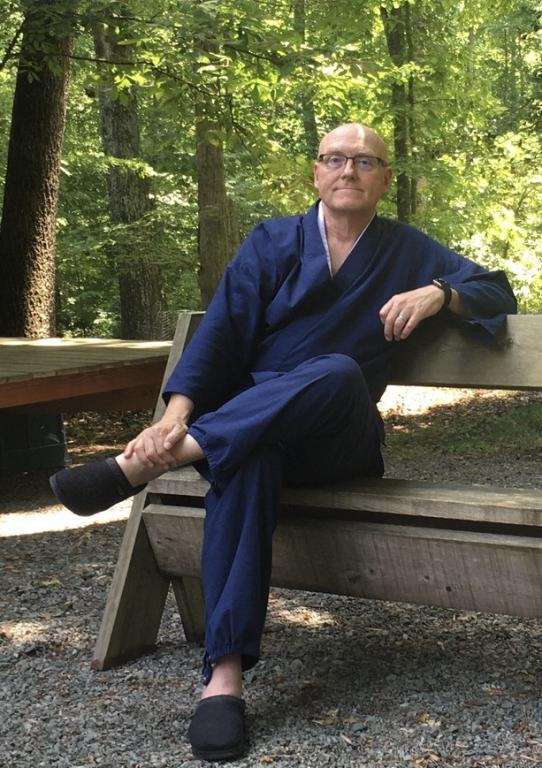
Dōshō Port began practicing Zen in 1977 and now co-teaches with his wife, Tetsugan Zummach Sensei, with the Vine of Obstacles Zen, an online training group. Dōshō received dharma transmission from Dainin Katagiri Rōshi and inka shōmei from James Myōun Ford Rōshi in the Harada-Yasutani lineage. He is also the author of Keep Me In Your Heart a While: The Haunting Zen of Dainin Katagiri. Dōshō’s translation and commentary on The Record of Empty Hall: One Hundred Classic Koans, was published in 2021 (Shambhala). His third book, Going Through the Mystery’s One Hundred Questions, is now available. Click here to support the teaching practice of Dōshō Rōshi.
Previous Post

June 9, 2022
The Vital Importance of Studying Buddhadharma: Why and How
Next Post
July 27, 2022 Stinking Skin Bags, Blind Donkeys, Parrots and Studying the Buddhadharma
Browse Our Archives
Select a Category Uncategorized
Select a Month August 2023 July 2023 June 2023 May 2023 April 2023 March 2023 February 2023 January 2023 December 2022 November 2022 October 2022 September 2022 August 2022 July 2022 June 2022 May 2022 April 2022 March 2022 February 2022 January 2022 December 2021 November 2021 August 2021 June 2021 April 2021 February 2021 January 2021 November 2020 September 2020 August 2020 July 2020 June 2020 May 2020 April 2020 January 2020 December 2019 November 2019 August 2019 June 2019 May 2019 April 2019 February 2019 January 2019 December 2018 November 2018 October 2018 September 2018 August 2018 July 2018 June 2018 May 2018 April 2018 March 2018 February 2018 January 2018 December 2017 November 2017 October 2017 September 2017 August 2017 July 2017 June 2017 December 2016 October 2016 June 2016 April 2016 February 2016 January 2016 December 2015 November 2015 October 2015 August 2015 June 2015 May 2015 April 2015 March 2015 February 2015 January 2015 December 2014 November 2014 October 2014 September 2014 August 2014 July 2014 June 2014 May 2014 April 2014 March 2014 February 2014 January 2014 December 2013 November 2013 October 2013 September 2013 August 2013 July 2013 June 2013 May 2013 April 2013 March 2013 February 2013 January 2013 December 2012 November 2012 October 2012 September 2012 August 2012 July 2012 June 2012 May 2012 April 2012 March 2012 February 2012 January 2012 December 2011 November 2011 October 2011 September 2011 August 2011 July 2011 June 2011 May 2011 April 2011 March 2011 February 2011 January 2011 December 2010 November 2010 October 2010 September 2010 August 2010 July 2010 June 2010 May 2010 April 2010 March 2010 February 2010 January 2010 December 2009 November 2009 October 2009 September 2009 August 2009 July 2009 June 2009 May 2009 April 2009 March 2009 February 2009 January 2009 December 2008 November 2008 October 2008 September 2008 August 2008 July 2008 June 2008 May 2008
Follow Us!
TAKE THE
Religious Wisdom Quiz
Which prophet saw a vision of a flying scroll?
Select your answer to see how you score.
Ezekiel Jeremiah Zechariah Daniel
Related posts from Wild Fox Zen

Gnawing Through Qiánfēng’s Three Illnesses and Two Lights

"Why, Oh Why, Is My Practice Not Progressing?"
A Black Lacquer Person Runs Through the Night:...

Intimate Friendship: "When You Sing, I Respond; When...
TRENDING AT PATHEOS Buddhist

On Taking Refuge in the Dharma
(Here I continue the feature of sharing talks and essays by teachers...

(Continuing my intention to share talks and essays by other members of Empty...
The Subtle Art of Bowing: A Dharma Discourse
(This presentation was first offered by my dear friend Dharma Holder Tom...

Internal Family Systems Can Heal you Mentally &...
How IFS Helped Me Stop Fighting Myself Internal Family Systems (IFS) is...

The Bible No One Spoke About: A Family’s...
A mysterious family Bible, unspoken faith, and a journey from curiosity to...

How Uncertainty Can Transform Your Life in 2025
Embracing Uncertainty: A New Year’s Resolution for the Brave As 2025 approaches,...
view all Buddhist blogs
Ad-Free & Subscriber Log-In Subscription Support
- About Us
- 2026 Calendar
- Videos
- Podcasts
- Library of World Religions
- Faith In Media Tracker
- Advertise With Us
- Write for Us
- Privacy Policy
- Terms of Service
- Do Not Sell My Data
- Contact Us
- Radiant Digital
- Manage Newsletter Subscriptions
- Unsubscribe From Notifications
- Sitemap
Copyright 2008-2026, Patheos. All rights reserved.
Subscription Support Ad-Free & Subscriber Log-In
Follow Patheos